Within The Idea That A Habit Forms In 21 Days
Why the 21 Day Habit Rule Misleads
The 21-day rule is memorable, but its origin story and later evidence show why it can mislead people trying to change behavior.
On this page
- Where the 21 day claim came from
- Why the claim spread beyond the evidence
- What to expect instead after three weeks
Page outline Jump by section
Introduction
The belief that a habit forms in 21 days remains one of the most enduring ideas in self-improvement. It survives not because the evidence is strong, but because the message is simple, memorable and emotionally appealing. Many people begin a new routine expecting that after three weeks it should feel automatic. When it does not, they assume they lack discipline or motivation.
 Research on habit formation paints a very different picture. Studies of real-world behaviour change show that habit development varies widely between people and behaviours, often taking far longer than three weeks. Yet the 21-day rule continues to circulate in books, courses, social media posts and workplace training because it offers a neat promise in a subject that is actually messy and individual. Understanding why the myth persists can help people avoid judging their progress too early and focus on the behaviours that genuinely lead to lasting change. University of Surrey[UCL Blogs]blogs.ucl.ac.ukUCL BlogsBusting the 21 days habit formation myth | UCL 'Health Chatter'29 Jun 2012 — 21 days is a myth; habit formation typically takes…
Where the 21-day claim came from
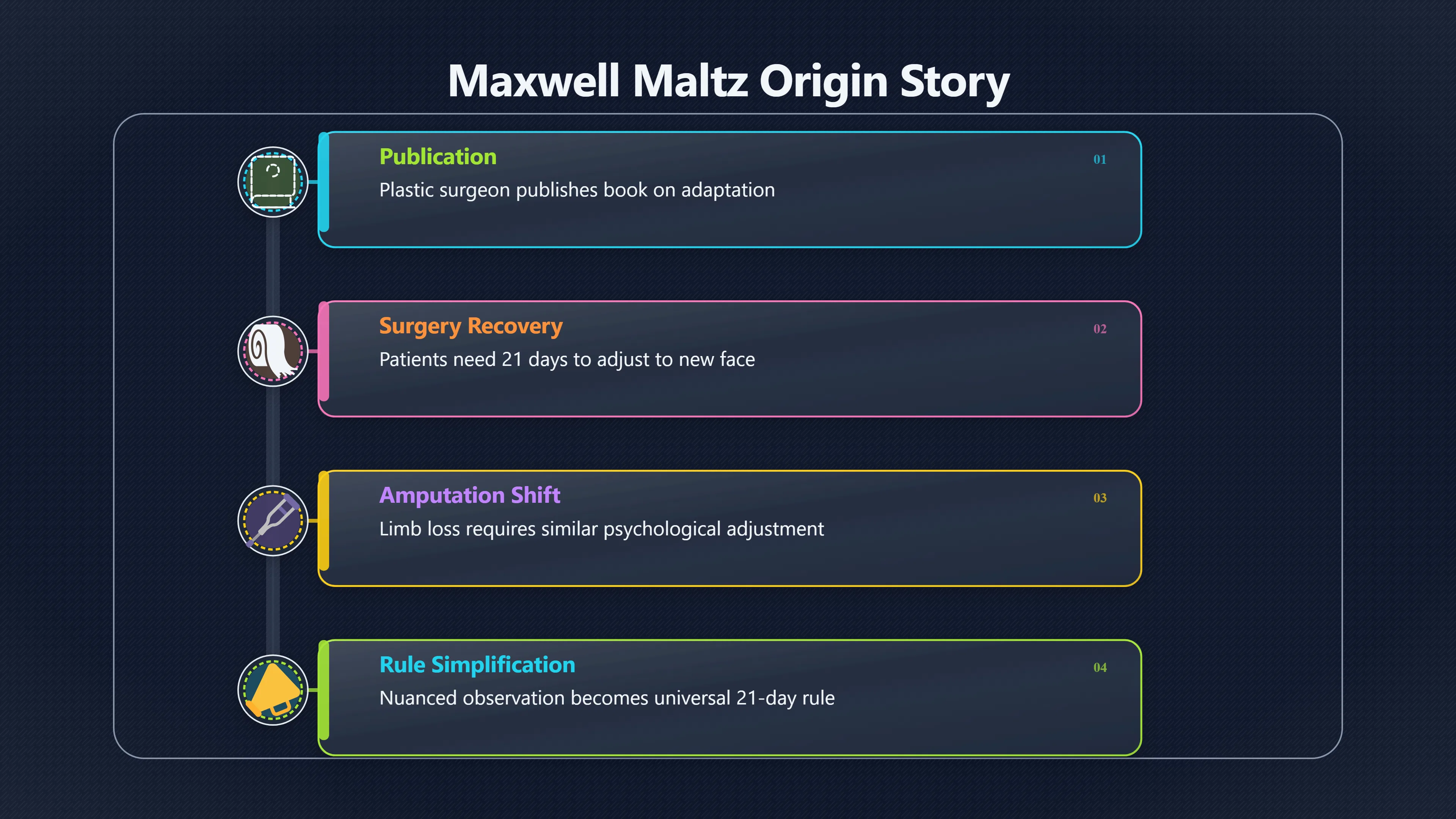
The origin of the claim is surprisingly distant from modern habit research. The idea is commonly traced to Maxwell Maltz, a plastic surgeon who published Psycho-Cybernetics in 1960. Maltz observed that patients often seemed to need around 21 days to adjust psychologically to changes such as facial surgery or limb amputation. He also noted that he personally experienced similar adjustment periods when adapting to changes in his own life.[Boreal Bliss Yoga Retreats]borealblissyogaretreats.com21 days to create a habit myth or scienceMaxwell Maltz, a plastic surgeon. Maltz observed that his patients typically took about 21 days…Read more… Sullivan What is often forgotten is that Maltz was not studying habit formation. He was describing adaptation to change. He wrote that adjustment appe[borealblissyogaretreats.com]borealblissyogaretreats.com21 days to create a habit myth or scienceMaxwell Maltz, a plastic surgeon. Maltz observed that his patients typically took about 21 days…Read more… ared to require a minimum of about 21 days, not that every new behaviour became automatic in exactly three weeks. Over time, this nuanced observation was simplified, repeated and transformed into a universal rule.[habitzup.com]habitzup.com21 day habit formationMaxwell Maltz, a plastic surgeon in the 1950s. In his best-selling book, “Psycho-…Read more…[opendeltas]opendeltas.com21 days habit formation mythThe 21 Days Habit Formation Myth and Mindfulness Benefits19 Jun 2019 — How long does it take to create a habit, does it really… The distinction matters. Becoming accustomed to a new appearance is not the same process as developing an automatic daily exercise routine or consistently preparing healthy meals. The original observation concerned psychological adjustment, whereas habit formation research examines how repeated actions become increasingly automatic through repetition and context cues. Medium[Behavioral Design Academy]behavioraldesign.academyBehavioral Design AcademyCLAIM 1: It only takes 21-days to form a habitThere is no substantial evidence that habits are routinely formed…
Why the claim spread beyond the evidence
The persistence of the myth is not primarily a scientific story. It is a communication story.
A major reason the claim survived is that it provides a precise answer to a question people desperately want answered: “How long will this take?” Behaviour change is uncertain and often frustrating. A fixed number creates a sense of predictability and control. Three weeks sounds challenging enough to feel meaningful but short enough to feel achievable.[Scientific American]scientificamerican.comhow long does it really take to form a habitScientific AmericanHow Long Does It Really Take to Form a Habit?24 Jan 2024 — There's a myth that it takes 21 days to form a habit. Exper…
Several factors helped the idea spread:
- It is easy to remember. A single number is far more memorable than explaining that habit formation varies between individuals and behaviours.
- It fits self-help marketing. “Transform your life in 21 days” is easier to promote than “progress depends on repetition, context and individual differences”.
- It offers a clear finish line. People prefer milestones and deadlines, even when those deadlines are arbitrary.
- It contains a grain of truth. Many people notice meaningful progress after several weeks, making the claim feel plausible even when automaticity has not fully developed.[Forbes]forbes.comhabit formation the 21 day mythHabit Formation: The 21-Day Myth15 Apr 2013 — Maltz did not find that 21 days of task completion forms a habit. People wanted it to…[Behavioral Design Academy]behavioraldesign.academyBehavioral Design AcademyCLAIM 1: It only takes 21-days to form a habitThere is no substantial evidence that habits are routinely formed…
The myth also benefits from repetition. Once a claim appears in bestselling books, coaching programmes, workplace presentations and social media content, familiarity itself can make it seem credible. Psychologists call this the “illusory truth effect”: repeated statements often feel more believable regardless of their accuracy. While the underlying research on habit formation became better known later, the simpler message had already become embedded in popular culture.
Why the real evidence is less appealing
Modern habit research offers a more accurate answer, but it is harder to package into a slogan.
One of the most influential studies followed people as they adopted everyday behaviours such as drinking water with lunch, eating fruit or exercising. Researchers found that habit formation was highly variable. The median time required to reach near-maximum automaticity was about 66 days, but individual estimates ranged from roughly 18 days to 254 days.[Wiley Online Library]onlinelibrary.wiley.comOnline Library Modelling habit formation in the real worldWiley Online LibraryModelling habit formation in the real world - Lally - 2010by P Lally · 2010 · Cited by 3493 — To investigate the proc…[University College London]ucl.ac.ukhow long does it take form habitUniversity College LondonHow long does it take to form a habit?4 Aug 2009 — It takes an average 66 days to form a new habit, according to…
That finding is scientifically useful but psychologically unsatisfying. It tells people that:
- There is no universal deadline.
- Different habits develop at different speeds.
- Progress is gradual rather than sudden.
- Consistency matters more than reaching a particular date.[University of Surrey]surrey.ac.ukdoes it really take 66 days form habit we asked expert dr pippa lallyUniversity of SurreyDoes it really take 66 days to form a habit?21 Jan 2026 — In 2010, Dr Pippa Lally, with colleagues at UCL, published…[PMC]pmc.ncbi.nlm.nih.govMaking health habitual: the psychology of 'habit-formation' and…by B Gardner · 2012 · Cited by 851 — More relevant research found t…
These conclusions are harder to summarise on a poster or in a social media graphic. A simple myth often spreads more easily than a nuanced truth.
Even the famous “66 days” figure is sometimes misunderstood. Researchers involved in the original work have repeatedly emphasised that the average is less important than the wide variation between individuals. The central lesson was not that habits take 66 days, but that habit formation does not follow a fixed timetable.[University of Surrey]surrey.ac.ukdoes it really take 66 days form habit we asked expert dr pippa lallyUniversity of SurreyDoes it really take 66 days to form a habit?21 Jan 2026 — In 2010, Dr Pippa Lally, with colleagues at UCL, published…
What to expect instead after three weeks
Three weeks is not meaningless. It is simply not a reliable endpoint.
After about 21 days of consistent repetition, many people experience early signs of progress. The behaviour may require less conscious effort than it did on day one. Environmental cues may begin to trigger the action more naturally. Resistance may decrease. These changes can create the impression that the habit is becoming established.[PMC]pmc.ncbi.nlm.nih.govTime to Form a Habit: A Systematic Review and Meta-Analysis…by B Singh · 2024 · Cited by 58 — Brief 21-day challenges or kickstarts…
However, in many cases the behaviour is still fragile. It may depend heavily on motivation, reminders or deliberate planning. Interruptions such as travel, illness or stress can still derail the routine more easily than they would later in the process.
A more realistic expectation after three weeks is:
- You are building consistency, not necessarily automaticity.
- The routine may still feel effortful.
- Missed days do not erase previous progress.
- Continued repetition is usually more important than perfection.[aftertone.io]aftertone.ioHabit Formation: It Takes 66 Days, Not 21Lally and colleagues tracked 96 adults forming real habits over 84 days and found the median time to automaticity was 66 days…[Wiley Online Library]onlinelibrary.wiley.comOnline Library Modelling habit formation in the real worldWiley Online LibraryModelling habit formation in the real world - Lally - 2010by P Lally · 2010 · Cited by 3493 — To investigate the proc…
For people seeking self improvement that works, this shift in expectations can be powerful. Instead of treating day 21 as a pass-or-fail test, it becomes one milestone within a longer process. The goal is not to reach a magical date. The goal is to make the desired behaviour increasingly automatic over time.
The practical cost of believing the myth
The greatest harm of the 21-day rule is not that it is inaccurate. It is that it can cause people to quit.
Someone who hears that habits should form in three weeks may reach day 22 still struggling and conclude that they have failed. In reality, they may be progressing exactly as expected. Research suggests that many successful habits remain under construction long after the first month.[UCL Blogs]blogs.ucl.ac.ukUCL BlogsBusting the 21 days habit formation myth | UCL 'Health Chatter'29 Jun 2012 — 21 days is a myth; habit formation typically takes…[PMC]pmc.ncbi.nlm.nih.govMaking health habitual: the psychology of 'habit-formation' and…by B Gardner · 2012 · Cited by 851 — More relevant research found t…
The myth creates unrealistic expectations. When reality does not match those expectations, motivation suffers. By contrast, understanding that habit formation is gradual encourages persistence. Progress becomes measured by repetition and increasing ease rather than by whether a calendar deadline has been reached.
That is ultimately why the 21-day habit myth persists: it offers certainty, simplicity and hope. The evidence offers something less tidy but more useful—a recognition that meaningful behaviour change is highly individual and that lasting habits are built through continued practice rather than a fixed three-week countdown.[Scientific American]scientificamerican.comhow long does it really take to form a habitScientific AmericanHow Long Does It Really Take to Form a Habit?24 Jan 2024 — There's a myth that it takes 21 days to form a habit. Exper…[University of Surrey]surrey.ac.ukdoes it really take 66 days form habit we asked expert dr pippa lallyUniversity of SurreyDoes it really take 66 days to form a habit?21 Jan 2026 — In 2010, Dr Pippa Lally, with colleagues at UCL, published…
Amazon book picks
Further Reading
Books and field guides related to Why the 21 Day Habit Rule Misleads. Use these as the next step if you want deeper reading beyond the article.
Atomic Habits
Rating: 3.5/5 from 7 Google Books ratings
Counters simplistic fixed-time habit claims with evidence-based approaches.
Psycho-Cybernetics
Rating: 4.0/5 from 5 Google Books ratings
Source commonly linked to the origin of the 21-day idea.
eBay marketplace picks
Marketplace Samples
Example marketplace items related to this page. Use the search link to explore similar finds on eBay.



Endnotes
1.
Source: habitzup.com
Title: 21 day habit formation
Link:https://habitzup.com/parenting/21-day-habit-formation/
Source snippet
Maxwell Maltz, a plastic surgeon in the 1950s. In his best-selling book, “Psycho-...Read more...
2.
Source: opendeltas.com
Title: 21 days habit formation myth
Link:https://www.opendeltas.com/post/21-days-habit-formation-myth
Source snippet
The 21 Days Habit Formation Myth and Mindfulness Benefits19 Jun 2019 — How long does it take to create a habit, does it really...
3.
Source: forbes.com
Title: habit formation the 21 day myth
Link:https://www.forbes.com/sites/jasonselk/2013/04/15/habit-formation-the-21-day-myth/
Source snippet
Habit Formation: The 21-Day Myth15 Apr 2013 — Maltz did not find that 21 days of task completion forms a habit. People wanted it to...
4.
Source: medium.com
Title: how long does it really take to change a habit eeb6740efa8f
Link:https://medium.com/%40jud.brewer/how-long-does-it-really-take-to-change-a-habit-eeb6740efa8f
Source snippet
How Long Does It Really Take to Change a Habit?It turns out, the origin of the 21-day myth isn't science — it's surgery. In 1960, a...
5.
Source: pmc.ncbi.nlm.nih.gov
Link:https://pmc.ncbi.nlm.nih.gov/articles/PMC3505409/
Source snippet
Making health habitual: the psychology of 'habit-formation' and...by B Gardner · 2012 · Cited by 851 — More relevant research found t...
6.
Source: onlinelibrary.wiley.com
Title: Online Library Modelling habit formation in the real world
Link:https://onlinelibrary.wiley.com/doi/10.1002/ejsp.674
Source snippet
Wiley Online LibraryModelling habit formation in the real world - Lally - 2010by P Lally · 2010 · Cited by 3493 — To investigate the proc...
7.
Source: pmc.ncbi.nlm.nih.gov
Link:https://pmc.ncbi.nlm.nih.gov/articles/PMC11641623/
Source snippet
Time to Form a Habit: A Systematic Review and Meta-Analysis...by B Singh · 2024 · Cited by 58 — Brief 21-day challenges or kickstarts...
8.
Source: aftertone.io
Title: Habit Formation: It Takes 66 Days, Not 21
Link:https://www.aftertone.io/science/habit-formation-timeline-66-days-not-21
Source snippet
Lally and colleagues tracked 96 adults forming real habits over 84 days and found the median time to automaticity was 66 days...
9.
Source: medium.com
Title: the myth 21 days to change habits 1983c419faf7
Link:https://medium.com/change-your-mind/the-myth-21-days-to-change-habits-1983c419faf7
Source snippet
The Myth 21 Days to Change Habits | by Mental GardenIn the 1950s, plastic surgeon Maxwell Maltz noticed a pattern in his patients. Maltz...
10.
Source: medium.com
Link:https://medium.com/%40claticivg/why-the-66-day-habit-installation-rule-is-a-myth-and-what-you-should-do-instead-e607bf5e6e5d
Source snippet
Of course, this can vary...Read more...
11.
Source: elijahszasz.medium.com
Title: can you really form a habit in 21 days 4f0011893593
Link:https://elijahszasz.medium.com/can-you-really-form-a-habit-in-21-days-4f0011893593
Source snippet
you really form a habit in 21 Days? | by Elijah SzaszThe findings suggest that it can take anywhere between 18 to 254 days, with an avera...
12.
Source: medium.com
Link:https://medium.com/%40iamrahulrao15/how-long-does-it-really-take-to-build-a-habit-the-science-not-the-myth-75b7854855f7
Source snippet
automatic. The finding that most articles leave out: the...Read more...
13.
Source: surrey.ac.uk
Title: does it really take 66 days form habit we asked expert dr pippa lally
Link:https://www.surrey.ac.uk/news/does-it-really-take-66-days-form-habit-we-asked-expert-dr-pippa-lally
Source snippet
University of SurreyDoes it really take 66 days to form a habit?21 Jan 2026 — In 2010, Dr Pippa Lally, with colleagues at UCL, published...
14.
Source: blogs.ucl.ac.uk
Link:https://blogs.ucl.ac.uk/bsh/2012/06/29/busting-the-21-days-habit-formation-myth/
Source snippet
UCL BlogsBusting the 21 days habit formation myth | UCL 'Health Chatter'29 Jun 2012 — 21 days is a myth; habit formation typically takes...
15.
Source: scientificamerican.com
Title: how long does it really take to form a habit
Link:https://www.scientificamerican.com/article/how-long-does-it-really-take-to-form-a-habit/
Source snippet
Scientific AmericanHow Long Does It Really Take to Form a Habit?24 Jan 2024 — There's a myth that it takes 21 days to form a habit. Exper...
16.
Source: borealblissyogaretreats.com
Title: 21 days to create a habit myth or science
Link:https://www.borealblissyogaretreats.com/blog/21-days-to-create-a-habit-myth-or-science
Source snippet
Maxwell Maltz, a plastic surgeon. Maltz observed that his patients typically took about 21 days...Read more...
17.
Source: drsullivan.ca
Title: Sullivan + Associates Does It Really Take 21 Days To Create A New Habit?Nope
Link:https://drsullivan.ca/does-it-really-take-just-21-days-to-create-a-new-habit/
Source snippet
The 21 days to a new habit myth likely comes from a book published by Dr. Maxwell Maltz in 1960, where he noticed a trend of people adapt...
18.
Source: behavioraldesign.academy
Link:https://www.behavioraldesign.academy/resources/practices/the-21-day-habit-myth-what-the-science-actually-says/
Source snippet
Behavioral Design AcademyCLAIM 1: It only takes 21-days to form a habitThere is no substantial evidence that habits are routinely formed...
19.
Source: ucl.ac.uk
Title: how long does it take form habit
Link:https://www.ucl.ac.uk/news/2009/aug/how-long-does-it-take-form-habit
Source snippet
University College LondonHow long does it take to form a habit?4 Aug 2009 — It takes an average 66 days to form a new habit, according to...
Additional References
20.
Source: researchgate.net
Title: 32898894 How are habits formed Modeling habit formation in the real world
Link:https://www.researchgate.net/publication/32898894_How_are_habits_formed_Modeling_habit_formation_in_the_real_world
Source snippet
Modeling habit formation in the real world | Request PDFThese students reached their peak automaticity after about 56 days (or 8 weeks)...
21.
Source: positivity.org
Title: Science doesn’t [support]({{ ‘support/’ | relative_url }}) such rigid deadlines. Truth: With consistent
Link:https://positivity.org/habits/the-21-90-rule-truth-or-myth-in-habit-building
Source snippet
The 21/90 Rule: Truth or Myth in Habit Building?17 Sept 2025 — Myth: The idea that all habits universally “form” in exactly 21...
22.
Source: jpost.com
Title: Study finds average habit formation time ranges from 59 to 66
Link:https://www.jpost.com/science/science-around-the-world/article-839911
Source snippet
New research shows forming habits can take up to a year...30 Jan 2025 — New research shows forming habits can take up to a year, debunki...
23.
Source: keelify.com
Title: The 66-day habit rule explained — what Lally’s data
Link:https://keelify.com/blog/66-day-habit-rule-explained
Source snippet
Apr 26, 2026 — 66 days is the median time for a behavior to become automatic — not 21 days. The "21 days" claim is a 1960 plastic...
24.
Source: scienceofselfhelp.org
Link:https://scienceofselfhelp.org/articles-1/phillippa-lally-and-the-number-of-days-to-form-a
Source snippet
Habit26 Jul 2013 — The study suggests that some tasks take less time and some tasks more time before they are considered a habit, but the...
25.
Source: studocu.vn
Title: Modelling Habit Formation: Insights from Eur
Link:https://www.studocu.vn/vn/document/truong-dai-hoc-ngoai-ngu-dai-hoc-da-nang/ngon-ngu-anh/modelling-habit-formation-insights-from-eur-j-soc-psychol-40-2010/157504686
Source snippet
J. Soc....Jul 16, 2009 — The median time to reach 95% of asymptote was 66 days, with a range from 18 to 254 days. There was substantial...
26.
Source: facebook.com
Link:https://www.facebook.com/jackdelosa/posts/the-21-days-to-build-a-habit-rule-is-one-of-the-most-harmful-myths-in-personal-g/1338527610971456/
Source snippet
l growth. The truth: habits take an average of 10 weeks to form...
27.
Source: acsh.org
Title: 21 day myth how habits really form 49330
Link:https://www.acsh.org/news/2025/03/03/21-day-myth-how-habits-really-form-49330
Source snippet
The 21-Day Myth: How Habits Really Form3 Mar 2025 — It was once believed that a habit forms after 21 consecutive days—a notion popularize...
28.
Source: jamesclear.com
Title: How Long Does it Take to Form a Habit?
Link:https://jamesclear.com/new-habit
Source snippet
Backed by Science.Maltz would perform an operation — like a nose job, for example — he found that it would take the patient about 21 days...
29.
Source: womenshealth.obgyn.msu.edu
Title: debunking 21 day myth about bad habits
Link:https://womenshealth.obgyn.msu.edu/blog/debunking-21-day-myth-about-bad-habits
Source snippet
the 21 Day Myth about bad habitsMost have heard that it takes 21 days to form a habit, but according to research published in The Europea...
Topic Tree