Within Accountability
When study groups stop being useful
A weak study group can drift into copying, scrolling or comparison unless expectations make everyone contribute.
On this page
- The common failure pattern
- Preparation rules that share the work
- When to repair, resize or leave the group
Page outline Jump by section
Introduction
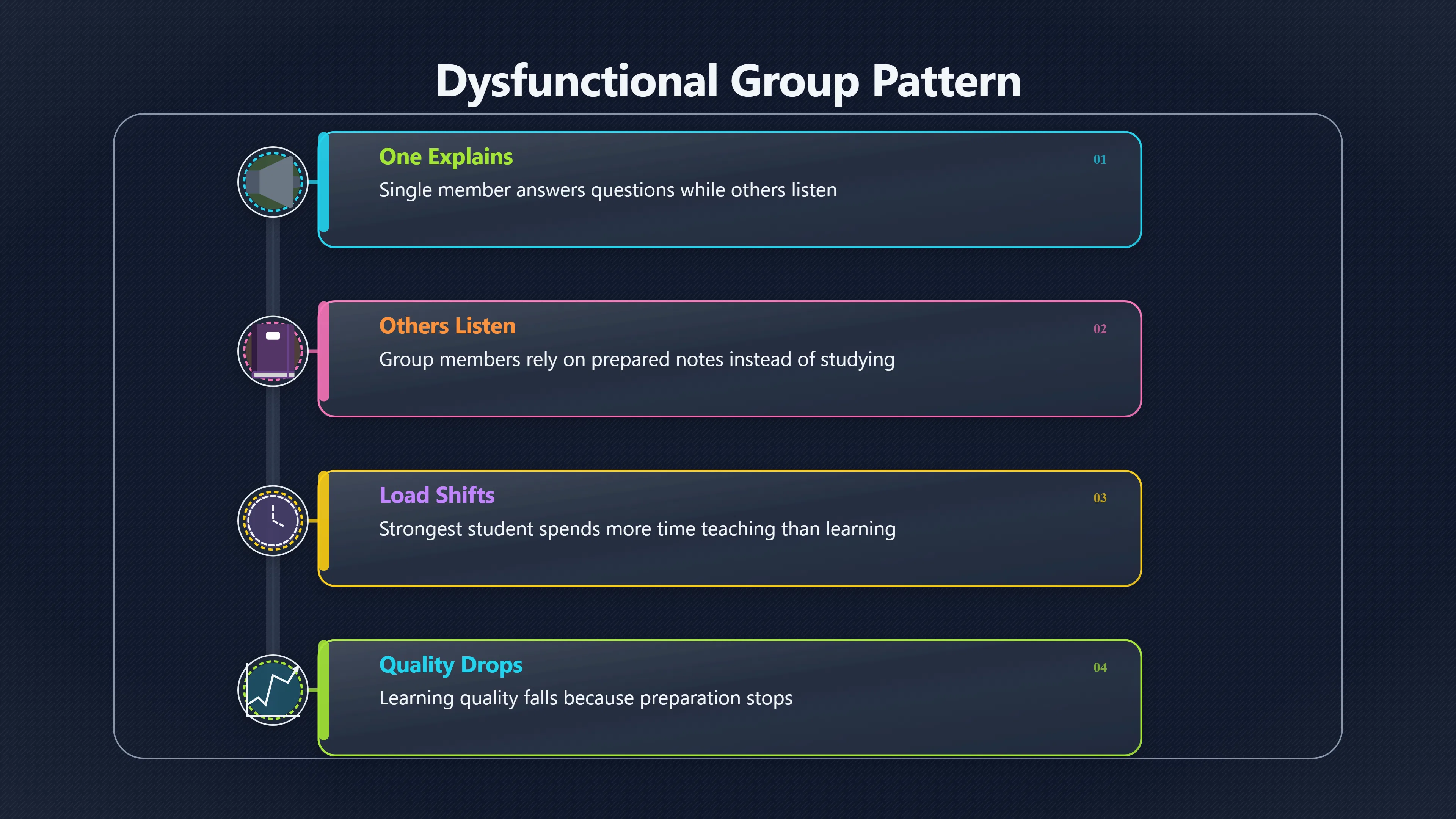
A study group becomes ineffective when learning is replaced by dependency. The most common failure pattern is not open conflict but a quieter arrangement in which one person prepares the material, explains everything, organises meetings and answers questions while everyone else consumes the benefit. The group may still meet regularly, yet learning quality falls because some members stop preparing and the strongest member spends more time teaching than studying. Research on collaborative learning repeatedly identifies this problem as a form of free-riding or social loafing: people contribute less when responsibility is unclear, effort is difficult to see, or rewards are shared regardless of contribution. IRRODL[Taylor & Francis Online]tandfonline.comTaylor & Francis OnlineFree Riding in Group Projects and the Effects of Timing…by CM Brooks · 2003 · Cited by 546 — The free-rider pro…
 The solution is usually not to abolish the group. Well-structured peer learning can improve understanding and accountability. The challenge is to redesign the group so that every member arrives with work already done and a visible contribution to make.[cte.tamu.edu]cte.tamu.eduA Practical Guide to Effective Group WorkIndividual Accountability: Each member demonstrates learning and effort. Interaction: Students a…[Harvard Bok Center]bokcenter.harvard.eduHarvard Bok CenterGroup Work | The Derek Bok Center for Teaching and LearningThis guide is intended to be short and simply written for st…
The Common Failure Pattern
The classic dysfunctional study group follows a predictable sequence.
A motivated student starts preparing thoroughly. Because they know the material, they naturally answer questions and explain difficult concepts. Other members begin relying on that preparation. Meetings gradually shift from collaborative learning to informal tutoring. Eventually, one person carries the intellectual load while everyone else reacts to it.
This pattern is reinforced by several psychological mechanisms. Social loafing research shows that individuals often reduce effort when their contribution is difficult to identify or when responsibility is spread across a group. The larger the group and the less visible each person’s work, the more likely unequal participation becomes.[Experts@Minnesota]experts.umn.eduExperts@MinnesotaSocial loafing on group projects: Structural antecedents…by P Aggarwal · 2008 · Cited by 617 — A common problem with…[ResearchGate]researchgate.netSocial Loafing on Group ProjectsStructural Antecedents…We study the impact of social loafing on students' satisfaction with group memb…
A second problem is that apparent free-riding is not always laziness. Research on group projects has found that unequal contribution can also arise from lack of confidence, skill gaps, time pressures, uncertainty about expectations or fear of looking foolish. Treating every weak contributor as selfish can therefore make the group worse rather than better.[ResearchGate]researchgate.netSocial Loafing on Group ProjectsStructural Antecedents…We study the impact of social loafing on students' satisfaction with group memb…[Taylor & Francis Online]tandfonline.comTaylor & Francis OnlineFree Riding in Group Projects and the Effects of Timing…by CM Brooks · 2003 · Cited by 546 — The free-rider pro…
The warning signs are usually visible before the group collapses:
- The same person always explains the reading.
- Few members arrive having completed preparation.
- Questions are directed to one member rather than discussed collectively.
- Meetings become note-sharing sessions.
- Phones, unrelated browsing and social conversation steadily consume more time.
- Stronger members leave feeling exhausted while others leave feeling helped.
When these patterns appear, the group is no longer creating accountability. It is creating dependency.
Preparation Rules That Share the Work
The most effective fix is to move responsibility before the meeting rather than trying to force participation during it.
Research and teaching guidance on collaborative learning consistently emphasise individual accountability: every member must have a visible responsibility that cannot be outsourced to the group.[cte.tamu.edu]cte.tamu.eduA Practical Guide to Effective Group WorkIndividual Accountability: Each member demonstrates learning and effort. Interaction: Students a…
A practical structure is to require preparation evidence before each session. For example:
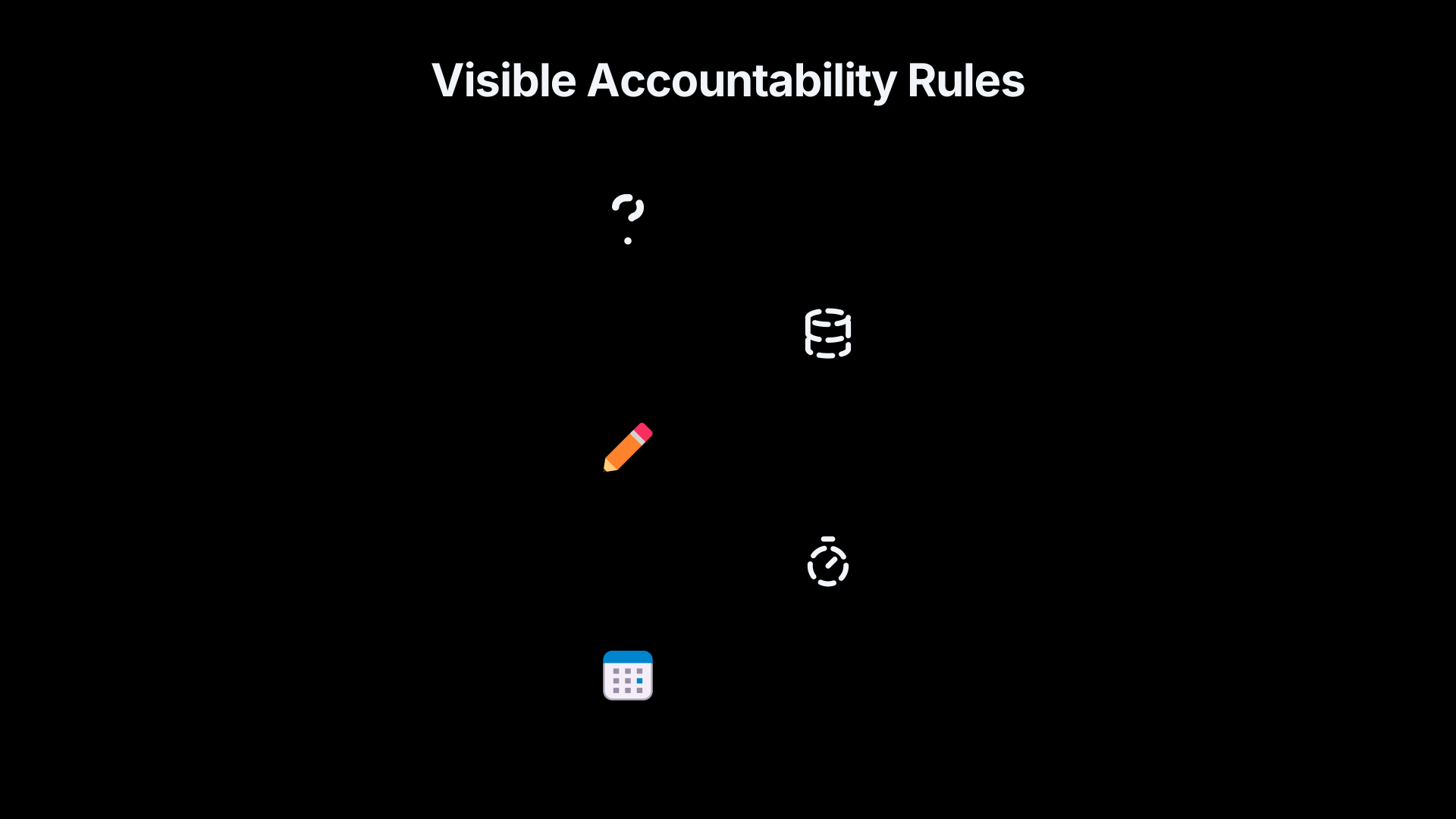
- Each member submits three retrieval-practice questions.
- Each member prepares a short explanation of one concept.
- Each member brings one problem they could not solve alone.
- Each member produces a brief summary of the assigned material.
The goal is not bureaucracy. It is making preparation observable.
Another useful rule is rotating expertise. Instead of allowing one person to become the permanent explainer, assign topics in advance. If four people attend, four people should arrive responsible for different sections. This prevents knowledge from concentrating in a single member and forces active engagement across the group.[Harvard Bok Center]bokcenter.harvard.eduHarvard Bok CenterGroup Work | The Derek Bok Center for Teaching and LearningThis guide is intended to be short and simply written for st…
Groups also benefit from replacing passive review with retrieval practice. Rather than asking, “Can someone explain chapter five?”, members should attempt questions individually before discussion. Research on peer interaction suggests that learning gains are strongest when participants first think independently and then compare reasoning with others.[arXiv]arxiv.orgSource details in endnotes.
A simple meeting structure often works better than an open-ended discussion:
- Five minutes: each member reports preparation completed.
- Twenty minutes: individual problem-solving.
- Twenty minutes: compare answers and reasoning.
- Fifteen minutes: unresolved questions.
- Five minutes: assign preparation for the next session.
This format makes contribution visible and reduces opportunities for passive attendance.
Why Accountability Must Be Visible
Many struggling groups assume that goodwill alone will solve unequal effort. Evidence suggests otherwise.
Studies examining social loafing in educational settings repeatedly find that accountability mechanisms reduce the problem. Multiple evaluation points, visible contributions and structured peer assessment are associated with lower levels of free-riding and higher satisfaction with group work.[Taylor & Francis Online]tandfonline.comTaylor & Francis OnlineFree Riding in Group Projects and the Effects of Timing…by CM Brooks · 2003 · Cited by 546 — The free-rider pro…[Taylor & Francis Online]tandfonline.comTaylor & Francis OnlineFree Riding in Group Projects and the Effects of Timing…by CM Brooks · 2003 · Cited by 546 — The free-rider pro…[ResearchGate]researchgate.netResearchGate(PDF) The problem of free-riding in group projectsThis study involved surveying students (N = 205) from all faculties of an A…
The lesson for informal study groups is not that members need grades. It is that contribution must be observable.
Consider two versions of the same meeting:
Invisible accountability: everyone is told to “read chapter six”.
Visible accountability: each member is responsible for teaching one subsection and bringing two practice questions.
The second arrangement makes absence of preparation obvious. It also creates positive pressure to contribute because everyone knows the group depends on their section.
Importantly, accountability should focus on actions rather than intelligence. Members should be expected to prepare, attend and participate. They should not be judged for finding material difficult. Difficulty is often the reason the group exists in the first place.
When to Repair the Group
Many groups can recover if problems are addressed early.
The strongest intervention is often a direct but non-accusatory conversation. Instead of saying, “You never do any work,” a member might say, “We’re relying on the same people each week. Can we agree on specific preparation responsibilities before the next session?”
This approach addresses the structure rather than attacking personalities.
Repair is most likely when:
- Members still attend consistently.
- Most people want the group to succeed.
- The problem is unclear expectations rather than lack of commitment.
- Contribution can be redistributed quickly.
Research on free-riding suggests that perceived fairness matters greatly. When expectations are explicit and workloads are visible, participation often improves.[ScienceDirect]sciencedirect.comExploring antecedents of social loafing in students' group…by Z Luo · 2021 · Cited by 56 — This study explored antecedent…[Sage Journals]journals.sagepub.comSage JournalsReducing free-riding in group projects in line with students'…by TM Benning · 2024 · Cited by 37 — In this study, we meas…
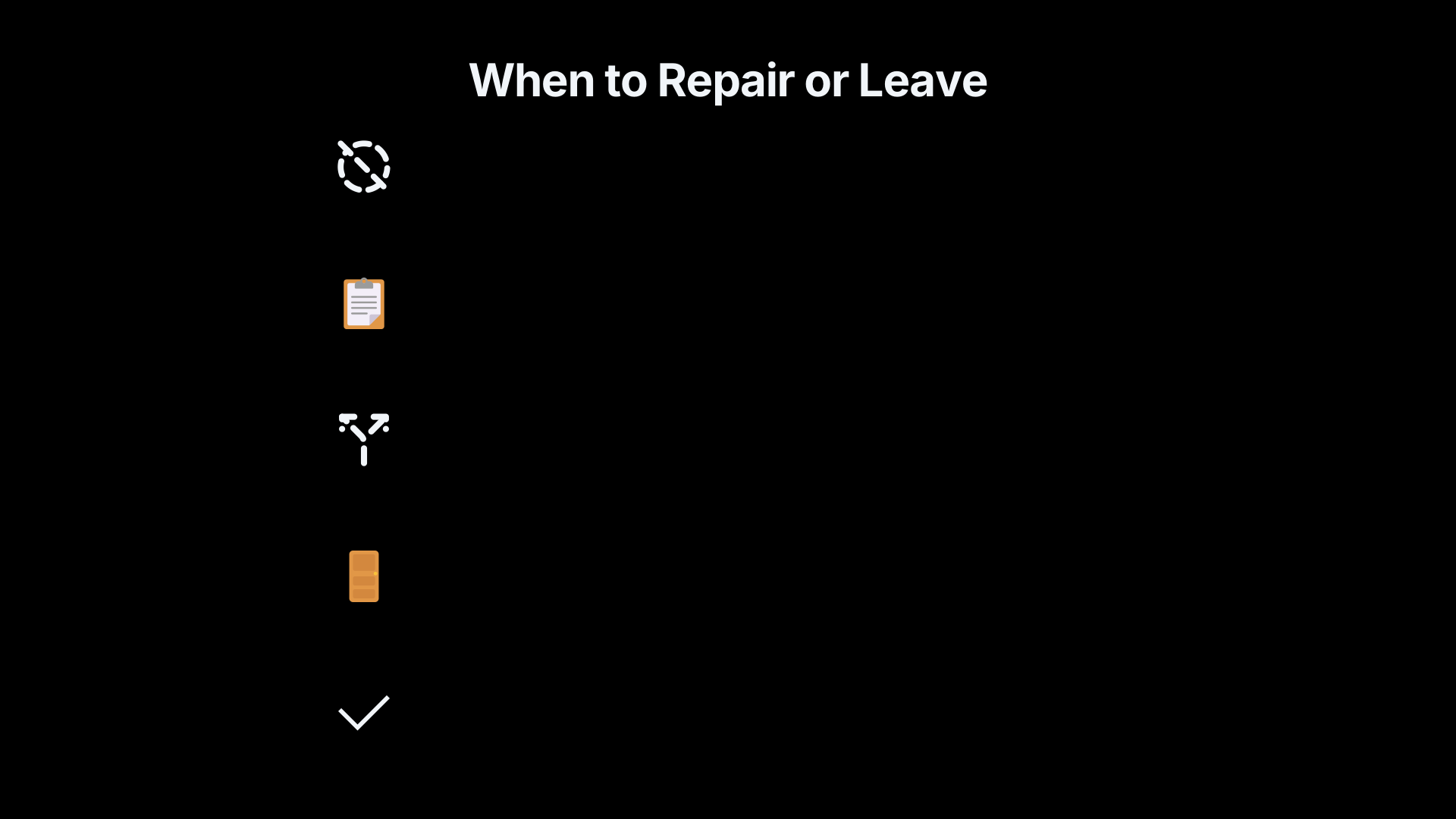
When to Resize the Group
Sometimes the issue is not motivation but scale.
Research has found that social loafing tends to increase as group size grows. Larger groups make it easier for effort to disappear into the background and harder for members to feel individually responsible.[Experts@Minnesota]experts.umn.eduExperts@MinnesotaSocial loafing on group projects: Structural antecedents…by P Aggarwal · 2008 · Cited by 617 — A common problem with…
For serious study, smaller groups often work better than larger ones. A group of two to four people leaves little room for hiding. Every absence is noticeable. Every contribution matters.
If a six-person study group consistently depends on two active members, splitting into two smaller groups may improve learning more than introducing additional rules.
A useful test is simple: if one person can skip a meeting and nobody notices a missing contribution, the group may already be too large.
When to Leave the Group
Not every study group deserves saving.
A group should be abandoned when it consistently consumes time without improving learning. Warning signs include repeated failure to prepare, refusal to adopt clearer expectations, chronic distraction, or a culture of copying rather than understanding.
For the person carrying everyone else, staying can become costly. Explaining material may feel productive, but it can reduce time available for deeper practice, revision and independent problem-solving. The strongest student is often the first to realise that the group has become an obligation rather than a learning tool.
Leaving is particularly reasonable when:
- Attempts to clarify expectations have failed.
- The same imbalance persists for weeks.
- Meetings regularly drift into unrelated conversation.
- Members expect help but resist preparation.
- Personal learning outcomes are declining.
A study group is valuable only when it improves learning for everyone involved. If the structure rewards passive attendance and punishes preparation by placing all responsibility on one member, the group is no longer functioning as an accountability system.
In self-improvement that works, accountability should distribute effort, not concentrate it. The best study groups make preparation visible, give every member a clear role and create conditions where contribution is expected from everyone. When those conditions disappear, repairing, shrinking or leaving the group is often more productive than carrying it alone.
eBay marketplace picks
Marketplace Samples
Topic-anchored marketplace searches for visual, collectible, or second-hand items related to this page.



Endnotes
1.
Source: irrodl.org
Link:https://www.irrodl.org/index.php/irrodl/article/view/484/1034/
Source snippet
Perceptions of Social Loafing in Online Learning Groupsby SL Piezon · 2008 · Cited by 198 — Free riding occurs when an individual d...
2.
Source: cte.tamu.edu
Link:https://cte.tamu.edu/resources/practical-guide-effective-group-work.html
Source snippet
A Practical Guide to Effective Group WorkIndividual Accountability: Each member demonstrates learning and effort. Interaction: Students a...
3.
Source: bokcenter.harvard.edu
Link:https://bokcenter.harvard.edu/group-work
Source snippet
Harvard Bok CenterGroup Work | The Derek Bok Center for Teaching and LearningThis guide is intended to be short and simply written for st...
4.
Source: arxiv.org
Link:https://arxiv.org/abs/2311.17302
5.
Source: researchgate.net
Link:https://www.researchgate.net/publication/247753226_Social_Loafing_on_Group_ProjectsStructural_Antecedents_and_Effect_on_Student_Satisfaction
Source snippet
Social Loafing on Group ProjectsStructural Antecedents...We study the impact of social loafing on students' satisfaction with group memb...
6.
Source: researchgate.net
Link:https://www.researchgate.net/publication/258124487_The_problem_of_free-riding_in_group_projects_Looking_beyond_social_loafing_as_reason_for_non-contribution
Source snippet
ResearchGate(PDF) The problem of free-riding in group projectsThis study involved surveying students (N = 205) from all faculties of an A...
7.
Source: sciencedirect.com
Link:https://www.sciencedirect.com/science/article/abs/pii/S1473837621000150
Source snippet
Exploring antecedents of social loafing in students' group...by Z Luo · 2021 · Cited by 56 — This study explored antecedent...
8.
Source: researchgate.net
Link:https://www.researchgate.net/publication/259081309_Individual_Accountability_in_Collaborative_Learning
Source snippet
The workload distribution...Read more...
9.
Source: researchgate.net
Link:https://www.researchgate.net/publication/215485932_Social_loafing_and_free_riding_in_online_learning_groups
Source snippet
Social loafing and free riding in online learning groupsThis paper presents an overview of the psycho-social aspects of social loafing an...
10.
Source: researchgate.net
Link:https://www.researchgate.net/publication/395501221_Exploring_the_experiences_of_social_loafing_in_group_work_among_online_psychology_students
Source snippet
(PDF) Exploring the experiences of social loafing in group...22 Oct 2025 — Through a qualitative approach, this research explores how on...
11.
Source: researchgate.net
Link:https://www.researchgate.net/publication/384659859_Social_Loafing_Understanding_Mitigating_and_Enhancing_Group_Performance
Source snippet
Social Loafing: Understanding, Mitigating, and Enhancing...5 Oct 2024 — Social loafing, a phenomenon in which individuals expend less ef...
13.
Source: hbsp.harvard.edu
Title: energize your online course with group work
Link:https://hbsp.harvard.edu/inspiring-minds/energize-your-online-course-with-group-work
Source snippet
Designing Breakout Groups. If your students are not...Read more...
14.
Source: sciencedirect.com
Link:https://www.sciencedirect.com/science/article/pii/S2666374020300194
Source snippet
Individualising teamwork scores based on peer assessmentby HB Shishavan · 2020 · Cited by 18 — Peer evaluation has been recommended as a...
15.
Source: tandfonline.com
Link:https://www.tandfonline.com/doi/abs/10.1080/08832320309598613
Source snippet
Taylor & Francis OnlineFree Riding in Group Projects and the Effects of Timing...by CM Brooks · 2003 · Cited by 546 — The free-rider pro...
16.
Source: experts.umn.edu
Link:https://experts.umn.edu/en/publications/social-loafing-on-group-projects-structural-antecedents-and-effec/
Source snippet
Experts@MinnesotaSocial loafing on group projects: Structural antecedents...by P Aggarwal · 2008 · Cited by 617 — A common problem with...
17.
Source: tandfonline.com
Link:https://www.tandfonline.com/doi/full/10.11120/plan.2003.00090007
Source snippet
Taylor & Francis OnlineRunning group projects: dealing with the free-rider problemby P Levin · 2003 · Cited by 28 — This paper describes...
18.
Source: tandfonline.com
Link:https://www.tandfonline.com/doi/full/10.1080/09639284.2022.2034023
Source snippet
Taylor & Francis OnlineManaging group work: the impact of peer assessment on...by OO Adesina · 2023 · Cited by 65 — This study investiga...
19.
Source: journals.sagepub.com
Link:https://journals.sagepub.com/doi/abs/10.1177/14697874221118864
Source snippet
Sage JournalsReducing free-riding in group projects in line with students'...by TM Benning · 2024 · Cited by 37 — In this study, we meas...
20.
Source: structural-learning.com
Title: social loafing
Link:https://www.structural-learning.com/post/social-loafing
Source snippet
20 May 2026 — Research shows that social loafing can reduce learner effort in group tasks. Learners may feel less accountable and think t...
Published: May 2026
21.
Source: dictionary.cambridge.org
Link:https://dictionary.cambridge.org/us/dictionary/english/social
Source snippet
definition in the Cambridge English DictionarySOCIAL [meaning]({{ 'meaning/' | relative_url }}): 1. relating to activities in which you meet and spend time with other peo...
22.
Source: learningcenter.unc.edu
Title: study partners
Link:https://learningcenter.unc.edu/tips-and-tools/study-partners/
Source snippet
Groups - The Learning CenterThis handout shares tips for how to create effective, productive, positive study partnerships, whether in per...
Additional References
23.
Source: ssa.gov
Link:https://www.ssa.gov/
Source snippet
The United States Social Security AdministrationWith a secure my Social Security account, you can get services and manage your benefits—a...
24.
Source: collinsdictionary.com
Link:https://www.collinsdictionary.com/us/dictionary/english/social
Source snippet
SOCIAL definition in American English1. of or having to do with human beings living together as a group in a situation in which their dea...
25.
Source: teachingkb.mcgill.ca
Link:https://teachingkb.mcgill.ca/tlk/peer-assessment-of-contributions-to-teamwork
Source snippet
assessment of contributions to teamworkThis article presents a four-stage framework—forming, storming, norming, and performing—for settin...
26.
Source: merriam-webster.com
Link:https://www.merriam-webster.com/dictionary/social
Source snippet
SOCIAL Definition & MeaningThe meaning of SOCIAL is marked by or passed in pleasant companionship with friends or associates. How to use...
27.
Source: ovid.com
Title: edu0000713~taking a free ride how team learning affects social loafing
Link:https://www.ovid.com/journals/jedup/pdf/10.1037/edu0000713~taking-a-free-ride-how-team-learning-affects-social-loafing
Source snippet
How Team Learning Affects Social Loafingby C Gabelica · 2022 · Cited by 56 — Both team and collaborative learning research are rooted in...
28.
Source: timeshighereducation.com
Title: use peer assessment give students more accountability group projects
Link:https://www.timeshighereducation.com/campus/use-peer-assessment-give-students-more-accountability-group-projects
Source snippet
Times Higher Education (THE)Use peer assessment to give students more accountability...22 May 2025 — Structured peer assessment can sign...
Published: May 2025
29.
Source: academia.edu
Link:https://www.academia.edu/120722181/Taking_a_free_ride_How_team_learning_affects_social_loafing
Source snippet
Social loafing on group projects: Structural antecedents and effect on student satisfaction.Read more...
30.
Source: ijopr.com
Title: diffusion of responsibility in group work social loafing 9316
Link:https://www.ijopr.com/article/diffusion-of-responsibility-in-group-work-social-loafing-9316
Source snippet
Diffusion of responsibility in group work: Social loafingby ŞB Tosuntaş · 2020 · Cited by 59 — The aim of this research is to examine the...
31.
Source: linkedin.com
Link:https://www.linkedin.com/posts/harvardbizedu_make-the-invisible-visible-in-student-group-activity-7361091632307310594-a_3w
Source snippet
View organization page for Harvard Business Impact Education · Harvard Business...Read more...
32.
Source: facebook.com
Title: Social Security Administration (@socialsecurity)Go Digital!
Link:https://www.facebook.com/socialsecurity/
Source snippet
Find the answers you need, without the wait. Need information about Social Security? From forms to benefit details to frequently asked qu...
Topic Tree