Within App Blockers
Why blocks should begin before work starts
Planned blocks work best when they start before the focus session and protect a specific task from predictable distraction.
On this page
- Choosing the danger window
- Blocking the right apps and sites
- Building a replacement break
Page outline Jump by section
Introduction
Scheduled app blocks are most effective when they begin before a deep work session starts. The key idea is simple: a blocker should be active before temptation appears, not after attention has already drifted. Deep work often fails in the first few seconds of distraction—a quick social media check, a messaging notification, or a habitual browser tab opening. By pre-scheduling restrictions around these predictable moments, a blocker turns an intention to focus into a rule that is already in force. Research on digital self-control tools consistently finds that interventions which alter the environment through blocking, delays, or access restrictions tend to be more effective than those that merely remind users to focus.[ACM Digital Library]dl.acm.orgThe analysis…Read more…[Wiley Online Library]onlinelibrary.wiley.commore…
 Within the broader category of app blockers and digital friction, scheduled blocks are specifically designed to protect a defined period of concentrated work. Their value comes less from punishment and more from timing.
Why blocks should begin before work starts
Many people schedule deep work but leave distraction management to willpower. This creates a predictable failure point. The decision about whether to check a distracting app is made repeatedly throughout the session, often during moments of boredom, uncertainty, or mental fatigue.
Scheduled blocking moves that decision earlier. Instead of negotiating with yourself at 10:17 a.m. when a difficult task becomes frustrating, you decide at 9:45 a.m. that certain apps and sites will be unavailable from 10:00 until noon. The decision is made once, under calmer conditions, and then enforced automatically.
This approach aligns with a broader finding from behavioural design: changing the environment before a temptation occurs is generally easier than resisting it in the moment. Reviews of digital self-control tools identify blocking, restriction, and environmental modification as central mechanisms for reducing unwanted digital behaviour.[ACM Digital Library]dl.acm.orgThe analysis…Read more…[ResearchGate]researchgate.netAchieving Digital Wellbeing Through Digital Self-Control…Aiming to guide future research in this important domain, this article presen…
The practical benefit is that scheduled blocks remove a series of tiny decisions that would otherwise consume attention throughout a focus session.
Choosing the danger window
The most common mistake is blocking distractions only during the intended work period. In practice, the danger window is often larger.
A writer planning to begin at 9:00 may start checking messages at 8:50. A student preparing to revise at 7:00 may lose thirty minutes to social media beforehand. The block therefore needs to start before the work itself begins.
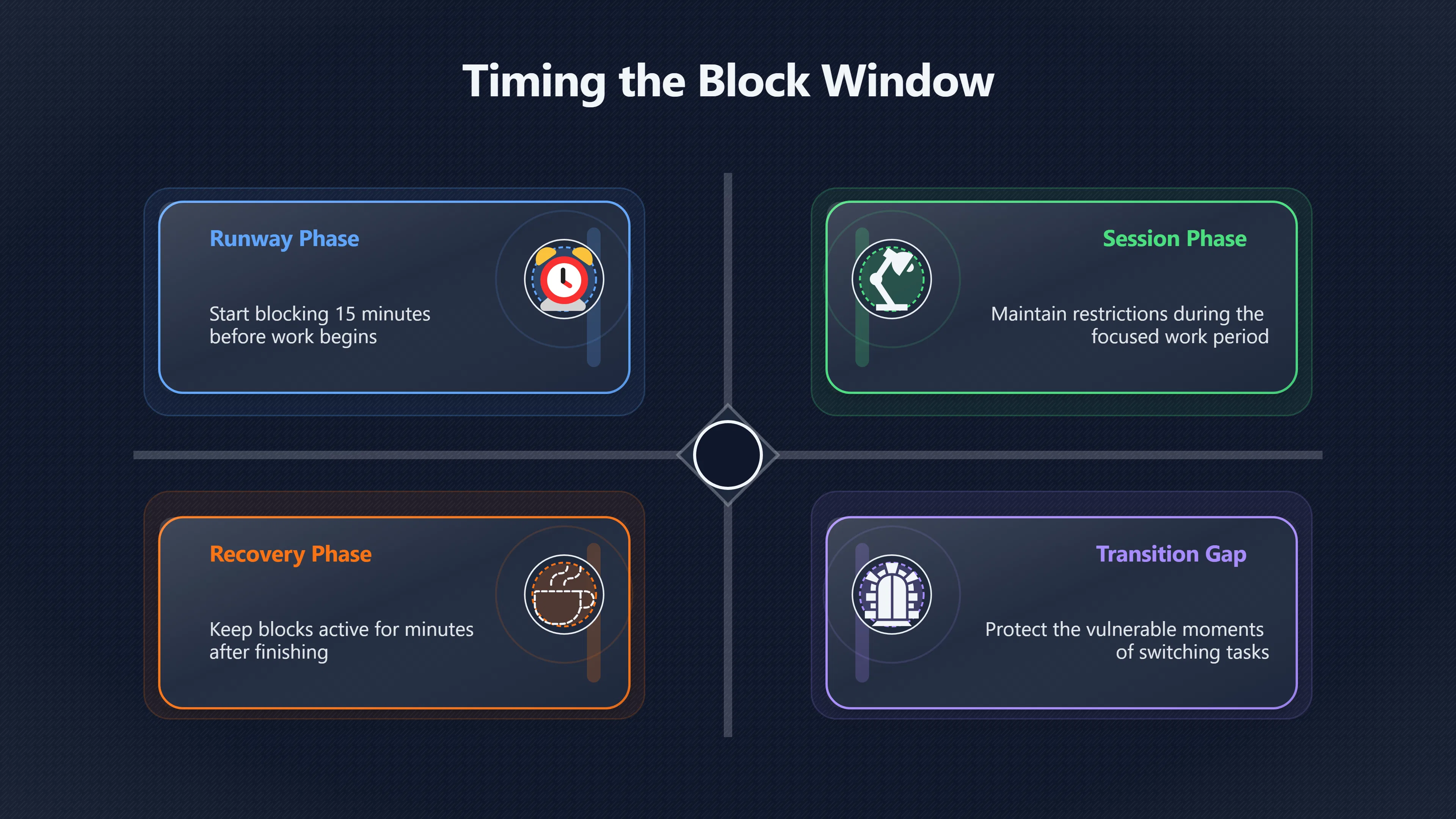
A useful method is to identify three periods:
- The runway: the 15–30 minutes before focused work begins.
- The session: the actual deep work period.
- The recovery phase: the first few minutes after completion, when many people reflexively switch into unplanned scrolling.
For a two-hour writing session from 9:00 to 11:00, a more effective schedule might block distractions from 8:45 to 11:15. The extra time protects the transition into and out of concentrated work.
This matters because distraction is often triggered during task-switching moments rather than during sustained concentration itself. Once someone is fully engaged in demanding work, resisting distraction becomes easier. The vulnerable period is usually the beginning.
Blocking the right apps and sites
Not every distraction deserves a block. Overly broad restrictions often create frustration and increase the likelihood of bypassing the system.
Research examining digital self-control tools has found that users respond best when restrictions match their personal definition of distraction and their actual work context. A tool that blocks everything can interfere with legitimate work, while a tool that blocks nothing important becomes irrelevant.[ScienceDirect]sciencedirect.comDigital wellbeing tools through users lensby MB Almourad · 2021 · Cited by 86 — In this paper, we examine the quality of the…
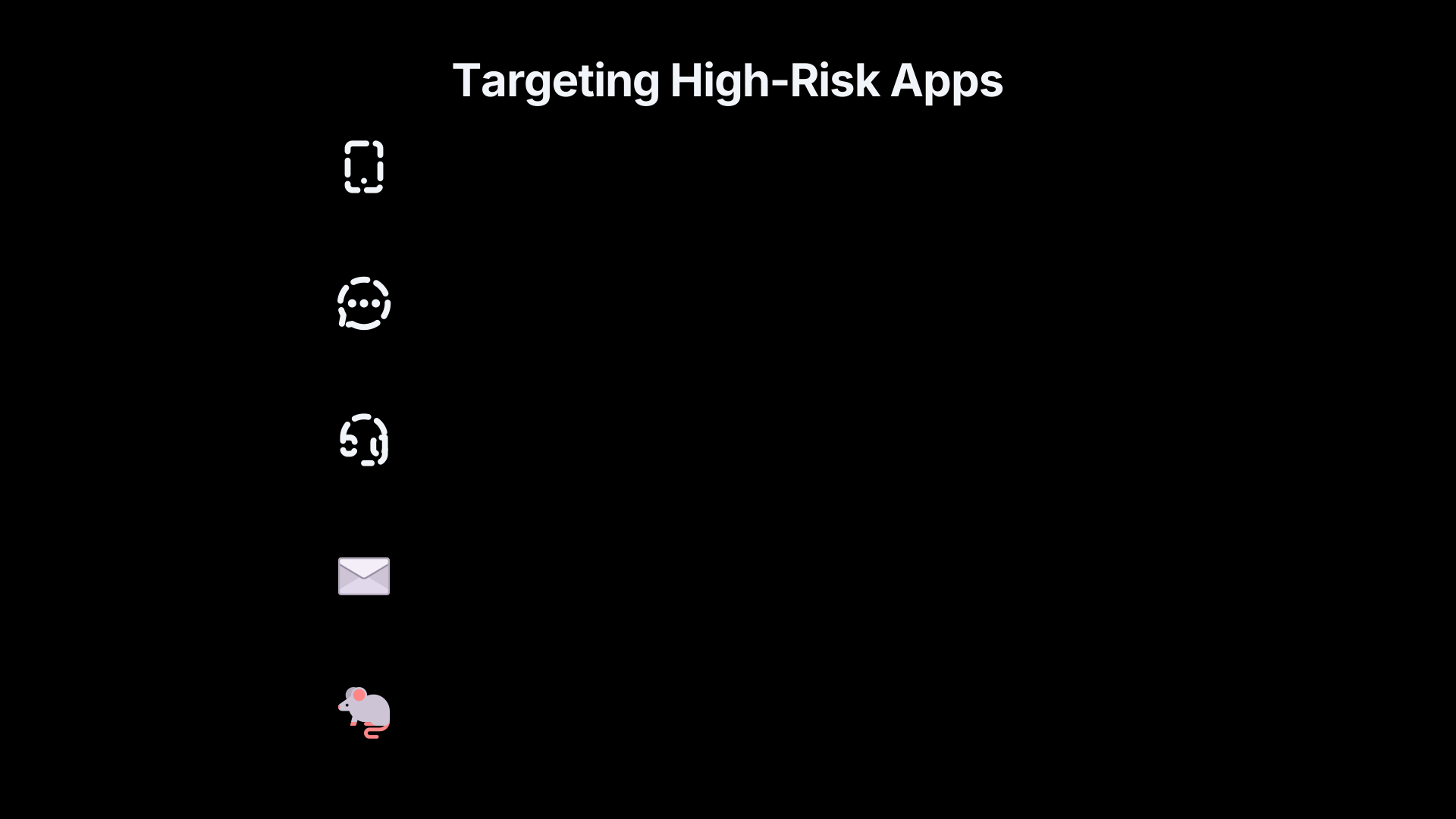
For deep work sessions, the highest-value targets are usually:
- Social media feeds.
- Short-form video platforms.
- News sites checked habitually rather than intentionally.
- Messaging apps that are not required for the task.
- Entertainment websites.
- Email, when constant checking is interrupting concentration.
The goal is not to eliminate technology but to remove the specific pathways that repeatedly pull attention away from the chosen task.
A useful test is to ask: “What app am I most likely to open automatically when the work becomes difficult?” That app belongs on the block list.
Building a replacement break
A scheduled block works best when it removes distractions and provides an alternative.
Without a replacement, people often spend their breaks searching for loopholes. They disable the blocker, switch devices, or substitute one distraction for another.
The strongest replacement activities are simple and low-stimulation:
- A short walk.
- Stretching.
- Making tea or coffee.
- Looking out of a window.
- Writing a quick note about the next work step.
- Brief conversation with a colleague or family member.
These activities create genuine recovery without restarting the cycle of endless digital input.
The principle is important because deep work requires alternating periods of effort and renewal. The block protects concentration; the replacement break protects recovery.
Making blocks harder to override
The effectiveness of a scheduled block depends partly on how easy it is to remove.
Many digital wellbeing tools now include strict modes, delayed overrides, approval requirements, or scheduled lockouts specifically because users often disable restrictions during moments of weakness. Reviews of digital self-control tools show that balancing flexibility with meaningful friction is one of the central design challenges.[ACM Digital Library]dl.acm.orgThe analysis…Read more…[ScienceDirect]sciencedirect.comDigital wellbeing tools through users lensby MB Almourad · 2021 · Cited by 86 — In this paper, we examine the quality of the…
For deep work, useful safeguards include:
- Requiring a waiting period before disabling a block.
- Preventing schedule edits during an active session.
- Synchronising blocks across devices.
- Using recurring schedules rather than manual activation.
The objective is not to create an inescapable prison. It is to ensure that breaking the rule requires a deliberate choice rather than a reflexive tap.
What evidence suggests about interruption and friction
Evidence from digital self-control research supports the broader logic behind scheduled blocks. A large field study of the self-control app one sec found that introducing friction before access to selected apps reduced target app openings by 57% over six weeks. The intervention combined delay, reflection prompts, and interruption of automatic behaviour, demonstrating the value of intervening before the habitual action is completed.[PubMed Central]pmc.ncbi.nlm.nih.govPubMed CentralDirecting smartphone use through the self-nudge app one secby DJ Grüning · 2023 · Cited by 93 — In 6 wk, one sec successful…
Scheduled blockers apply the same principle at a larger scale. Instead of interrupting a single app opening, they create a protected environment for an entire work session.
The evidence does not suggest that blocking alone solves every productivity problem. However, research reviews consistently indicate that environmental interventions such as blocking, restriction, and access control are among the more promising features of digital self-control tools.[ACM Digital Library]dl.acm.orgThe analysis…Read more…[Wiley Online Library]onlinelibrary.wiley.commore…
A simple deep work blocking policy
For most knowledge work, a practical scheduled blocking policy looks like this:
- Define a single high-value task.
- Start the block 15–30 minutes before work begins.
- Block only the apps and sites most likely to derail the session.
- Keep the block active until after the planned finish time.
- Schedule a specific replacement break.
- Review whether the blocked items were actually the sources of distraction.
This approach keeps the blocker focused on its real purpose: protecting a specific period of deep work from predictable interruptions. Rather than demanding constant self-control, it creates conditions where concentration is the default option when the work begins.
Amazon book picks
Further Reading
Books and field guides related to Why blocks should begin before work starts. Use these as the next step if you want deeper reading beyond the article.
Atomic Habits
Rating: 3.5/5 from 7 Google Books ratings
Useful for turning scheduled focus blocks into repeatable routines.
eBay marketplace picks
Marketplace Samples
Example marketplace items related to this page. Use the search link to explore similar finds on eBay.






Endnotes
1.
Source: dl.acm.org
Link:https://dl.acm.org/doi/full/10.1145/3571810
Source snippet
The analysis...Read more...
2.
Source: onlinelibrary.wiley.com
Link:https://onlinelibrary.wiley.com/doi/10.1111/jcal.12581
Source snippet
more...
3.
Source: researchgate.net
Link:https://www.researchgate.net/publication/365589107_Achieving_Digital_Wellbeing_Through_Digital_Self-Control_Tools_A_Systematic_Review_and_Meta-Analysis
Source snippet
Achieving Digital Wellbeing Through Digital Self-Control...Aiming to guide future research in this important domain, this article presen...
4.
Source: sciencedirect.com
Link:https://www.sciencedirect.com/science/article/pii/S0160791X21002530
Source snippet
Digital wellbeing tools through users lensby MB Almourad · 2021 · Cited by 86 — In this paper, we examine the quality of the...
5.
Source: dl.acm.org
Link:https://dl.acm.org/doi/abs/10.1145/3571810
Source snippet
Digital Wellbeing Through Digital Self-control...by AM Roffarello · 2023 · Cited by 156 — This article presents a systematic review and...
6.
Source: researchgate.net
Link:https://www.researchgate.net/publication/353906557Digital_self-control_interventions_for_distracting_media_multitasking-_A_systematic_review
Source snippet
From a search of the...Read more...
7.
Source: researchgate.net
Link:https://www.researchgate.net/publication/368573395_Directing_smartphone_use_through_the_self-nudge_app_one_sec
Source snippet
Directing smartphone use through the self-nudge app one...In sum, one sec decreased users' actual opening of target apps by 57% after si...
8.
Source: one-sec.app
Link:https://one-sec.app/ko/research/
Source snippet
y improves life...Read more...
9.
Source: sciencedirect.com
Title: The other three
Link:https://www.sciencedirect.com/science/article/pii/S1386505624003885
Source snippet
Persuasive strategies in digital interventions to combat...by Y Theopilus · 2025 · Cited by 15 — Three showed promising efficacy in redu...
10.
Source: sciencedirect.com
Link:https://www.sciencedirect.com/science/article/abs/pii/S1071581923000435
Source snippet
Editorial Understanding digital wellbeing within complex...by AM Roffarello · 2023 · Cited by 26 — The papers allow for a better underst...
11.
Source: pmc.ncbi.nlm.nih.gov
Link:https://pmc.ncbi.nlm.nih.gov/articles/PMC9974409/
Source snippet
PubMed CentralDirecting smartphone use through the self-nudge app one secby DJ Grüning · 2023 · Cited by 93 — In 6 wk, one sec successful...
12.
Source: pmc.ncbi.nlm.nih.gov
Link:https://pmc.ncbi.nlm.nih.gov/articles/PMC10498313/
Source snippet
PubMed CentralEvaluating the Effectiveness of Apps Designed to Reduce...by FI Rahmillah · 2023 · Cited by 32 — This paper investigated e...
Additional References
13.
Source: flown.com
Link:https://flown.com/blog/deep-work/time-blocking-apps
Source snippet
Time blocking apps: 16 top options, ranked4 days ago — 1. ⭐ TickTick – Time block your day, then run it with Pomodoro. TickTick is the “p...
14.
Source: reddit.com
Link:https://www.reddit.com/r/productivity/comments/15r02ur/best_apps_that_blocks_app_for_certain_time/
15.
Source: calnewport.com
Title: deep habits the importance of planning every minute of your work day
Link:https://calnewport.com/deep-habits-the-importance-of-planning-every-minute-of-your-work-day/
Source snippet
I take time blocking seriously, dedicating ten to twenty minutes every evening to building my schedule for the next...Read more...
16.
Source: elite.polito.it
Title: it”Achieving Digital Wellbeing Through Digital Self-Control
Link:https://elite.polito.it/news/2023/05/31/tochi-dscts
Source snippet
polito.it"Achieving Digital Wellbeing Through Digital Self-Control...May 31, 2023 — Our systematic literature review and meta-analysis o...
Published: May 31, 2023
17.
Source: pauso.io
Title: Why App Blockers Don’t Work (And What Actually Does)
Link:https://pauso.io/blog/why-app-blockers-dont-work
Source snippet
13 Mar 2026 — Friction-based awareness interventions can reduce app openings by over 50% (PNAS study on one sec app); The most effec...
18.
Source: facebook.com
Link:https://www.facebook.com/thedoctorpreneuracademy/posts/two-weeks-without-mobile-internet-helped-people-regain-attention-levels-similar-/1323246429814804/
Source snippet
ire internet—reduced constant stimulation and boosted focus, mood...Read more...
19.
Source: semanticscholar.org
Link:https://www.semanticscholar.org/paper/Achieving-Digital-Wellbeing-Through-Digital-Tools%3A-Roffarello-Russis/644dcfa1743129fc8d77a21ae896041687d34c49
Source snippet
self-control allows insights on how to overcome a limited perspective that...
20.
Source: pubmed.ncbi.nlm.nih.gov
Link:https://pubmed.ncbi.nlm.nih.gov/36795756/
Source snippet
apps 37% less than in the first week. In sum, one sec decreased users' actual opening of target apps by 57% after six consecutive weeks.R...
21.
Source: zapier.com
Title: stay focused avoid distractions
Link:https://zapier.com/blog/stay-focused-avoid-distractions/
Source snippet
The 7 best apps to help you focus and block distractions5 Nov 2024 — The 7 best focus apps; Freedom for blocking distractions on all you...
22.
Source: usrtk.org
Link:https://usrtk.org/healthwire/blocking-mobile-phone-internet-may-boost-mood-mental-health-attention/
Source snippet
Blocking mobile phone internet may boost mood, mental...24 Apr 2025 — Blocking mobile phone internet for two weeks may boost mood, menta...
Topic Tree