Within App Blockers
When app limits need more than a nudge
The right blocker is strong enough to change behavior but not so harsh that it invites loopholes or abandonment.
On this page
- What soft limits are good for
- When bypassing means friction is too weak
- How to avoid punitive blocking
Page outline Jump by section
Introduction
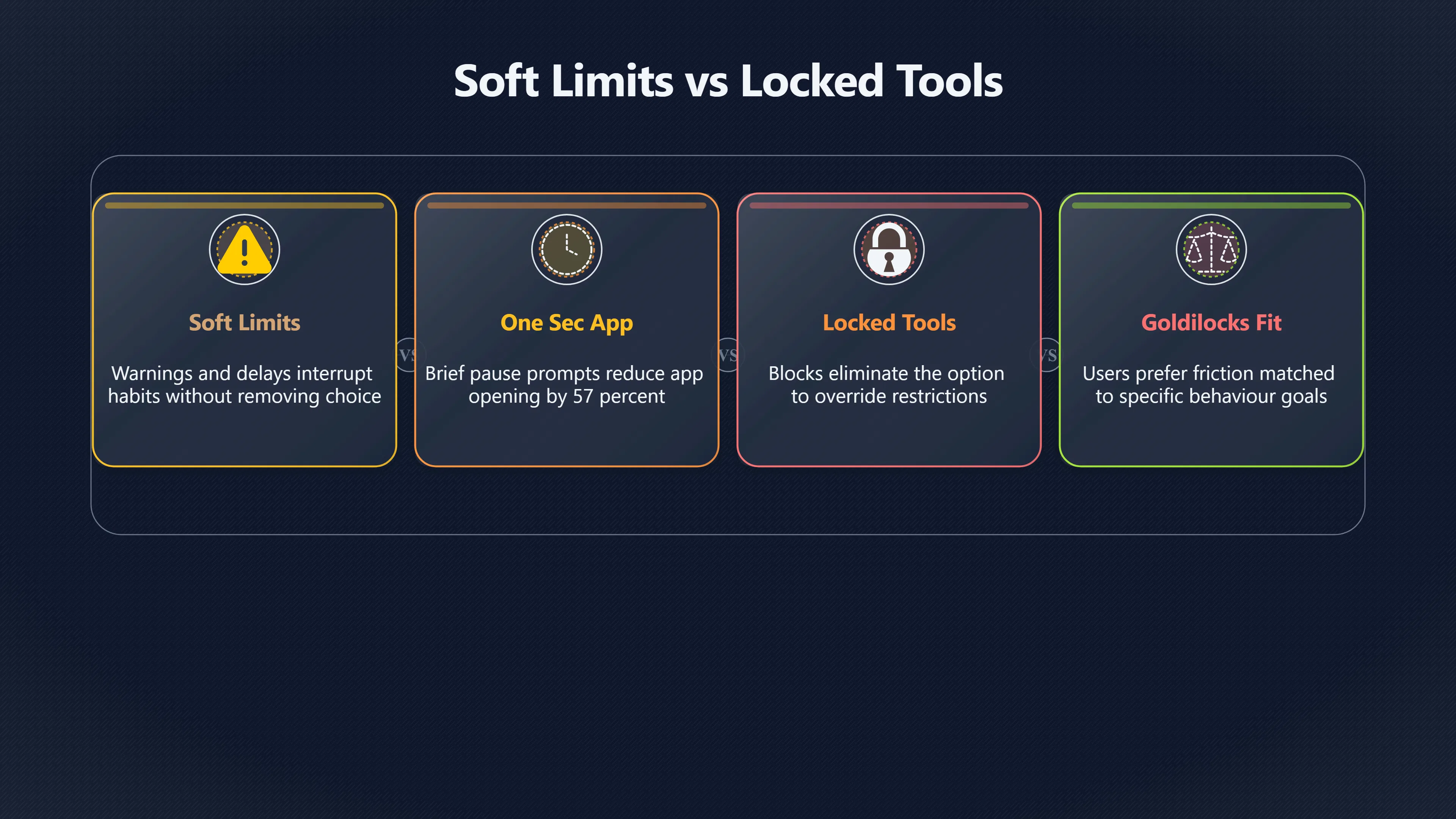
Most people start with soft app limits and only consider locked commitment tools after repeated failures. That progression makes sense. Soft limits are easy to adopt, preserve flexibility and work well when the problem is occasional mindless checking rather than a deeply ingrained habit. Locked commitment tools, by contrast, deliberately remove the option to override a restriction, at least for a defined period. The key question is not which approach is tougher. It is which approach changes behaviour without creating so much resistance that the system collapses.
 Research on digital self-control tools suggests that users consistently prefer support that is strong enough to change behaviour but not so coercive that it feels hostile. The most effective solution is often neither complete freedom nor total lockdown, but a level of friction matched to the specific behaviour being changed.[ScienceDirect]sciencedirect.comThe Goldilocks level of support: Using user reviews, ratings…by U Lyngs · 2022 · Cited by 55 — We analyse ratings & revie…
What soft limits are good for
Soft limits are interventions that can be bypassed with relatively little effort. Examples include screen-time warnings, daily usage caps that can be extended, reminders, delays before opening an app, greyscale displays, or prompts asking whether you really want to continue.
Their strength is that they interrupt automatic behaviour without removing choice. A person can still access the app if there is a legitimate reason. This matters because many distracting apps are also useful tools. Messaging services, video platforms and social networks often switch between productive and unproductive roles depending on context.
Soft limits work particularly well when:
- The behaviour is largely habitual rather than compulsive.
- The user already wants to change and mainly needs a reminder.
- The cost of accidental blocking would be high.
- The goal is awareness rather than abstinence.
Evidence for this approach comes from self-nudging research. The app one sec, for example, inserts a brief pause and reflection prompt before selected apps open. In a field study, users opened targeted apps 57% less often after six weeks. Importantly, the intervention relied on delay and reflection rather than complete prohibition.[ResearchGate]researchgate.netDirecting smartphone use through the self-nudge app one…In sum, one sec decreased users' actual opening of target apps by…
This illustrates a broader principle: many unwanted app visits are not deliberate decisions. They are reflexes. A small interruption can be enough to break the automatic sequence.
When bypassing means friction is too weak
Soft limits fail when the cost of ignoring them becomes trivial compared with the reward of the habit.
Anyone who has clicked “ignore limit” dozens of times has experienced this problem. The warning remains visible, but it no longer changes behaviour. At that point the tool has become informational rather than behavioural.
This is especially common when:
- The same override option appears every day.
- The target behaviour provides immediate emotional rewards.
- The user is stressed, tired or procrastinating.
- The limit requires only a single tap to dismiss.
Research examining hundreds of digital self-control tools found that users repeatedly described wanting support that was “just enough” to change behaviour. Complaints frequently arose when tools were either too easy to circumvent or so restrictive that they felt oppressive.[ScienceDirect]sciencedirect.comThe Goldilocks level of support: Using user reviews, ratings…by U Lyngs · 2022 · Cited by 55 — We analyse ratings & revie…
The weakness of soft limits is not merely that they can be bypassed. It is that repeated bypassing trains a new habit: overriding the intervention itself. Once that happens, the friction disappears psychologically even if it remains technically present.
A useful diagnostic question is simple: if you override the limit almost every time it appears, it is no longer functioning as a limit.
What locked commitment tools do differently
Locked commitment tools raise the cost of reversal.
Instead of asking for another decision at the moment of temptation, they attempt to eliminate the decision altogether. Examples include app blockers that cannot be disabled during a focus session, website restrictions that require a long waiting period to remove, or systems where another person controls the password.
The logic comes from commitment devices in behavioural economics. People often recognise that their future self will be tempted to abandon a plan. A commitment device allows them to bind that future self in advance.
In digital environments, this can mean:
- A study session that cannot be interrupted by social media.
- A writing block that prevents access to entertainment sites.
- A bedtime restriction that remains active until morning.
- A scheduled lockout during known distraction windows.
Reviews of digital self-control interventions consistently identify blocking and removal features as among the most common and potentially powerful approaches for reducing unwanted use. These interventions modify the environment directly rather than relying primarily on awareness or motivation.[ACM Digital Library]dl.acm.orgACM Digital LibraryAchieving Digital Wellbeing Through Digital Self-control…by AM Roffarello · 2023 · Cited by 164 — The most common i…[ResearchGate]researchgate.netDirecting smartphone use through the self-nudge app one…In sum, one sec decreased users' actual opening of target apps by…
The advantage is obvious: a block that cannot be dismissed cannot become a reflexively ignored warning.

The hidden risk of stronger commitment
Stronger tools are not automatically better.
A blocker that is too restrictive can create a different failure mode. Instead of bypassing the limit, the user abandons the entire system. They uninstall the blocker, switch devices, find alternative websites or stop using the tool altogether.
This is why the strongest possible restriction is rarely the optimal one. A full-day lockout may sound impressive, but if it survives only three days before being removed, it has achieved less than a moderate intervention that lasts six months.
Researchers studying digital self-control tools describe this challenge as a “Goldilocks” problem. Users tend to favour interventions that feel proportionate to their goals and circumstances. Excessive restriction can undermine the sense of autonomy that makes long-term behaviour change sustainable.[ScienceDirect]sciencedirect.comThe Goldilocks level of support: Using user reviews, ratings…by U Lyngs · 2022 · Cited by 55 — We analyse ratings & revie…
The practical lesson is that commitment strength should be matched to the severity of the problem. A person who occasionally checks social media during work may need only a delay. Someone repeatedly losing entire afternoons to the same platforms may benefit from a temporary lock that removes the option to negotiate.
How to avoid punitive blocking
The best commitment tools are protective rather than punitive.
Punitive blocking feels like a punishment imposed on the present self by a past self. Protective blocking feels like a structure designed to support a valued activity.
Several design choices help maintain that distinction.
Limit the block to a specific purpose
Blocking everything all the time creates unnecessary conflict. Blocking selected distractions during a clearly defined activity creates a visible benefit.
A writing session, revision period or bedtime routine provides a concrete reason for the restriction.
Match strength to vulnerability
Use the weakest intervention that reliably works.
If a five-second delay consistently prevents impulsive checking, a non-removable four-hour lockout may be excessive. If delays fail repeatedly, stronger commitment may be justified.
Build escape routes for genuine needs
Many successful blockers distinguish between emergencies and temptations. The goal is not to trap the user. It is to make impulsive use harder than intentional use.

Review outcomes, not ideology
The question is not whether soft limits or locked tools are morally superior. The question is whether they improve behaviour over time.
If a strict blocker produces reliable focus without resentment, it is working. If a softer system produces the same outcome with less friction, that may be the better solution.
Choosing between soft and locked approaches
A useful rule is to match the intervention to the stage of the habit.
SituationBetter starting pointOccasional mindless checkingSoft limitsBuilding awareness of usageSoft limitsRepeatedly ignoring warningsStronger commitmentDeep work sessionsLocked commitment toolsBedtime scrolling that persists despite remindersLocked commitment toolsLong-term sustainable behaviour changeThe least restrictive option that reliably works
The most successful digital friction systems often evolve rather than remain fixed. People begin with reminders and delays, discover where those interventions fail, and then selectively introduce stronger commitment where necessary.
The objective is not maximum restriction. It is dependable behaviour change. Soft limits provide a nudge. Locked commitment tools provide a boundary. The most effective choice is the one that reliably protects the activity that matters while remaining acceptable enough to keep using.[ScienceDirect]sciencedirect.comThe Goldilocks level of support: Using user reviews, ratings…by U Lyngs · 2022 · Cited by 55 — We analyse ratings & revie… 2pmc.ncbi.nlm.nih.gov
Amazon book picks
Further Reading
Books and field guides related to When app limits need more than a nudge. Use these as the next step if you want deeper reading beyond the article.
Atomic Habits
Rating: 3.5/5 from 7 Google Books ratings
Explains friction, environment design and habit systems that relate directly to app limits and digital self-control.
The Power of Habit
Provides habit-loop concepts useful for deciding when stronger restrictions are needed.
eBay marketplace picks
Marketplace Samples
Topic-anchored marketplace searches for visual, collectible, or second-hand items related to this page.



Endnotes
1.
Source: sciencedirect.com
Link:https://www.sciencedirect.com/science/article/pii/S1071581922000957
Source snippet
The Goldilocks level of support: Using user reviews, ratings...by U Lyngs · 2022 · Cited by 55 — We analyse ratings & revie...
2.
Source: researchgate.net
Link:https://www.researchgate.net/publication/368573395_Directing_smartphone_use_through_the_self-nudge_app_one_sec
Source snippet
Directing smartphone use through the self-nudge app one...In sum, one sec decreased users' actual opening of target apps by...
3.
Source: one-sec.app
Link:https://one-sec.app/research/
Source snippet
ResearchWe have conducted research on the psychological effects of the app demonstrating that one sec reduces app usage by 57% and signif...
4.
Source: dl.acm.org
Link:https://dl.acm.org/doi/full/10.1145/3571810
Source snippet
ACM Digital LibraryAchieving Digital Wellbeing Through Digital Self-control...by AM Roffarello · 2023 · Cited by 164 — The most common i...
5.
Source: researchgate.net
Link:https://www.researchgate.net/publication/353906557Digital_self-control_interventions_for_distracting_media_multitasking-_A_systematic_review
Source snippet
(PDF) Digital self‐control interventions for distracting media...These interventions use different approaches, such as the blocking of a...
6.
Source: dl.acm.org
Link:https://dl.acm.org/doi/fullHtml/10.1145/3411763.3451843
Source snippet
ACM Digital LibraryReducing Risk in Digital Self-Control Toolsby RX Schwartz · 2021 · Cited by 19 — ” Their features can be grouped into...
7.
Source: pmc.ncbi.nlm.nih.gov
Link:https://pmc.ncbi.nlm.nih.gov/articles/PMC10498313/
Source snippet
Evaluating the Effectiveness of Apps Designed to Reduce...by FI Rahmillah · 2023 · Cited by 29 — This paper investigated existing apps d...
8.
Source: pmc.ncbi.nlm.nih.gov
Link:https://pmc.ncbi.nlm.nih.gov/articles/PMC12894810/
Source snippet
nih.govSelf‐nudging toward physical activity: Scale development...by AB Bakker · 2026 — This study uses nudging theory to develop and va...
9.
Source: pmc.ncbi.nlm.nih.gov
Link:https://pmc.ncbi.nlm.nih.gov/articles/PMC11005480/
Source snippet
NIHby N Junger · 2024 · Cited by 12 — Nudging, a controversial technique for modifying people's behavior in a predictable way, is c...
10.
Source: pmc.ncbi.nlm.nih.gov
Link:https://pmc.ncbi.nlm.nih.gov/articles/PMC8145956/
Source snippet
by SCL Lau · 2020 · Cited by 46 — Our findings support the use of theory to guide the development of digital self-management intervent...
11.
Source: pmc.ncbi.nlm.nih.gov
Link:https://pmc.ncbi.nlm.nih.gov/articles/PMC9112639/
Source snippet
by JA Olson · 2022 · Cited by 114 — We tested an intervention with ten strategies that nudge users to reduce their smartphone use, for...
12.
Source: pmc.ncbi.nlm.nih.gov
Link:https://pmc.ncbi.nlm.nih.gov/articles/PMC9066336/
Source snippet
Review of Digital Well-being Apps - PMCby S Almoallim · 2022 · Cited by 35 — Findings indicate four interventions for limiting the overal...
13.
Source: one-sec.app
Link:https://one-sec.app/it/research/
Source snippet
StudiWe have conducted research on the psychological effects of the app demonstrating that one sec reduces app usage by 57% and significa...
14.
Source: researchgate.net
Title: 374003343 Use of digital self control tools in higher education a survey study
Link:https://www.researchgate.net/publication/374003343Use_of_digital_self-control_tools_in_higher_education-_a_survey_study
Source snippet
(PDF) Use of digital self-control tools in higher education18 Sept 2023 — Digital self-control tools, which aim to assist users in their...
15.
Source: sciencedirect.com
Link:https://www.sciencedirect.com/science/article/pii/S2666558126000011
Source snippet
digital self-control tools. Young children takes part in educational settings. Cao and Li (2023) found that the existing evidence highlig...
16.
Source: play.google.com
Link:https://play.google.com/store/apps/details?hl=en_US&id=wtf.riedel.onesec
Source snippet
sec | app blocker, focus5 days ago — App usage drops by 57% on average thanks to one sec – proven by science!... Having two more weeks p...
17.
Source: apps.apple.com
Title: comone sec | screen time + focus
Link:https://apps.apple.com/ag/app/one-sec-screen-time-focus/id1532875441
Source snippet
sec | screen time + focus - App Store - AppleWillpower is not enough against social media algorithms! That's why I made one sec: one sec...
Additional References
18.
Source: facebook.com
Link:https://www.facebook.com/PNASNews/
Source snippet
PNAS | Washington D.C. DCCutting edge news and reports from PNAS, one of the world's most-cited multidisciplinary scientific journals.Rea...
19.
Source: pnas.org
Link:https://www.pnas.org/
Source snippet
Explore High-Impact Scientific Research Across...PNAS is one of the world's most-cited and comprehensive multidisciplinary scient...
20.
Source: iris.polito.it
Link:https://iris.polito.it/retrieve/28c10713-3c1e-4084-83d0-0a9b2e8b2723/dwbreview.pdf
Source snippet
Digital Wellbeing Through Digital Self-Control...To assess the state-of-the-art characterizing the development of DSCTs and to guide fut...
21.
Source: reddit.com
Link:https://www.reddit.com/r/PsychologicalTricks/comments/114kc1x/pt_breathing_intervention_before_socialmediaapps/
22.
Source: Wikipedia
Title: Proceedings of the National Academy of Sciences of the United States of America
Link:https://en.wikipedia.org/wiki/Proceedings_of_the_National_Academy_of_Sciences_of_the_United_States_of_America
Source snippet
Proceedings of the National Academy of SciencesIt is the official journal of the National Academy of Sciences, published since 1915, a...
23.
Source: youtube.com
Link:https://www.youtube.com/c/PNASNews/videos
Source snippet
PNASPNAS is one of the world's most-cited and comprehensive multidisciplinary scientific journals, publishing more than 3,500 research pa...
24.
Source: jstor.org
Link:https://www.jstor.org/journal/procnatiacadscie
Source snippet
It publishes high-impact research reports, commentaries, perspectives, reviews, colloquium...Read more...
25.
Source: d-nb.info
Link:https://d-nb.info/1256424374/34
Source snippet
Digital self‐control interventions for distracting media...by D Biedermann · Cited by 53 — In this review, we summarized and categorized...
26.
Source: reddit.com
Link:https://www.reddit.com/r/science/comments/1167elo/directing_smartphone_use_through_the_selfnudge/
Source snippet
dismiss their consumption attempt after having opened a target app...Read more...
27.
Source: fortune.com
Title: one sec app can help cut your social media use
Link:https://fortune.com/well/2023/03/06/one-sec-app-can-help-cut-your-social-media-use/
Source snippet
This app may curb your social media usage by halfMar 6, 2023 — Key takeaways · The app, One Sec, can help reduce screen time by asking yo...
Topic Tree