Within Motivation
Why tiny progress can feel powerful
Small wins work best when they are visible, repeatable steps in a valued direction rather than random easy tasks.
On this page
- Why competence depends on evidence, not hype
- Designing first steps that survive low energy days
- Making progress visible without turning tracking obsessive
Page outline Jump by section
Introduction
Small wins matter in self-improvement, but not because they create a temporary feeling of success. They matter because they provide evidence. When a small action demonstrates that you can learn, improve, or handle a challenge, it strengthens the sense of competence that supports long-term motivation. In contrast, easy wins that have little connection to a valued goal may feel good briefly without building any lasting capability.
 Research on motivation consistently points to competence as a central psychological need. People are more likely to persist when they can see proof that their efforts are making them more effective. The most useful small wins are therefore not random achievements. They are visible, repeatable steps that move a person in a direction they genuinely care about. Over time, these small pieces of evidence accumulate into a stronger belief: “I can do this, and I am getting better at it.”[Self]next.co.ukSource details in endnotes. -Determination Theory
Why competence depends on evidence, not hype
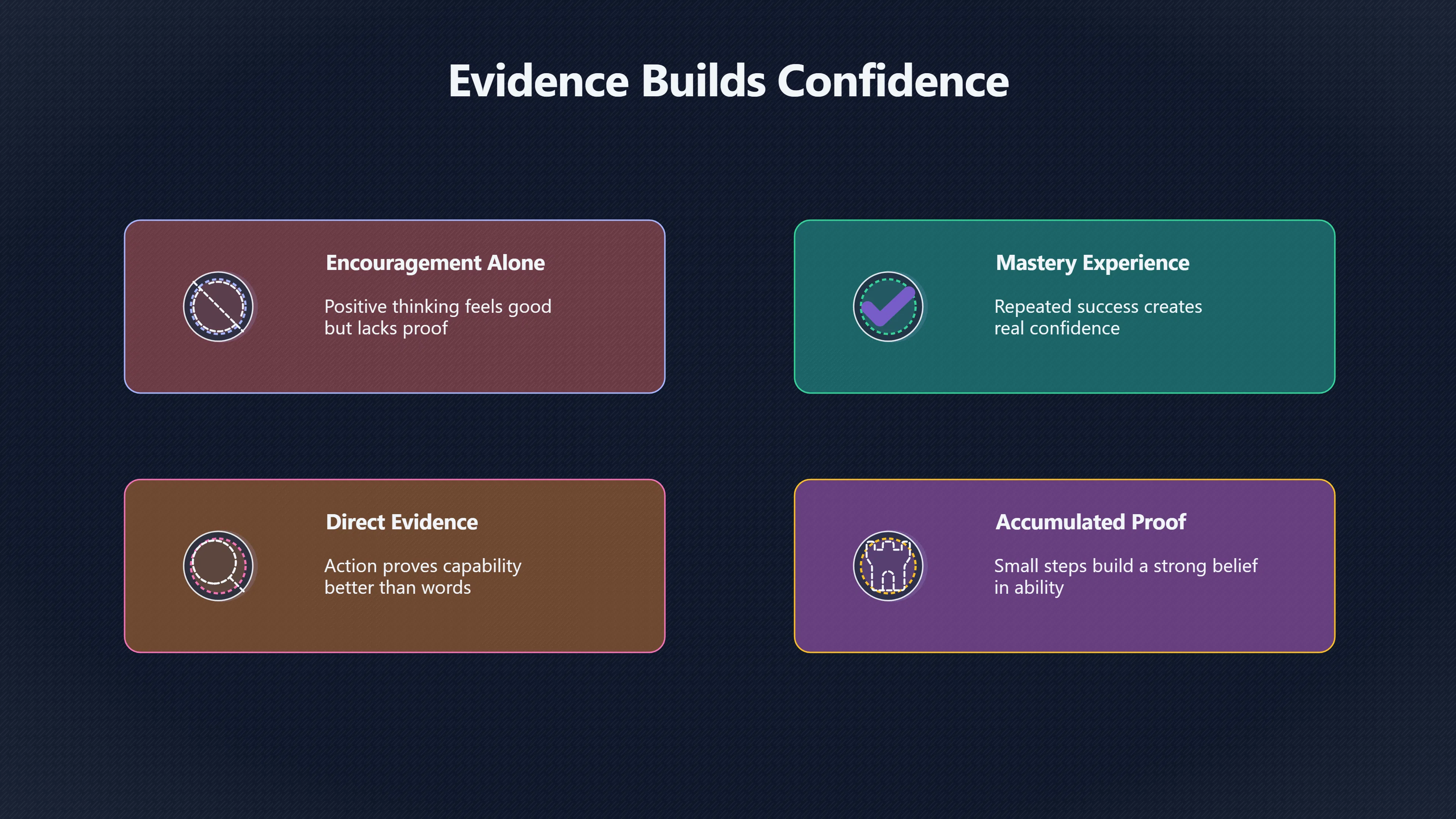
A common mistake in self-improvement is trying to create motivation through encouragement alone. Encouragement can help, but confidence built only on positive thinking is fragile. Real confidence grows from experience.
Psychologist Albert Bandura’s work on self-efficacy—the belief that one can successfully perform a task—identified mastery experiences as the most powerful source of confidence. In practical terms, people become more confident when they repeatedly succeed at meaningful tasks, even small ones. Success creates evidence that they can influence outcomes through their own actions.[Teaching at Sydney]educational-innovation.sydney.edu.au1977). Self-EfficacyMarch 8, 2006 — by A Bandura · Cited by 132145 — In the proposed model, expectations of personal efficacy are derive…[Simply Psychology]simplypsychology.orgSimply PsychologyBandura's Self-Efficacy Theory Of Motivation In Psychologyby G Lopez-Garrido · Cited by 180 — Performance Outcomes (Mast…
This explains why a person who completes a ten-minute walk every day may become more motivated than someone who spends hours consuming inspirational content about fitness. The walk provides direct evidence. The inspiration provides a feeling.
The distinction matters because competence is not merely a belief. It is an interpretation of accumulated experience. Self-determination theory, which places competence alongside autonomy and relatedness as a basic psychological need, suggests that people function best when they experience themselves as increasingly capable. That experience comes from interacting successfully with challenges, not from being told they are capable.[Self]next.co.ukSource details in endnotes. -Determination Theory[PMC]pmc.ncbi.nlm.nih.govPMCWhy Do I Feel More Confident?Bandura's Sources Predict…by F Pfitzner-Eden · 2016 · Cited by 521 — Bandura (1997) proposed four sources of self-efficacy: mastery ex…
A useful test is to ask whether a small win teaches something.
- Reading an article about guitar playing may feel productive.
- Practising one chord change fifty times creates evidence of skill.
Only the second activity strengthens competence directly.
Why meaningful progress feels disproportionately motivating
The power of small wins is not just a theory of skill development. It is also a theory of motivation.
Research by Teresa Amabile and Steven Kramer analysed nearly 12,000 work diary entries and found that making progress in meaningful work was one of the strongest drivers of positive emotions, engagement and motivation. Importantly, the progress did not have to be dramatic. Even modest forward movement mattered when it occurred in a direction that people considered meaningful.[Harvard Business School]hbs.eduHarvard Business SchoolThe Progress Principle: Using Small Wins to Ignite Joy…by TM Amabile · 2011 · Cited by 1632 — The book shows h…[American Management Association]amanet.orgAmerican Management AssociationThe Worth of Small Wins: Teresa Amabile and Steven…First, the progress principle provides the key—provi…
This helps explain why people often abandon goals despite occasional large achievements. A dramatic result can be motivating, but motivation becomes more reliable when progress is frequent enough to be noticed.
Consider two learners:
- One studies a language intensely for a weekend and then stops.
- Another learns five new words every day and notices growing comprehension.
The second learner receives continuous feedback that improvement is happening. Each day reinforces the connection between effort and progress.
The emotional effect is significant because small wins reduce uncertainty. They answer a question that often sits beneath motivation problems: “Is this actually working?” Every visible improvement provides a small but meaningful “yes”.
Designing first steps that survive low-energy days
The most effective small wins are not the smallest possible actions. They are the smallest actions that still develop the target capability.
This distinction is important. Making a goal easier can help, but making it too easy can disconnect the action from real growth.
For example:
- Doing one push-up may be an effective starting point if it reliably leads to exercise.
- Opening a fitness app and immediately closing it is probably too disconnected from the actual skill or behaviour.
A good first step has three characteristics:
It is achievable under ordinary conditions.
The action should still be possible on a tired, busy or stressful day.
It directly expresses the skill being developed.
The step should involve doing the thing, not merely preparing to do it.
It produces observable evidence.
At the end, there should be some indication that progress occurred.
This is why writing one paragraph often works better than planning a writing session. The paragraph is evidence. The plan is only intention.
Small wins become especially valuable during periods of low motivation because they maintain continuity. Missing ambitious targets can create doubt about competence. Completing a modest but meaningful action preserves the story that improvement is still happening.
The difference between activity and mastery
Not all progress indicators are equally useful.
Many self-improvement systems reward activity because activity is easy to measure. Yet competence grows from increasingly effective performance, not merely from accumulating effort.
Someone learning to cook could record:
- Days spent in the kitchen.
- Recipes successfully completed.
- New techniques mastered.
The final two measures provide stronger evidence of competence because they reflect capability rather than presence.
This distinction helps explain why some highly tracked self-improvement projects become frustrating. People accumulate streaks, points or checkmarks without feeling noticeably more skilled.
The problem is not the tracking itself. The problem is that the tracked behaviour has drifted away from actual mastery.
A useful question is: “If I continue collecting these wins for six months, what capability will I genuinely possess?”
If the answer is unclear, the wins may be measuring participation rather than growth.
Making progress visible without becoming obsessive
Visible progress supports motivation because it helps people recognise improvement that would otherwise be overlooked. Yet there is a risk of turning measurement into the goal itself.
The solution is to track evidence, not everything.
Useful indicators tend to be simple:
- Number of workouts completed this week.
- Pages written.
- Practice sessions finished.
- Problems solved correctly.
- Conversations held in a new language.
These measures remain close to the behaviour being developed.
Problems often arise when tracking becomes excessively detailed. Recording every calorie, minute, metric and fluctuation can shift attention away from learning and towards constant evaluation. The person spends more time measuring performance than building it.
A healthier approach is periodic visibility rather than continuous surveillance. Weekly reviews, simple logs or occasional before-and-after comparisons often provide enough evidence to maintain motivation without creating obsession.
The goal is not to maximise data collection. The goal is to make improvement visible enough that the brain can recognise a pattern of growth.
When small wins stop working
Small wins lose their motivational power when they no longer represent progress.
This can happen in several ways:
- The task becomes completely automatic and no longer stretches ability.
- The win is disconnected from a meaningful goal.
- The challenge level never increases.
- The person starts collecting easy victories while avoiding harder growth.
Bandura’s work suggests that self-efficacy develops through mastery experiences, not through endless repetition of actions that require little effort. Eventually, competence requires slightly larger challenges.[Teaching at Sydney]educational-innovation.sydney.edu.au1977). Self-EfficacyMarch 8, 2006 — by A Bandura · Cited by 132145 — In the proposed model, expectations of personal efficacy are derive…[PMC]pmc.ncbi.nlm.nih.govPMCWhy Do I Feel More Confident?Bandura's Sources Predict…by F Pfitzner-Eden · 2016 · Cited by 521 — Bandura (1997) proposed four sources of self-efficacy: mastery ex…
A useful pattern is gradual expansion:
- Achieve a small, reliable success.
- Repeat it until confidence grows.
- Increase the challenge slightly.
- Repeat the cycle.
This creates a chain of mastery experiences rather than a collection of isolated victories.
Small wins as proof of a chosen direction
Within the broader question of motivation quality, the value of small wins is that they provide evidence that a chosen goal is becoming reality. They support competence without relying on hype, guilt or constant external pressure.
The most powerful small wins are not impressive from the outside. They are the ones that quietly answer a meaningful question: “Am I becoming more capable than I was before?”
When the answer becomes visible day after day, motivation no longer depends entirely on mood. Progress itself becomes a source of energy. Small wins stop being tiny achievements and start becoming proof that growth is possible.[Self]next.co.ukSource details in endnotes. -Determination Theory[PMC]pmc.ncbi.nlm.nih.govPMCWhy Do I Feel More Confident?Bandura's Sources Predict…by F Pfitzner-Eden · 2016 · Cited by 521 — Bandura (1997) proposed four sources of self-efficacy: mastery ex…
Amazon book picks
Further Reading
Books and field guides related to Why tiny progress can feel powerful. Use these as the next step if you want deeper reading beyond the article.
Atomic Habits
Rating: 3.5/5 from 7 Google Books ratings
Built around small improvements, visible progress, and accumulating evidence of competence.
eBay marketplace picks
Marketplace Samples
Example marketplace items related to this page. Use the search link to explore similar finds on eBay.






Endnotes
1.
Source: pmc.ncbi.nlm.nih.gov
Title: PMCWhy Do I Feel More Confident?
Link:https://pmc.ncbi.nlm.nih.gov/articles/PMC5070217/
Source snippet
Bandura's Sources Predict...by F Pfitzner-Eden · 2016 · Cited by 521 — Bandura (1997) proposed four sources of self-efficacy: mastery ex...
2.
Source: teresa.com
Link:https://www.teresa.com/
Source snippet
Teresa, who uses only her first name, is a Singer-Songwriter who brings her sunny disposition and positive approach to her music an...
3.
Source: educational-innovation.sydney.edu.au
Link:https://educational-innovation.sydney.edu.au/news/pdfs/Bandura%201977.pdf
Source snippet
(1977). Self-EfficacyMarch 8, 2006 — by A Bandura · Cited by 132145 — In the proposed model, expectations of personal efficacy are derive...
Published: March 8, 2006
4.
Source: simplypsychology.org
Link:https://www.simplypsychology.org/self-efficacy.html
Source snippet
Simply PsychologyBandura's Self-Efficacy Theory Of Motivation In Psychologyby G Lopez-Garrido · Cited by 180 — Performance Outcomes (Mast...
5.
Source: hbs.edu
Link:https://www.hbs.edu/faculty/Pages/item.aspx?num=40692
Source snippet
Harvard Business SchoolThe Progress Principle: Using Small Wins to Ignite Joy...by TM Amabile · 2011 · Cited by 1632 — The book shows h...
6.
Source: amanet.org
Link:https://www.amanet.org/articles/the-worth-of-small-wins-teresa-amabile-and-steven-kramer-on-the-progress-principle/
Source snippet
American Management AssociationThe Worth of Small Wins: Teresa Amabile and Steven...First, the progress principle provides the key—provi...
7.
Source: Wikipedia
Link:https://en.wikipedia.org/wiki/Teresa
Source snippet
TeresaArts · Teresa Berganza (1933–2022), Spanish opera singer · Teresa Brewer (1931–2007), American pop and jazz singer · Teresa Came...
8.
Source: next.co.uk
Link:https://www.next.co.uk/shop/brand-self-0
9.
Source: simplypsychology.org
Title: self determination theory
Link:https://www.simplypsychology.org/self-determination-theory.html
Source snippet
Self-Determination Theory Of Motivation1 Apr 2026 — The term self-determination refers to a person's own ability to manage themselves, to...
10.
Source: sciencedirect.com
Title: Sources of Self-efficacy
Link:https://www.sciencedirect.com/topics/social-sciences/sources-of-self-efficacy
Source snippet
an overviewAccording to Bandura, self-efficacy can arise from four sources—mastery of experiences, vicarious experiences, social or verba...
11.
Source: youtube.com
Title: Teresa Amabile
Link:https://www.youtube.com/watch?v=-v9c8Q4lfKs
Source snippet
The Progress PrincipleThe Progress Principle: How Small Wins Boost Motivation and Happiness at Work... research on motivation and emotio...
12.
Source: progressprinciple.com
Title: Teresa amabile
Link:https://progressprinciple.com/
Source snippet
Her books include Retiring: Creating a Life That Works for You and The Progress Principle: Using Small Wins to Ignite Joy, Engagement, an...
Additional References
13.
Source: psychologywriting.com
Link:https://psychologywriting.com/experiences-to-enhance-self-efficacy/
Source snippet
Experiences to Enhance Self-EfficacyBandura identified mastery experiences as the most significant motivator of self-efficacy among the f...
14.
Source: helloitsdanielle.com
Link:https://helloitsdanielle.com/blogs/news/the-power-of-small-wins
Source snippet
The Power of Small WinsHer studies found that making progress, even in tiny increments, is one of the most powerful motivators. This is k...
15.
Source: open.ncl.ac.uk
Link:https://open.ncl.ac.uk/academic-theories/30/self-efficacy-theory/
Source snippet
TheoryHubSelf-Efficacy TheoryThe theory posits that self-efficacy is influenced by four primary sources: mastery experiences, vicarious e...
16.
Source: fuelingcreativitypodcast.com
Link:https://fuelingcreativitypodcast.com/the-value-of-small-wins-and-the-progress-principle-with-dr-teresa-amabile-part-two
Source snippet
Amabile shares insights from her research involving R&D teams at corporations, revealing how a positive inner work life, driven by progress...
17.
Source: cambridge.org
Title: University Press & Assessment Self-Efficacy Interventions (Chapter 32)
Link:https://www.cambridge.org/core/books/handbook-of-behavior-change/selfefficacy-interventions/D4EC41A2F16CB6171058C5B00AE575AB
Source snippet
Cambridge University Press & AssessmentSelf-Efficacy Interventions (Chapter 32) - The Handbook of...Bandura posits that guided mastery e...
18.
Source: researchgate.net
Link:https://www.researchgate.net/publication/11490001_The_theory_and_measurement_of_the_self-efficacy_construct
Source snippet
Self-efficacy is influenced by four important sources of information: performance...Read more...
19.
Source: uvi.edu
Title: National Self Determination Richard Ryan and Edward Deci
Link:https://www.uvi.edu/files/documents/College_of_Liberal_Arts_and_Social_Sciences/social_sciences/OSDCD/National_Self_Determination_Richard_Ryan_and_Edward_Deci.pdf
Source snippet
Self-Determination Theory and the Facilitation of Intrinsic...by RM Ryan · 2000 · Cited by 88300 — Accumulated research now suggests tha...
20.
Source: researchgate.net
Link:https://www.researchgate.net/publication/381567340_A_systematic_review_and_meta-analysis_of_self-determination-theory-based_interventions_in_the_education_context
Source snippet
autonomy, competence, and relatedness, which are highly relevant in SRL...Read more...
21.
Source: verywellmind.com
Link:https://www.verywellmind.com/what-is-self-efficacy-2795954
Source snippet
iences," Bandura explained.1 Performing a task successfully strengthens...Read more...
22.
Source: positivepsychology.com
Title: How to Improve Self-Efficacy: 4 Science Based Ways1
Link:https://positivepsychology.com/3-ways-build-self-efficacy/
Source snippet
Mastery Experiences. Among the four sources of self-efficacy, Bandura identified mastery experiences as the most powerful driver of self...
Topic Tree