Within Action Plans
What Is Your Plan When Energy Drops?
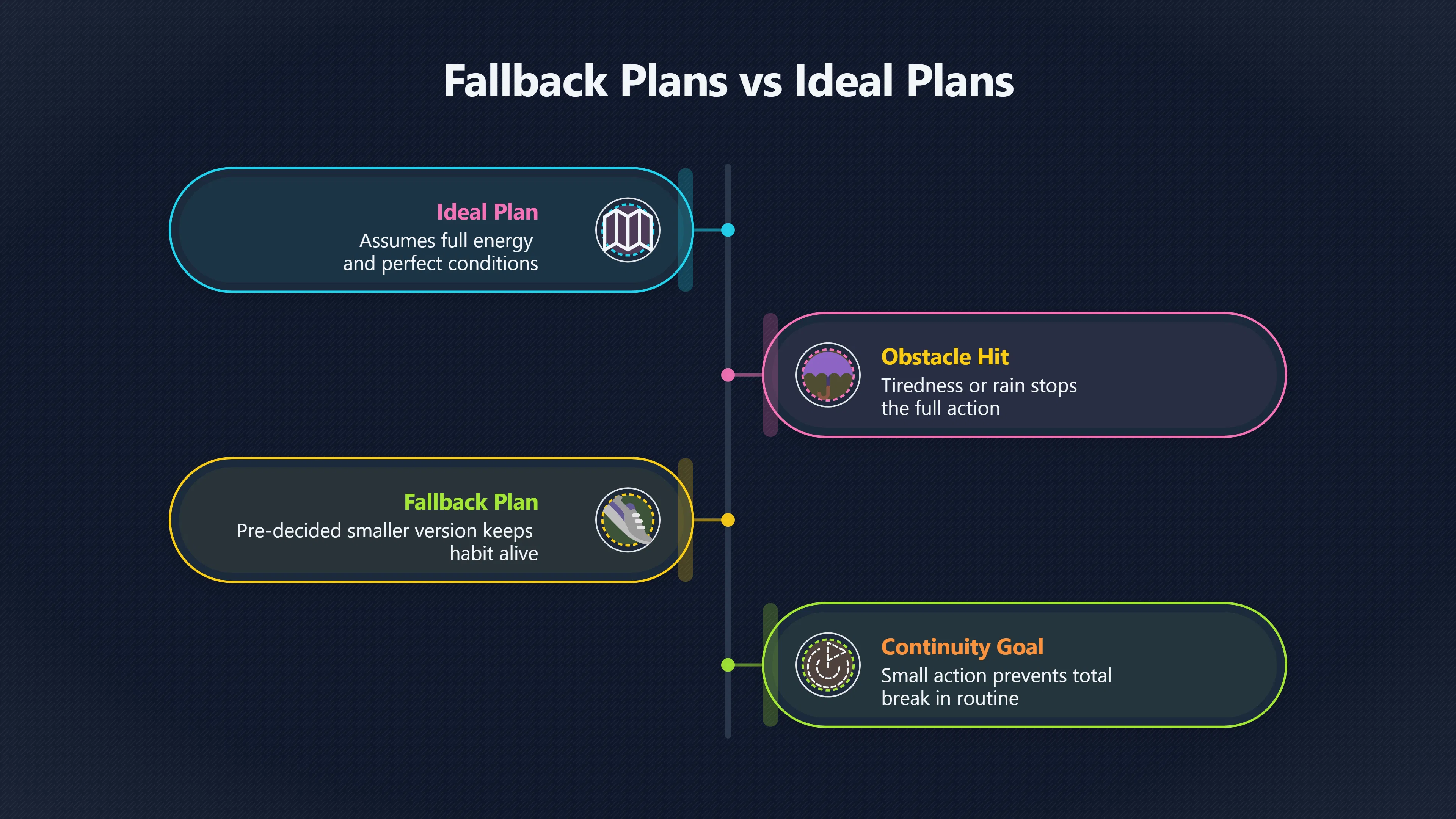
A good fallback plan keeps the habit alive when exhaustion, delays, weather or low mood make the full version unrealistic.
On this page
- Why full plans fail under predictable pressure
- How to write a minimum viable version
- Examples for exercise, writing, food and sleep
Page outline Jump by section
Introduction
Busy days rarely destroy a habit because the goal was wrong. More often, they destroy it because the planned version was too ambitious for the conditions that actually arrived. A fallback plan is a pre-decided, easier version of the same behaviour that keeps the habit alive when exhaustion, delays, bad weather, travel, stress or low mood make the full version unrealistic.
 The key idea is simple: do not wait until you are tired to decide what “counts”. Decide in advance. Behaviour-change research on implementation intentions shows that specific if-then plans help people translate intentions into action by linking predictable situations to predetermined responses. Rather than negotiating with yourself in the moment, you follow a prepared rule.[Division of Cancer Control]cancercontrol.cancer.govDivision of Cancer ControlImplementation Intentionsby PM Gollwitzer — Accumulated evidence indicates that if-then plan formation promotes…[PMC]pmc.ncbi.nlm.nih.govPMCPromoting the translation of intentions into action byby F Wieber · 2015 · Cited by 215 — One effective strategy to reduce this intention–behavior gap is the formation of implementation in…
A good fallback plan is not an excuse to do less forever. It is insurance against doing nothing.
What Is Your Plan When Energy Drops?
Most people plan only for ideal conditions. They imagine the version of themselves who sleeps well, leaves work on time and feels motivated. Yet many obstacles are predictable long before they occur.
Common examples include:
- Arriving home mentally exhausted.
- Running late because of work or family demands.
- Bad weather disrupting outdoor activities.
- Feeling stressed, discouraged or emotionally flat.
- Travelling or being away from normal routines.
- Having less time than expected.
These are not surprises. They are recurring conditions. If a behaviour repeatedly disappears under the same circumstances, the problem is often not commitment but the absence of a fallback response.
Research on implementation intentions suggests that specifying responses to predictable barriers improves goal pursuit because the decision has already been made before the obstacle appears.[Division of Cancer Control]cancercontrol.cancer.govDivision of Cancer ControlImplementation Intentionsby PM Gollwitzer — Accumulated evidence indicates that if-then plan formation promotes…[PMC]pmc.ncbi.nlm.nih.govPMCPromoting the translation of intentions into action byby F Wieber · 2015 · Cited by 215 — One effective strategy to reduce this intention–behavior gap is the formation of implementation in…
Instead of:
“I hope I exercise after work.”
The fallback version becomes:
“If I am too tired for the planned workout, I will walk for ten minutes.”
The habit survives even when the original plan does not.
Why Full Plans Fail Under Predictable Pressure
The hidden cost of decision-making
A full-sized plan often assumes more time, energy and attention than a difficult day provides. When tiredness appears, people must suddenly answer several questions:
- Should I still do it?
- How much should I do?
- Is it worth starting now?
- Would skipping once matter?
Every extra decision increases the chance of abandonment.
Implementation-intention research suggests that pre-selecting responses reduces the need for deliberation at the critical moment. The cue triggers the behaviour rather than a fresh round of decision-making.[PMC]pmc.ncbi.nlm.nih.govPMCPromoting the translation of intentions into action byby F Wieber · 2015 · Cited by 215 — One effective strategy to reduce this intention–behavior gap is the formation of implementation in…[Division of Cancer Control]cancercontrol.cancer.govDivision of Cancer ControlImplementation Intentionsby PM Gollwitzer — Accumulated evidence indicates that if-then plan formation promotes…
All-or-nothing thinking
Another common failure mode is treating the ideal version as the only acceptable version.
Examples include:
- Missing a 60-minute gym session and therefore doing no exercise.
- Failing to write 1,000 words and therefore writing nothing.
- Missing a perfect meal plan and therefore ordering whatever is easiest.
This mindset converts a small disruption into a complete break in consistency.
Tiny-habit approaches and related behaviour-design models argue that reducing the required effort can preserve action even when motivation drops. Behaviour occurs more reliably when the required action remains within a person’s available ability at that moment.[Fogg Behavior Model]behaviormodel.orgFogg Behavior ModelFogg Behavior Model - BJ FoggThe Fogg Behavior Model shows that three elements must converge at the same moment for a…[Tiny Habits]tinyhabits.comTiny Habits: BJ FoggChange your life for good with the Tiny Habits method—where simple changes lead to real, life-changing results. It's…
How to Write a Minimum Viable Version
A fallback plan should be small enough that it remains realistic on a genuinely difficult day while still preserving the identity of the habit.
A useful process is:
- Define the normal version.
- Identify the most common obstacle.
- Create a reduced version requiring far less time, effort or preparation.
- Decide in advance when the fallback replaces the normal plan.
The reduced version should feel almost impossible to fail.
The three tests
A minimum viable habit usually passes three tests.
It preserves the direction.
The fallback should be the same behaviour family, not a different goal.
- Run becomes walk.
- Write chapter becomes write paragraph.
- Cook full meal becomes prepare simple healthy option.
It can be started immediately.
Long setup requirements defeat the purpose. If exhaustion is the obstacle, the fallback should require minimal preparation.
It remains meaningful.
The goal is not symbolic box-ticking. The action should still reinforce the desired identity and routine.
Research on habit formation and implementation intentions suggests that consistency of cue-response links matters because repeated execution strengthens behavioural patterns over time.[PubMed]pubmed.ncbi.nlm.nih.govThis may be achieved by mentally forming stimulus…Read more…[BPS Psych Hub]bpspsychub.onlinelibrary.wiley.comBPS Psych HubPromoting new habits at work through implementation intentions9 Aug 2024 — The results indicate that implementation intentio…
Examples for Exercise, Writing, Food and Sleep
Exercise
A common mistake is creating a plan with only one acceptable outcome.
Normal plan:
- Forty-five minutes of exercise after work.
Fallback plans:
- Ten-minute walk.
- One set of bodyweight exercises.
- Five minutes of stretching.
- Walk around the block before entering the house.
The purpose is not fitness optimisation. The purpose is preventing the exercise habit from disappearing whenever energy falls below ideal levels.
Writing
Creative work is especially vulnerable to fatigue because starting feels mentally expensive.
Normal plan:
- Write 1,000 words.
Fallback plans:
- Write 100 words.
- Open the document and draft one paragraph.
- Spend five minutes outlining tomorrow’s work.
The fallback keeps contact with the project. Tomorrow begins from momentum rather than from zero.

Food
Busy days often trigger unhealthy eating because cooking feels overwhelming.
Normal plan:
- Cook a balanced meal from scratch.
Fallback plans:
- Pre-prepared healthy meal kept in the freezer.
- Simple protein-and-vegetable combination requiring minimal cooking.
- A standard emergency meal chosen in advance.
The important decision is made before hunger and tiredness arrive.
Sleep
Many evening routines collapse when people feel exhausted.
Normal plan:
- Full wind-down routine with reading, stretching and planning tomorrow.
Fallback plans:
- Brush teeth and go directly to bed.
- Set alarm and avoid screens for the final ten minutes.
- Complete only the single action that most improves sleep.
A reduced routine still protects the broader sleep habit.
Build Fallbacks Around Predictable Obstacles
The strongest fallback plans are obstacle-specific.
Instead of one generic backup, create responses for recurring barriers.
ObstacleFallback responseOvertime at workDo the 10-minute versionHeavy rainIndoor alternativeLow moodStart for five minutes onlyTravelHotel-room versionPoor sleepReduced-intensity versionFamily interruptionReschedule to a predefined backup slot
This structure resembles an implementation intention:[pmc.ncbi.nlm.nih.gov]pmc.ncbi.nlm.nih.govPMCPromoting the translation of intentions into action byby F Wieber · 2015 · Cited by 215 — One effective strategy to reduce this intention–behavior gap is the formation of implementation in…
If obstacle X appears, then I will do behaviour Y.
Research consistently finds that such if-then planning can improve the translation of intentions into action because it links situations directly to responses.[Division of Cancer Control]cancercontrol.cancer.govDivision of Cancer ControlImplementation Intentionsby PM Gollwitzer — Accumulated evidence indicates that if-then plan formation promotes…[PMC]pmc.ncbi.nlm.nih.govPMCPromoting the translation of intentions into action byby F Wieber · 2015 · Cited by 215 — One effective strategy to reduce this intention–behavior gap is the formation of implementation in…
The Goal Is Continuity, Not Performance
Many people evaluate habits using daily performance. Fallback plans use a different standard: continuity.
On a great day, the full version may be appropriate. On a difficult day, the minimum viable version may be the success condition.
This distinction matters because habits are often lost through repeated breaks rather than through occasional low-performance days. A ten-minute walk is not equivalent to a full training session, but it is far closer to maintaining an exercise habit than doing nothing.
Behaviour-design approaches emphasise that reliable action depends on matching the required behaviour to the person’s available ability, not merely relying on motivation. Small actions anchored to existing routines and clear prompts are more likely to survive real-world pressure.[The Washington Post]washingtonpost.comPopularized by authors BJ Fogg and James Clear, and widely used by behavioral therapists, habit-stacking involves "stacking" small, speci…[Fogg Behavior Model]behaviormodel.orgFogg Behavior ModelFogg Behavior Model - BJ FoggThe Fogg Behavior Model shows that three elements must converge at the same moment for a…[Tiny Habits]tinyhabits.comTiny Habits: BJ FoggChange your life for good with the Tiny Habits method—where simple changes lead to real, life-changing results. It's…
A practical rule is therefore: never allow a predictable obstacle to force an unplanned decision. When you know the likely failure point in advance, create the easier version before you need it. The best fallback plan is the one that keeps the habit alive until better days return.
Amazon book picks
Further Reading
Books and field guides related to What Is Your Plan When Energy Drops?. Use these as the next step if you want deeper reading beyond the article.
Atomic Habits
Rating: 3.5/5 from 7 Google Books ratings
Excellent match for fallback behaviors and maintaining consistency.
eBay marketplace picks
Marketplace Samples
Example marketplace items related to this page. Use the search link to explore similar finds on eBay.



Endnotes
1.
Source: cancercontrol.cancer.gov
Link:https://cancercontrol.cancer.gov/brp/research/constructs/implementation-intentions
Source snippet
Division of Cancer ControlImplementation Intentionsby PM Gollwitzer — Accumulated evidence indicates that if-then plan formation promotes...
2.
Source: pmc.ncbi.nlm.nih.gov
Title: PMCPromoting the translation of intentions into action by
Link:https://pmc.ncbi.nlm.nih.gov/articles/PMC4500900/
Source snippet
by F Wieber · 2015 · Cited by 215 — One effective strategy to reduce this intention–behavior gap is the formation of implementation in...
3.
Source: behaviormodel.org
Link:https://www.behaviormodel.org/
Source snippet
Fogg Behavior ModelFogg Behavior Model - BJ FoggThe Fogg Behavior Model shows that three elements must converge at the same moment for a...
4.
Source: tinyhabits.com
Link:https://tinyhabits.com/
Source snippet
Tiny Habits: BJ FoggChange your life for good with the Tiny Habits method—where simple changes lead to real, life-changing results. It's...
5.
Source: pubmed.ncbi.nlm.nih.gov
Link:https://pubmed.ncbi.nlm.nih.gov/36476147/
Source snippet
This may be achieved by mentally forming stimulus...Read more...
6.
Source: bpspsychub.onlinelibrary.wiley.com
Link:https://bpspsychub.onlinelibrary.wiley.com/doi/10.1111/joop.12540
Source snippet
BPS Psych HubPromoting new habits at work through implementation intentions9 Aug 2024 — The results indicate that implementation intentio...
7.
Source: thriva.co
Title: implementation intentions
Link:https://thriva.co/hub/behaviour-change/implementation-intentions
Source snippet
Track and improve your healthImplementation Intentions: The Science of 'If-Then'...20 Nov 2024 — This strategy, developed by ps...
8.
Source: washingtonpost.com
Link:https://www.washingtonpost.com/wellness/2026/04/26/habit-stacking/
Source snippet
Popularized by authors BJ Fogg and James Clear, and widely used by behavioral therapists, habit-stacking involves "stacking" small, speci...
9.
Source: nehrlich.com
Title: tiny habits by bj fogg
Link:https://www.nehrlich.com/blog/2020/03/03/tiny-habits-by-bj-fogg/
Source snippet
Tiny Habits, by BJ Fogg3 Mar 2020 — Fogg suggests troubleshooting first the prompt, then ability, then motivation. If the prompt isn't cl...
10.
Source: dictionary.cambridge.org
Link:https://dictionary.cambridge.org/dictionary/english-chinese-traditional/habit
Source snippet
in Traditional Chinese - Cambridge DictionaryHABIT translate: 重複的行爲, 習慣, 壞習慣,毛病, 毒癮, 衣服, (僧侶或修女穿的)衣服,長袍. Learn more in the Cambridge Engl...
11.
Source: Wikipedia
Title: Implementation intention
Link:https://en.wikipedia.org/wiki/Implementation_intention
Source snippet
Implementation intentionAn implementation intention is a self-regulatory strategy in the form of if-then-plans that can lead to better...
12.
Source: pubmed.ncbi.nlm.nih.gov
Link:https://pubmed.ncbi.nlm.nih.gov/18851764/
Source snippet
However, the effect of forming implementation intentions was smaller among...Read more...
13.
Source: get-alfred.ai
Title: implementation intentions
Link:https://get-alfred.ai/blog/implementation-intentions
Source snippet
The If-Then Planning Trick That...19 Feb 2026 — Peter Gollwitzer's if-then planning format is one of the most robustly validated behavio...
14.
Source: reddit.com
Link:https://www.reddit.com/r/BettermentBookClub/comments/obdygp/tiny_habits_is_what_i_wanted_atomic_habits_to_be/
Source snippet
Tiny Habits is what I wanted Atomic Habits to beI've seen a couple of posts here about Atomic Habits by James Clear, but I haven't seen a...
15.
Source: durmonski.com
Title: implementation intentions
Link:https://durmonski.com/psychology/implementation-intentions/
Source snippet
Defining Implementation Intentions and How to Make Them...23 Dec 2022 — Implementation intentions are self-regulating strategies – creat...
Additional References
16.
Source: researchgate.net
Link:https://www.researchgate.net/publication/232586066_Implementation_Intentions
Source snippet
(PDF) Implementation IntentionsImplementation intentions link a situational cue to a goal-directed action, typically using an if/when-the...
17.
Source: effectiveselfhelp.org
Link:https://effectiveselfhelp.org/research/a-guide-to-forming-habits-you-ll-keep/
Source snippet
[Behaviour change]({{ 'behaviour-change/' | relative_url }}): a guide to forming habits you'll keepImplementation intentions involve 'specifying the behaviour one will perform in th...
18.
Source: norfolk.gov.uk
Link:https://www.norfolk.gov.uk/article/42206/Set-goals-and-plans-to-change-your-behaviour
Source snippet
Set goals and plans to change your behaviourSet a goal. It's helpful to think about what it is exactly that you want to change. Think fir...
19.
Source: shortform.com
Link:https://www.shortform.com/podcast/episode/the-diary-of-a-ceo-with-steven-bartlett-2025-12-11-episode-summary-discipline-expert-the-tiny-habit-that-finally-makes-you-lose-weight-the-2-minute-trick
Source snippet
Discipline Expert: The Tiny Habit That Finally Makes You...Dec 11, 2025 — The discussion explores practical strategies for habit develop...
20.
Source: ljmu.ac.uk
Link:https://www.ljmu.ac.uk/microsites/promoting-healthy-weight-in-pre-school-children/modules/behaviour-change-[techniques
Source snippet
tion PlanningAn action plan is a type of process goal that comprises detailed planning of the exact steps that must be taken in order t...
21.
Source: GOV.UK
Link:https://www.gov.uk/government/publications/delivering-better-oral-health-an-evidence-based-toolkit-for-prevention/chapter-3-behaviour-change
Source snippet
3: behaviour changeby NHS England — In this chapter, the latest guidance on approaches to supporting individuals to change their health b...
22.
Source: informme.org.au
Link:https://informme.org.au/media/ux0huiqb/act-now-toolkit-behaviour-change-plan.pdf
23.
Source: medium.com
Link:https://medium.com/%40MoneyMiniBlog/how-to-change-every-part-of-your-life-with-tiny-habits-7aba0e009163
24.
Source: win.wolverhampton.gov.uk
Link:https://win.wolverhampton.gov.uk/kb5/wolverhampton/directory/advice.page?id=vcDFYTnjTgc
Source snippet
It is important that you understand that successful behaviour change is not a smooth process and it takes time and effort.Read more...
25.
Source: d-nb.info
Link:https://d-nb.info/1097212408/34
Source snippet
ntrol from a conscious effortful mode (action control by goal intentions) to stimulus control of behavior (action...
Topic Tree