Within Social Support
When leaderboards make people quit
Social comparison can motivate some behaviour, but public rankings can also make beginners, injured people or tired people disappear.
On this page
- When comparison gives useful information
- Why public ranking can raise emotional stakes
- Designing challenges that beginners can survive
Page outline Jump by section
Introduction
Step challenges and leaderboards are often presented as a simple way to make healthy behaviour more engaging. Sometimes they work exactly as intended. Seeing friends walk more can provide a useful benchmark, create a sense of momentum and encourage people to take a few extra walks. Research on physical activity apps consistently finds that social comparison can increase activity for at least some users under some conditions.[PMC]pmc.ncbi.nlm.nih.govPMCExercise or lie down?The impact of fitness app use on users…by J Cai · 2024 · Cited by 23 — It has been found that upward social comparison may discourages…
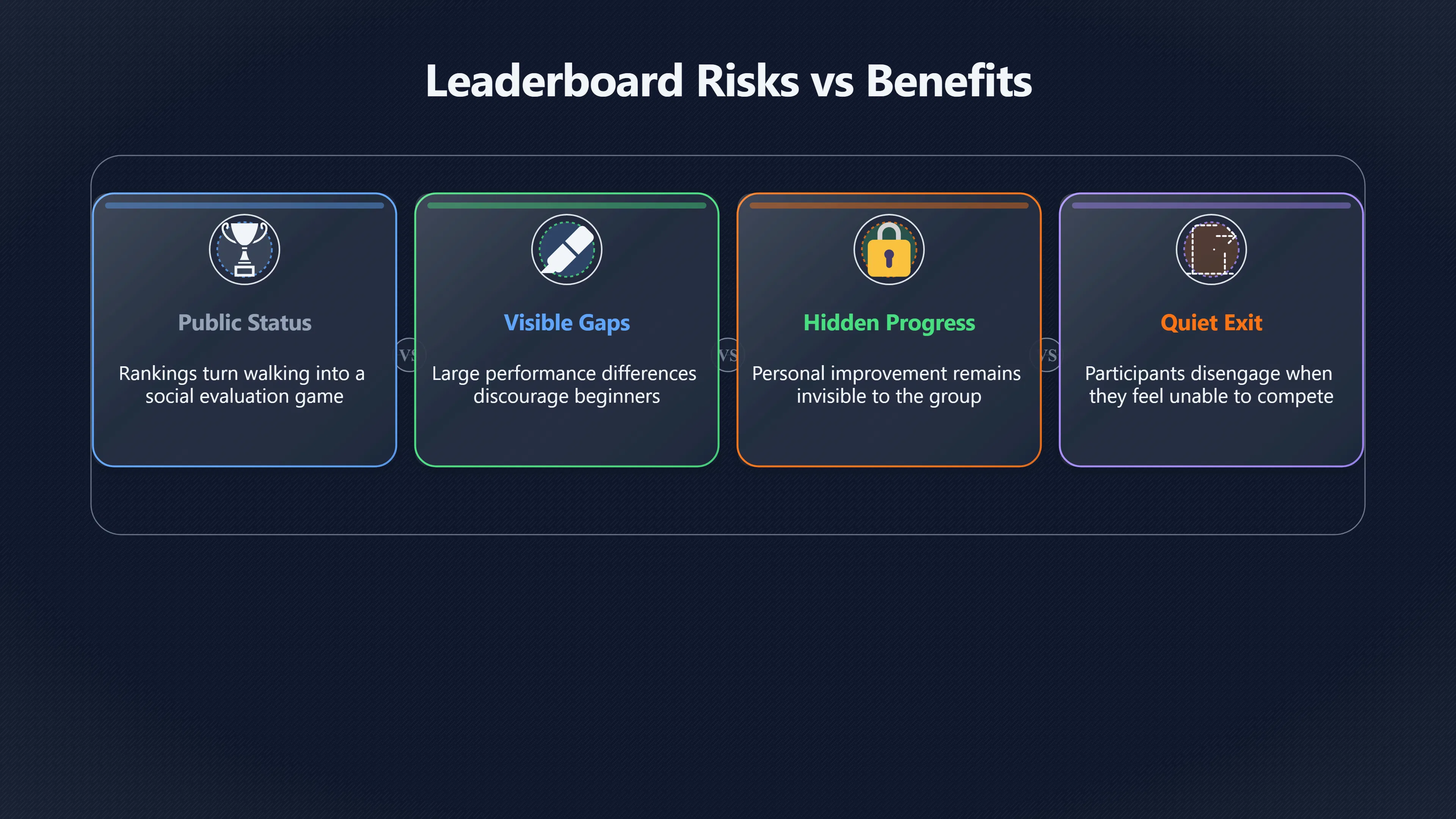
 The problem is that the same mechanism that motivates one person can quietly push another person out. Public rankings change the meaning of a walk. Instead of asking, “Did I move more than usual?” people begin asking, “How do I compare with everyone else?” When beginners, injured people, older adults, busy parents or people having a difficult week repeatedly appear near the bottom of a leaderboard, participation can become emotionally costly. The challenge may still look successful from the outside, while some of the people who could benefit most have already stopped engaging.
When comparison gives useful information
Comparison is not automatically harmful. Human beings naturally use other people as reference points. In physical activity settings, seeing what others achieve can help people judge what is realistic, identify role models and discover new habits. Research examining social comparison features in physical activity apps suggests that comparison can support motivation and behaviour change, particularly when it provides relevant and attainable information.[PMC]pmc.ncbi.nlm.nih.govPMCExercise or lie down?The impact of fitness app use on users…by J Cai · 2024 · Cited by 23 — It has been found that upward social comparison may discourages…
Leaderboards can be especially useful when they answer practical questions:
- Is my current activity level unusually low or fairly typical?
- What does gradual improvement look like?
- How much walking do people with similar schedules manage?
- What habits help others stay consistent?
In these cases, comparison functions as feedback rather than judgement. The focus remains on learning.
Evidence from fitness-app research also suggests that comparison effects are highly variable. Some users respond positively to competitive environments, while others show weaker responses or react negatively. Studies of Fitbit-style challenges have found substantial differences between individuals in both the direction and size of behaviour changes produced by comparison-based challenges.[SciSpace]scispace.comSci Space An Evaluation of Social Comparison of Physical ActivityAn Evaluation of Social Comparison of Physical Activity…July 20, 2022 — 18 Feb 2022 — Results showed that physical activity in…
That variability is the first warning sign against assuming that a single leaderboard design works for everyone.
Why public ranking can raise emotional stakes
A private step count is information. A public ranking is a social signal.
Once performance becomes visible, people are no longer simply tracking behaviour. They are managing impressions. Finishing near the bottom of a leaderboard can feel like public evidence of low effort even when the real explanation is injury, caregiving responsibilities, illness, fatigue or different starting fitness levels.
Social comparison theory helps explain why. People often compare themselves upward, looking at those who are performing better. Upward comparison can sometimes inspire effort, but it can also produce discouragement when the gap feels too large to close. Research on fitness-app use has found that upward comparison can reduce exercise motivation, increase anxiety and lower self-esteem for some users, even while motivating others.[PMC]pmc.ncbi.nlm.nih.govPMCExercise or lie down?The impact of fitness app use on users…by J Cai · 2024 · Cited by 23 — It has been found that upward social comparison may discourages…
The emotional stakes increase further when rankings are persistent and public:
- A bad day becomes visible to others.
- Missing a week becomes visible to others.
- Falling behind becomes visible to others.
- Rejoining after a lapse becomes harder because the gap is already obvious.
This creates a subtle shift from behaviour support to social evaluation. Instead of making walking easier, the system begins rewarding status.
The risk is not necessarily that participants feel intense shame. More often, they simply disengage. They stop opening the app, stop checking the challenge or stop participating in future competitions. From an organisational perspective, this can be mistaken for lack of motivation when the real problem is the design of the comparison environment.
The beginner’s dilemma
Step leaderboards often assume that everyone starts from roughly the same place. In reality, participants may differ enormously.
One person may already average 15,000 steps per day. Another may be recovering from illness and averaging 3,000. A third may work long shifts with limited opportunities to walk. Placing all three into the same ranking system can create predictable outcomes before the challenge even begins.
Research on social-comparison interventions highlights the importance of comparison targets. People tend to respond differently depending on who they compare themselves with and how large the performance gap is. Large, persistent gaps can make comparison less useful as a source of actionable information.[JMIR Human Factors]humanfactors.jmir.orgJMIR Human FactorsSelection of and Response to Physical Activity–Based Social…by D Arigo · 2023 · Cited by 9 — We examined the types o…
Imagine a newcomer who finishes near the bottom every week:
- Improvement may occur.
- Fitness may improve.
- Consistency may improve.
Yet none of these gains are reflected in the leaderboard position.
The participant receives a message that their progress is invisible while their rank is highly visible.
This is one reason why a challenge can increase total group activity while still producing negative experiences for specific participants. Aggregate success and individual experience are not the same thing.
Why more competition is not always better
A common assumption is that if a little competition motivates people, more competition should motivate them even more.
The evidence is mixed.
Reviews of gamification generally find that competitive features can improve engagement and physical activity, but effects vary substantially across contexts and users. Many studies report positive outcomes, yet researchers repeatedly note that benefits are inconsistent and not universally sustained.[PMC]pmc.ncbi.nlm.nih.govPMCExercise or lie down?The impact of fitness app use on users…by J Cai · 2024 · Cited by 23 — It has been found that upward social comparison may discourages…[PMC]pmc.ncbi.nlm.nih.govPMCExercise or lie down?The impact of fitness app use on users…by J Cai · 2024 · Cited by 23 — It has been found that upward social comparison may discourages…
Research on negative effects of gamification also identifies leaderboards, rankings and competitions among the most frequently reported sources of unintended consequences, including motivational problems, worsened performance and disengagement.[ScienceDirect]sciencedirect.comLinking social features of fitness apps with physical activity…by M Sun · 2022 · Cited by 15 — The results provide compelling support…
An important lesson emerges: competition is not a free motivational upgrade. It is a trade-off.
Competition can:
- Increase effort among some participants.
- Create excitement and social energy.
- Encourage short-term engagement.
But it can also:
- Magnify differences in ability.
- Shift attention from progress to status.
- Encourage withdrawal among people who feel they cannot compete.
For self-improvement that works, the goal is not to maximise competitive pressure. The goal is to help more people continue the behaviour.
Designing challenges that beginners can survive
The most inclusive step challenges keep comparison available without making rank the central story.
Several design choices help achieve this balance.
Compare against yourself first
Personal improvement leaderboards often create healthier incentives than absolute step rankings.
Instead of rewarding the highest total steps, a challenge might recognise:
- Percentage improvement from baseline.
- Consistency across weeks.
- Number of active days.
- Completion of personally chosen targets.
A participant who moves from 3,000 to 6,000 daily steps can then be recognised for meaningful progress rather than punished for not matching a veteran walker.
Use peer groups rather than one giant ranking
People benefit more from comparisons that feel relevant.
Grouping participants by starting activity level, age range or challenge category can reduce impossible comparisons and create more useful benchmarks. Research on physical activity interventions has explored how group composition influences responses to social comparison, highlighting that who people compare themselves with matters.[Sage Journals]journals.sagepub.comSage JournalsPhysical Activity and Social Comparison17 Mar 2023 — This study examined the impact of group composition of a 6-week group-b…
Make rankings temporary, not permanent
Short competitions create bursts of energy without defining someone’s identity within the group.
Weekly resets, rotating teams and fresh starts reduce the feeling that participants are trapped at the bottom indefinitely.
Reward contribution, not only victory
Challenges built entirely around winning create a narrow definition of success.
Recognition can instead include:
- Most consistent participation.
- Largest improvement.
- Returning after a lapse.
- Supporting teammates.
- Meeting a personal target.
These achievements reinforce behaviour while protecting dignity.
Allow private participation
Not everyone wants public performance data.
Providing options to hide rankings, share selectively or focus on personal dashboards allows people to receive feedback without turning every walk into a public comparison exercise.
A simple test for healthy comparison
A useful leaderboard answers the question, “What can I learn from this?”
A harmful leaderboard increasingly answers the question, “Where do I stand as a person?”
The distinction matters because self-improvement is usually sustained through repetition, not through occasional bursts of competitive intensity. If a challenge motivates the top performers but causes beginners to disappear, it may succeed as entertainment while failing as behaviour change.
The strongest social support systems use comparison as information rather than judgement. They help people see what is possible, celebrate progress and stay connected to the activity itself. When leaderboards do that, they can be energising. When they turn movement into a public status contest, they often lose the very people who most need encouragement.
Amazon book picks
Further Reading
Books and field guides related to When leaderboards make people quit. Use these as the next step if you want deeper reading beyond the article.
Mindset
Rating: 4.5/5 from 11 Google Books ratings
Helps readers focus on progress and learning rather than ranking.
Atomic Habits
Rating: 3.5/5 from 7 Google Books ratings
Emphasises personal systems and improvement over competition.
The Happiness Trap
Provides tools for handling difficult thoughts triggered by comparison.
eBay marketplace picks
Marketplace Samples
Example marketplace items related to this page. Use the search link to explore similar finds on eBay.


Endnotes
1.
Source: pmc.ncbi.nlm.nih.gov
Link:https://pmc.ncbi.nlm.nih.gov/articles/PMC7148546/
Source snippet
However, 2 aspects of work that apply social...Read more...
2.
Source: sciencedirect.com
Link:https://www.sciencedirect.com/science/article/abs/pii/S0306457322001972
Source snippet
Linking social features of fitness apps with physical activity...by M Sun · 2022 · Cited by 15 — The results provide compelling support...
3.
Source: jmir.org
Link:https://www.jmir.org/2020/3/e15642/
Source snippet
Social Comparison Features in Physical Activity Promotion...by D Arigo · 2020 · Cited by 83 — The aim of this meta-review was to summari...
4.
Source: scispace.com
Title: Sci Space An Evaluation of Social Comparison of Physical Activity
Link:https://scispace.com/pdf/stepping-up-an-evaluation-of-social-comparison-of-physical-3dwqtuxm.pdf
Source snippet
An Evaluation of Social Comparison of Physical Activity...July 20, 2022 — 18 Feb 2022 — Results showed that physical activity in...
Published: July 20, 2022
5.
Source: pmc.ncbi.nlm.nih.gov
Title: PMCExercise or lie down?
Link:https://pmc.ncbi.nlm.nih.gov/articles/PMC10806118/
Source snippet
The impact of fitness app use on users...by J Cai · 2024 · Cited by 23 — It has been found that upward social comparison may discourages...
6.
Source: humanfactors.jmir.org
Link:https://humanfactors.jmir.org/2023/1/e41239/
Source snippet
JMIR Human FactorsSelection of and Response to Physical Activity–Based Social...by D Arigo · 2023 · Cited by 9 — We examined the types o...
7.
Source: pmc.ncbi.nlm.nih.gov
Link:https://pmc.ncbi.nlm.nih.gov/articles/PMC10012003/
Source snippet
of and Response to Physical Activity–Based Social...by D Arigo · 2023 · Cited by 9 — We examined the types of comparison target selectio...
8.
Source: pmc.ncbi.nlm.nih.gov
Link:https://pmc.ncbi.nlm.nih.gov/articles/PMC6096297/
Source snippet
Gamification for health and wellbeing: A systematic review of...by D Johnson · 2016 · Cited by 1799 — The current state of evidence s...
9.
Source: pmc.ncbi.nlm.nih.gov
Link:https://pmc.ncbi.nlm.nih.gov/articles/PMC8767479/
Source snippet
the Effectiveness of Gamification on Physical Activityby A Mazeas · 2022 · Cited by 240 — The aim of this systematic review and meta-anal...
10.
Source: sciencedirect.com
Link:https://www.sciencedirect.com/science/article/abs/pii/S0950584922002518
Source snippet
Negative effects of gamification in education softwareby C Almeida · 2023 · Cited by 238 — We found that badges, leaderboard...
11.
Source: sciencedirect.com
Link:https://www.sciencedirect.com/science/article/pii/S1469029224000013
Source snippet
A randomized controlled mHealth trial that evaluates social...by B Sañudo · 2024 · Cited by 21 — This study aims to evaluate whether com...
12.
Source: sciencedirect.com
Link:https://www.sciencedirect.com/science/article/pii/S2405844023062412
Source snippet
The role of gamified learning strategies in student's...by E Ratinho · 2023 · Cited by 241 — The results suggest a positive influence of...
13.
Source: games.jmir.org
Link:https://games.jmir.org/2025/1/e68151
Source snippet
of Gamification Interventions to Improve Physical...by M Wang · 2025 · Cited by 26 — Our findings showed that the gamification intervent...
14.
Source: journals.sagepub.com
Link:https://journals.sagepub.com/doi/10.1177/15248399231160152
Source snippet
Sage JournalsPhysical Activity and Social Comparison17 Mar 2023 — This study examined the impact of group composition of a 6-week group-b...
Additional References
15.
Source: ssa.gov
Link:https://www.ssa.gov/
16.
Source: revista-apunts.com
Link:https://revista-apunts.com/en/benefits-of-gamified-learning-in-physical-education-students-a-systematic-review/
Source snippet
Benefits of Gamified Learning in Physical Education StudentsRegarding the benefits of gamification, the review showed that it was conside...
17.
Source: researchgate.net
Link:https://www.researchgate.net/publication/404881910_Associations_between_leaderboard_usage_in_physical_activity_apps_and_perceived_stress_among_university_students_the_roles_of_social_comparison_and_physical_activity
Source snippet
the roles of social comparison and physical activity17 May 2026 — Leaderboard usage was positively associated with social comparison (β...
Published: May 2026
18.
Source: researchwithrowan.com
Title: stepping up an evaluation of social comparison of physical activi
Link:https://www.researchwithrowan.com/en/publications/stepping-up-an-evaluation-of-social-comparison-of-physical-activi/
Source snippet
Rowan UniversityStepping Up: An Evaluation of Social Comparison of Physical...by JA Nastasi · 2022 · Cited by 9 — Results showed that ph...
19.
Source: systematic.com
Link:https://systematic.com/us/
Source snippet
Systematic Inc.Systematic Inc. is a leading provider of simple and reliable C4I integration software solutions for the Department of Defe...
20.
Source: mysportscience.com
Link:https://www.mysportscience.com/post/can-apps-and-gamification-increase-physical-activity
Source snippet
Can apps and gamification increase physical activity?Jun 12, 2025 — Some apps use gamification and help to make healthy behaviours more e...
21.
Source: pedro.org.au
Link:https://pedro.org.au/english/systematic-review-gamified-smartphone-apps/
Source snippet
tphone apps have small-to-moderate positive effects on physical activity levels.Read more...
22.
Source: researchgate.net
Link:https://www.researchgate.net/profile/Atreyi-Kankanhalli/publication/309557443_Gamification_in_Fitness_Apps_How_do_Leaderboards_influence_Exercise/links/586ca96f08ae8fce4919f096/Gamification-in-Fitness-Apps-How-do-Leaderboards-influence-Exercise.pdf
Source snippet
ison theory that explains how social comparison via leaderboards influences...Read more...
23.
Source: thier.io
Title: Social Dynamics in Health and Wellbeing [Part 2 of 2]
Link:https://www.thier.io/blog/social-dynamics-in-health-and-wellbeing-part-2-of-2
Source snippet
❤️🩹2 May 2026 — The negative effects of social comparison are not experienced uniformly by all users. The impact of a social feature is...
Published: May 2026
24.
Source: sparkdayapp.com
Title: A Nature study of 1.1M runners proved exercise is causally contagious.Read more
Link:https://sparkdayapp.com/blog/step-challenge-with-friends
Source snippet
Step Challenge With Friends: The Fitness Hack That Actually...A Penn RCT found competition produced 90% more exercise attendance than so...
Topic Tree