Within Defaults
When is a self nudge still free choice?
Self-nudging is most credible when the person can see, review and change the defaults shaping their own choices.
On this page
- Transparency, consent and easy exits
- How hidden defaults become waste or manipulation
- Review rituals that keep defaults aligned with real goals
Page outline Jump by section
Introduction
Self-nudging is one of the most practical forms of choice architecture for self-improvement: you deliberately arrange your environment so that the behaviour you already want becomes easier to carry out. The ethical question is not whether you influence yourself. Everyone does. The question is whether the influence remains visible, reversible and aligned with your own goals.
 A self-nudge remains a free choice when you can recognise the default, understand why it exists, and change or remove it without undue friction. Ethical behavioural science frameworks consistently emphasise transparency, autonomy and accountability rather than hidden steering. When defaults become difficult to detect or unusually hard to reverse, they begin to resemble manipulation rather than self-governance.[oecd.org]oecd.orgct to ethical considerations that can arise at any point from scoping to policy…Read more…[oecd.org]oecd.orgTools and Ethics for Applied Behavioural InsightsThis toolkit presents both general principles for the ethical application of BI and a se…
Within everyday self-improvement, the distinction matters because successful systems often work precisely when motivation is low. The same design features that help people save money, exercise or limit distractions can also lock them into outdated priorities if they are never reviewed.
When is a self-nudge still free choice?
The standard definition of a nudge is a change in choice architecture that predictably influences behaviour without banning alternatives or significantly changing incentives.[Springer Nature Link]link.springer.comSpringer Nature LinkNudge and Nudging in Public Policy | Springer Nature LinkA nudge refers to any aspect of the choice architecture that…
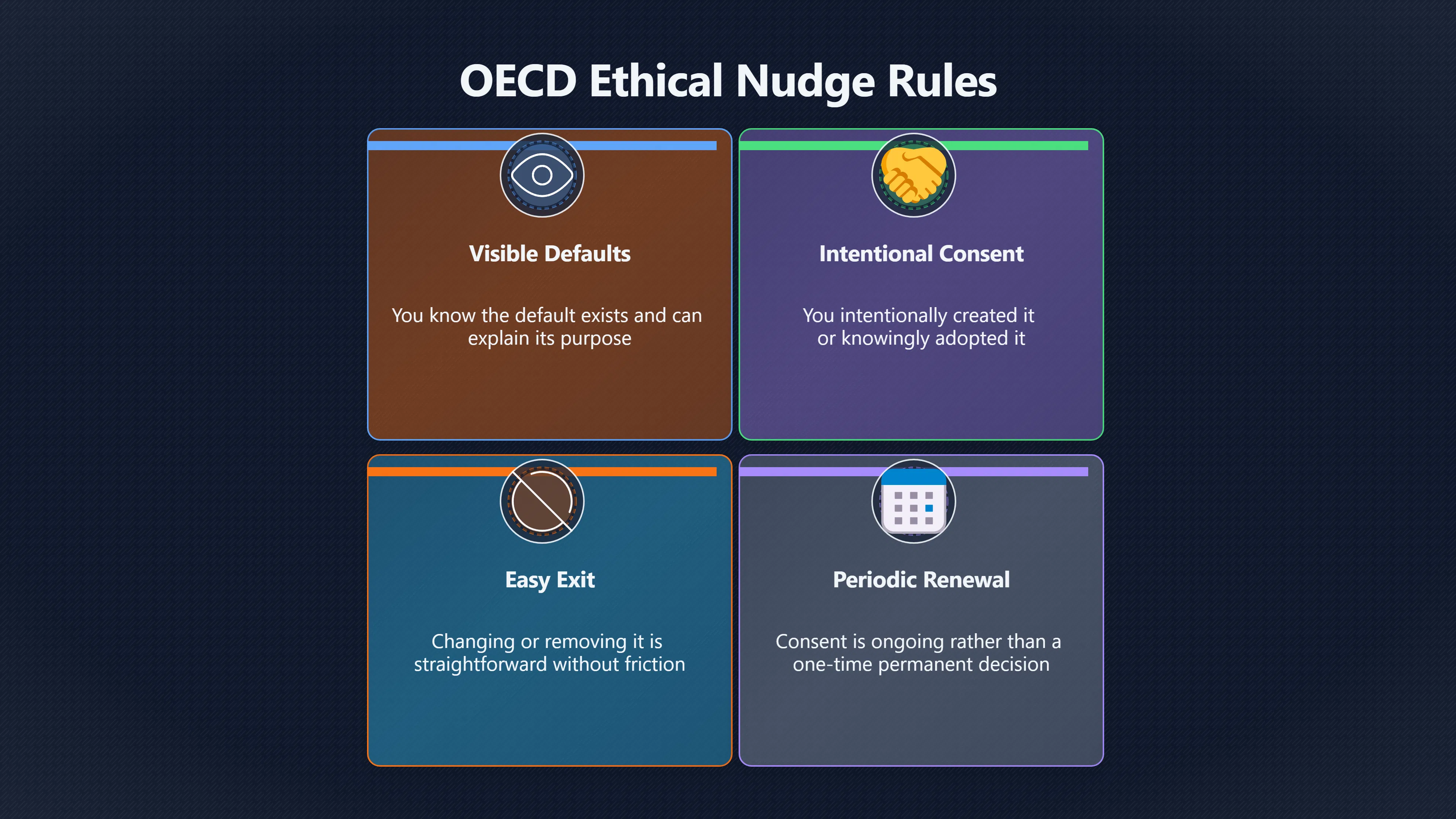
For self-improvement, a useful practical test is whether the arrangement passes three conditions:
- Transparency: you know the default exists and can explain its purpose.
- Consent: you intentionally created it or knowingly adopted it.
- Easy exit: changing or removing it is straightforward.
Consider three common examples:
- An automatic monthly transfer into savings that you can alter in a banking app within minutes.
- A website blocker that activates during working hours but can be disabled if circumstances change.
- A recurring exercise booking that can be cancelled without penalties.
These systems influence behaviour, but they do so through previously expressed intentions. They help yesterday’s considered decision guide today’s distracted moment.
The ethical justification becomes weaker when the person affected no longer understands the system, cannot easily inspect it, or faces significant barriers to opting out. Behavioural ethics frameworks developed by the OECD and other researchers repeatedly identify transparency and respect for autonomy as central safeguards for legitimate nudging.[ResearchGate]researchgate.netEthical Considerations of Digital Nudging Based on Its…28 May 2019 — Three important ethical considerations for digital nudges are dis… 3oecd.org 3oecd.org
Transparency, consent and easy exits
Why visible defaults are more trustworthy
A transparent self-nudge is not necessarily less effective. In many cases, effectiveness and legitimacy can coexist.
Research and policy guidance on ethical behavioural interventions increasingly treats transparency as a core principle. A person should be able to recognise that an intervention exists and understand its intended effect. One widely cited framework describes a nudge as transparent when people are, or could reasonably become, aware that behavioural steering is taking place.[European Law Institute]europeanlawinstitute.euGP 5. Explainability.Read moreEuropean Law InstituteA Framework for Good Green NudgingA nudge is transparent when the person being nudged is, or could reasonably becom…
Applied to self-improvement, that means:
- Naming the purpose of a default.
- Recording why it was created.
- Making its settings visible.
- Avoiding hidden triggers and unexplained restrictions.
For example, a calendar entry labelled “Tuesday gym session – supports energy and health goals” is ethically clearer than an automated commitment whose rationale has long been forgotten.
Consent is ongoing, not permanent
People often imagine consent as a one-time decision. In practice, self-improvement systems work over months or years while priorities change.
A savings transfer created when paying off debt may become inappropriate after a job change. A social media blocker installed during exam preparation may be unnecessary six months later.
Ethical self-nudging therefore depends on continuing consent rather than historical consent. The question is not merely “Did I choose this once?” but “Would I still endorse this if I reviewed it today?”
This governance perspective treats defaults as policies that require periodic renewal rather than permanent instructions.
How hidden defaults become waste or manipulation
The clearest way to understand ethical boundaries is to look at the opposite phenomenon: dark patterns.
| Regulators, researchers and consumer-protection bodies use the term “dark patterns” for interface designs that exploit behavioural tendencies to steer people toward outcomes they may not actually want. Common examples include making acceptance easy while making refusal difficult, hiding options, creating unnecessary friction, or obscuring the consequences of a choice. Finnegan | Leading IP Law Firm 3oecd.org[3www.drcf.org.uk]drcf.org.ukdesign in digital markets: How Online Choice…This paper provides further clarity on how certain techniques could contravene data prote… |
The same warning signs apply to personal systems.
A self-nudge begins drifting toward manipulation when:
- The default becomes difficult to discover.
- Opting out requires substantially more effort than opting in.
- The original purpose is forgotten.
- The system continues running despite changed goals.
- The person feels trapped by their own setup.
Imagine a productivity application configured years ago with extensive blocking rules. At first it supported focused work. Later it begins interfering with legitimate activities, yet the settings are so complex that changing them feels burdensome. The system is still influencing behaviour, but it no longer serves the user’s current objectives.
In this situation, the harm is not dramatic. It is usually wasted time, unnecessary friction and reduced autonomy. Yet these small losses accumulate. Recent discussions of manipulation and dark-pattern regulation increasingly highlight harms to attention, time and personal agency, not only financial loss.[OECD.AI]oecd.aiai act manipulation methodsThe EU's AI Act needs to address critical manipulation…21 Mar 2023 — The EU AI Act regulations focus on preventing manipulation that c…

The danger of success without review
One paradox of effective defaults is that successful systems attract less attention.
A recurring savings transfer that works flawlessly may continue for years without inspection. A meal-planning routine may persist long after dietary preferences change. An automatic donation may continue after financial circumstances worsen.
The better a default performs, the less likely people are to question whether it still reflects their goals.
For this reason, ethical self-nudging requires mechanisms for periodic scrutiny. Otherwise a tool designed to support autonomy can gradually substitute for it.
Review rituals that keep defaults aligned with real goals
The strongest protection against hidden manipulation is a regular review process.
Rather than relying on memory, treat personal defaults as assets that require maintenance.
A simple quarterly review can include questions such as:
- What recurring actions happen automatically in my life?
- Which of them still serve current goals?
- Which create friction without clear benefit?
- Which would I choose again today?
- Which need modification or removal?
The review should cover practical systems, including:
- Automatic savings and transfers.
- Recurring calendar commitments.
- Subscription services.
- App restrictions and website blockers.
- Notification settings.
- Shopping and delivery defaults.
- Health and exercise routines.
This process mirrors governance principles used in ethical behavioural science: interventions should not only be designed responsibly but also monitored and reassessed over time.[oecd.org]oecd.orgDark commercial patterns (ENMay 14, 2025 — The OECD Committee on Consumer Policy proposes a working definition of dark patterns to facilitate near-term discussion am…[oecd.org]oecd.aiai act manipulation methodsThe EU's AI Act needs to address critical manipulation…21 Mar 2023 — The EU AI Act regulations focus on preventing manipulation that c…
A useful rule: defaults should expire before values do
One practical safeguard is attaching review dates to important defaults.
For example:
- Reassess savings rates every six months.
- Revisit digital restrictions every quarter.
- Review recurring commitments at the start of each season.
- Audit subscriptions annually.
The goal is not constant optimisation. Excessive review defeats the purpose of a default. Instead, the aim is to prevent long-term drift between systems and intentions.
Ethical nudges as self-governance
The most credible form of self-improvement through choice architecture is not hidden influence but visible self-governance.
Ethical self-nudging recognises that people are imperfect planners and inconsistent decision-makers. It uses defaults to bridge the gap between long-term intentions and everyday behaviour. At the same time, it preserves the ability to inspect, question and change those defaults.
A useful rule of thumb is simple: if a future version of you can easily see the nudge, understand why it exists and remove it without difficulty, the system is supporting freedom rather than replacing it. Transparency, continuing consent and easy exits are not obstacles to effective self-improvement. They are what keep behavioural tools aligned with the person they are supposed to serve.[ResearchGate]researchgate.netEthical Considerations of Digital Nudging Based on Its…28 May 2019 — Three important ethical considerations for digital nudges are dis… 3oecd.org 3oecd.org
Amazon book picks
Further Reading
Books and field guides related to When is a self nudge still free choice?. Use these as the next step if you want deeper reading beyond the article.
Atomic Habits
Rating: 3.5/5 from 7 Google Books ratings
Focuses on self-directed environmental design rather than coercion.
eBay marketplace picks
Marketplace Samples
Topic-anchored marketplace searches for visual, collectible, or second-hand items related to this page.




Endnotes
1.
Source: oecd.org
Link:https://www.oecd.org/en/publications/good-practice-principles-for-ethical-behavioural-science-in-public-policy_e19a9be9-en.html
Source snippet
ct to ethical considerations that can arise at any point from scoping to policy...Read more...
2.
Source: oecd.org
Link:https://www.oecd.org/content/dam/oecd/en/publications/reports/2019/06/tools-and-ethics-for-applied-behavioural-insights-the-basic-toolkit_bbbaaa7a/9ea76a8f-en.pdf
Source snippet
Tools and Ethics for Applied Behavioural InsightsThis toolkit presents both general principles for the ethical application of BI and a se...
3.
Source: researchgate.net
Link:https://www.researchgate.net/publication/333421600_To_Nudge_or_Not_To_Nudge_Ethical_Considerations_of_Digital_Nudging_Based_on_Its_Behavioral_Economics_Roots
Source snippet
Ethical Considerations of Digital Nudging Based on Its...28 May 2019 — Three important ethical considerations for digital nudges are dis...
Published: May 2019
4.
Source: link.springer.com
Link:https://link.springer.com/rwe/10.1007/978-3-030-90434
Source snippet
Springer Nature LinkNudge and Nudging in Public Policy | Springer Nature LinkA nudge refers to any aspect of the choice architecture that...
5.
Source: oecd.org
Title: Dark commercial patterns (EN)
Link:https://www.oecd.org/content/dam/oecd/en/publications/reports/2022/10/dark-commercial-patterns_9f6169cd/44f5e846-en.pdf
Source snippet
May 14, 2025 — The OECD Committee on Consumer Policy proposes a working definition of dark patterns to facilitate near-term discussion am...
Published: May 14, 2025
6.
Source: drcf.org.uk
Link:https://www.drcf.org.uk/siteassets/drcf/pdf-files/harmful-design-in-digital-markets-ico-cma-joint-position-paper.pdf?v=380506
Source snippet
design in digital markets: How Online Choice...This paper provides further clarity on how certain [techniques]({{ 'techniques/' | relative_url }}) could contravene data prote...
7.
Source: finnegan.com
Title: dark patterns regulation in the uk and us
Link:https://www.finnegan.com/en/insights/articles/dark-patterns-regulation-in-the-uk-and-us.html
Source snippet
Leading IP+ Law FirmDark Patterns Regulation in the UK and US | Articles7 May 2025 — Dark patterns are design elements and pra...
Published: May 2025
8.
Source: oecd.ai
Title: ai act manipulation methods
Link:https://oecd.ai/en/wonk/ai-act-manipulation-methods
Source snippet
The EU's AI Act needs to address critical manipulation...21 Mar 2023 — The EU AI Act regulations focus on preventing manipulation that c...
9.
Source: oecd.org
Title: LOGI C: Good Practice Principles for Mainstreaming
Link:https://www.oecd.org/en/publications/logic-good-practice-principles-for-mainstreaming-behavioural-public-policy_6cb52de2-en/full-report/component-13.html
Source snippet
LOGIC: Good Practice Principles for Mainstreaming...May 23, 2024 — This report outlines good practice principles intended to encourage t...
Published: May 23, 2024
10.
Source: oecd.org
Link:https://www.oecd.org/content/dam/oecd/en/publications/reports/2022/10/good-practice-principles-for-ethical-behavioural-science-in-public-policy_8be8043a/e19a9be9-en.pdf
Source snippet
icy, both in the development of tools and standards to serve the BI community and as a...Read more...
11.
Source: oecd.org
Link:https://www.oecd.org/en/publications/tools-and-ethics-for-applied-behavioural-insights-the-basic-toolkit_9ea76a8f-en.html
Source snippet
Tools and Ethics for Applied Behavioural InsightsThis toolkit provides practitioners and policy makers with a step-by-step process for an...
12.
Source: oecd.org
Link:https://www.oecd.org/en.html
Source snippet
The Organisation for Economic Co-operation and...The OECD designs international standards and guidelines for development co-operat...
13.
Source: oecd.org
Link:https://www.oecd.org/en/publications/behavioural-insights-for-public-integrity_9789264297067-en.html
Source snippet
Behavioural Insights for Public IntegrityThis report describes how behavioural insights can help make integrity and anti-corruption polic...
14.
Source: oecd.org
Link:https://www.oecd.org/en/topics/behavioural-science.html
Source snippet
Behavioural scienceAt the OECD, we research context-specific behavioural drivers and barriers, and support countries in the use of behavi...
15.
Source: oecd.org
Link:https://www.oecd.org/content/dam/oecd/en/publications/reports/2018/03/behavioural-insights-for-public-integrity_g1g8c0a5/9789264297067-en.pdf
Source snippet
Behavioural Insights for Public IntegrityMoments of ethical reflection can be integrated in many policies. Sometimes, people are not even...
16.
Source: oecd.org
Title: 9789264270480 en
Link:https://www.oecd.org/content/dam/oecd/en/publications/reports/2017/03/behavioural-insights-and-public-policy_g1g7590e/9789264270480-en.pdf
Source snippet
Behavioural Insights and Public Policy (EN)15 Mar 2017 — The case studies are for the benefit of public officials and practitioners when...
17.
Source: oecd.org
Link:https://www.oecd.org/en/publications/oecd-good-practice-principles-for-data-ethics-in-the-public-sector_caa35b76-en.html
Source snippet
OECD Good Practice Principles for Data Ethics in the...The Good Practice Principles for Data Ethics in the Public Sector presented in th...
18.
Source: oecd.org
Link:https://www.oecd.org/content/dam/oecd/en/publications/reports/2020/04/behavioural-insights-and-organisations_3b0933c2/e6ef217d-en.pdf
Source snippet
stand how human behaviour influences policy outcomes.Read more...
19.
Source: oecd.org
Link:https://www.oecd.org/en/publications/2018/03/behavioural-insights-for-public-integrity_g1g8c0a5.html
Source snippet
Behavioural Insights for Public IntegrityThis report describes how behavioural insights can help make integrity and anti-corruption polic...
20.
Source: oecd.org
Link:https://www.oecd.org/en/publications/oecd-regulatory-policy-outlook-2018_9789264303072-en/full-report/improving-regulation-and-outcomes-through-behavioural-insights_g1g97944.html
Source snippet
be put in place to help keep actors “nudging for good,” as 2017 Nobel Laureate...Read more...
21.
Source: link.springer.com
Title: We conducted 81 in-depth
Link:https://link.springer.com/article/10.1007/s11299-025-00333-0
Source snippet
behavioural insights in the policy process: on...by F Spitzer · 2025 · Cited by 2 — This study investigates how behavioural insights are...
22.
Source: researchgate.net
Link:https://www.researchgate.net/publication/337902696_Institutionalisation_of_Behavioural_Insights_in_Public_Policy
Source snippet
Institutionalisation of Behavioural Insights in Public PolicyThis study explores the nuances of South Koreans' approval for nudge policie...
23.
Source: europeanlawinstitute.eu
Title: GP 5. Explainability.Read more
Link:https://www.europeanlawinstitute.eu/fileadmin/user_upload/p_eli/Publications/A_Framework_for_Good_Green_Nudging.pdf
Source snippet
European Law InstituteA Framework for Good Green NudgingA nudge is transparent when the person being nudged is, or could reasonably becom...
24.
Source: termsfeed.com
Title: dark patterns
Link:https://www.termsfeed.com/blog/dark-patterns/
Source snippet
, the FTC and the GDPR8 Feb 2026 — Dark patterns are an underhanded, manipulative way to get people to do what you want them to on your c...
Additional References
25.
Source: elgaronline.com
Link:https://www.elgaronline.com/display/book/9781802207736/chapter30.pdf
Source snippet
30. Behavioural public policyBehavioural scientists oper- ating transparently, ethically, and with integrity are more likely to build the...
26.
Source: oecd-opsi.org
Link:https://oecd-opsi.org/guide/behavioural-insights/
Source snippet
Behavioural InsightsBehavioural insights (BI) is an inductive approach to policy making that combines insights from psychology, cognitive...
27.
Source: digital-skills-jobs.europa.eu
Link:https://digital-skills-jobs.europa.eu/en/learning-space/resources/oecds-good-practice-principles-data-ethics-public-sector
Source snippet
europa.euOECD's Good Practice Principles for Data Ethics in the Public...Embrace Ethical Data Governance: Dive into the OECD's visionary...
28.
Source: paulvittles.medium.com
Link:https://paulvittles.medium.com/good-practice-principles-for-deliberative-participative-democracy-shared-principles-with-c5fc28a786df
Source snippet
practice principles for deliberative & participative...The OECD (and others) have suggested we promote and support innovation in democra...
29.
Source: globalgovernmentforum.com
Title: behavioural insights have taken root in governments oecd report
Link:https://www.globalgovernmentforum.com/behavioural-insights-have-taken-root-in-governments-oecd-report/
Source snippet
Behavioural insights 'have taken root' in governments12 Apr 2017 — The use of 'behavioural insight' techniques in public policy is enteri...
30.
Source: publicpolicy.ie
Link:https://publicpolicy.ie/environment/nudges-and-other-behavioural-public-policy-instruments-to-encourage-environmentally-friendly-behaviour/
Source snippet
nticipate how people actually react to policies and to design behaviourally informed...Read more...
31.
Source: bar.anpad.org.br
Title: Behavioural insights and public policy: Lessons from around the world.Read more
Link:https://bar.anpad.org.br/index.php/bar/article/view/580/507
Source snippet
of Tax Compliance in the wild: Critical review of nudging...by HC Carvalho · 2023 · Cited by 5 — Most OECD countries have implemented in...
32.
Source: resolve.cambridge.org
Title: Most policy mak- ers, insofar as they were concerned with studies.Read more
Link:https://resolve.cambridge.org/core/services/aop-cambridge-core/content/view/87141221C86C1A52B76C0AB068A2D046/9781108425636c28_414-427.pdf/behavioral_insights_public_policy_and_human_rights.pdf
Source snippet
cambridge.org28 Behavioral Insights, Public Policy, and Human RightsUntil relatively recently, psychology did not play a major part in pu...
33.
Source: bm.wel.by
Link:https://bm.wel.by/2021/03/15/oecd-good-practice-principles-for-data-ethics-in-the-public-sector/
Source snippet
Good Practice Principles for Data Ethics in the Public...Mar 15, 2021 — Citizens expect more: transparency, fairness, inclusion, and acc...
34.
Source: oneplanetnetwork.org
Link:https://www.oneplanetnetwork.org/sites/default/files/from-crm/BASIC-Toolkit-web.pdf
Source snippet
TOOLS AND ETHICS FOR APPLIED BEHAVIOURAL...Issues around privacy, consent and ethics of applying certain solutions to only some groups c...
Topic Tree