Within Tracking
What should you track every day?
The best daily tracker records the action you can take, not the slow outcome you hope will eventually change.
On this page
- Behaviour metrics versus outcome metrics
- Examples across fitness, work, money and sleep
- How to choose one fair daily signal
Page outline Jump by section
Introduction
If you want self-monitoring to improve behaviour without becoming obsessive, track actions rather than outcomes. A good daily metric records something you can directly do today: writing for 20 minutes, walking for 30 minutes, saving £10, or putting your phone away before bed. A poor daily metric records a result that is delayed, noisy or only partly under your control, such as body weight, productivity output, income, mood or a sleep score.
 This distinction matters because behaviour change research consistently treats self-monitoring of behaviour as a separate technique from monitoring outcomes. The former creates immediate feedback about actions; the latter measures consequences that may take days, weeks or months to respond. Tracking remains useful when it helps you make decisions. It becomes less useful when it turns into a daily judgement of progress.[NCBI]ncbi.nlm.nih.govNCBIResults of the behaviour change technique synthesisby J Baker · 2022 — Self-monitoring of outcome(s) of behaviour (behavior change technique 2.4). Establish a method for the person to…
Behaviour Metrics Versus Outcome Metrics
The simplest test is to ask: “Could I make this happen in the next hour?”
If the answer is yes, you are probably looking at a behaviour metric. If the answer is no, you are probably looking at an outcome metric.
GoalBehaviour MetricOutcome MetricLose weightAte planned mealsScale weightImprove fitnessCompleted workoutBody fat percentageSleep betterPhone out of bedroom by 10 pmSleep scoreBuild savingsTransferred money to savingsNet worthAdvance careerSent one application or proposalSalary increaseWrite a bookWrote 500 wordsBook completed
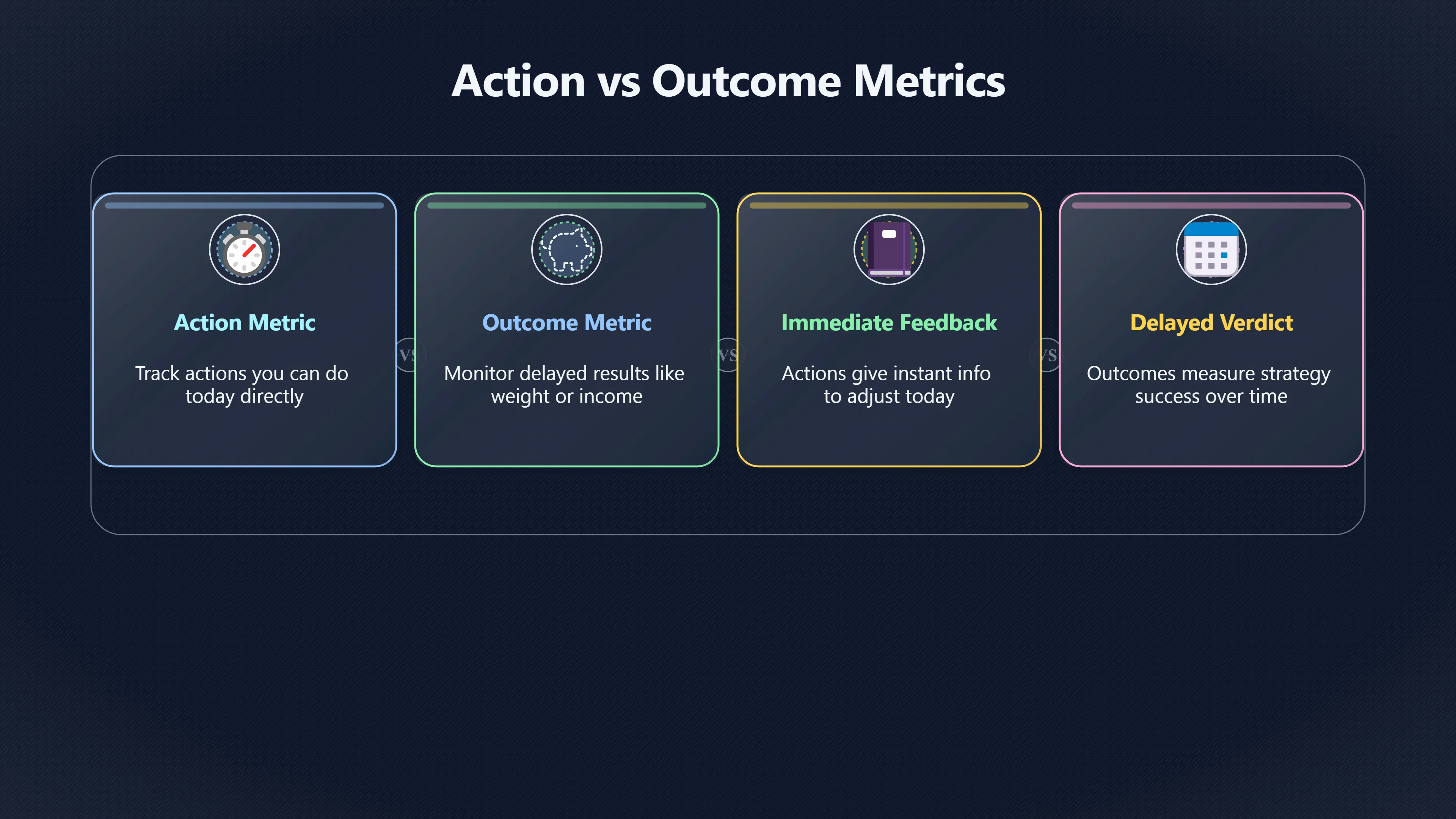
The Behaviour Change Technique Taxonomy, a widely used framework in behaviour-change research, explicitly separates “self-monitoring of behaviour” from “self-monitoring of outcomes of behaviour”. The distinction exists because actions and results provide different kinds of information. Actions tell you what to repeat or change. Outcomes tell you whether the overall strategy is working.[NCBI]ncbi.nlm.nih.govNCBIResults of the behaviour change technique synthesisby J Baker · 2022 — Self-monitoring of outcome(s) of behaviour (behavior change technique 2.4). Establish a method for the person to…[2bmjleader.bmj.com]bmjleader.bmj.cominline supplementary material 1Feedback on behaviour, 2.3. Self-monitoring of behaviour, 2.4. Self-monitoring of outcome(s) of behaviour, 2.5. Monitoring of…
For daily tracking, behaviour metrics usually provide cleaner feedback. If you exercised today, that fact does not change because of water retention, market conditions, poor weather or a difficult week at work. The behaviour happened or it did not.
Why Controllable Metrics Reduce Frustration
Many people abandon tracking because they monitor variables that naturally fluctuate.
Body weight can move because of hydration. Sleep scores can vary according to device algorithms. Income can depend on factors outside personal effort. Creative work often improves before recognition appears.
When a daily tracker focuses on outcomes, these normal fluctuations can create the illusion of failure. A person may complete all intended behaviours and still see an unchanged result.
Behaviour metrics reduce this problem because they shorten the feedback loop. The tracker answers a practical question: “Did I perform the action I intended to perform?” That makes the system fairer and easier to sustain over time.
Research on goal monitoring shows that monitoring progress tends to improve goal attainment, especially when records are maintained consistently and physically recorded. However, the usefulness of monitoring depends on what is being monitored. Tracking actions provides information that can be acted upon immediately.[PubMed]pubmed.ncbi.nlm.nih.govPub Med Does monitoring goal progress promote goal attainment?B Harkin · 2016 · Cited by 712 — The findings suggest that monitoring goal progress is an effective self-regulation strategy, and…[American Psychological Association]apa.orgmore…
Examples Across Fitness, Work, Money and Sleep
Fitness
A common mistake is weighing yourself multiple times per day and treating every change as meaningful.
More useful daily signals include:
- Completed planned workout
- Minutes spent walking
- Protein target met
- Stretching session completed
- Number of exercise sessions this week
The outcome measures—weight, body composition, race times or strength increases—can then be reviewed weekly or monthly rather than treated as daily verdicts.
Habit-formation research suggests that repeated performance of a behaviour in a stable context is what gradually creates automaticity. Tracking the behaviour itself therefore aligns with the mechanism that produces lasting change.[PMC]pmc.ncbi.nlm.nih.govTime to Form a Habit: A Systematic Review and Meta-Analysis…by B Singh · 2024 · Cited by 95 — The premise of habit formation involv…
Work
Knowledge work often produces delayed outcomes. A salesperson may make calls today but close deals next month. A writer may publish consistently before readership grows.
Useful daily metrics include:
- Deep-work minutes completed
- Number of proposals sent
- Pages written
- Revision sessions completed
- Key task started before a set time
Less useful daily metrics include:
- Revenue earned today
- Number of compliments received
- Social media engagement
- Career advancement
The controllable behaviour is the lever. The outcome is the lagging indicator.

Money
Financial goals are particularly vulnerable to outcome obsession because markets, interest rates and economic conditions affect results.
Better daily measures include:
- Expense tracking completed
- Spending plan followed
- Savings transfer made
- Investment contribution executed
The growth of total wealth remains important, but it is often a review metric rather than a daily one.
Sleep
Sleep quality is partly involuntary. Attempting to control it directly can create anxiety.
More useful daily measures focus on behaviours known to support sleep:
- Consistent bedtime maintained
- Screens avoided before bed
- Caffeine stopped after a chosen hour
- Bedroom prepared for sleep
The next morning’s sleep quality becomes information, not a scorecard.
How to Choose One Fair Daily Signal
A useful daily metric passes three tests.
Is it fully under your control?
A fair metric should depend primarily on your actions.
“Write for 20 minutes” is controllable.
“Feel creative” is not.
“Save £5” is controllable.
“Become financially secure” is not.
If outside events can easily override the metric, it is probably too outcome-focused for daily use.
Can you record it in seconds?
The best trackers create awareness without becoming a second job.
A simple yes-or-no record often works better than detailed scoring systems. Many successful habit-tracking systems use completion rather than optimisation because completion is easier to sustain.
The purpose is not data collection. The purpose is behavioural feedback.
Does it predict the result you want?
A controllable metric should still connect logically to the larger goal.
Tracking the number of books on your shelf is controllable, but it is unlikely to improve learning. Tracking 20 minutes of reading is both controllable and relevant.
A good daily signal sits close to the behaviour that causes the outcome.
A Simple Rule for Daily Tracking
For most goals, one behaviour metric is enough.
Instead of asking:
- Did I lose weight today?
- Did I become fitter today?
- Did I earn more today?
- Did I sleep perfectly today?
Ask:
- Did I complete the planned workout?
- Did I walk after lunch?
- Did I transfer money into savings?
- Did I put my phone away before bed?
The daily tracker should measure commitment to the process, not proof of the result. Outcomes still matter, but they are better used as periodic reviews of whether the chosen behaviours are working. By keeping the daily signal small, controllable and close to the action itself, self-monitoring remains a tool for adjustment rather than a source of constant judgement.[NCBI]ncbi.nlm.nih.govNCBIResults of the behaviour change technique synthesisby J Baker · 2022 — Self-monitoring of outcome(s) of behaviour (behavior change technique 2.4). Establish a method for the person to…[PubMed]pubmed.ncbi.nlm.nih.govPub Med Does monitoring goal progress promote goal attainment?B Harkin · 2016 · Cited by 712 — The findings suggest that monitoring goal progress is an effective self-regulation strategy, and…
Amazon book picks
Further Reading
Books and field guides related to What should you track every day?. Use these as the next step if you want deeper reading beyond the article.
Atomic Habits
Rating: 3.5/5 from 7 Google Books ratings
Strongly supports tracking daily actions rather than outcomes.
eBay marketplace picks
Marketplace Samples
Example marketplace items related to this page. Use the search link to explore similar finds on eBay.




Endnotes
1.
Source: ncbi.nlm.nih.gov
Title: NCBIResults of the behaviour change technique synthesis
Link:https://www.ncbi.nlm.nih.gov/books/NBK580337/
Source snippet
by J Baker · 2022 — Self-monitoring of outcome(s) of behaviour (behavior change technique 2.4). Establish a method for the person to...
2.
Source: bmjleader.bmj.com
Title: inline supplementary material 1
Link:https://bmjleader.bmj.com/content/leader/7/4/301/embed/inline-supplementary-material-1.pdf?download=true
Source snippet
Feedback on behaviour, 2.3. Self-monitoring of behaviour, 2.4. Self-monitoring of outcome(s) of behaviour, 2.5. Monitoring of...
3.
Source: pmc.ncbi.nlm.nih.gov
Link:https://pmc.ncbi.nlm.nih.gov/articles/PMC11641623/
Source snippet
Time to Form a Habit: A Systematic Review and Meta-Analysis...by B Singh · 2024 · Cited by 95 — The premise of habit formation involv...
4.
Source: pmc.ncbi.nlm.nih.gov
Link:https://pmc.ncbi.nlm.nih.gov/articles/PMC7429262/
Source snippet
Self-regulatory behavior change [techniques]({{ 'techniques/' | relative_url }}) in interventions to...by B Spring · 2020 · Cited by 115 — From the taxonomies, the team se...
5.
Source: self.inc
Link:https://www.self.inc/
Source snippet
Build Credit, Build Savings and Access CashBuild credit and savings with Self. The Credit Builder Account and Self Visa® Credit Ca...
6.
Source: pubmed.ncbi.nlm.nih.gov
Title: Pub Med Does monitoring goal progress promote goal attainment?
Link:https://pubmed.ncbi.nlm.nih.gov/26479070/
Source snippet
B Harkin · 2016 · Cited by 712 — The findings suggest that monitoring goal progress is an effective self-regulation strategy, and...
7.
Source: apa.org
Link:https://www.apa.org/pubs/journals/releases/bul-bul0000025.pdf
Source snippet
more...
8.
Source: pubmed.ncbi.nlm.nih.gov
Link:https://pubmed.ncbi.nlm.nih.gov/31923898/
Source snippet
Intentions for Exercise and Physical Activityby J Kompf · 2020 · Cited by 34 — Implementation intentions are an effective behavior change...
9.
Source: Wikipedia
Link:https://en.wikipedia.org/wiki/Self
Source snippet
SelfIn philosophy, the self is an individual's own being, knowledge, and values, and the relationship between these attributes. The fi...
10.
Source: scienceforwork.com
Title: goal monitoring
Link:https://scienceforwork.com/blog/goal-monitoring/
Source snippet
A meta-analysis of the experimental evidence.” Psychological Bulletin 142.2 (2016):...Read more...
Additional References
11.
Source: psychiatry.ucsd.edu
Link:https://psychiatry.ucsd.edu/research/programs-centers/instep/tools-resource/definitions/team-processes/action-phase/goal-progress.html
Source snippet
Goal Progress MonitoringMeta-analysis, found that targeted interventions are successful at increases [frequency]({{ 'frequency/' | relative_url }}) of progress monitoring beh...
12.
Source: researchgate.net
Link:https://www.researchgate.net/publication/332067663_Meta-Analysis_and_Quality_of_Self-Monitoring_Behavior_Interventions_with_Children_and_Adolescents
Source snippet
(PDF) Meta-Analysis and Quality of Self-Monitoring...12 Mar 2019 — Self-monitoring is an intervention that has been used for decades to...
13.
Source: aftertone.io
Link:https://www.aftertone.io/science/self-monitoring-and-progress-tracking
Source snippet
(2016) across 138 studies found that monitoring progress towards a goal increases attainment by 33% compared to setting goals...Read more...
14.
Source: ouci.dntb.gov.ua
Title: dntb.gov.ua Self-tracking of daily physical activity using a fitness tracker
Link:https://ouci.dntb.gov.ua/works/9JNGEJ19/
Source snippet
dntb.gov.uaSelf-tracking of daily physical activity using a fitness tracker...AbstractActivity self-tracking technologies have become a...
15.
Source: eprints.whiterose.ac.uk
Title: whiterose.ac.uk Does Monitoring Goal Progress Promote Goal Attainment?
Link:https://eprints.whiterose.ac.uk/id/eprint/87431/
Source snippet
by B Harkin · 2016 · Cited by 738 —... Monitoring Goal Progress Promote Goal Attainment? A Meta-Analysis of the Experimental Evidence. P...
16.
Source: researchgate.net
Title: Second, it discusses four main outcomes of fitness tracking behaviour
Link:https://www.researchgate.net/publication/343443200_Self-tracking_behaviour_in_physical_activity_a_systematic_review_of_drivers_and_outcomes_of_fitness_tracking
Source snippet
Self-tracking behaviour in physical activity: a systematic...5 Aug 2020 — First, it identifies 19 drivers of fitness tracking technology...
17.
Source: theoryandtechniquetool.humanbehaviourchange.org
Title: The Theory and Techniques Tool Self-monitoring of behaviour
Link:https://theoryandtechniquetool.humanbehaviourchange.org/tool
Source snippet
Theory and Techniques ToolSelf-monitoring of behaviour. +. 2.4. Self-monitoring of outcomes of behaviour. +. 2.5. Monitoring of outcome(s...
18.
Source: semanticscholar.org
Title: Does monitoring goal progress promote goal attainment?
Link:https://www.semanticscholar.org/paper/Does-monitoring-goal-progress-promote-goal-A-of-the-Harkin-Webb/71c6265bf7a8ded9084ff21a417cd63d6f4119ea
Source snippet
findings suggest that monitoring goal progress is an effective self-regulation strategy, and that interventions that increase th...
19.
Source: GOV.UK
Title: behaviour change techniques review descriptive studies
Link:https://www.gov.uk/guidance/behaviour-change-techniques-review-descriptive-studies
Source snippet
change techniques review: descriptive studies6 Jul 2020 — A behaviour change techniques (BCTs) review uses established classifications of...
20.
Source: phwwhocc.co.uk
Link:https://phwwhocc.co.uk/wp-content/uploads/2024/02/Identifying-and-Applying-Behaviour-Change-Techniques-1.pdf
Source snippet
Observe or record outcomes of behaviour with the person's knowledge as part of a...
Topic Tree