Within Weekly Review
The Hidden Steps Breaking Your Habit
A friction audit finds the extra steps, decisions, tools, time, or social effort that made a planned habit collapse in real life.
On this page
- How friction builds up before a habit
- Time, effort, equipment, and decision barriers
- Removing one barrier without redesigning your life
Page outline Jump by section
Introduction
A friction audit is a weekly review tool for habits that keep feeling harder in real life than they looked on paper. Instead of asking, “Why am I not motivated?”, a friction audit asks, “What extra steps, decisions, delays, tools, or obstacles appeared between the intention and the action?”
 This distinction matters because many failed habits are not failing due to weak commitment. Behaviour change research consistently shows that actions depend not only on motivation but also on how easy the behaviour is to perform in the moment. In the Fogg Behavior Model, behaviour occurs when motivation, ability, and a prompt come together. If a behaviour repeatedly does not happen, the problem is often hidden difficulty rather than a lack of desire.[Behavior Design Lab]behaviordesign.stanford.eduBehavior Design LabFogg Behavior ModelThe Fogg Behavior Model shows that three elements must converge at the same moment for a behavior t…
Within a weekly review, a friction audit helps identify those hidden difficulties so that the next week’s plan is built around reality rather than optimism.
How Friction Builds Up Before a Habit
Most habits do not fail at the obvious point.
A person may believe they failed because they did not go for a run. In reality, the failure began earlier: they finished work late, could not find clean clothes, had to decide which route to take, noticed rain outside, and realised their headphones were uncharged. The run itself was only the final step in a chain of small obstacles.
This accumulation effect is what makes friction difficult to spot. Each barrier appears minor on its own, yet together they raise the effort required to act. Research and behaviour-design frameworks repeatedly highlight the importance of simplicity, ease, prompts, and environmental support in determining whether intended behaviours actually occur.[Behavior Design Lab]behaviordesign.stanford.eduBehavior Design LabFogg Behavior ModelThe Fogg Behavior Model shows that three elements must converge at the same moment for a behavior t…[The Decision Lab]thedecisionlab.comThe Decision LabThe COM-B Model for Behavior ChangeThe COM-B model for behavior change cites capability (C), opportunity (O), and motivat…
A friction audit therefore looks backwards from the missed habit and asks:
- What happened immediately before the intended action?
- What extra step appeared?
- What decision had to be made?
- What resource was missing?
- What made postponement easier than action?
The goal is to reconstruct the real experience rather than the idealised plan.
The Difference Between Difficulty and Friction
Difficulty is the behaviour itself.
Friction is everything surrounding it.
For example:
- Strength training is the behaviour.
- Finding gym clothes, packing a bag, travelling, waiting for equipment, and deciding on a workout are sources of friction.
Likewise:
- Reading ten pages is the behaviour.
- Choosing a book, locating it, finding a quiet place, and deciding when to start are friction points.
This distinction matters because habits often improve faster when friction is reduced than when motivation is increased. Fogg’s work emphasises that making behaviour easier is often more reliable than attempting to sustain high motivation.[Behavior Design Lab]behaviordesign.stanford.eduBehavior Design LabFogg Behavior ModelThe Fogg Behavior Model shows that three elements must converge at the same moment for a behavior t…[Tiny Habits]tinyhabits.comTiny Habits: BJ FoggBJ Fogg, PhD, created the Tiny Habits method. He directs the Behavior Design Lab at Stanford University. Dr. Fogg's m…
Time, Effort, Equipment, and Decision Barriers
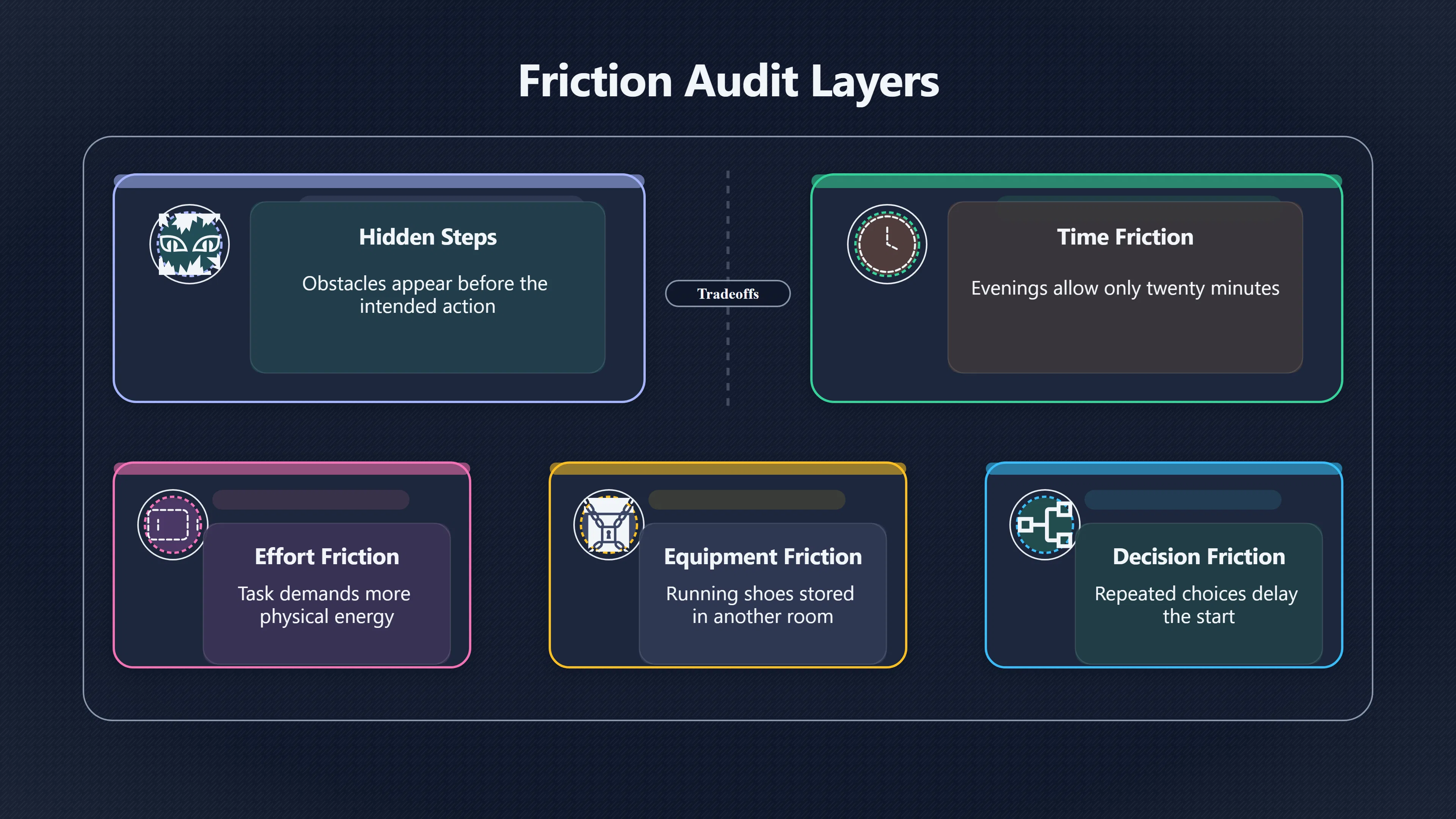
A useful friction audit sorts obstacles into categories. This prevents vague explanations such as “I was busy” and reveals the specific mechanism that caused the breakdown.
Time Friction
Time friction occurs when the habit requires more uninterrupted time than real life reliably provides.
Examples include:
- Planning a 60-minute workout when most evenings allow only 20 minutes.
- Scheduling deep reading after a workday filled with meetings.
- Requiring a perfect morning routine before beginning work.
Research on exercise behaviour repeatedly identifies perceived lack of time as a major barrier, making time-related friction one of the most common causes of habit failure.[PubMed Central]pmc.ncbi.nlm.nih.govThe current pilot study examined the effects of an implementation intention intervention to enhance…
During a review, the key question is not whether time existed in theory, but whether it existed at the moment the habit was supposed to happen.
Effort Friction
Effort friction appears when the task demands more physical or mental energy than expected.
Examples:
- Cooking healthy meals after an exhausting commute.
- Writing after a cognitively demanding day.
- Beginning a workout that feels intimidating.
The habit may still be reasonable on high-energy days but unrealistic on average days. Weekly reviews often reveal that the habit succeeds only when circumstances are unusually favourable.
Equipment Friction
Equipment friction comes from missing tools, materials, or preparation.
Examples include:
- Running shoes stored in another room.
- A guitar left in its case.
- Ingredients not purchased in advance.
- Exercise equipment buried in a cupboard.
Many people misinterpret these failures as inconsistency when they are actually preparation failures.
A useful audit asks: “Could I begin this habit within sixty seconds if I wanted to?”
If not, equipment friction may be involved.
Decision Friction
Decision friction is especially damaging because it appears every time the habit is attempted.
Examples:
- Deciding which workout to do.
- Choosing between several productivity tasks.
- Selecting a recipe every evening.
- Determining the best time to start.
Implementation-intention research suggests that specifying the when, where, and how of an action helps convert intentions into behaviour by reducing the need for in-the-moment decisions.[ScienceDirect]sciencedirect.comHow do implementation intentions promote goal attainment…by TL Webb · 2007 · Cited by 565 — Implementation intentions are…[JMIR]jmir.orgHuman associative memory…Read more…
A habit that requires repeated decision-making remains vulnerable to postponement.
Social Friction
Some habits quietly depend on other people.
Examples:
- Exercising in a crowded gym that feels intimidating.
- Studying in a noisy household.
- Declining social invitations to protect sleep.
The habit itself may be simple, but the social effort required to perform it may be substantial.
A friction audit treats these social realities as genuine constraints rather than excuses.
Running a Friction Audit During Your Weekly Review
A practical friction audit can be completed in a few minutes.
For every habit that repeatedly failed, answer three questions:
What was the first obstacle?
Not the final failure, but the first point where the process became harder.
What barrier appeared most often?
Look for recurring patterns rather than one-off events.
Which barrier is easiest to remove?
Focus on leverage rather than perfection.
For example:
HabitFailure PatternLikely FrictionMorning exerciseMissed four daysClothes not prepared the night beforeReadingStarted only twiceBook not visible and no fixed reading locationMeal preparationOrdered takeaway repeatedlyNo ingredients available after workWritingConstant postponementHad to decide topic each session
The audit is complete when the barrier is identified in concrete terms.
Removing One Barrier Without Redesigning Your Life
The most common mistake after a review is attempting a complete system overhaul.
People discover friction and respond by creating elaborate routines, buying new tools, redesigning schedules, and setting ambitious rules. The result is often more complexity and more friction.
A better approach is to remove only one obstacle at a time.
Reduce the Next Action
Ask:
“What is the smallest change that makes starting easier?”
Examples:
- Lay out gym clothes the night before.
- Leave the book on the pillow.
- Prepare ingredients on Sunday.
- Open the document before ending today’s work session.
The behaviour remains the same, but the starting cost drops.
Remove Decisions
Implementation intentions are useful because they replace repeated choices with predefined responses. Instead of “I will exercise more”, the plan becomes:
“If it is 7:00 a.m. on Monday, Wednesday, or Friday, I will walk for twenty minutes.”[ScienceDirect]sciencedirect.comHow do implementation intentions promote goal attainment…by TL Webb · 2007 · Cited by 565 — Implementation intentions are…[ResearchGate]researchgate.netPDF) Implementation IntentionsImplementation intentions delegate the control of goal-directed responses to anticipated situational cues…
The weekly review can reveal exactly which decisions need to disappear.
Move Resources Closer
A surprising amount of friction comes from distance.
Examples include:
- Keeping workout equipment visible.
- Placing fruit on the counter.
- Storing books where reading occurs.
- Leaving notebooks open rather than packed away.
These changes look trivial, but they directly increase opportunity and reduce effort, two factors repeatedly identified in behaviour-change frameworks.[The Decision Lab]thedecisionlab.comThe Decision LabThe COM-B Model for Behavior ChangeThe COM-B model for behavior change cites capability (C), opportunity (O), and motivat…
Create a Smaller Version
Sometimes the friction audit reveals that the planned habit is simply too large for current circumstances.
Instead of:
- Thirty minutes of meditation.
- A full gym session.
- One thousand words of writing.
The temporary version may become:
- Three minutes.
- Ten minutes.
- One paragraph.
This is not lowering standards permanently. It is reducing friction until repetition becomes reliable.
What a Good Friction Audit Reveals
The most valuable outcome of a friction audit is often a change in interpretation.
A person who believed they lacked discipline may discover:
- The habit required too many decisions.
- The timing was unrealistic.
- Equipment was unavailable.
- The environment worked against them.
- The first step was larger than expected.
That shift matters because it turns behaviour change into a design problem rather than a character judgement. Weekly reviews become less about evaluating willpower and more about identifying barriers between intention and action.
When a habit feels mysteriously hard, the hidden steps are usually more informative than the missed repetitions. A friction audit brings those hidden steps into view, allowing one small obstacle to be removed before the next week begins.
Amazon book picks
Further Reading
Books and field guides related to The Hidden Steps Breaking Your Habit. Use these as the next step if you want deeper reading beyond the article.
Atomic Habits
Rating: 3.5/5 from 7 Google Books ratings
Explains reducing friction and making habits easier.
eBay marketplace picks
Marketplace Samples
Example marketplace items related to this page. Use the search link to explore similar finds on eBay.


Endnotes
1.
Source: sciencedirect.com
Link:https://www.sciencedirect.com/science/article/abs/pii/S002210310600028X
Source snippet
How do implementation intentions promote goal attainment...by TL Webb · 2007 · Cited by 565 — Implementation intentions are...
2.
Source: jmir.org
Link:https://www.jmir.org/2017/11/e397/
Source snippet
Human associative memory...Read more...
3.
Source: researchgate.net
Link:https://www.researchgate.net/publication/232586066_Implementation_Intentions
Source snippet
(PDF) Implementation IntentionsImplementation intentions delegate the control of goal-directed responses to anticipated situational cues...
4.
Source: sciencedirect.com
Link:https://www.sciencedirect.com/org/science/article/pii/S1438887124002619
Source snippet
Digital Behavior Change Intervention Designs for Habit...by Y Zhu · 2024 · Cited by 83 — The results show that the most applied behavior...
5.
Source: sciencedirect.com
Link:https://www.sciencedirect.com/science/article/pii/S1364661324002663
Source snippet
At its core, habit formation relies on strengthening S–R associations...Read m...
6.
Source: jmir.org
Link:https://www.jmir.org/2024/1/e54375/
Source snippet
Digital Behavior Change Intervention Designs for Habit...by Y Zhu · 2024 · Cited by 82 — The results show that the most applied behavior...
7.
Source: researchgate.net
Title: 290193001 Implementation Intentions
Link:https://www.researchgate.net/publication/290193001_Implementation_Intentions
Source snippet
(PDF) Implementation Intentions12 Jan 2016 — Implementation intentions have been used extensively to promote health behaviour change. Res...
8.
Source: researchgate.net
Link:https://www.researchgate.net/publication/381044449_What_is_habit_and_how_can_it_be_used_to_change_real-world_behaviour_Narrowing_the_theory-reality_gap
Source snippet
Making 'good' behaviours habitual—that is, ensuring a behaviour...Read more...
9.
Source: researchgate.net
Link:https://www.researchgate.net/publication/391205475_Small_changes_big_impact_A_mini_review_of_habit_formation_and_behavioral_change_principles
Source snippet
Small changes, big impact: A mini review of habit formation...27 Apr 2025 — This mini-review explores the science of habit formation, em...
10.
Source: behaviordesign.stanford.edu
Link:https://behaviordesign.stanford.edu/resources/fogg-behavior-model
Source snippet
Behavior Design LabFogg Behavior ModelThe Fogg Behavior Model shows that three elements must converge at the same moment for a behavior t...
11.
Source: thedecisionlab.com
Link:https://thedecisionlab.com/reference-guide/organizational-behavior/the-com-b-model-for-behavior-change
Source snippet
The Decision LabThe COM-B Model for Behavior ChangeThe COM-B model for behavior change cites capability (C), opportunity (O), and motivat...
12.
Source: tinyhabits.com
Link:https://tinyhabits.com/
Source snippet
Tiny Habits: BJ FoggBJ Fogg, PhD, created the Tiny Habits method. He directs the Behavior Design Lab at Stanford University. Dr. Fogg's m...
13.
Source: gsb.stanford.edu
Title: building habits key lasting behavior change
Link:https://www.gsb.stanford.edu/insights/building-habits-key-lasting-behavior-change
Source snippet
Stanford Graduate School of BusinessBuilding Habits: The Key to Lasting Behavior Change18 Apr 2023 — In this episode, BJ Fogg reveals the...
14.
Source: pmc.ncbi.nlm.nih.gov
Link:https://pmc.ncbi.nlm.nih.gov/articles/PMC6440859/
Source snippet
The current pilot study examined the effects of an implementation intention intervention to enhance...
15.
Source: drpaulmccarthy.com
Link:https://www.drpaulmccarthy.com/post/tiny-habits-the-breakthrough-method-for-building-life-changing-behaviors
Source snippet
Tiny Habits: The Breakthrough Method for Building Life-...10 Feb 2026 — A powerful scientific framework by Stanford behavior scientist B...
16.
Source: scribd.com
Link:https://www.scribd.com/document/984100172/Tiny-Habits-summary
Source snippet
B.J. Fogg's 'Tiny Habits' framework, which emphasizes the importance of Motivation, Ability, and Prompt (MAP) in behavior change.Read more...
17.
Source: behaviormodel.org
Title: Fogg Behavior Model
Link:https://www.behaviormodel.org/
Source snippet
BJ FoggThe Fogg Behavior Model shows that three elements must converge at the same moment for a behavior to occur: Motivation, Ability, a...
18.
Source: retirementwisdom.com
Title: tiny habits can lead to big changes bj fogg
Link:https://www.retirementwisdom.com/podcasts/tiny-habits-can-lead-to-big-changes-bj-fogg/
Source snippet
Tiny Habits Can Lead to Big Changes – BJ Fogg2 Jan 2020 — Behavior change is hard. BJ Fogg, PhD, has built a simple method to build habit...
Additional References
19.
Source: cancercontrol.cancer.gov
Link:https://cancercontrol.cancer.gov/brp/research/constructs/implementation-intentions
Source snippet
Cancer ControlImplementation Intentionsby PM Gollwitzer — Implementation intentions are formed for the purpose of enhancing the translati...
20.
Source: medium.com
Link:https://medium.com/design-bootcamp/com-b-using-behavioural-psychology-in-ux-a850d0d2e7db
Source snippet
COM-B: Using behavioural psychology in UXHow you can use behavioural psychology to encourage behavioural changes when designing the exper...
21.
Source: thebettercompany.io
Link:https://thebettercompany.io/en/tiny-habits-method/
Source snippet
The Tiny habits methodEvery action occurs when these three elements are present simultaneously: Motivation (motivation), Ability (capabil...
22.
Source: digitalwellbeing.org
Link:https://digitalwellbeing.org/wp-content/uploads/2016/11/BCTTv1_PDF_version.pdf
Source snippet
2.1, Monitoring of behavior by others... 2.3, Self-monitoring of behavior; if monitoring is by someone else (without.Read more...
23.
Source: youtube.com
Link:https://www.youtube.com/watch?v=k-TCLz37IPE
Source snippet
The Fogg Behavior Model: How to Turn Learning into ActionLearning's one thing, but genuine behavior change is a whole other kettle of fis...
24.
Source: thecenterforimplementation.com
Title: The Center for Implementation The Capability, Opportunity, Motivation
Link:https://thecenterforimplementation.com/toolbox/com-b
Source snippet
The Capability, Opportunity, Motivation - Behavior (COM-B)...26 Sept 2025 — The Capability, Opportunity, Motivation - Behavior (COM-B) t...
25.
Source: pmc.ncbi.nlm.nih.gov
Link:https://pmc.ncbi.nlm.nih.gov/articles/PMC12318445/
Source snippet
the Science of Habit Formation to Evidence-Based...by AG Harvey · 2021 · Cited by 55 — Planning to break unwanted habits: Habit strength...
26.
Source: globalrph.com
Link:https://globalrph.com/2026/04/the-science-of-habit-formation-how-to-rewire-your-brain-for-change/
Source snippet
lying habit formation and explores evidence-based strategies for behavioral change.Read more...
27.
Source: lifestylemedicine.org.au
Link:https://lifestylemedicine.org.au/content/behaviour-change-for-health/
Source snippet
They are specific plans that link actions to triggers — for example, “If...Read more...
28.
Source: theartofcharm.com
Link:https://theartofcharm.com/art-of-business/deal-making-negotiations/bj-fogg-biggest-myth-about-habit-formation/
Source snippet
BJ Fogg | The Biggest Myth About Habit Formation and 2...In today's episode, we cover the breaking and creation of habits with BJ Fogg...
Topic Tree