Within Willpower
Can Your Environment Do the Resisting?
Small changes to rooms, devices and defaults can prevent self-control battles before they become vivid temptations.
On this page
- Why avoidance is not weakness
- Home and work friction points
- How to redesign one recurring temptation
Page outline Jump by section
Introduction
Self-improvement becomes easier when temptation never reaches full strength. One of the most practical lessons from behavioural science is that self-control works best when it acts as a backup system rather than the main engine of change. Instead of repeatedly fighting urges in the moment, people can redesign their surroundings so that the desired action is easier, more visible and more automatic, while the tempting action becomes less convenient. Researchers describe these approaches as “situational strategies” because they intervene before an impulse grows into a difficult internal battle.[PMC]pmc.ncbi.nlm.nih.govPMCSituational Strategies for Self-Controlself-control strategies can be organized using the process model of self-control (Duckworth, Gendler, & Gross, 2014). This framework pred…
 This matters because most failures of consistency do not happen after careful deliberation. They happen when the easiest option is also the most tempting one: the phone is beside the bed, snacks are within arm’s reach, entertainment is one click away, or spending requires no pause. Environmental design changes the structure of those moments. Rather than asking, “How can I be stronger?”, it asks, “How can I make the better choice the path of least resistance?”[Association for Psychological Science]psychologicalscience.orgeffective self control strategiesAssociation for Psychological ScienceEffective Self-Control Strategies Involve Much More Than…14 Feb 2019 — They observe that in some…
Can Your Environment Do the Resisting?
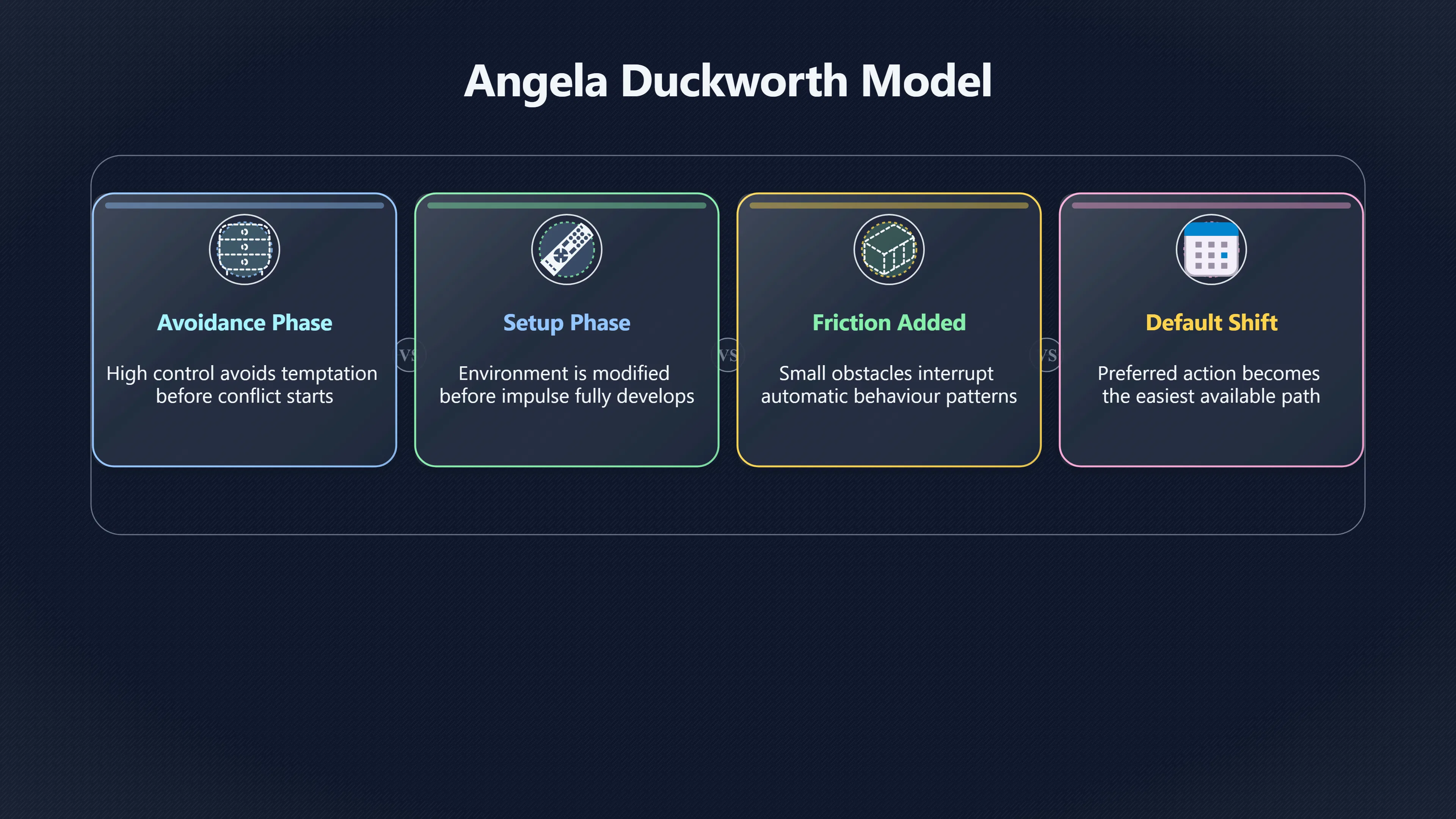
The process model of self-control developed by Angela Duckworth, Tamar Gendler and James Gross argues that the earliest interventions are often the most effective. Instead of waiting until temptation is intense and then trying to suppress it, people can select or modify situations before the conflict fully develops. In practice, that means changing what is available, visible, accessible or expected. PMC PubMed This idea challenges a common image of discipline. Many people imagine that disciplined individuals constantly resist powerful urges. Yet evi[thedecisionlab.com]thedecisionlab.comChoice ArchitectureChoice architecture refers to the deliberate crafting of decision-making environments. By subtly shaping how options a… dence suggests that people with higher trait self-control often avoid temptation more successfully than they resist it. They are more likely to arrange circumstances that reduce exposure to distractions and temptations before those temptations demand effortful restraint.[ScienceDirect]sciencedirect.comTrait self-control and the avoidance of temptationby MR Ent · 2015 · Cited by 329 — The present research suggests that high…
The practical implication is simple: every temptation has a setup phase. Long before someone scrolls for an hour, overeats, procrastinates or makes an impulsive purchase, the environment has often already made that outcome easier.
Why Avoidance Is Not Weakness
Many people treat avoidance as if it were a form of surrender. They assume real self-control means standing face-to-face with temptation and winning every time. Behavioural research points in a different direction.
A useful comparison is between carrying biscuits in a desk drawer and keeping them out of the room entirely. Both approaches aim at the same outcome, but only one requires repeated acts of resistance. The second strategy removes dozens of decisions and moments of friction. The individual has not become weaker; they have become more efficient.[Association for Psychological Science]psychologicalscience.orgeffective self control strategiesAssociation for Psychological ScienceEffective Self-Control Strategies Involve Much More Than…14 Feb 2019 — They observe that in some…
This principle appears across many domains:
- People who want to focus often work better when distracting websites are blocked before work begins.
- People trying to sleep better often benefit from charging devices outside the bedroom.
- People attempting to eat differently often succeed more consistently when healthier foods are more accessible than less healthy alternatives.
- People trying to save money frequently rely on automatic transfers rather than repeated spending decisions.[Association for Psychological Science]psychologicalscience.orgeffective self control strategiesAssociation for Psychological ScienceEffective Self-Control Strategies Involve Much More Than…14 Feb 2019 — They observe that in some…[PMC]pmc.ncbi.nlm.nih.govChoice architecture interventions to change physical activity…by LL Landais · 2020 · Cited by 105 — Choice architecture interventio…
In each case, the environment absorbs part of the self-control burden.[sciencedirect.com]sciencedirect.comSelf Controlan overviewOne way people overcome the challenge of self-control is by actively inhibiting the thoughts, feelings, and behavioral tendenc…
Home and Work Friction Points
Environmental design works largely through friction. Friction is any small obstacle that slows a behaviour down. Even minor increases or decreases in friction can meaningfully influence what people do repeatedly.[MPG.PuRe]pure.mpg.deMPG.PuReSelf-Nudging and the Citizen Choice Architectby S Reijula · 2022 · Cited by 214 — Self-deployed changes of accessibility, default…
At Home
Many recurring temptations are sustained by convenience.
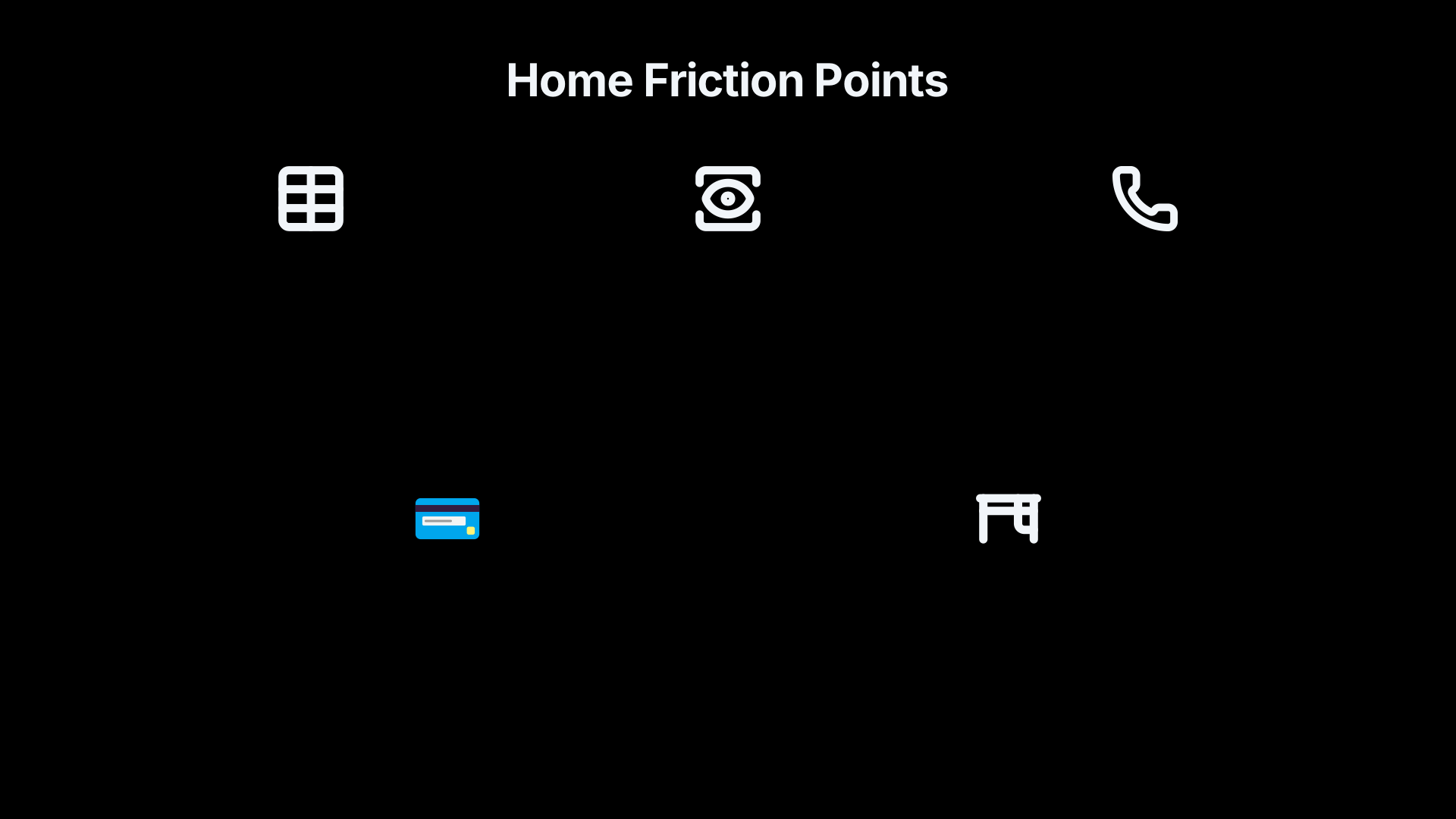
If a television remote is always visible, streaming services open automatically and snacks are stored at eye level, entertainment and eating become default actions. Conversely, if a book is placed on the coffee table, exercise clothes are laid out the night before and snacks require preparation, the balance shifts.
Useful home friction adjustments include:
- Storing tempting foods in opaque containers or less convenient locations.
- Keeping phones outside bedrooms.
- Making productive tools visible and easy to access.
- Removing saved payment details from shopping sites.
- Creating dedicated spaces for specific activities such as reading, studying or exercising.
The goal is not punishment. The goal is to create a slight delay between impulse and action.
At Work
Work environments often generate temptations through interruptions rather than pleasures.
Open tabs, constant notifications, email alerts and messaging platforms create a landscape of continuous attention switching. Because distractions are highly visible and immediately available, they repeatedly compete with deeper work.
Environmental redesign at work can include:
- Turning off non-essential notifications.
- Using full-screen work modes.
- Keeping only the current task visible.
- Physically separating work devices from entertainment devices where possible.
- Scheduling email review periods instead of leaving inboxes permanently open.
Research on choice architecture shows that subtle changes in the decision environment can alter behaviour without requiring major changes in motivation. The environment influences what feels normal, obvious and easy at the moment of choice. PMC[The Decision Lab]thedecisionlab.comChoice ArchitectureChoice architecture refers to the deliberate crafting of decision-making environments. By subtly shaping how options a…
The Power of Defaults
One of the strongest environmental tools is the default option.
A default is what happens when no active decision is made. Because people tend to follow the easiest available path, defaults often shape behaviour more strongly than intentions do. Choice architecture research has repeatedly demonstrated the influence of defaults across domains ranging from health decisions to workplace behaviour. PMC[The Decision Lab]thedecisionlab.comChoice ArchitectureChoice architecture refers to the deliberate crafting of decision-making environments. By subtly shaping how options a…
For self-improvement, effective defaults include:[psychologicalscience.org]psychologicalscience.orgeffective self control strategiesAssociation for Psychological ScienceEffective Self-Control Strategies Involve Much More Than…14 Feb 2019 — They observe that in some…
- Automatic savings transfers.
- Pre-planned meals.
- Calendar blocks reserved for exercise or focused work.
- Website blockers that activate automatically during work hours.
- Standing desks preset to a preferred position.
The key insight is that many behaviours occur because they are the default, not because they were carefully chosen. Changing defaults often changes outcomes without requiring stronger motivation.
How to Redesign One Recurring Temptation
Most people do not need a complete life overhaul. A single recurring temptation is usually enough to reveal how environmental design works.
Start by identifying a temptation that appears repeatedly rather than occasionally. Examples include social media during work, late-night snacking, impulsive online shopping or postponing exercise.
Then ask three questions:
What Makes This Temptation Easy?
Look for visibility, proximity and convenience.
Is the cue constantly present? Is access immediate? Does the behaviour require fewer steps than the alternative?
The answer often reveals why the temptation keeps winning.

What Friction Can Be Added?
Add small obstacles rather than dramatic restrictions.
Examples include:
- Logging out after each session.
- Moving apps off the home screen.
- Keeping snacks outside immediate reach.
- Leaving credit cards in another room.
- Using app-blocking software during vulnerable periods.
The obstacle does not need to be large. It only needs to interrupt automatic behaviour.
What Friction Can Be Removed From the Better Alternative?
Many self-improvement failures occur because the desired behaviour is less convenient than the unwanted one.
Reduce the effort required for the preferred action:
- Prepare workout clothes in advance.
- Keep healthy food ready to eat.
- Open the document you need before ending work.
- Leave a book where you normally reach for your phone.
Environmental design is strongest when it simultaneously increases friction for the unwanted behaviour and decreases friction for the desired one.[MPG.PuRe]pure.mpg.deMPG.PuReSelf-Nudging and the Citizen Choice Architectby S Reijula · 2022 · Cited by 214 — Self-deployed changes of accessibility, default…
Small Changes, Large Effects
Environmental redesign can feel almost trivial compared with dramatic stories of willpower and determination. Yet its strength comes from repetition. A tiny obstacle encountered once is insignificant. A tiny obstacle encountered fifty times a week can reshape behaviour.
This is why effective self-improvement often looks surprisingly mundane. It is not always a story of heroic resistance. More often, it is a story of rearranged rooms, altered defaults, hidden cues, blocked distractions and small amounts of friction placed in exactly the right locations. By the time temptation arrives, much of the decision has already been made.[PMC]pmc.ncbi.nlm.nih.govenvironmental and inhibitory control strategies to…by NA Cáceres · 2022 · Cited by 5 — This research addresses the oft-debated questio…[ScienceDirect]sciencedirect.comTrait self-control and the avoidance of temptationby MR Ent · 2015 · Cited by 329 — The present research suggests that high…
Amazon book picks
Further Reading
Books and field guides related to Can Your Environment Do the Resisting?. Use these as the next step if you want deeper reading beyond the article.
Atomic Habits
Rating: 3.5/5 from 7 Google Books ratings
Directly teaches habit formation through environmental cues, friction reduction, and making desired behaviors the path of least resistance.
The Power of Habit
Explains habit loops, behavioral triggers, and how changing situations and cues can reshape behavior.
How to Change
Focuses on overcoming self-control problems using evidence-based strategies, including changing environments and systems.
Better Than Before
Explores practical ways to structure surroundings, routines, and expectations to support consistent behavior.
eBay marketplace picks
Marketplace Samples
Example marketplace items related to this page. Use the search link to explore similar finds on eBay.



Endnotes
1.
Source: pmc.ncbi.nlm.nih.gov
Title: PMCSituational Strategies for Self-Control
Link:https://pmc.ncbi.nlm.nih.gov/articles/PMC4736542/
Source snippet
self-control strategies can be organized using the process model of self-control (Duckworth, Gendler, & Gross, 2014). This framework pred...
2.
Source: pmc.ncbi.nlm.nih.gov
Link:https://pmc.ncbi.nlm.nih.gov/articles/PMC7140383/
Source snippet
Choice architecture interventions to change physical activity...by LL Landais · 2020 · Cited by 105 — Choice architecture interventio...
3.
Source: sciencedirect.com
Link:https://www.sciencedirect.com/science/article/abs/pii/S0191886914005339
Source snippet
Trait self-control and the avoidance of temptationby MR Ent · 2015 · Cited by 329 — The present research suggests that high...
4.
Source: pmc.ncbi.nlm.nih.gov
Link:https://pmc.ncbi.nlm.nih.gov/articles/PMC9420799/
Source snippet
environmental and inhibitory control strategies to...by NA Cáceres · 2022 · Cited by 5 — This research addresses the oft-debated questio...
5.
Source: pure.mpg.de
Link:https://pure.mpg.de/rest/items/item_3188203_12/component/file_3363457/content
Source snippet
MPG.PuReSelf-Nudging and the Citizen Choice Architectby S Reijula · 2022 · Cited by 214 — Self-deployed changes of accessibility, default...
6.
Source: pmc.ncbi.nlm.nih.gov
Title: PMCNudging to move: a scoping review of the use of choice
Link:https://pmc.ncbi.nlm.nih.gov/articles/PMC6724306/
Source snippet
by S Forberger · 2019 · Cited by 156 — This paper aims to (1) give an overview of the scope of interventions using choice architecture...
7.
Source: sciencedirect.com
Link:https://www.sciencedirect.com/science/article/pii/S0749597820303848
Source snippet
Behavior changeby AL Duckworth · 2020 · Cited by 130 — We propose the process model of behavior change as a parsimonious framework for or...
8.
Source: pmc.ncbi.nlm.nih.gov
Link:https://pmc.ncbi.nlm.nih.gov/articles/PMC4731333/
Source snippet
than Resisting Temptation: Beneficial Habits Mediate the...by BM Galla · 2015 · Cited by 767 — Indeed, it is intuitive to liken self-con...
9.
Source: self.inc
Link:https://www.self.inc/
Source snippet
Build Credit, Build Savings and Access CashBuild credit and savings with Self. The Credit Builder Account and Self Visa® Credit Ca...
10.
Source: sciencedirect.com
Link:https://www.sciencedirect.com/science/article/pii/S2352250X2400071X
Source snippet
James Gross: Writing – review & editing. Declaration of competing interest. The authors declare that they have no...
11.
Source: sciencedirect.com
Title: Self Control
Link:https://www.sciencedirect.com/topics/biochemistry-genetics-and-molecular-biology/self-control
Source snippet
an overviewOne way people overcome the challenge of self-control is by actively inhibiting the thoughts, feelings, and behavioral tendenc...
12.
Source: psychologicalscience.org
Title: effective self control strategies
Link:https://www.psychologicalscience.org/news/releases/effective-self-control-strategies.html
Source snippet
Association for Psychological ScienceEffective Self-Control Strategies Involve Much More Than...14 Feb 2019 — They observe that in some...
13.
Source: thedecisionlab.com
Link:https://thedecisionlab.com/reference-guide/psychology/choice-architecture
Source snippet
Choice ArchitectureChoice architecture refers to the deliberate crafting of decision-making environments. By subtly shaping how options a...
14.
Source: pmc.ncbi.nlm.nih.gov
Link:https://pmc.ncbi.nlm.nih.gov/articles/PMC12294546/
Source snippet
at Work - Effect of Nudges on Stand-Up Workingby M Celis · 2025 — This field experiment investigates the effectiveness of behavioral nudg...
15.
Source: angeladuckworth.com
Link:https://angeladuckworth.com/tag/self-control/
Source snippet
Angela DuckworthDuckworth, A. L., Gendler, T. S., & Gross, J. J. (2014). Self-control in school-age children. Educational Psychologist, 4...
16.
Source: csap.yale.edu
Link:https://csap.yale.edu/sites/default/files/files/bsw-ad-5-10-2021.pdf
Source snippet
change - Center for the Study of American Politicsby AL Duckworth · 2020 · Cited by 139 — This supplemental issue collects papers by part...
Additional References
17.
Source: nanohabits.com
Link:https://www.nanohabits.com/learn/designing-environment-for-habits
Source snippet
Designing an Environment Where Good Habits HappenBehavior is shaped by what is visible, close, and easy. Learn how small environmental sh...
18.
Source: semanticscholar.org
Link:https://www.semanticscholar.org/paper/Trait-self-control-and-the-avoidance-of-temptation-Ent-Baumeister/0cff1161825dee3e0ff154fc499371efd5a955dc
Source snippet
Trait self-control and the avoidance of temptationHigh trait self-control has been traditionally described as a keen ability to resist te...
19.
Source: raybwilliams.medium.com
Link:https://raybwilliams.medium.com/why-we-get-willpower-wrong-and-what-its-costing-us-635e07973460
Source snippet
We Get Willpower Wrong, And What It's Costing UsWendy Wood's research shows that behavior is much more affected by environmental friction...
20.
Source: dictionary.com
Link:https://www.dictionary.com/browse/high
Source snippet
HIGH Definition & MeaningHIGH definition: having a great or considerable extent or reach upward or vertically; lofty; tall. See examples...
21.
Source: merriam-webster.com
Link:https://www.merriam-webster.com/dictionary/high
22.
Source: researchgate.net
Link:https://www.researchgate.net/publication/384352065_The_process_model_of_self-control_Developing_a_measure_of_self-control_strategies
Source snippet
Situational strategies encompass various attempts to control the situation... Duckworth, Gendler, & Gross, 2016). In step 2, the...
23.
Source: collinsdictionary.com
Title: HIG H definition in American Englishhigh in American English · 1
Link:https://www.collinsdictionary.com/us/dictionary/english/high
Source snippet
of more than normal height; lofty; tall [not used of persons] · 2. extending upward a (specified) distance · 3. situated far above...Rea...
24.
Source: goalsandprogress.com
Link:https://goalsandprogress.com/home-environment-design-for-better-habits/
Source snippet
Environment Design for Habits: Set Up Your Home for ChangeEnvironment design for habits uses choice architecture, friction, and cue place...
25.
Source: emotrab.ufba.br
Title: Emotion regulationCurrent status and future prospectsGross2015
Link:https://emotrab.ufba.br/wp-content/uploads/2020/08/Emotion-regulationCurrent-status-and-future-prospectsGross2015.pdf
Source snippet
L., Gendler, T.S., & Gross, J. J. (in press). Self-con- trol in school-age children. Educational Psychologist. Dunning, J. P., & Hajcak, G...
26.
Source: curee.co.uk
Link:https://www.curee.co.uk/files/RMHolyRosary/Resources/The_process_model_of_self_control.pdf
Source snippet
ehaviour, and built upon the efforts of Magen & Gross (2010) in exploring how the...
Topic Tree