Within Techniques
What is the self help advice really doing?
The taxonomy gives readers a practical way to ask which techniques a book, app or coach is really using.
On this page
- Translate slogans into named techniques
- Spot missing active ingredients
- Separate useful combinations from technique clutter
Page outline Jump by section
Introduction
Most self-help advice sounds bigger than it is. A book may promise discipline, consistency, confidence or motivation, but those words do not tell you what is actually supposed to change. The Behaviour Change Technique Taxonomy offers a more practical question: what techniques are being used underneath the promise? Instead of evaluating slogans, you look for identifiable ingredients such as goal setting, action planning, self-monitoring, prompts, feedback, social support or environmental restructuring. The taxonomy was created to make behaviour-change interventions describable and testable rather than vague. It organises 93 distinct behaviour change techniques into a shared framework that researchers and practitioners can identify and compare.[PubMed]pubmed.ncbi.nlm.nih.govThe behavior change technique taxonomy (v1) of 93…by S Michie · 2013 · Cited by 8845 — "BCT taxonomy v1," an extensive taxonomy…[City Research Online]openaccess.city.ac.ukMichie et al Annals of Behavioral Medicine 2013 BCT Taxonomy v1City Research OnlineMichie et al Annals of Behavioral Medicine 2013by S Michie · 2013 · Cited by 8746 — The Behavior Change Technique Tax…
 For readers of self-help material, this creates a useful habit. Rather than asking whether a book sounds inspiring, you can ask what it is asking you to do, how that mechanism is expected to work, and whether the active ingredients match the behaviour you are trying to change.
Translate slogans into named techniques
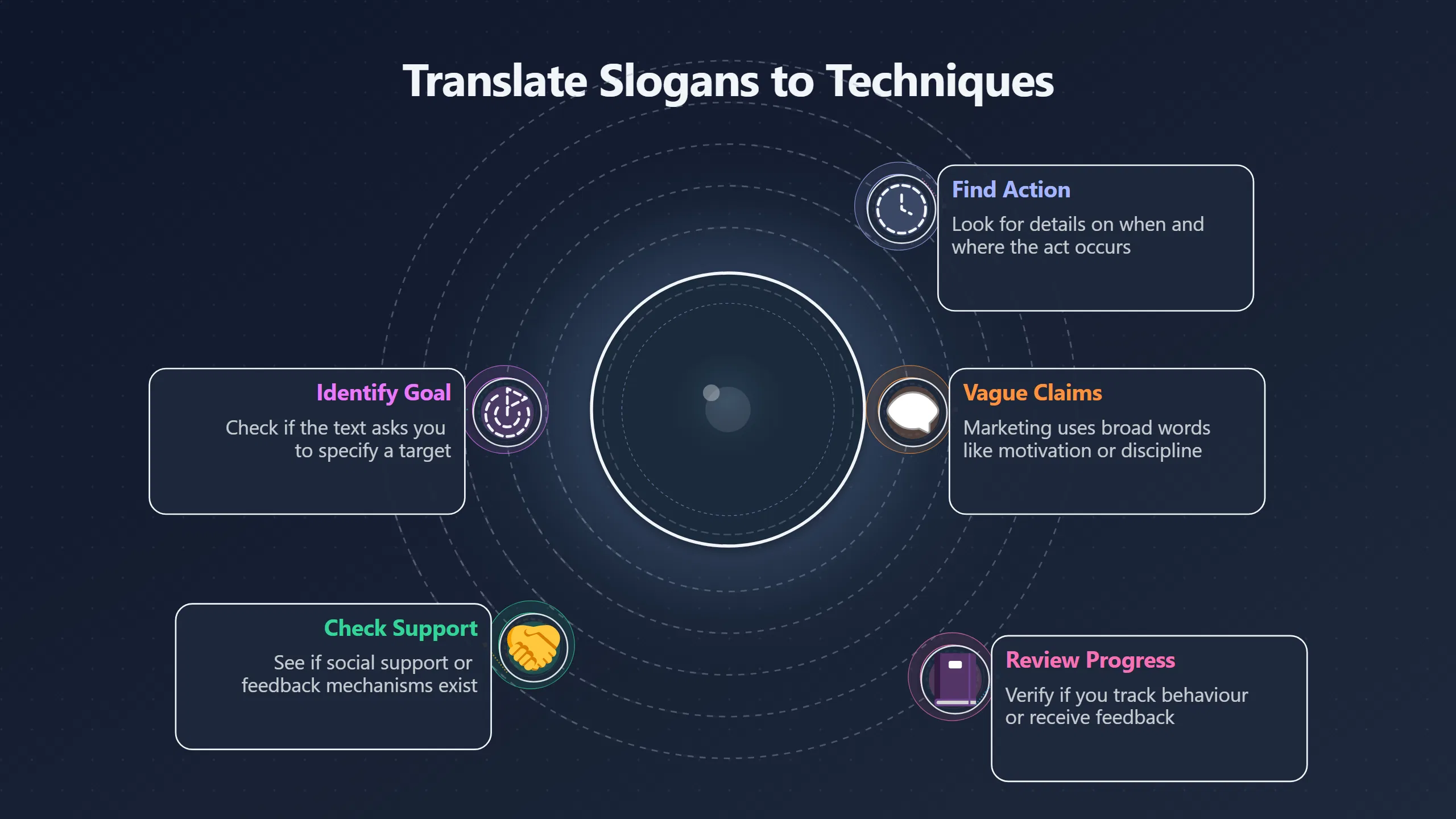
A useful first step is to mentally translate broad claims into specific techniques.
Many self-help products rely on language that feels concrete but is actually difficult to evaluate. Consider a few common examples:
- “Get serious about your goals.”
- “Build unstoppable consistency.”
- “Take ownership of your habits.”
- “Stay accountable.”
- “Become the kind of person who succeeds.”
None of these statements identifies a technique. They describe outcomes, identities or aspirations.
The taxonomy encourages a different reading. When a programme says “get serious about your goals”, does it actually include behavioural goal setting? Does it ask you to specify when, where and how a behaviour will occur through action planning? Does it include regular review of progress? These are distinct techniques rather than interchangeable ideas. The taxonomy explicitly separates goal setting, action planning, self-monitoring, feedback and many other components because each represents a different mechanism of change.[digitalwellbeing.org]digitalwellbeing.orgi BCT Taxonomy (v1): 93 hierarchically-clustered techniquesNote: evidence of action planning does not necessarily imply goal setting…[BCT Taxonomy]bct-taxonomy.comBehaviour Change Technique TaxonomyA cross-domain, hierarchically structured taxonomy of 93 distinct BCTs with labels, definitions and ex…
For example, a productivity app may advertise accountability. Looking through the taxonomy lens reveals that accountability could mean several different things:
- Social support from another person.
- Monitoring of behaviour.[nice.org.uk]nice.org.ukBehaviour change: digital and mobile health interventions7 Oct 2020 — These include: goals and planning, feedback and monitoring, and soc…
- Feedback on performance.
- Commitment devices.
- Public reporting of progress.
These are not the same intervention. Some may fit your problem better than others.
The practical advantage is that named techniques can be tested. “Accountability did not work” is a vague conclusion. “Weekly feedback helped but public reporting did not” is information that can improve future decisions.
What is the self-help advice really doing?
A surprisingly large amount of self-improvement content combines familiar techniques under new branding.
A coach might present a proprietary “success system” that consists largely of:
- Setting behavioural goals.
- Creating implementation plans.
- Tracking behaviour.
- Reviewing progress weekly.
Those elements may still be useful. The point is not that repackaging is deceptive. The point is that readers can recognise the underlying ingredients and evaluate them independently of the marketing.
The taxonomy was originally developed because interventions were often described too vaguely for researchers to know what they contained. If an intervention is labelled simply as “coaching”, “education” or “support”, different readers may imagine completely different methods. The taxonomy attempts to make those methods visible.[City Research Online]openaccess.city.ac.ukMichie et al Annals of Behavioral Medicine 2013 BCT Taxonomy v1City Research OnlineMichie et al Annals of Behavioral Medicine 2013by S Michie · 2013 · Cited by 8746 — The Behavior Change Technique Tax…[OUP Academic]academic.oup.comOUP AcademicBehavior Change Technique Taxonomy (v1) of 93…by S Michie · 2013 · Cited by 8845 — An extensive taxonomy of 93 consensuall…
When reading self-help claims, it can help to ask three questions:
- What behaviour is being targeted?
- Which specific techniques are being used?
- How are those techniques expected to influence behaviour?[more-life.co.uk]more-life.co.ukbehaviour change techniquesResearch 2025: Behaviour Change TechniquesNICE recommends identifying combinations of behaviour change techniques and modes of delivery t…
A programme that answers all three questions is usually easier to evaluate than one that relies mainly on motivational language.

Spot missing active ingredients
One of the most valuable uses of the taxonomy is identifying what is absent.
Many self-help resources spend substantial time explaining why a behaviour matters. They provide information, stories and persuasion. Yet they may devote very little attention to implementation.
Imagine a reader who wants to exercise regularly. A book might provide dozens of pages about the benefits of exercise and the importance of commitment. But if it never helps the reader create an action plan, establish prompts, monitor behaviour or solve practical barriers, important active ingredients may be missing.
Research and guidance in behaviour change repeatedly highlight clusters such as goals and planning, feedback and monitoring, and social support as important intervention components. NICE guidance specifically discusses these categories rather than treating behaviour change as a matter of information alone.[NICE]nice.org.ukBehaviour change: individual approaches | Guidance2 Jan 2014 — This guideline covers changing health-damaging behaviours among people…[NICE]nice.org.ukBehaviour change: digital and mobile health interventions7 Oct 2020 — These include: goals and planning, feedback and monitoring, and soc…
This does not mean every successful intervention requires every technique. It means readers should be cautious when a programme offers mainly explanation and inspiration while providing few mechanisms for turning intentions into action.
A useful warning sign is when a self-help product can describe why change matters but struggles to specify what the user will actually do tomorrow morning.
Separate useful combinations from technique clutter
Another common mistake is assuming that more techniques automatically mean a better programme.
The taxonomy contains 93 techniques, but effective behaviour change is not achieved by collecting techniques like badges. The important question is whether the techniques work together to address a real obstacle.
Consider someone who repeatedly forgets to practise a desired behaviour. A combination of prompts, environmental restructuring and action planning may directly address the problem.
Now consider a programme that includes affirmations, journalling, goal setting, visualisation, public commitments, rewards, reminders, daily challenges, habit tracking and several other components without a clear rationale. The intervention may look sophisticated, but the reader can no longer tell which ingredients matter.
The taxonomy helps separate purposeful combinations from technique clutter because each component can be identified and justified. Researchers increasingly use taxonomies and related frameworks to specify intervention content precisely for this reason.[BMJ Open]bmjopen.bmj.comBMJ OpenUsing the behaviour change technique taxonomy v1…by C Scott · 2020 · Cited by 31 — The aim of this study was to identify which…
The question becomes: what problem is each technique solving?
If there is no clear answer, complexity may be creating confusion rather than effectiveness.
A practical claim-check method
When evaluating a book, app or coaching programme, a simple taxonomy-based review can be surprisingly revealing.
Read the claim and look for evidence of specific techniques:
Marketing claimTaxonomy-style questionBuild consistencyWhat behaviours are planned, monitored or prompted?Stay motivatedWhat changes when motivation falls?Create accountabilityWhat form of support, monitoring or feedback exists?Develop better habitsWhat cues, routines or environmental changes are used?Achieve your goalsHow are goals translated into actions?
If the answers remain unclear after careful reading, the programme may be relying more on aspiration than mechanism.
Conversely, a modest-sounding resource that clearly explains its techniques may be easier to evaluate and improve. You can keep what works, remove what does not, and understand why a result occurred.
Why naming techniques changes how you read self-help
The biggest benefit of the taxonomy is not that it tells you which book to buy or which coach to trust. It changes the level at which you evaluate claims.
Instead of asking whether a message feels motivating, you ask what behavioural ingredients it contains. Instead of treating success as proof that a philosophy is correct, you look for the techniques that may have contributed to the outcome. Instead of accepting broad promises about discipline or consistency, you examine whether the intervention includes planning, monitoring, feedback, support, prompts or environmental changes that can realistically influence behaviour.
A named technique is not automatically effective, and no taxonomy can guarantee success. But a named technique is easier to inspect, test and improve than a slogan. That shift—from promises to mechanisms—is one of the most practical ways the Behaviour Change Technique Taxonomy can help readers navigate the crowded world of self-improvement.[PubMed]pubmed.ncbi.nlm.nih.govThe behavior change technique taxonomy (v1) of 93…by S Michie · 2013 · Cited by 8845 — "BCT taxonomy v1," an extensive taxonomy…[BCT Taxonomy]bct-taxonomy.comStarter Packby S Michie¹ — Examples of BCTs are: 'Prompts/cues', 'Information about health consequences', 'Incentive', 'Goal setting ', '…
Amazon book picks
Further Reading
Books and field guides related to What is the self help advice really doing?. Use these as the next step if you want deeper reading beyond the article.
Atomic Habits
Rating: 3.5/5 from 7 Google Books ratings
Contains clear, testable behaviour-change techniques beneath the motivational language.
eBay marketplace picks
Marketplace Samples
Example marketplace items related to this page. Use the search link to explore similar finds on eBay.


Endnotes
1.
Source: bct-taxonomy.com
Link:https://www.bct-taxonomy.com/about
Source snippet
Behaviour Change Technique TaxonomyA cross-domain, hierarchically structured taxonomy of 93 distinct BCTs with labels, definitions and ex...
2.
Source: digitalwellbeing.org
Link:https://digitalwellbeing.org/wp-content/uploads/2016/11/BCTTv1_PDF_version.pdf
Source snippet
i BCT Taxonomy (v1): 93 hierarchically-clustered techniquesNote: evidence of action planning does not necessarily imply goal setting...
3.
Source: bct-taxonomy.com
Link:https://www.bct-taxonomy.com/pdf/StarterPack.pdf
Source snippet
Starter Packby S Michie¹ — Examples of BCTs are: 'Prompts/cues', 'Information about health consequences', 'Incentive', 'Goal setting ', '...
4.
Source: academic.oup.com
Link:https://academic.oup.com/abm/article/46/1/81/4563254
Source snippet
OUP AcademicBehavior Change Technique Taxonomy (v1) of 93...by S Michie · 2013 · Cited by 8845 — An extensive taxonomy of 93 consensuall...
5.
Source: nice.org.uk
Link:https://www.nice.org.uk/guidance/ph49
Source snippet
Behaviour change: individual approaches | Guidance2 Jan 2014 — This guideline covers changing health-damaging behaviours among people...
6.
Source: nice.org.uk
Link:https://www.nice.org.uk/guidance/ng183/chapter/Recommendations
Source snippet
Behaviour change: digital and mobile health interventions7 Oct 2020 — These include: goals and planning, feedback and monitoring, and soc...
7.
Source: wellcomeopenresearch.org
Link:https://wellcomeopenresearch.org/articles/8-308
Source snippet
The Behaviour Change Technique Ontology:...by MM Marques · 2024 · Cited by 254 — The Behaviour Change Technique Taxonomy v1 (BCTTv1) spec...
8.
Source: bmjopen.bmj.com
Link:https://bmjopen.bmj.com/content/10/9/e036500
Source snippet
BMJ OpenUsing the behaviour change technique taxonomy v1...by C Scott · 2020 · Cited by 31 — The aim of this study was to identify which...
9.
Source: wellcomeopenresearch.org
Link:https://wellcomeopenresearch.org/articles/7-211
Source snippet
Behaviour change techniques taxonomy v1:...by E Corker · 2023 · Cited by 43 — The BCTTv1 provides a list of 93 clearly labelled and defin...
10.
Source: academic.oup.com
Link:https://academic.oup.com/abm/article-abstract/46/1/81/4563254
Source snippet
Change Technique Taxonomy (v1) of 93...by S Michie · 2013 · Cited by 8845 — The objective of this study is to develop an extensive, cons...
11.
Source: pubmed.ncbi.nlm.nih.gov
Link:https://pubmed.ncbi.nlm.nih.gov/23512568/
Source snippet
The behavior change technique taxonomy (v1) of 93...by S Michie · 2013 · Cited by 8845 — "BCT taxonomy v1," an extensive taxonomy...
12.
Source: openaccess.city.ac.uk
Title: Michie et al Annals of Behavioral Medicine 2013 BCT Taxonomy v1
Link:https://openaccess.city.ac.uk/3293/1/Michie%20et%20al%20Annals%20of%20Behavioral%20Medicine%202013%20-%20BCT%20Taxonomy%20v1.pdf
Source snippet
City Research OnlineMichie et al Annals of Behavioral Medicine 2013by S Michie · 2013 · Cited by 8746 — The Behavior Change Technique Tax...
13.
Source: openaccess.city.ac.uk
Link:https://openaccess.city.ac.uk/id/eprint/3293/
Source snippet
City Research OnlineThe Behavior Change Technique Taxonomy (v1) of 93...by S Michie · 2013 · Cited by 8903 — Objectives: The objective o...
14.
Source: Wikipedia
Link:https://en.wikipedia.org/wiki/Nice
Source snippet
NiceNice is the second-largest French city on the Mediterranean coast and second-largest city in the Provence-Alpes-Côte d'Azur region...
15.
Source: Wikipedia
Link:https://en.wikipedia.org/wiki/Behavior
Source snippet
BehaviorBehavior (American English) or behaviour (British English) is the range of actions of organisms, individuals, systems or artif...
16.
Source: scribd.com
Link:https://www.scribd.com/document/405190916/behaviour-control-theory-taxonomy
Source snippet
BCT Taxonomy v1: 93 Techniques OverviewThe document describes a taxonomy of 93 behavior change techniques organized into groupings and te...
17.
Source: more-life.co.uk
Title: behaviour change techniques
Link:https://www.more-life.co.uk/research-and-studies/behaviour-change-techniques/
Source snippet
Research 2025: Behaviour Change TechniquesNICE recommends identifying combinations of behaviour change techniques and modes of delivery t...
18.
Source: sciencedirect.com
Link:https://www.sciencedirect.com/topics/psychology/behavior-change-technique
Source snippet
Behavior Change Technique - an overviewA refined taxonomy of behavior change techniques to help people change their physical activity and...
19.
Source: dictionary.cambridge.org
Link:https://dictionary.cambridge.org/dictionary/english/behavior
Source snippet
English [meaning]({{ 'meaning/' | relative_url }}) - Cambridge Dictionary...
Additional References
20.
Source: researchgate.net
Link:https://www.researchgate.net/publication/263504602_The_Behaviour_Change_Technique_Taxonomy_BCTTv1_of_93_hierarchically-clustered_techniques_testing_reliability_of_the_taxonomy_in_specifying_the_content_of_behaviour_change_interventions
Source snippet
The Behaviour Change Technique Taxonomy (BCTTv1) of...18 Jan 2016 — This work produced the 93-item hierarchically-structured BCT Taxonom...
21.
Source: merriam-webster.com
Link:https://www.merriam-webster.com/dictionary/behavior
Source snippet
BEHAVIOR Definition & Meaning1. The way in which someone conducts oneself or behaves (see behave sense 1). We were grateful for the graci...
22.
Source: en.wiktionary.org
Link:https://en.wiktionary.org/wiki/nice
Source snippet
also: Nice, NICE, -nice, and niče. Contents. 1 English. 1.1 Alternative forms; 1.2 Pronunciation; 1.3 Etymology 1. 1.3.1 Adjective. 1.3.1...
23.
Source: discovery.ucl.ac.uk
Link:https://discovery.ucl.ac.uk/1400691/
Source snippet
Behavior Change Technique Taxonomy (v1) of 93...The Behavior Change Technique Taxonomy (v1) of 93 Hierarchically Clustered Techniques: B...
24.
Source: GOV.UK
Link:https://www.gov.uk/government/organisations/national-institute-for-clinical-excellence
Source snippet
Institute for Health and Care ExcellenceThe National Institute for Health and Care Excellence (NICE) provides national guidance and advic...
25.
Source: tripadvisor.co.uk
Link:https://www.tripadvisor.co.uk/Tourism-g187234-Nice_French_Riviera_Cote_d_Azur_Provence_Alpes_Cote_d_Azur-Vacations.html
Source snippet
Nice, France: All You Need to Know Before You Go (2026)The deep blue waters of the Cote d'Azur are the dramatic backdrop for elegant Nice...
26.
Source: scribd.com
Title: NIC E Guidance on Individual Behaviour Change | PDFBehaviour change techniques
Link:https://www.scribd.com/document/738350834/Behaviour-Change-Individual-Approaches-PDF-1996366337989
Source snippet
Recommendations were made to include goals and planning and feedback and monitoring techniques in behaviour change interventions.Read more...
27.
Source: scribbr.co.uk
Link:https://www.scribbr.co.uk/uk-vs-us/behavior-or-behaviour/
Source snippet
Behaviour or Behavior | Meaning, Spelling & Examples - Scribbr16 Jan 2023 — In UK English, “behaviour” (with a “u”) is standard...
28.
Source: revistas.innovacionumh.es
Title: esthe Behaviour Change Techniques Taxonomy v1 (BCTTv1)Michie et al
Link:https://revistas.innovacionumh.es/index.php/psicologiasalud/en/article/view/882/1227
Source snippet
(2013)'s paper presents an important step in improving reporting: a taxonomy of 93 behaviour change techniques (BCTs), each with a label...
29.
Source: research-portal.uea.ac.uk
Title: the behavior change technique taxonomy v1 of 93 hierarchically cl
Link:https://research-portal.uea.ac.uk/en/publications/the-behavior-change-technique-taxonomy-v1-of-93-hierarchically-cl
Source snippet
behavior change technique taxonomy (v1) of 93...by S Michie · 2013 · Cited by 8667 — Conclusions: "BCT taxonomy v1," an extensive taxono...
Topic Tree