Within Better Change
What Health Habits Teach About Change
Health habits offer a well-studied window into why timing, frequency and affect shape automaticity.
On this page
- Habit formation studies
- Frequency and timing
- Enjoyment and regulation
Page outline Jump by section
Introduction
Health habits are one of the best-tested parts of “self improvement that works” because they move the subject away from slogans and into measurable behaviour: drinking water, eating fruit, taking a vitamin, walking, stretching, flossing, filling half a plate with vegetables, or becoming more physically active. The central lesson is simple but not simplistic: habits form when a chosen behaviour is repeated in a stable enough context for the cue to start triggering action with less conscious effort. Timing, frequency and enjoyment matter because they change whether repetition actually happens, and whether it becomes easier rather than merely dutiful. The evidence does not support the tidy claim that habits take 21 days. It suggests a slower, more variable process, often measured in months, with automaticity depending on the behaviour, the person, the cue, and the emotional experience of doing it.[Wiley Online Library]onlinelibrary.wiley.comOnline Library Modelling habit formation in the real worldFor the majority of participants, automaticity increased steadily over…Read more…
The health-habit evidence starts with automaticity, not motivation
In health psychology, a habit is not just something done often. The more useful definition is a behaviour that is prompted automatically by a context cue, with relatively little deliberation. That distinction matters for self improvement because a person may perform an action frequently while still having to decide, persuade and remember each time. Habit formation is the process by which the cue-response link strengthens: “after lunch” starts to prompt a walk, “brushing teeth” starts to prompt flossing, or “dinner plate” starts to prompt adding vegetables.[PubMed Central]pmc.ncbi.nlm.nih.govPubMed CentralTime to Form a Habit: A Systematic Review and Meta-Analysis…by B Singh · 2024 · Cited by 97 — The meta-analysis showed s…
The landmark real-world study by Phillippa Lally and colleagues followed volunteers for 12 weeks as they chose a new eating, drinking or activity behaviour and tried to perform it daily in a consistent situation. Automaticity usually rose gradually and then began to plateau, rather than appearing suddenly after a fixed number of days. The often-quoted “66 days” comes from this work, but it is better understood as a rough central tendency in a variable sample, not a universal deadline. In the same evidence tradition, later reviews emphasise that behaviour type and individual differences produce wide variation.[Wiley Online Library]onlinelibrary.wiley.comOnline Library Modelling habit formation in the real worldFor the majority of participants, automaticity increased steadily over…Read more…
This is why health habits are such a useful window into realistic self improvement. They show that change is not mostly about finding a more intense feeling of commitment. It is about creating enough repeated contact between a cue and a behaviour that the behaviour becomes easier to start. Motivation can help a person begin, but the point of habit is to reduce the amount of motivation needed on ordinary days.
What the “how long does it take?” studies really show
The most reader-useful answer is: often longer than people hope, but not so long that habit formation is mysterious. A 2024 systematic review and meta-analysis of health behaviour habit formation found that healthy habits can begin forming within about two months, while the time needed varies substantially between people and behaviours. One summary of the review reports median or mean habit-formation estimates ranging from 59–66 days for medians and 106–154 days for means, with very wide individual ranges.[PubMed Central]pmc.ncbi.nlm.nih.govPubMed CentralTime to Form a Habit: A Systematic Review and Meta-Analysis…by B Singh · 2024 · Cited by 97 — The meta-analysis showed s…
That variation is not a technical footnote. It changes how self-improvement advice should be interpreted. A simple behaviour such as drinking water after breakfast is not the same challenge as completing a demanding workout after work. Lally and colleagues’ work found that simple actions reached stronger automaticity more quickly than more complex routines, and subsequent habit researchers have treated behavioural complexity as one of the unresolved practical issues in designing habit-based interventions.[PubMed Central]pmc.ncbi.nlm.nih.govPubMed CentralTime to Form a Habit: A Systematic Review and Meta-Analysis…by B Singh · 2024 · Cited by 97 — The meta-analysis showed s…
The evidence also weakens the motivational trap of “I missed a day, so I have failed”. In habit formation, the larger pattern of repeated performance in a stable context matters more than a flawless streak. The practical conclusion is not to make the habit so tiny that it becomes meaningless, but to make it simple enough that it can be repeated often while life is imperfect.

Frequency matters, but only when it is tied to a cue
Frequency is the visible part of habit formation: the action has to happen repeatedly. But the studies suggest that repetition alone is not the full mechanism. The behaviour needs to be repeated in relation to a recognisable cue, otherwise the person may simply be practising effortful remembering.
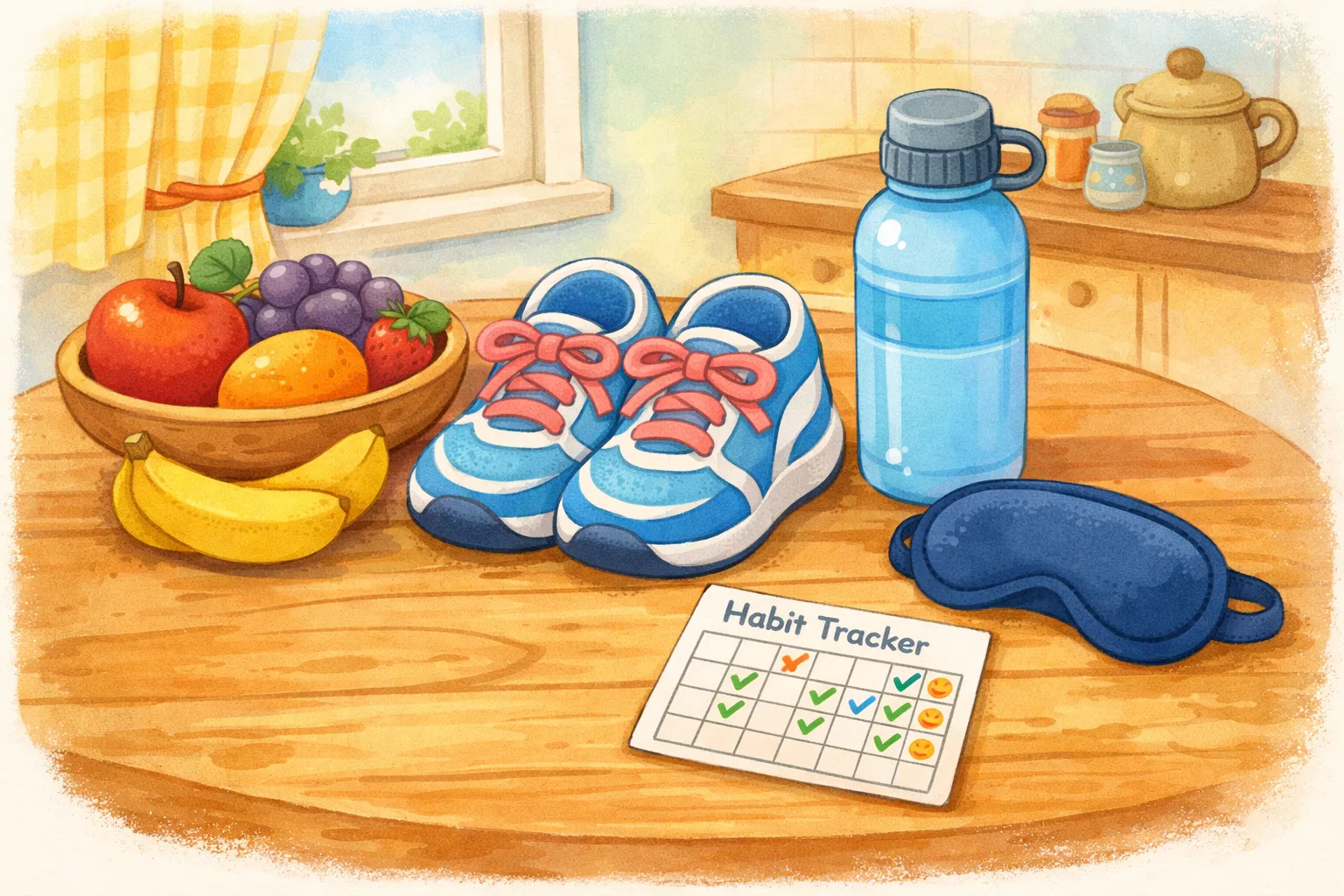
This is where health habits clarify a common misunderstanding. “Exercise more often” is not yet a habit plan. “Put walking shoes on after lunch” is closer, because it links the behaviour to a recurring event. “Eat more vegetables” is vague; “fill half the plate with vegetables at dinner” gives the behaviour a stable setting. Keller and colleagues’ randomised controlled trial on everyday nutrition behaviour found that both routine-based cues and time-based cues supported increases in automaticity, with repeated enactment of the plan emerging as the important driver.[PubMed]pubmed.ncbi.nlm.nih.govPubMed CentralTime to Form a Habit: A Systematic Review and Meta-Analysis…by B Singh · 2024 · Cited by 97 — The meta-analysis showed s
Other evidence points in the same direction. A 2022 study on context stability found, across two datasets, that stable habit contexts predicted greater automaticity and better goal attainment. This does not mean every habit must happen at the exact same clock time forever. It means that the brain learns more readily when the intended action has a reliable “when this happens, do that” structure.[Frontiers]frontiersin.orgFrontiers Context Stability in Habit Building Increases AutomaticityFrontiers Context Stability in Habit Building Increases Automaticity
For practical self improvement, frequency works best when it is anchored:
- A daily event: after breakfast, after brushing teeth, after arriving home.
- A physical location: the kitchen counter, the bedside table, the office door.
- A repeated transition: finishing lunch, closing the laptop, putting on trainers.
- A prepared object: a water bottle, floss, walking shoes, gym kit, chopped vegetables.
The cue does not have to be dramatic. It has to be reliably encountered.
Timing is not magic, but mornings often make repetition easier
Timing matters because some parts of the day are more predictable than others. A morning cue may work well because it occurs before the day has accumulated interruptions, fatigue and competing demands. The 2024 review notes evidence that muscle-stretching habits were stronger when practised in the morning than in the evening, while also reporting that time-based and routine-based cue planning can both support habit formation.[MDPI]mdpi.comOpen source on mdpi.com.
The useful takeaway is not “everyone must build every habit in the morning”. It is that a good habit time is one the person can protect often enough for repetition to accumulate. For one person, that might be a morning walk. For another, it might be preparing tomorrow’s lunch straight after dinner, or taking medication when making the first cup of tea. A cue that is emotionally convenient but behaviourally unreliable is weaker than a cue that is ordinary, repeated and hard to miss.
Health-habit studies also show why “same time every day” is sometimes too narrow. Routine-based cues can be more flexible than clock-time cues: “after I brush my teeth” can survive a late morning better than “at 7.00 am”. Keller’s trial found no clear superiority of routine-based over time-based cue planning for the nutrition behaviour studied, so the best choice is likely to depend on the person and the behaviour rather than on a universal rule.[PubMed]pubmed.ncbi.nlm.nih.govPubMed CentralTime to Form a Habit: A Systematic Review and Meta-Analysis…by B Singh · 2024 · Cited by 97 — The meta-analysis showed s
Enjoyment is not a luxury; it can help habits stick
Health habits are often framed as virtuous acts that should be done regardless of enjoyment. The evidence is more interesting. Enjoyment, intrinsic reward and autonomous motivation appear to influence whether repetition becomes self-sustaining.
A study of physical activity habit strength found that self-determined motivation moderated the relationship between past behaviour and habit strength: previous physical activity was more predictive of habit among people whose motivation was more autonomous. In plain English, repeated exercise seemed more likely to become habitual when it felt personally valued or intrinsically motivated, not merely imposed.[UCL Discovery]discovery.ucl.ac.ukSource details in endnotes.
The same theme appears in nutrition research. An intensive longitudinal diary study asked participants to build the higher-order habit of filling half their dinner plate with vegetables. Habit strength increased over time, and people with higher average behavioural performance developed stronger habit gains. Mean levels of behavioural performance, intrinsic reward value, and context stability were all positively related to mean habit strength, although the study also found that day-to-day fluctuations did not neatly predict next-day habit strength.[Springer Nature Link]link.springer.comSource details in endnotes.
A separate exploratory study on perceived reward concluded that pleasure and intrinsic motivation may aid habit formation by increasing habit strength per repetition. This matters because a health habit that feels punishing has two problems: it is less likely to be repeated, and each repetition may be less reinforcing.[Springer Nature Link]link.springer.comSource details in endnotes.
The practical implication is modest but powerful: make the healthy behaviour more pleasant without undermining it. A person trying to walk regularly might choose a route with trees rather than traffic. Someone trying to eat more vegetables might improve flavour, texture and convenience rather than relying on grim compliance. Enjoyment does not replace repetition; it helps repetition survive.

Regulation still matters after a habit begins
A tempting overclaim is that once behaviour becomes habitual, self-regulation is no longer needed. The evidence is more careful. Habit can reduce the amount of conscious effort needed to start an action, but people still need planning, adjustment and recovery when contexts change.
Gardner and colleagues’ work on habit-based health behaviour change notes that habitual behaviours can be triggered with little conscious forethought, but also highlights research gaps in how to use habit formation and habit disruption in real-world interventions. Reviews of habit-based interventions have found encouraging short-term behavioural effects, while also noting that fewer studies assess longer-term behaviour change robustly.[Taylor & Francis Online]tandfonline.comSource details in endnotes.
This is important for self improvement because health habits do not occur in laboratory conditions. Travel, illness, stress, shift work, family duties and seasonal changes can all break cues. A walking habit tied to an office commute may weaken when work becomes remote. A healthy breakfast routine may vanish during school holidays. A gym habit may fail after injury, not because the person lacks character, but because the cue-behaviour system has been disrupted.
So regulation remains part of effective habit formation. The task is to reduce unnecessary effort, not to pretend effort disappears. Useful regulation includes choosing the cue, preparing the environment, monitoring whether the action happens, adapting after disruption, and making the behaviour small enough to resume.
What health habits teach about self improvement that works
The evidence from health habit formation points towards a grounded model of change: behaviour becomes more reliable when it is specific, repeated, cued, context-stable and at least tolerable enough to repeat. That is less glamorous than a total life transformation, but it is much more usable.
Several lessons stand out.
First, start with the behaviour, not the identity. “Become healthy” is too broad to automate. “Eat fruit with lunch” or “walk after dinner” gives the habit system something concrete to learn. Lally’s real-world study deliberately used everyday eating, drinking and activity behaviours because habits form around specific actions in specific contexts.[Wiley Online Library]onlinelibrary.wiley.comOnline Library Modelling habit formation in the real worldFor the majority of participants, automaticity increased steadily over…Read more…
Second, choose a cue the day already gives you. Habit formation is helped when the desired behaviour has a stable prompt. Evidence from cue-planning and context-stability studies supports linking the behaviour to a routine, time or setting that recurs reliably.[Frontiers]frontiersin.orgFrontiers Context Stability in Habit Building Increases AutomaticityFrontiers Context Stability in Habit Building Increases Automaticity
Third, expect a curve, not a switch. Automaticity usually builds gradually and may plateau. The “21 days” idea is too neat; the better expectation is weeks to months, with large variation. This makes patience part of the method, not a consolation prize.[Wiley Online Library]onlinelibrary.wiley.comOnline Library Modelling habit formation in the real worldFor the majority of participants, automaticity increased steadily over…Read more…
Fourth, protect repetition early. Repetition is the raw material of habit formation, especially when the behaviour is performed in response to the intended cue. A person who wants a habit to form should make the early version easy to repeat, even if it is not yet the full ideal behaviour.
Fifth, improve the feeling of the behaviour. Enjoyment, reward value and autonomous motivation are not superficial. They help explain why some repeated health behaviours become easier and others remain a fight.[UCL Discovery]discovery.ucl.ac.ukSource details in endnotes.
The limits of the evidence are part of the lesson
Health habit formation is well studied compared with many self-improvement claims, but the evidence is not complete. Many studies use self-reported habit strength, specific populations, relatively short follow-up periods, and selected behaviours that are easier to measure than large life changes. Reviews also note that more work is needed on complex behaviours, habit disruption, long-term maintenance and how interventions should be personalised.[PubMed Central]pmc.ncbi.nlm.nih.govPubMed CentralTime to Form a Habit: A Systematic Review and Meta-Analysis…by B Singh · 2024 · Cited by 97 — The meta-analysis showed s…
That caution actually strengthens the practical message. The evidence does not justify a universal formula such as “do anything for 21 days and it will stick”. It supports a more realistic approach: choose a behaviour narrow enough to repeat, attach it to a dependable cue, perform it frequently in a stable context, make it rewarding enough to continue, and treat automaticity as something that grows unevenly over time.
Health habits teach that self improvement works best when it stops depending on a heroic version of the self. The aim is to design ordinary conditions so that the better action becomes the easier action more often.
Amazon book picks
Further Reading
Books and field guides related to What Health Habits Teach About Change. Use these as the next step if you want deeper reading beyond the article.
Atomic Habits
Rating: 3.5/5 from 7 Google Books ratings
Connects habit science to everyday health behaviors.
eBay marketplace picks
Marketplace Samples
Example marketplace items related to this page. Use the search link to explore similar finds on eBay.



Endnotes
1.
Source: onlinelibrary.wiley.com
Title: Online Library Modelling habit formation in the real world
Link:https://onlinelibrary.wiley.com/doi/full/10.1002/ejsp.674
Source snippet
For the majority of participants, automaticity increased steadily over...Read more...
2.
Source: mdpi.com
Link:https://www.mdpi.com/2227-9032/12/23/2488
3.
Source: link.springer.com
Link:https://link.springer.com/article/10.1186/s12966-022-01343-8
4.
Source: link.springer.com
Link:https://link.springer.com/article/10.1186/s40359-018-0270-z
5.
Source: onlinelibrary.wiley.com
Link:https://onlinelibrary.wiley.com/doi/abs/10.1002/ejsp.674
6.
Source: iaap-journals.onlinelibrary.wiley.com
Link:https://iaap-journals.onlinelibrary.wiley.com/doi/10.1111/aphw.70064
7.
Source: bpspsychub.onlinelibrary.wiley.com
Link:https://bpspsychub.onlinelibrary.wiley.com/doi/10.1111/bjhp.12509
8.
Source: bpspsychub.onlinelibrary.wiley.com
Link:https://bpspsychub.onlinelibrary.wiley.com/doi/10.1111/bjhp.12504
9.
Source: iaap-journals.onlinelibrary.wiley.com
Link:https://iaap-journals.onlinelibrary.wiley.com/doi/pdf/10.1111/aphw.12649
10.
Source: iaap-journals.onlinelibrary.wiley.com
Link:https://iaap-journals.onlinelibrary.wiley.com/doi/10.1111/aphw.12612
11.
Source: mdpi.com
Title: 2076 328X
Link:https://www.mdpi.com/2076-328X/16/4/535
12.
Source: mdpi.com
Link:https://www.mdpi.com/2071-1050/13/6/3216
13.
Source: habit.com
Link:https://habit.com/
14.
Source: nature.com
Link:https://www.nature.com/nature-index/topics/l4/behavior-change-and-habit-formation-in-health-contexts
15.
Source: link.springer.com
Link:https://link.springer.com/article/10.1007/s10389-022-01766-4
16.
Source: pmc.ncbi.nlm.nih.gov
Link:https://pmc.ncbi.nlm.nih.gov/articles/PMC11641623/
Source snippet
PubMed CentralTime to Form a Habit: A Systematic Review and Meta-Analysis...by B Singh · 2024 · Cited by 97 — The meta-analysis showed s...
17.
Source: pmc.ncbi.nlm.nih.gov
Link:https://pmc.ncbi.nlm.nih.gov/articles/PMC4566897/
Source snippet
PubMed CentralA review and analysis of the use of 'habit' in understanding...by B Gardner · 2014 · Cited by 1341 — This paper examines u...
18.
Source: pmc.ncbi.nlm.nih.gov
Link:https://pmc.ncbi.nlm.nih.gov/articles/PMC3505409/
19.
Source: pubmed.ncbi.nlm.nih.gov
Link:https://pubmed.ncbi.nlm.nih.gov/33405284/
20.
Source: discovery.ucl.ac.uk
Link:https://discovery.ucl.ac.uk/id/eprint/10118622/
21.
Source: frontiersin.org
Title: Frontiers Context Stability in Habit Building Increases Automaticity
Link:https://www.frontiersin.org/journals/psychology/articles/10.3389/fpsyg.2022.883795/full
22.
Source: discovery.ucl.ac.uk
Title: UCL Discovery Does Intrinsic Motivation Strengthen Physical Activity Habit
Link:https://discovery.ucl.ac.uk/1349432/1/Gardner%20%26%20Lally%20-%20Accepted%20SDT%20and%20PA%20habit%20paper.pdf
23.
Source: tandfonline.com
Link:https://www.tandfonline.com/doi/full/10.1080/08870446.2021.2003362
24.
Source: pubmed.ncbi.nlm.nih.gov
Link:https://pubmed.ncbi.nlm.nih.gov/35962435/
25.
Source: uplift-psych.sites.olt.ubc.ca
Title: Health Habits
Link:https://uplift-psych.sites.olt.ubc.ca/files/2023/06/Health-Habits.pdf
26.
Source: frontiersin.org
Link:https://www.frontiersin.org/journals/psychology/articles/10.3389/fpsyg.2021.626750/full
Additional References
27.
Source: youtube.com
Title: What Behavioral Science Says About Changing Habits Around the New Year
Link:https://www.youtube.com/watch?v=GmkzPcbFh8k
Source snippet
360 ‒ How to change your habits: why they form and how to build or break them...
28.
Source: youtube.com
Title: The Science of Making & Breaking Habits | Huberman Lab Essentials
Link:https://www.youtube.com/watch?v=HXuj7wAt7u8
Source snippet
What Behavioral Science Says About Changing Habits Around the New Year...
29.
Source: youtube.com
Title: It Takes 66 Days to Build a Habit — NOT 21 (Harvard Research Explained)
Link:https://www.youtube.com/watch?v=kVdmFTWAfC4
Source snippet
6 How can I form a Lasting Habit? | Dr Philippa Lally...
30.
Source: helda.helsinki.fi
Link:https://helda.helsinki.fi/server/api/core/bitstreams/5c3dcce8-5ced-44ee-87a4-e6fa151b6232/content
Source snippet
Developing habit-based health behaviour change interventionsby B Gardner · 2023 · Cited by 157 — Habit formation is a process of str...
31.
Source: researchgate.net
Link:https://www.researchgate.net/publication/348328187_Habit_formation_following_routine-based_versus_time-based_cue_planning_A_randomized_controlled_trial
32.
Source: researchgate.net
Link:https://www.researchgate.net/publication/362666582_Effects_of_behavioral_performance_intrinsic_reward_value_and_context_stability_on_the_formation_of_a_higher-order_nutrition_habit_an_intensive_longitudinal_diary_study
33.
Source: researchgate.net
Link:https://www.researchgate.net/publication/386593213_Time_to_Form_a_Habit_A_Systematic_Review_and_Meta-Analysis_of_Health_Behaviour_Habit_Formation_and_Its_Determinants
34.
Source: researchgate.net
Link:https://www.researchgate.net/publication/259287063A_review_and_analysis_of_the_use_of%27habit%27_in_understanding_predicting_and_influencing_health-related_behaviour
35.
Source: instagram.com
Link:https://www.instagram.com/reel/DV4fBYdD0pm/
36.
Source: cambridge.org
Link:https://www.cambridge.org/core/books/handbook-of-behavior-change/changing-behavior-using-habit-theory/5F222BC3AF6ADD9A8307BBB726D43F5C
Topic Tree