Within Apologies
The First Sentence That Makes Repair Easier
A clear opening names the action, owns the impact, and makes the other person work less hard to be understood.
On this page
- The three parts of a useful opening line
- Why vague apologies often fail
- Examples for home, work, and friendship
Page outline Jump by section
Introduction
The first sentence of an apology often determines whether a conversation moves towards repair or further defensiveness. Many failed apologies do not fail because the person lacks regret; they fail because the opening line asks the other person to argue for why they were hurt. A useful first sentence reduces that burden. It identifies the action, acknowledges the impact, and accepts responsibility before moving into explanations.
 Research on apology effectiveness consistently finds that taking responsibility is among the most important elements of a successful apology, while vague regret without ownership is far less persuasive. Studies led by Roy Lewicki and colleagues found that acknowledgement of responsibility was one of the strongest components of an effective apology, alongside an offer of repair. Ohio State News[Association for Psychological Science]psychologicalscience.orgAssociation for Psychological Science Effective Apologies Include Six ElementsAssociation for Psychological ScienceEffective Apologies Include Six ElementsMay 24, 2016 — Across two studies Lewicki and colleagues fou…
When resentment is still soft rather than hardened, a clear opening sentence can signal, “I see what happened, and I am not going to make you prove it to me.”
The Three Parts of a Useful Opening Line
A strong first sentence is usually short enough to say in one breath and specific enough that the other person recognises their experience in it.
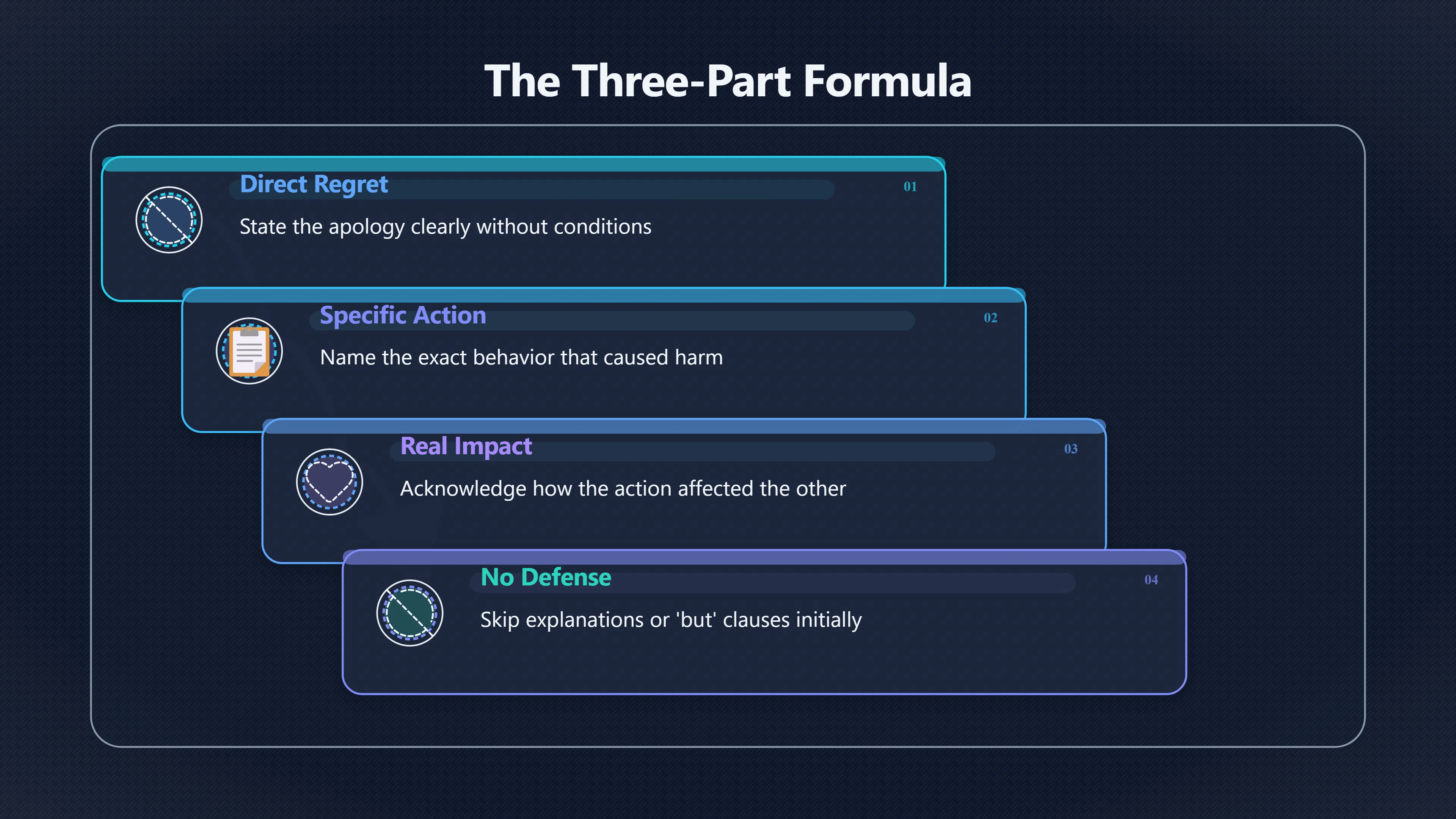
The most useful formula contains three parts:
- The apology itself – a direct statement of regret.
- The specific action – what you did or failed to do.
- The impact – how it affected the other person.
For example:
- “I’m sorry I interrupted you repeatedly in the meeting; it made it harder for you to get your point across.”
- “I’m sorry I forgot your birthday call; I can see how that felt unimportant.”
- “I’m sorry I dismissed your concern; that probably made you feel unheard.”
This structure works because it demonstrates understanding. Rather than saying, “Sorry about earlier,” it shows that you know what requires repair. Research and practitioner guidance on apologies repeatedly emphasise acknowledging responsibility and recognising the harm caused, not merely expressing regret. Harvard Health[Harvard Medical School]hms.harvard.eduHarvard Medical SchoolThe Power of ApologiesAn apology can often be the first step to better understanding in a damaged relationship. It…
A useful test is simple: after hearing your first sentence, would the other person need to explain again what upset them? If so, the opening is probably too vague.
Why Vague Apologies Often Fail
Many apology openings sound polite but trigger resistance because they avoid ownership.
Consider these examples:
- “Sorry if you were offended.”
- “I’m sorry you feel that way.”
- “I’m sorry, but that’s not what I meant.”
- “Mistakes were made.”[hbr.org]hbr.orgGood Leaders Admit MistakesHBR VideoThe best leaders know when they've made a wrong decision. They admit it, apologize, and take swift action to correct the mistake…
Each one shifts attention away from the speaker’s behaviour. The problem is not merely wording. The wording signals a deeper message: the speaker is protecting themselves before acknowledging the other person’s experience.
Psychologists who study apologies note that defensiveness often appears when people feel their self-image is threatened. A common response is to minimise, explain, or qualify the wrongdoing before recognising its impact. Yet apologies are generally more effective when responsibility is acknowledged directly.[ScienceDirect]sciencedirect.comThe role of apology beliefs for apology tendencies across…by A Kirchner-Häusler · 2025 · Cited by 2 — For instance, indiv…[Self Determination Theory]selfdeterminationtheory.org2003 HodginsLeibeskind JESPSelf Determination TheoryApology versus defense: Antecedents and consequencesby HS Hodgins · 2003 · Cited by 273 — Past research has show…
Certain phrases are especially risky in the first sentence:
- “If” – suggests uncertainty about whether harm occurred.
- “But” – often cancels the apology that came before it.
- “You misunderstood” – centres interpretation instead of impact.
- “That wasn’t my intention” – may be true, but usually belongs later, not in the opening.[The Guardian]theguardian.comThe Guardian How sorry are you?Why learning to apologise well could save your relationshipsJune 28, 2025 — Apologizing effectively is a nuanced yet vital interpersonal…
The first sentence is not the place to settle every factual disagreement. Its job is to establish that the other person’s experience matters enough to be acknowledged.
What Lowers Defensiveness in the Listener
People become less defensive when they feel understood. An effective opening sentence communicates that understanding before asking for anything in return.
Three features tend to help:
Specificity. Naming the actual behaviour signals attention. “I’m sorry I spoke over you” is stronger than “I’m sorry for what happened.”
Impact awareness. Referring to the likely consequence shows empathy. “It put you in a difficult position” demonstrates more understanding than “I made a mistake.”
Ownership. Using “I” language keeps responsibility clear. Research on effective apologies repeatedly highlights responsibility-taking as a central ingredient. Ohio State News[Association for Psychological Science]psychologicalscience.orgAssociation for Psychological Science Effective Apologies Include Six ElementsAssociation for Psychological ScienceEffective Apologies Include Six ElementsMay 24, 2016 — Across two studies Lewicki and colleagues fou…
Notice what is absent: self-defence, requests for forgiveness, and detailed explanations. Those may have a place later. The opening sentence works best when it is simple enough that the other person does not need to decode it.
Examples for Home, Work, and Friendship
At Home
Relationships often suffer from repeated small injuries rather than dramatic conflicts. The opening sentence should identify the specific moment.
Less helpful:
“Sorry about last night.”
More helpful:
“I’m sorry I snapped at you when you asked a simple question; that wasn’t fair to you.”
Another example:
“I’m sorry I agreed to help and then disappeared; I left you carrying the whole load.”
These openings name behaviour and impact without immediately defending it.
At Work
Workplace apologies often become overly formal and indirect.
Less helpful:
“I regret any confusion that may have occurred.”
More helpful:
“I’m sorry I gave you the wrong information; it created extra work for you.”
Or:
“I’m sorry I interrupted your presentation; it undermined your chance to finish your point.”
Specificity is especially important in professional settings because it signals accountability rather than damage control. Research on apologies in organisations similarly emphasises responsibility and corrective action as trust-building elements.[Harvard Business School]hbs.eduWas it core to our promise or mission? How will the public react? Are we committed to…Read more…[Communique PR]communiquepr.comThe Importance of an Effective ApologyAccording to research, an effective apology meets three criteria: it's credible, it works to restor…

With Friends
Friendships are often damaged by perceived indifference rather than overt hostility.
Less helpful:
“Sorry if I upset you.”
More helpful:
“I’m sorry I cancelled at the last minute; I can see how that made you feel taken for granted.”
Or:
“I’m sorry I joked about something personal; I crossed a line.”
These sentences show that the speaker has thought about the friend’s experience rather than merely reacting to their disappointment.
The Goal Is Understanding, Not Instant Forgiveness
A common mistake is treating the first sentence as a tool for obtaining forgiveness. The better goal is lowering the temperature enough for an honest conversation.
Research suggests that requests for forgiveness are among the less important components of an effective apology compared with responsibility-taking and repair. In other words, the strongest opening sentence is rarely “Can you forgive me?” It is more often a clear acknowledgement of what happened and why it mattered.[Harvard Pon]pon.harvard.eduthe right way to say im sorry nbHarvard PonThe Right Way to Say I'm Sorry17 Jun 2016 — Of the six components, acknowledgment of responsibility and an offer of repair wer… Larry Ferlazzo’s Websites of the Day…[larryferlazzo.edublogs.org]larryferlazzo.edublogs.orgnew study highlights six components of an effective apologyLarry Ferlazzo's Websites of the Day…New Study Highlights Six Components Of An Effective Apology15 Apr 2016 — The next three elements w…
The first sentence that makes repair easier is usually uncomplicated:
“I’m sorry I did X; it affected you in Y way.”
That formula is not elegant. It is effective because it makes the other person work less hard to feel understood. In the early stages of repair, that is often the most important thing an apology can do.
Amazon book picks
Further Reading
Books and field guides related to The First Sentence That Makes Repair Easier. Use these as the next step if you want deeper reading beyond the article.
The Five Languages of Apology
Provides language and structure for effective apologies.
eBay marketplace picks
Marketplace Samples
Example marketplace items related to this page. Use the search link to explore similar finds on eBay.







Endnotes
1.
Source: pon.harvard.edu
Title: the right way to say im sorry nb
Link:https://www.pon.harvard.edu/daily/conflict-resolution/the-right-way-to-say-im-sorry-nb/
Source snippet
Harvard PonThe Right Way to Say I'm Sorry17 Jun 2016 — Of the six components, acknowledgment of responsibility and an offer of repair wer...
2.
Source: health.harvard.edu
Title: the art of a heartfelt apology 2021041322366
Link:https://www.health.harvard.edu/blog/the-art-of-a-heartfelt-apology-2021041322366
Source snippet
Harvard HealthThe art of a heartfelt apologyDec 21, 2023 — A successful apology validates that the other person felt offended, and acknow...
3.
Source: hms.harvard.edu
Link:https://hms.harvard.edu/sites/default/files/Departments/Ombuds%20Office/files/M.Wagner.ColumbiaUniversity.OmbudsOffice.ThePowerofApologies.pdf
Source snippet
Harvard Medical SchoolThe Power of ApologiesAn apology can often be the first step to better understanding in a damaged relationship. It...
4.
Source: sciencedirect.com
Link:https://www.sciencedirect.com/science/article/pii/S2666622725000176
Source snippet
The role of apology beliefs for apology tendencies across...by A Kirchner-Häusler · 2025 · Cited by 2 — For instance, indiv...
5.
Source: communiquepr.com
Link:https://www.communiquepr.com/understanding-trust-part-ii-the-importance-of-an-effective-apology/
Source snippet
The Importance of an Effective ApologyAccording to research, an effective apology meets three criteria: it's credible, it works to restor...
6.
Source: hms.harvard.edu
Title: M.Wagner.Columbia University.Elements of an Effective Apology
Link:https://hms.harvard.edu/sites/default/files/Departments/Ombuds%20Office/files/M.Wagner.ColumbiaUniversity.Elements%20of%20an%20Effective%20Apology.pdf
Source snippet
of an Effective ApologySome of the most common considerations include the following: 1. A common understanding of the exact substance and...
7.
Source: psychologicalscience.org
Title: Association for Psychological Science Effective Apologies Include Six Elements
Link:https://www.psychologicalscience.org/news/minds-business/effective-apologies-include-six-elements.html
Source snippet
Association for Psychological ScienceEffective Apologies Include Six ElementsMay 24, 2016 — Across two studies Lewicki and colleagues fou...
Published: May 24, 2016
8.
Source: selfdeterminationtheory.org
Title: 2003 HodginsLeibeskind JESP
Link:https://selfdeterminationtheory.org/SDT/documents/2003_HodginsLeibeskind_JESP.pdf
Source snippet
Self Determination TheoryApology versus defense: Antecedents and consequencesby HS Hodgins · 2003 · Cited by 273 — Past research has show...
9.
Source: theguardian.com
Title: The Guardian How sorry are you?
Link:https://www.theguardian.com/science/2025/jun/29/learning-how-to-apologise-well-best-way-to-say-sorry
Source snippet
Why learning to apologise well could save your relationshipsJune 28, 2025 — Apologizing effectively is a nuanced yet vital interpersonal...
Published: June 28, 2025
10.
Source: hbs.edu
Link:https://www.hbs.edu/faculty/Pages/item.aspx?num=49586
Source snippet
Was it core to our promise or mission? How will the public react? Are we committed to...Read more...
11.
Source: larryferlazzo.edublogs.org
Title: new study highlights six components of an effective apology
Link:https://larryferlazzo.edublogs.org/2016/04/15/new-study-highlights-six-components-of-an-effective-apology/
Source snippet
Larry Ferlazzo's Websites of the Day...New Study Highlights Six Components Of An Effective Apology15 Apr 2016 — The next three elements w...
12.
Source: hbr.org
Link:https://hbr.org/2026/04/when-apologizing-to-customers-hurts-more-than-it-helps
Source snippet
When Apologizing to Customers Hurts More Than It Helps20 Apr 2026 — Some failures, like product defects, require disclosure, making an ap...
13.
Source: hbr.org
Title: stop over apologizing at work
Link:https://hbr.org/2023/08/stop-over-apologizing-at-work
Source snippet
Stop Over-Apologizing at Work21 Aug 2023 — There are a variety of reasons we may feel the need to say sorry at work, even when it's not n...
14.
Source: hbr.org
Title: the elements of a good company apology
Link:https://hbr.org/2019/07/the-elements-of-a-good-company-apology
Source snippet
Jul 23, 2019 — Dennis Muilenburg, CEO of Boeing, faced a near-impossible task: He had to apologize for two 737 Max jet crashes, one in Oc...
15.
Source: hbr.org
Title: what a real apology requires
Link:https://hbr.org/2016/10/what-a-real-apology-requires
Source snippet
21 Oct 2016 — What a Real Apology Requires; Leadership And Managing People. Why Effective Leaders Get Branded as Problems; Personal Gro...
16.
Source: hbr.org
Title: sorry not sorry
Link:https://hbr.org/podcast/2019/05/sorry-not-sorry
Source snippet
13 May 2019 — How minimizing language hurts women's careers, how to stop apologizing unnecessarily, and what to say instead...
Published: May 2019
17.
Source: hbr.org
Title: Good Leaders Admit Mistakes
Link:https://hbr.org/video/2228473497001/good-leaders-admit-mistakes
Source snippet
HBR VideoThe best leaders know when they've made a wrong decision. They admit it, apologize, and take swift action to correct the mistake...
18.
Source: hbr.org
Title: how to give a meaningful apolo
Link:https://hbr.org/2013/03/how-to-give-a-meaningful-apolo
Source snippet
gy11 Mar 2013 — Start by saying, “I was wrong.”...
19.
Source: hbr.org
Link:https://hbr.org/2018/01/sorry-is-not-enough
Source snippet
“Sorry” Is Not EnoughSurprising new research shows that approach can backfire: An apology that extends beyond the first seconds of an int...
Additional References
20.
Source: merriam-webster.com
Link:https://www.merriam-webster.com/dictionary/apology
Source snippet
APOLOGY Definition & Meaning1. a: an admission of error or discourtesy accompanied by an expression of regret a public apology b apologi...
21.
Source: ingramcounseling.com
Link:https://www.ingramcounseling.com/an-apology-thats-meaningful/
Source snippet
An Apology That's MeaningfulExpression of regret; Explanation of what went wrong; Acknowledgment of responsibility; Declaration of repent...
22.
Source: researchgate.net
Link:https://www.researchgate.net/publication/301251986_An_Exploration_of_the_Structure_of_Effective_Apologies
Source snippet
An Exploration of the Structure of Effective ApologiesFor an apology to effectively repair trust, it should incorporate multiple componen...
23.
Source: researchgate.net
Link:https://www.researchgate.net/publication/287124645_The_Art_of_the_ApologyThe_Structure_and_Effectiveness_of_Apologies_in_Trust_Repair
Source snippet
The Art of the ApologyThe Structure and Effectiveness...They argue that a maximally effective apology should consist of six components i...
24.
Source: library.tcdc.or.th
Link:https://library.tcdc.or.th/record/read/a00044301
Source snippet
anizational apologyAt some point, every company makes a mistake that requires an apology-to an individual; a group of custom- ers, emp...
25.
Source: thescienceexplorer.com
Title: an effective apology must have these 6 elements according to science 1407
Link:https://www.thescienceexplorer.com/an-effective-apology-must-have-these-6-elements-according-to-science-1407
Source snippet
Expression of regret · 2. Explanation of what went wrong · 3. Acknowledgment of responsibility · 4. Declaration of repentance · 5. Offer...
26.
Source: youtube.com
Link:https://www.youtube.com/watch?v=lpNH9SCegIE
Source snippet
3 Questions to Answer in an ApologyTrust is not as fragile as people think — it can be rebuilt. And that process starts with a good apolo...
27.
Source: researchgate.net
Link:https://www.researchgate.net/publication/262192215_An_Affirmed_Self_and_a_Better_Apology_The_Effect_of_Self-Affirmation_on_Transgressors_Responses_to_Victims
Source snippet
ation reduces defensiveness via self-transcendence, rather than self-integrity...Read more...
28.
Source: news.osu.edu
Title: the 6 elements of an effective apology according to science
Link:https://news.osu.edu/the-6-elements-of-an-effective-apology-according-to-science/
Source snippet
Expression of regret · 2. Explanation of what went wrong · 3. Acknowledgment of responsibility · 4. Declaration of repentance · 5. Offer...
29.
Source: upworthy.com
Link:https://www.upworthy.com/the-6-elements-of-an-effective-apology-as-shown-by-one-of-the-best-apology-songs-ever/
Source snippet
The 6 elements of an effective apology, as shown by one...The 6 elements of an effective apology, as shown by one of the best apology so...
Topic Tree