Within Motivation
How to make a goal feel like yours
Autonomy grows when a goal has a clear personal reason, real choice in the route, and language that reduces pressure.
On this page
- Finding the personal value behind the target
- Adding choice without making the plan vague
- Using non controlling language for hard tasks
Page outline Jump by section
Introduction
A goal feels more chosen when it is connected to reasons you genuinely endorse, pursued through methods that leave room for meaningful choice, and described in language that supports commitment rather than pressure. Research in self-determination theory suggests that people sustain effort more effectively when they experience autonomy—a sense that their actions are willingly endorsed rather than imposed. Importantly, a chosen goal does not have to be pleasant or easy. Revision, rehabilitation exercises, saving money, or training for a race can all feel demanding while still feeling personally worthwhile. The difference is whether you can honestly say, “I choose this because it matters to me,” rather than “I have to do this because I’ll feel guilty if I do not.”[self]self.incBuild Credit, Build Savings and Access CashBuild credit and savings with Self. The Credit Builder Account and Self Visa® Credit Ca… -Determination Theory
 Within self-improvement, making a goal feel more chosen is often less about changing the target and more about changing the relationship to the target. The aim is not to eliminate discipline but to strengthen ownership.
Finding the Personal Value Behind the Target
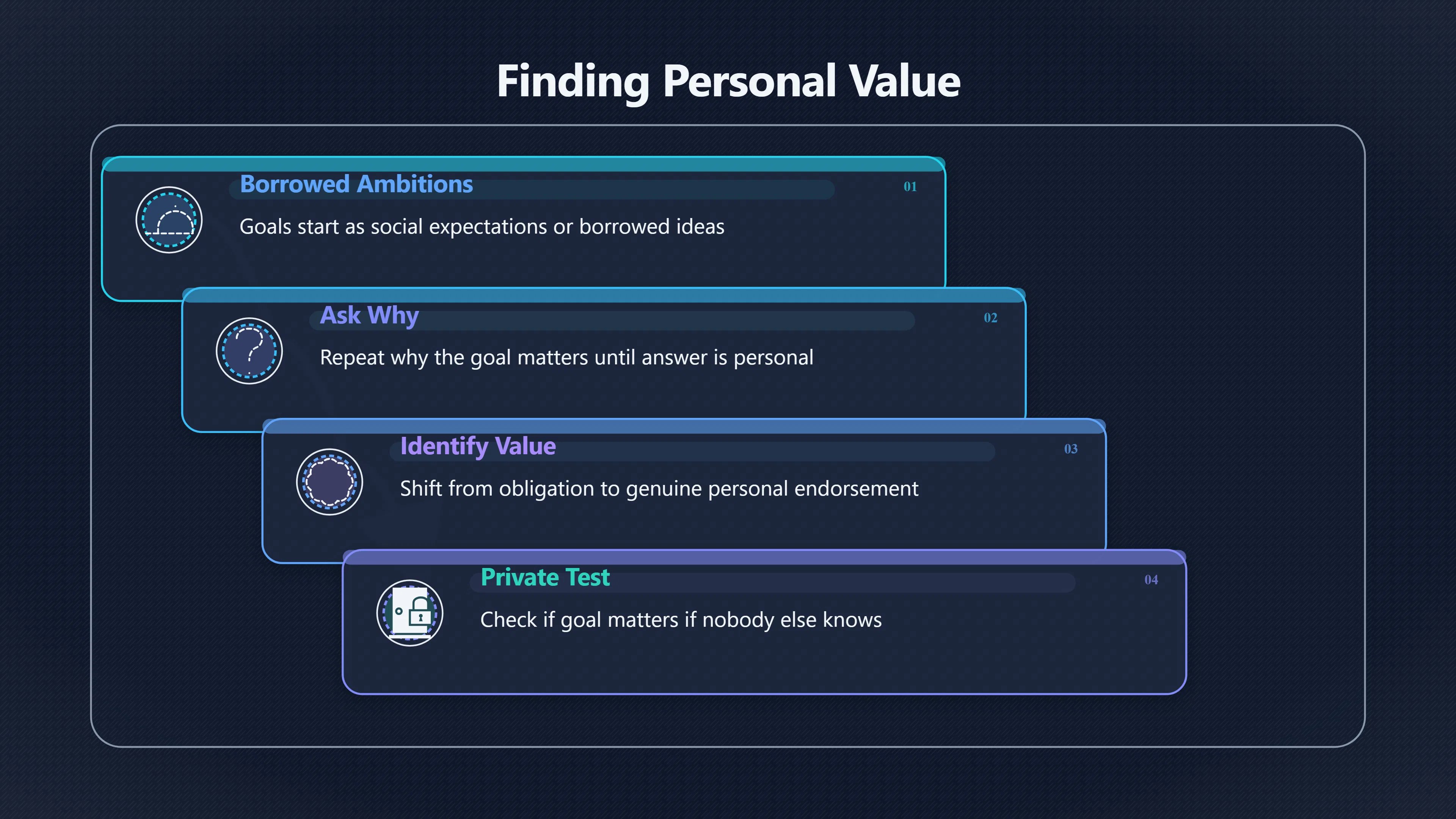
Many goals begin as borrowed ambitions. A person decides to get fit because it seems socially desirable, earn a qualification because others expect it, or start a side project because successful people appear to do the same. These goals may produce short bursts of effort, but they often become fragile when motivation drops.
Research on self-concordant goals shows that people invest more sustained effort when goals align with their interests and core values. That sustained effort increases the likelihood of attainment and contributes to greater wellbeing.[PubMed]pubmed.ncbi.nlm.nih.govGoal striving, need satisfaction, and longitudinal well-beingby KM Sheldon · 1999 · Cited by 4375 — First, those pursuing self-conc…
A practical way to increase ownership is to repeatedly ask why the goal matters until the answer becomes personal rather than performative.
For example:
- “I want to run a marathon.”
- Why? “Because it is a respected achievement.”
- Why does that matter? “I want evidence that I can complete difficult things.”
- Why is that important? “I have spent years doubting my ability to follow through.”
The real goal may not be the marathon itself. It may be developing trust in your own persistence. Once that value becomes clear, the effort feels less like compliance and more like self-expression.
One useful test is to imagine that nobody else would ever know you achieved the goal. If some version of the goal would still matter, you have probably identified a more self-endorsed reason.
Distinguishing Value From Pressure
People often confuse value with obligation.
These statements sound similar but create different motivational experiences:
- “I exercise because I value having energy and mobility.”
- “I exercise because I should be fitter.”
The first reflects identified value. The second reflects pressure. Self-determination theory describes identified regulation as a form of motivation where a person recognises and accepts the personal importance of an activity, even when the activity itself is not especially enjoyable.[TheoryHub]open.ncl.ac.ukself determination theoryTheoryHubSelf-Determination Theory: A review14 Mar 2026 — Identified regulation is a form of extrinsic motivation in SDT where an individ…
When a goal feels stale, the problem is often not the goal itself but the fact that the original value connection has become buried beneath layers of obligation.
Adding Choice Without Making the Plan Vague
Many people assume that commitment requires removing choice. In reality, autonomy tends to increase when people retain control over how a goal is pursued.
Research on autonomy-supportive environments consistently finds that providing meaningful choices strengthens motivation and engagement. Choice does not mean unlimited freedom; it means having options within a clear structure.[Stial]stial.ieRyan and Deci 2020 self determination theorySDT suggests that when students experience a sense of choice they feel.Read more…[Sage Journals]journals.sagepub.comSage JournalsApplying Self-Determination Theory to Educationby F Guay · 2022 · Cited by 796 — Autonomy-supportive behaviors encompass beh…
A useful principle is to keep the destination stable while allowing flexibility in the route.
Instead of:
- “I must study from 6 p.m. to 8 p.m. every weekday.”
Try:
- “I will complete ten hours of focused study this week. I can decide when and where those hours happen.”
Instead of:
- “I have to go to the gym.”
Try:
- “My goal is strength and fitness. I can use the gym, train at home, or go for a challenging walk.”
The objective remains intact, but the person retains agency.

Where Choice Helps Most
Choice is particularly valuable in three areas:
Method choice. Different routes can lead to the same outcome. Someone pursuing fitness might choose swimming, cycling, resistance training, or team sports.
Scheduling choice. Fixed deadlines can coexist with flexible timing. Deciding when to complete a task often preserves autonomy without reducing accountability.
Intensity choice. On difficult days, allowing a smaller version of the behaviour can prevent the all-or-nothing thinking that makes goals feel imposed.
Research on autonomy-supportive communication has found that opportunities for choice often have stronger motivational effects than wording changes alone.[JMIR]jmir.orgIdentifying the Most Autonomy-Supportive Message Frame…by ES Smit · 2019 · Cited by 37 — Conclusions: Results suggest that provisi…
The key is that the choices must be real. Offering fake choices that all lead to the same outcome rarely creates a genuine sense of ownership.
Using Non-Controlling Language for Hard Tasks
The way a goal is described influences how it feels.
Controlling language signals pressure:[yukaichou.com]yukaichou.comSelf-Determination Theory: All 6 Mini-TheoriesMay 6, 2026 — Replace controlling language with autonomy-supportive language…
- “I must.”
- “I should.”
- “I have no choice.”
- “I cannot fail.”
Autonomy-supportive language signals endorsement:[jmir.org]jmir.orgIdentifying the Most Autonomy-Supportive Message Frame…by ES Smit · 2019 · Cited by 37 — Conclusions: Results suggest that provisi…
- “I choose to.”
- “I want to.”
- “I am willing to.”
- “This matters because.”
Research within self-determination theory has repeatedly found that controlling environments increase feelings of pressure and tension, while autonomy-supportive approaches are associated with greater engagement and intrinsic motivation.[self]self.incBuild Credit, Build Savings and Access CashBuild credit and savings with Self. The Credit Builder Account and Self Visa® Credit Ca… -Determination Theory ScienceDirect This does not mean pretending difficult tasks are enjoyable. A more effective approach is acknowledging the difficulty while reaffirming the[sciencedirect.com]sciencedirect.comLearning how to become an autonomy-supportive teacher…by J Reeve · 2024 · Cited by 51 — First, a self-determination theory model of te… value.
For example:
- “I do not feel like writing today, but finishing this project matters to me.”
- “Budgeting is tedious, but financial stability is important to me.”
- “Training is uncomfortable today, but becoming stronger is still worth pursuing.”
This framing preserves honesty. The task is not romanticised, yet it remains self-endorsed.

Rewriting Internal Rules
Many people unknowingly turn goals into commands.
Consider the difference:
Pressure-based ruleChoice-based alternativeI must read every day.I want to become someone who learns consistently.I should never miss a workout.Regular movement is important to me, and I will return after interruptions.I have to be productive.I want to make meaningful progress on work that matters.
The behaviour often stays the same. The psychological experience changes.
A Chosen Goal Still Includes Effort
One common misunderstanding is that a chosen goal should feel easy. Research on internalisation suggests the opposite. People frequently adopt goals that are demanding, repetitive, or uncomfortable because they see them as personally important. The crucial factor is not enjoyment but endorsement.[PubMed]pubmed.ncbi.nlm.nih.govGoal striving, need satisfaction, and longitudinal well-beingby KM Sheldon · 1999 · Cited by 4375 — First, those pursuing self-conc…
Someone training for a marathon may dislike early morning runs. A student may not enjoy every revision session. A person recovering from injury may find rehabilitation tedious. Yet these actions can still feel autonomous because the individual accepts the purpose behind them.
A useful question during difficult periods is:
“If I freely chose this goal for a good reason, what reason am I trying to honour right now?”
That question reconnects effort to meaning.
Signs That a Goal Is Starting to Feel Like Yours
A goal is becoming more chosen when:
- You can explain why it matters in your own words.
- The reason goes beyond avoiding criticism, guilt, or embarrassment.
- You have some genuine choice in how you pursue it.
- Temporary setbacks do not immediately make you question your worth.
- The goal still feels meaningful even when motivation is low.
- You can acknowledge the cost of the effort while continuing to endorse it.
Self-improvement works best when goals are not merely imposed targets but commitments that reflect personal values. The more clearly a goal is connected to who you want to be and why you care, the less it feels like a burden handed to you by circumstance and the more it feels like a direction you have deliberately chosen.
Amazon book picks
Further Reading
Books and field guides related to How to make a goal feel like yours. Use these as the next step if you want deeper reading beyond the article.
The 7 Habits of Highly Effective People
Emphasizes values-based decision making and personal responsibility for chosen goals.
The Happiness of Pursuit
Explores pursuing personally meaningful quests rather than externally imposed ambitions.
Drive
The author of the bestseller "A Whole New Mind" is back with a paradigm-changing examination of how to harness motivation to find greater...
eBay marketplace picks
Marketplace Samples
Example marketplace items related to this page. Use the search link to explore similar finds on eBay.




Endnotes
1.
Source: stial.ie
Title: Ryan and Deci 2020 self determination theory
Link:https://stial.ie/resources/Ryan%20and%20Deci%202020%20self%20determination%20theory.pdf
Source snippet
SDT suggests that when students experience a sense of choice they feel.Read more...
2.
Source: jmir.org
Link:https://www.jmir.org/2019/10/e14074/
Source snippet
Identifying the Most Autonomy-Supportive Message Frame...by ES Smit · 2019 · Cited by 37 — Conclusions: Results suggest that provisi...
3.
Source: sciencedirect.com
Link:https://www.sciencedirect.com/science/article/pii/S0742051X24002348
Source snippet
Learning how to become an autonomy-supportive teacher...by J Reeve · 2024 · Cited by 51 — First, a self-determination theory model of te...
4.
Source: self.inc
Link:https://www.self.inc/
Source snippet
Build Credit, Build Savings and Access CashBuild credit and savings with Self. The Credit Builder Account and Self Visa® Credit Ca...
5.
Source: sciencedirect.com
Link:https://www.sciencedirect.com/science/article/abs/pii/S0361476X20300254
Source snippet
Intrinsic and extrinsic motivation from a self-determination...by RM Ryan · 2020 · Cited by 10215 — SDT is a broad framework for underst...
6.
Source: sciencedirect.com
Link:https://www.sciencedirect.com/org/science/article/pii/S1462373021000158
Source snippet
Goal Self-Concordance Model: What Have We Learned...by P Wan · 2021 · Cited by 15 — Goal self-concordance reflects self-generated person...
7.
Source: sciencedirect.com
Link:https://www.sciencedirect.com/science/article/abs/pii/S0191886916301477
Source snippet
Some goals just feel easier: Self-concordance leads to...by KM Werner · 2016 · Cited by 211 — Research has found that pursuing self-conc...
8.
Source: sciencedirect.com
Title: Self-Determination Theory
Link:https://www.sciencedirect.com/topics/social-sciences/self-determination-theory
Source snippet
an overviewIdentified regulation reflects a more internalized form of extrinsic motivation whereby individuals understand the value of th...
9.
Source: pubmed.ncbi.nlm.nih.gov
Link:https://pubmed.ncbi.nlm.nih.gov/10101878/
Source snippet
Goal striving, need satisfaction, and longitudinal well-beingby KM Sheldon · 1999 · Cited by 4375 — First, those pursuing self-conc...
10.
Source: open.ncl.ac.uk
Title: self determination theory
Link:https://open.ncl.ac.uk/theories/20/self-determination-theory/
Source snippet
TheoryHubSelf-Determination Theory: A review14 Mar 2026 — Identified regulation is a form of extrinsic motivation in SDT where an individ...
11.
Source: journals.sagepub.com
Link:https://journals.sagepub.com/doi/10.1177/08295735211055355
Source snippet
Sage JournalsApplying Self-Determination Theory to Educationby F Guay · 2022 · Cited by 796 — Autonomy-supportive behaviors encompass beh...
12.
Source: pubmed.ncbi.nlm.nih.gov
Link:https://pubmed.ncbi.nlm.nih.gov/11392867/
Source snippet
nih.govSelf-determination theory and the facilitation of intrinsic...Research guided by self-determination theory has focused on the soc...
13.
Source: pubmed.ncbi.nlm.nih.gov
Link:https://pubmed.ncbi.nlm.nih.gov/8169757/
Source snippet
Facilitating internalization: the self-determination theory...by EL Deci · 1994 · Cited by 4810 — Self-determination theory (Deci...
14.
Source: Wikipedia
Link:https://en.wikipedia.org/wiki/Self
Source snippet
SelfIn philosophy, the self is an individual's own being, knowledge, and values, and the relationship between these attributes. The fi...
Additional References
15.
Source: researchgate.net
Link:https://www.researchgate.net/publication/11946306_Self-Determination_Theory_and_the_Facilitation_of_Intrinsic_Motivation_Social_Development_and_Well-Being
Source snippet
Self-Determination Theory and the Facilitation of Intrinsic...11 Nov 2025 — Self-regulation is analyzed in terms of self-determination t...
16.
Source: selfdeterminationtheory.org
Link:https://selfdeterminationtheory.org/research/autonomy-supportive-practices/
Source snippet
Autonomy-Supportive Practices – Page ArrayExploring the pathways through which teacher [support]({{ 'support/' | relative_url }}) predicts changes in students' academic cop...
17.
Source: merriam-webster.com
Link:https://www.merriam-webster.com/dictionary/self
Source snippet
SELF Definition & Meaning1. a (1): an individual's typical character or behavior her true self was revealed (2): an individual's tempor...
18.
Source: reddit.com
Link:https://www.reddit.com/r/CRedit/comments/161z70h/self_credit_builder/
19.
Source: youtube.com
Link:https://www.youtube.com/watch?v=_juPDoa3GBY
Source snippet
Self-Determination Theory ExplainedSelf-determination Theory argues that we do what we do because we are motivated by three basic needs t...
20.
Source: selfdeterminationtheory.org
Link:https://selfdeterminationtheory.org/wp-content/uploads/2021/05/2021_ReeveCheon_AutonomySupportive.pdf
Source snippet
mpirical findings, researchers have developed and implemented numerous teacher-focused and...Read more...
21.
Source: issep.org
Link:https://www.issep.org/features/optimizing-free-will
Source snippet
Optimizing free will: Goal self-concordance and...Aug 12, 2025 — A diagram of the original self-concordance model (Sheldon & Elliot, 1999)...
22.
Source: yukaichou.com
Link:https://yukaichou.com/gamification-analysis/self-determination-theory-guide-to-ryan-and-decis-motivation-framework/
Source snippet
Self-Determination Theory: All 6 Mini-TheoriesMay 6, 2026 — Replace controlling language with autonomy-supportive language...
Published: May 6, 2026
23.
Source: kyptraining.com
Title: Self-determination theory and work motivation
Link:https://kyptraining.com/self-determination-theory-and-work-motivation/
Source snippet
Within SDT, when a behavior is so motivated it is said to be externally regulated—that is, initiated and maintained by conting...
24.
Source: verywellmind.com
Title: what is self determination theory 2795387
Link:https://www.verywellmind.com/what-is-self-determination-theory-2795387
Source snippet
How Self-Determination Theory Explains Motivation29 Oct 2025 — Self-determination theory suggests that fulfilling the core needs for auto...
Topic Tree