Within Tracking
When should outcomes be reviewed?
Outcomes can help test whether a habit is working, but checking them too often turns noisy data into judgement.
On this page
- Why weight, mood and sleep scores fluctuate
- Daily dashboard versus weekly review calendar
- How to change strategy without self criticism
Page outline Jump by section
Introduction
Outcome metrics matter because they answer an important question: is the habit actually working? But many people turn those metrics into daily judgements about themselves. A slightly higher weight, a poor sleep score or a bad mood becomes evidence of failure, even when nothing meaningful has changed.
 For self-improvement that works, outcome measures are most useful when they are treated as trend indicators rather than daily verdicts. Many outcomes move slowly, fluctuate naturally or contain measurement error. Looking at them too often can make random variation feel significant. The goal is not to ignore outcomes. It is to review them on a schedule that matches how quickly they can realistically change.
When should outcomes be reviewed?
A useful distinction is between a daily dashboard and a review calendar.
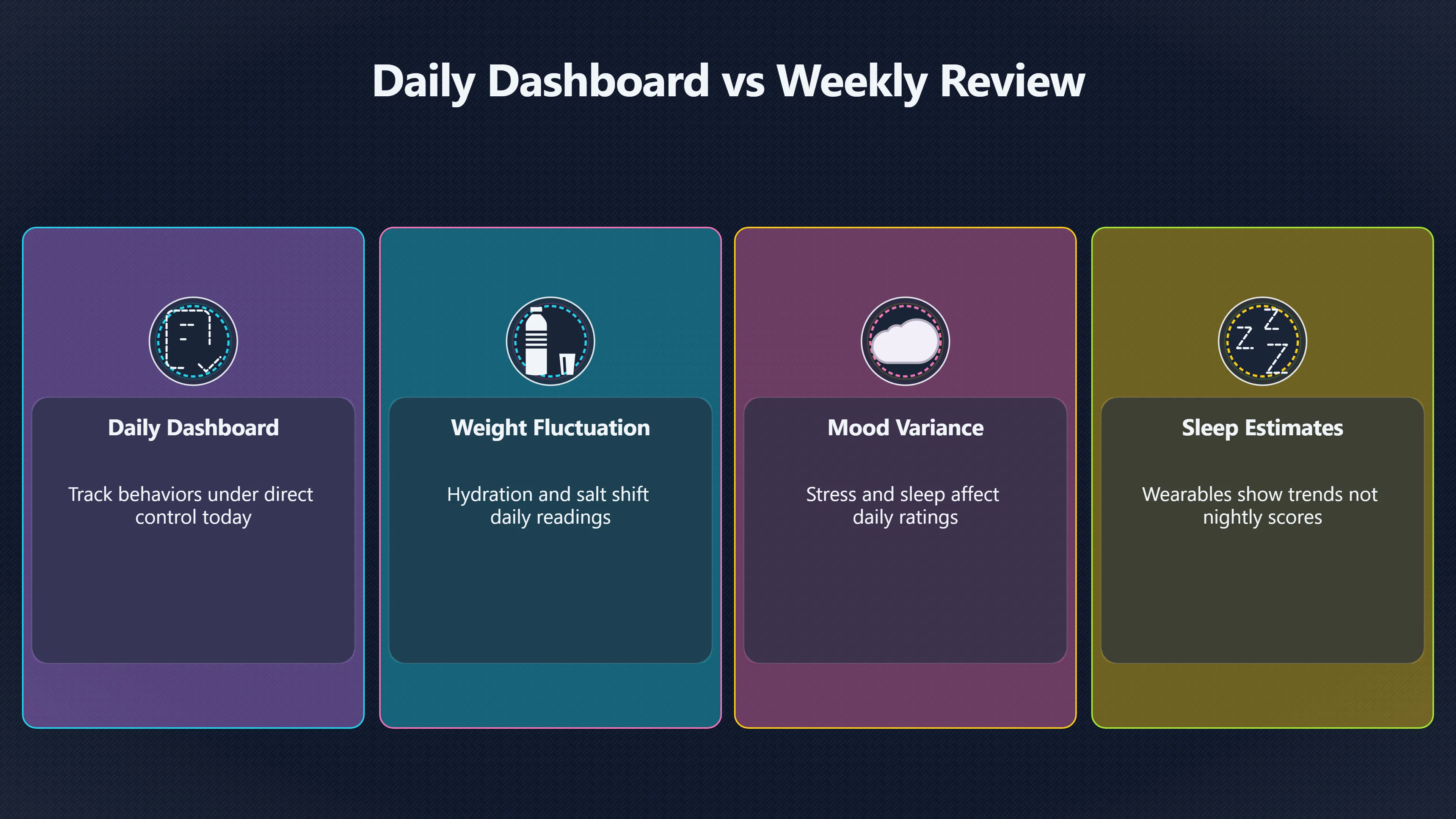
The daily dashboard contains behaviours under direct control: whether you exercised, wrote, studied, went to bed on time or followed a spending plan. These actions generate the future result.
The review calendar contains outcomes: body weight, fitness performance, sleep quality, mood trends, savings balances or other end results. These metrics answer whether the current strategy deserves continuation, adjustment or replacement.
Research on goal progress monitoring consistently finds that monitoring helps goal attainment, particularly when information is recorded and used for self-regulation. However, effective monitoring is not the same as constant evaluation. Monitoring provides information; interpretation requires enough data to identify a pattern rather than a fluctuation.[PubMed]pubmed.ncbi.nlm.nih.govPub Med Does monitoring goal progress promote goal attainment?B Harkin · 2016 · Cited by 750 — Taken together, the findings suggest that monitoring goal progress is an effective self-regulati…
A practical rule is:
- Behaviours: review daily.
- Short-term outcomes: review weekly.
- Slow-moving outcomes: review monthly or quarterly.
The slower the outcome changes, the less useful daily interpretation becomes.
Why weight, mood and sleep scores fluctuate
The biggest mistake in outcome tracking is assuming every measurement reflects genuine progress or decline.
Weight is not the same as fat loss
Body weight can move substantially from one day to the next because of hydration, food volume, digestion, salt intake, hormonal changes and exercise-related fluid shifts. Studies of large populations show predictable weekly weight rhythms, with weight often rising after weekends and falling during the working week.[PMC]pmc.ncbi.nlm.nih.govWeight Rhythms: Weight Increases during Weekends and…by AL Orsama · 2014 · Cited by 83 — A pattern of daily weight changes was foun…
Even health organisations note that body weight can fluctuate by one or more kilograms within a day under normal conditions.[Singapore General Hospital]sgh.com.sghow often should you weigh yourselfSingapore General HospitalHow often should you weigh yourself?15 Feb 2023 — Body weight can fluctuate by 1 to 2kg during a single day…
This means that a single weigh-in often tells a story about yesterday’s meals and water balance rather than long-term body composition. Trend lines and weekly averages are usually more informative than isolated readings. PMC[JAMA Network]jamanetwork.comWeekly, Seasonal, and Festive Period Weight Gain Among…by C Maher · 2023 · Cited by 12 — In this cohort study of 368 adults, weight fl…
Interestingly, research has found that frequent self-weighing can support weight management when it functions as information gathering rather than emotional judgement. The problem is not collecting the data; the problem is treating each measurement as a verdict on success or failure.[PMC]pmc.ncbi.nlm.nih.govby DM Steinberg · 2015 · Cited by 149 — Weighing everyday led to greater adoption of weight control behaviors and produced greater wei…[PMC]pmc.ncbi.nlm.nih.govPMCFrequency of Self-Weighing and Weight Changeof Self-Weighing and Weight Change - PMC - NIHby AL Vuorinen · 2021 · Cited by 26 — Frequent self-weighing is associated with successful…
Mood naturally varies
Mood responds to sleep, stress, social experiences, physical health, workload and countless situational factors. A difficult meeting or poor night’s sleep can affect a day’s rating without revealing anything about long-term wellbeing.
When mood tracking becomes a search for daily proof of improvement, ordinary variation can be misread as regression. Weekly patterns often reveal more than individual entries because they smooth temporary spikes and dips.
Sleep scores are estimates, not judgements
Consumer sleep trackers can be useful for identifying broad trends, but sleep metrics contain uncertainty. Research comparing wearables with laboratory sleep measurements shows meaningful limitations in accuracy, particularly for sleep stages and certain sleep parameters.[PMC]pmc.ncbi.nlm.nih.govPMCEffect of wearables on sleep in healthy individualsAlthough some have shown unacceptably high variability…Read more…
Sleep experts increasingly recommend focusing on long-term patterns rather than obsessing over nightly scores. Even high-quality devices are better at highlighting trends than providing perfect night-by-night assessments.[WIRED]wired.comIt reviews and compares various types of sleep trackers—smart rings, wristbands, and mattress covers—focusing on accuracy, comfort, app u…[The Guardian]theguardian.comIndividuals like Annie use wearables such as smartwatches and rings to monitor sleep quality, guiding lifestyle decisions including daily…
A single low sleep score may reflect normal variability, device limitations or temporary circumstances. It is rarely a reliable basis for changing an entire sleep strategy.
Daily dashboard versus weekly review calendar
Separating behaviour tracking from outcome review protects motivation.
Consider someone trying to improve sleep.
A daily dashboard might include:
- Bedtime consistency.
- Phone out of the bedroom.
- Caffeine cut-off time.
- Morning light exposure.
The outcome metric might be:
- Average sleep duration.
- Average sleep score.
- Subjective feeling of restfulness.
The behavioural measures receive daily attention because they guide today’s decisions. The outcome measures receive weekly review because they answer whether the behaviour package is producing results.
The same structure works elsewhere:
GoalDaily dashboardReview calendarWeight lossMeals planned, exercise completed, protein target metWeekly weight trendFitnessTraining sessions completedMonthly performance metricsWritingWriting time completedMonthly output and quality indicatorsSavingsSpending behaviour trackedMonthly account growthMoodRecovery habits and routinesWeekly mood patterns
This approach prevents a common psychological trap: abandoning a useful behaviour before the outcome has had time to respond.

Why daily verdicts create misleading feedback
Human beings are highly sensitive to recent information. A disappointing measurement today often feels more important than twenty encouraging measurements over the previous month.
This creates several distortions:
- Noise becomes meaning. Random variation is interpreted as evidence.
- Short-term emotions dominate. Discouragement follows normal fluctuations.
- Good systems are abandoned too early. Temporary setbacks look like proof that a strategy has failed.
- Self-worth becomes attached to numbers. The metric shifts from information to identity.
The result is often more tracking but less learning.
Paradoxically, excessive checking can make people less accurate because they become focused on individual data points rather than the underlying trend.
How to change strategy without self-criticism
Outcome reviews are valuable because they create a scheduled opportunity to learn.
The key question is not:
Why am I failing?
Instead ask:
What does this trend suggest about the current strategy?
That small shift changes the role of outcome metrics.
A weekly review might reveal:
- The behaviour was inconsistent.
- The behaviour was consistent but insufficient.
- The outcome measure was too noisy to judge yet.
- External circumstances temporarily affected results.
- The strategy needs adjustment.
None of these conclusions require self-criticism.
For example, if six weeks of consistent exercise produce no improvement in a fitness goal, the useful response is strategic curiosity: perhaps training volume, intensity or recovery needs modification. The data is serving its purpose by revealing a mismatch between effort and outcome.
Outcome metrics are most helpful when they function like a navigation system. They tell you whether the route is working. They do not determine your worth as a person. A wrong turn requires a course correction, not a verdict.
The most useful mindset: trends over moments
Many self-improvement outcomes resemble weather more than clockwork. They move through cycles, fluctuations and temporary disturbances before revealing a longer pattern.
A single number is a moment. A collection of numbers becomes a trend.
When outcomes are reviewed at appropriate intervals, they become tools for learning. When they are checked constantly and interpreted emotionally, they become tools for judgement.
The difference is not the metric itself. It is the rhythm of review. A daily dashboard helps you act. A review calendar helps you learn whether those actions are working. Together they provide feedback without turning every day into a pass-or-fail test.
Amazon book picks
Further Reading
Books and field guides related to When should outcomes be reviewed?. Use these as the next step if you want deeper reading beyond the article.
Atomic Habits
Rating: 3.5/5 from 7 Google Books ratings
Distinguishes process measures from outcomes.
eBay marketplace picks
Marketplace Samples
Example marketplace items related to this page. Use the search link to explore similar finds on eBay.




Endnotes
1.
Source: pmc.ncbi.nlm.nih.gov
Link:https://pmc.ncbi.nlm.nih.gov/articles/PMC5644907/
Source snippet
Weight Rhythms: Weight Increases during Weekends and...by AL Orsama · 2014 · Cited by 83 — A pattern of daily weight changes was foun...
2.
Source: pmc.ncbi.nlm.nih.gov
Link:https://pmc.ncbi.nlm.nih.gov/articles/PMC4380831/
Source snippet
by DM Steinberg · 2015 · Cited by 149 — Weighing everyday led to greater adoption of weight control behaviors and produced greater wei...
3.
Source: pmc.ncbi.nlm.nih.gov
Title: PMCFrequency of Self-Weighing and Weight Change
Link:https://pmc.ncbi.nlm.nih.gov/articles/PMC8277333/
Source snippet
of Self-Weighing and Weight Change - PMC - NIHby AL Vuorinen · 2021 · Cited by 26 — Frequent self-weighing is associated with successful...
4.
Source: pmc.ncbi.nlm.nih.gov
Title: PMCEffect of wearables on sleep in healthy individuals
Link:https://pmc.ncbi.nlm.nih.gov/articles/PMC7849816/
Source snippet
Although some have shown unacceptably high variability...Read more...
5.
Source: wired.com
Link:https://www.wired.com/story/best-sleep-trackers
Source snippet
It reviews and compares various types of sleep trackers—smart rings, wristbands, and mattress covers—focusing on accuracy, comfort, app u...
6.
Source: pubmed.ncbi.nlm.nih.gov
Title: Pub Med Does monitoring goal progress promote goal attainment?
Link:https://pubmed.ncbi.nlm.nih.gov/26479070/
Source snippet
B Harkin · 2016 · Cited by 750 — Taken together, the findings suggest that monitoring goal progress is an effective self-regulati...
7.
Source: jamanetwork.com
Link:https://jamanetwork.com/journals/jamanetworkopen/fullarticle/2807660
Source snippet
Weekly, Seasonal, and Festive Period Weight Gain Among...by C Maher · 2023 · Cited by 12 — In this cohort study of 368 adults, weight fl...
8.
Source: sgh.com.sg
Title: how often should you weigh yourself
Link:https://www.sgh.com.sg/news/patient-care/how-often-should-you-weigh-yourself
Source snippet
Singapore General HospitalHow often should you weigh yourself?15 Feb 2023 — Body weight can fluctuate by 1 to 2kg during a single day...
9.
Source: theguardian.com
Link:https://www.theguardian.com/lifeandstyle/2025/oct/20/smart-watch-wearable-sleep-trackers-data-harder-to-sleep
Source snippet
Individuals like Annie use wearables such as smartwatches and rings to monitor sleep quality, guiding lifestyle decisions including daily...
10.
Source: psychiatry.ucsd.edu
Title: goal progress
Link:https://psychiatry.ucsd.edu/research/programs-centers/instep/tools-resource/definitions/team-processes/action-phase/goal-progress.html
Source snippet
Progress MonitoringTracking task and progress toward mission accomplishment, interpreting system information in terms of what needs to be...
Additional References
11.
Source: clinicaltrials.gov
Link:https://clinicaltrials.gov/study/NCT01369004
Source snippet
The WEIGH Study: Weighing to Improve and Gain HealthThe objective of the WEIGH Study (Weighing to Improve and Gain Health) is to test the...
12.
Source: catalystfitnessflorida.com
Link:https://catalystfitnessflorida.com/why-its-important-to-focus-on-your-weekly-weight-average-instead-of-daily-fluctuations/
Source snippet
Tracking Weight: Why Weekly Averages MatterWhen you calculate your weekly weight average, you smooth out the daily highs and lows, giving...
13.
Source: labfront.com
Link:https://www.labfront.com/course-video/how-consumer-wearables-measure-sleep-quality
Source snippet
Sleep 5.1 How Consumer Wearables Measure Sleep QualityWe cover the physiological measures used by consumer wearables like Apple Watch, Ga...
14.
Source: t3.com
Link:https://www.t3.com/active/fitness-trackers/why-your-smartwatch-thinks-you-slept-badly
Source snippet
Smartwatches, such as the Apple Watch and Samsung Galaxy Watch, use motion sensors and optical heart rate data to estimate sleep quality...
15.
Source: healthline.com
Link:https://www.healthline.com/health/weight-fluctuation
Source snippet
The average adult's weight fluctuates up to 5 or 6 pounds per day. It all comes down to what and when you eat and drink.Read more...
16.
Source: eprints.whiterose.ac.uk
Link:https://eprints.whiterose.ac.uk/id/eprint/87431/1/bul%20harkin%20raw%20final.pdf
Source snippet
by B Harkin · 2016 · Cited by 750 — Moderation tests revealed that progress monitoring had larger effects on goal attainment when the out...
17.
Source: blog.nasm.org
Title: research in review will weighing in every day improve weight control behaviors
Link:https://blog.nasm.org/fitness/research-in-review-will-weighing-in-every-day-improve-weight-control-behaviors
Source snippet
Everyday Weight Control...Results: Overall compliance of self-weighing was high: 51% weighed ever day; 76% weighed more than or equal to...
18.
Source: youtube.com
Link:https://www.youtube.com/watch?v=MHj9R9u5a8Y
Source snippet
Best Wearables for Sleep: Scientific RankingsWe will see which devices are good at tracking your deep sleep RAM sleep and light sleep and...
19.
Source: eprints.whiterose.ac.uk
Title: whiterose.ac.uk Does Monitoring Goal Progress Promote Goal Attainment?
Link:https://eprints.whiterose.ac.uk/id/eprint/91437/
Source snippet
by B Harkin · 2016 · Cited by 750 — Moderation tests revealed that progress monitoring had larger effects on goal attainment when the out...
20.
Source: ovid.com
Link:https://www.ovid.com/journals/plbul/fulltext/10.1037/bul0000025~does-monitoring-goal-progress-promote-goal-attainment-a
Source snippet
Does Monitoring Goal Progress Promote Goal...by B Harkin · 2016 · Cited by 750 — Taken together, the findings suggest that monitoring goa...
Topic Tree