Within Low Energy
Make the next good action obvious
The right cue makes the desired action easier to notice and start when motivation is low.
On this page
- Starting friction versus decision friction
- Useful cues in bedrooms, kitchens and workspaces
- When setup becomes another barrier
Page outline Jump by section
Introduction
On low-energy days, the hardest part of a useful habit is often not the work itself but getting started. Environmental cues reduce that starting friction by making the next good action easier to notice, easier to remember and easier to begin. Instead of relying on motivation, they use the physical environment as a prompt: a book left on a pillow, a water bottle already on a desk, walking shoes placed by the door, or a prepared workspace that requires no setup. Research on habit formation shows that stable contextual cues help behaviours become more automatic over time, reducing the need for conscious effort and decision-making.[PubMed Central]pmc.ncbi.nlm.nih.govThey not only support memory but may also help to make the new…[Taylor & Francis Online]tandfonline.comTaylor & Francis OnlineDeveloping habit-based health behaviour change…by B Gardner · 2023 · Cited by 156 — Understanding the 'shape' o…
 For a low-energy self-improvement plan, the goal is not to create a perfect environment. It is to make the next useful action obvious enough that tiredness does not immediately derail it.
Starting friction versus decision friction
Starting friction is the effort required to begin an action. Decision friction is the mental effort required to decide what action to take. Low-energy days amplify both.
Consider two versions of the same reading habit:
- Version A: decide what to read, find the book, clear a space and sit down.
- Version B: the book is already open on the chair where you usually sit.
The reading itself has not changed. The starting conditions have.
Behaviour-change research suggests that environmental cues support action by strengthening links between situations and behaviours. Repeating an action in a stable context helps create cue-behaviour associations that later trigger behaviour with less conscious effort. Taylor & Francis Online[Cambridge University Press & Assessment]cambridge.orgUniversity Press & Assessment Habit Interventions (Chapter 41Cambridge University Press & AssessmentHabit Interventions (Chapter 41) - The Handbook of…The central BCT involved in habit formation…
This is closely related to implementation intentions, often expressed as “when X happens, I will do Y”. These plans work partly because they connect a specific cue with a specific response, reducing the need for fresh decisions at the moment of action.[PubMed Central]pmc.ncbi.nlm.nih.govThey not only support memory but may also help to make the new…[Good.You]good.youHabit Stacking and Implementation Intentions - Good.You13 Feb 2026 — An implementation intention is a specific plan that links a situatio…
The practical lesson is simple: if you want a behaviour to survive low-energy days, reduce the number of decisions between noticing the cue and starting the action.
Why visible cues work when motivation is low
Many people assume motivation causes action. In reality, prompts and environmental signals often matter just as much.
The Fogg Behaviour Model proposes that behaviour occurs when motivation, ability and a prompt converge at the same moment. When motivation is low, increasing ability (making the behaviour easier) and improving prompts (making the cue more obvious) become especially important.[Behavior Design Lab]behaviordesign.stanford.eduBehavior Design LabFogg Behavior ModelThe Fogg Behavior Model shows that three elements must converge at the same moment for a behavior t…[Fogg Behavior Model]behaviormodel.orgFogg Behavior ModelFogg Behavior Model - BJ FoggThe Fogg Behavior Model shows that three elements must converge at the same moment for a…
Environmental cues are effective because they reduce the burden on memory. Research on contextual cues and habit formation suggests that cues do more than remind people; they help establish routines that eventually require less conscious regulation.[PubMed Central]pmc.ncbi.nlm.nih.govThey not only support memory but may also help to make the new…[ORCA]orca.cardiff.ac.ukWhat influences the selection of contextual cues when…by K Stawarz · 2020 · Cited by 45 — Background: Contextual cues play an impo…
There is also a memory component. Studies of context-dependent memory show that environmental features can become linked with particular thoughts and actions, making recall easier when the same cues are present again.[Simply Psychology]simplypsychology.orgSimply PsychologyContext and State-Dependent Memoryby S McLeod · Cited by 3 — Context-dependent memory refers to improved recall of speci… PubMed A useful cue therefore performs two jobs at once:[behaviormodel.org]behaviormodel.orgFogg Behavior ModelFogg Behavior Model - BJ FoggThe Fogg Behavior Model shows that three elements must converge at the same moment for a…
- It attracts attention.
- It reminds the brain what action usually follows.
Useful cues in bedrooms, kitchens and workspaces
Different environments naturally support different behaviours. The most effective cues are usually those placed exactly where the behaviour should begin.
Bedrooms
A bedroom can either encourage passive scrolling or support recovery-focused habits.
Useful examples include:
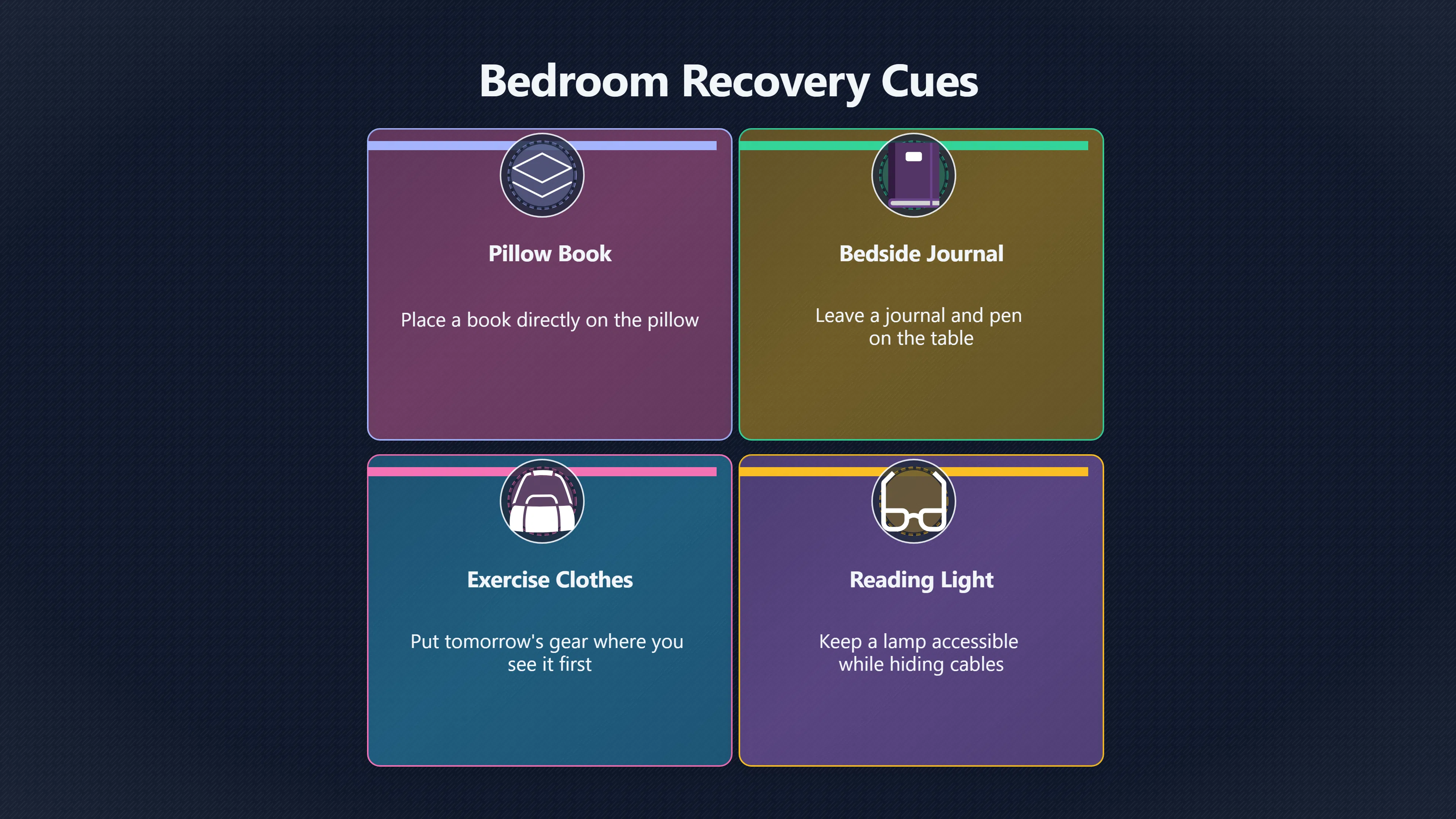
- Placing a book directly on the pillow to create a reading prompt before sleep.
- Leaving a journal and pen on the bedside table rather than in a drawer.
- Putting tomorrow’s exercise clothes where they are the first thing seen after waking.
- Keeping charging cables away from the bed while leaving a reading light easily accessible.
The common feature is visibility. The desired behaviour is physically easier to notice than the competing behaviour.
Kitchens
Kitchens strongly influence eating and hydration habits because they contain constant behavioural cues.
Examples include:
- Leaving a filled water bottle on the counter.
- Storing healthier foods at eye level.
- Preparing vegetables or ingredients in advance so cooking begins with less effort.
- Keeping a fruit bowl visible while storing less desirable options out of immediate sight.
Choice architecture research shows that how options are presented influences behaviour. Small changes in visibility, accessibility and default options can meaningfully affect choices without requiring stronger motivation.[ResearchGate]researchgate.netPDF) Habit Formation and ChangeAs people repeat behavior in a stable context, their intentions and goals to perform the behavior. gradua…[The Decision Lab]thedecisionlab.comThe Decision LabChoice ArchitectureThe three main types of choice architecture are defaults, information restructuring, and information f…[PubMed Central]pmc.ncbi.nlm.nih.govThey not only support memory but may also help to make the new…

Workspaces
Workspaces are particularly vulnerable to friction because productive tasks often require setup.
Useful cues include:
- Leaving the document you need open before ending the previous session.
- Keeping a notebook open to the next blank page.
- Positioning task lists within the normal line of sight.
- Placing headphones, study materials or work tools in their starting positions before finishing for the day.
The best workspace cue often answers the question, “What do I do first?” before you have to ask it.
Make cues specific, not merely present
A common mistake is assuming that any reminder will work.
Research examining contextual cues found that people frequently choose cues that are memorable in theory but ineffective in practice because they are inconsistent, easy to ignore or disconnected from existing routines.[PubMed Central]pmc.ncbi.nlm.nih.govThey not only support memory but may also help to make the new…
Strong cues tend to have three characteristics:
- They are encountered reliably. You see them almost every day.
- They appear immediately before the desired action. The cue and behaviour are closely linked.
- They require little interpretation. The next step is obvious.
For example, “exercise more” attached to a vague phone reminder is weaker than placing walking shoes beside the front door. The shoes communicate both the reminder and the next action.
This principle appears in habit-stacking approaches, where a new behaviour is attached to an existing routine. An established event becomes the cue for the new action.[Thrive Street Advisors]thrivestreetadvisors.comThrive Street AdvisorsTiny HabitsA simple version of the new habit you want, such as flossing one tooth or doing two push-ups. You do the…
When setup becomes another barrier
Environmental design can fail when people turn preparation into a project.
A low-energy plan does not require colour-coded systems, expensive equipment or elaborate organisation. In fact, excessive setup often creates a new layer of friction.
Warning signs include:
- Spending more time organising than performing the behaviour.
- Constantly redesigning the system instead of using it.
- Creating so many cues that they blend into the background.
- Depending on perfect environmental conditions before acting.
The strongest environmental cues are usually simple and practical. A visible book is often more useful than a sophisticated reading tracker. A pair of shoes by the door is often more useful than a detailed exercise spreadsheet.
The purpose of the environment is not to impress you. It is to reduce the distance between noticing and doing.
Design for the next action, not the entire goal
People often try to cue the end result: becoming fit, organised, productive or well-read. Environmental cues work better when they target the first physical action.
Instead of prompting “work on my health”, cue “fill the water bottle”.
Instead of prompting “be productive”, cue “open the document”.
Instead of prompting “exercise”, cue “put on the trainers”.
This focus aligns with evidence that habits develop through repeated responses to stable contexts. Over time, the cue becomes associated with the action itself rather than with an abstract goal. Taylor & Francis Online[Cambridge University Press & Assessment]cambridge.orgUniversity Press & Assessment Habit Interventions (Chapter 41Cambridge University Press & AssessmentHabit Interventions (Chapter 41) - The Handbook of…The central BCT involved in habit formation…
For low-energy days, that distinction matters. Goals require energy to interpret. Clear environmental cues reduce interpretation and make the next useful action obvious. When motivation fluctuates, that small reduction in friction can be the difference between doing nothing and maintaining momentum.
Amazon book picks
Further Reading
Books and field guides related to Make the next good action obvious. Use these as the next step if you want deeper reading beyond the article.
Atomic Habits
Rating: 3.5/5 from 7 Google Books ratings
Strong emphasis on environment design and visible cues.
eBay marketplace picks
Marketplace Samples
Example marketplace items related to this page. Use the search link to explore similar finds on eBay.

Endnotes
1.
Source: cambridge.org
Title: University Press & Assessment Habit Interventions (Chapter 41)
Link:https://www.cambridge.org/core/books/handbook-of-behavior-change/habit-interventions/420CFDC7EE75036CC4D08EE137108E45
Source snippet
Cambridge University Press & AssessmentHabit Interventions (Chapter 41) - The Handbook of...The central BCT involved in habit formation...
2.
Source: researchgate.net
Link:https://www.researchgate.net/publication/322222649_Habit_Formation_and_Change
Source snippet
(PDF) Habit Formation and ChangeAs people repeat behavior in a stable context, their intentions and goals to perform the behavior. gradua...
3.
Source: good.you
Link:https://good.you/growth/habits/habit-stacking-implementation-intentions
Source snippet
Habit Stacking and Implementation Intentions - Good.You13 Feb 2026 — An implementation intention is a specific plan that links a situatio...
4.
Source: orca.cardiff.ac.uk
Link:https://orca.cardiff.ac.uk/id/eprint/130662/1/130662.pdf
Source snippet
What influences the selection of contextual cues when...by K Stawarz · 2020 · Cited by 45 — Background: Contextual cues play an impo...
5.
Source: researchgate.net
Link:https://www.researchgate.net/publication/263111226_Context_Dependent_Memory_The_Role_of_Environmental_Cues
Source snippet
Context Dependent Memory: The Role of Environmental...Memory's dependence on environmental context implies that elements of the learning...
6.
Source: researchgate.net
Link:https://www.researchgate.net/publication/357588610_The_effectiveness_of_nudging_A_meta-analysis_of_choice_architecture_interventions_across_behavioral_domains
Source snippet
The effectiveness of nudging: A meta-analysis of choice...Choice architecture interventions aim to nudge people toward personally and so...
7.
Source: researchgate.net
Link:https://www.researchgate.net/publication/343756368_Habits_to_Save_our_Habitat_Using_the_Psychology_of_Habits_to_Promote_Sustainability
Source snippet
e in eco-friendly actions and making it harder to continue environmentally damaging...Read more...
8.
Source: pmc.ncbi.nlm.nih.gov
Link:https://pmc.ncbi.nlm.nih.gov/articles/PMC7106637/
Source snippet
They not only support memory but may also help to make the new...
9.
Source: tandfonline.com
Link:https://www.tandfonline.com/doi/full/10.1080/08870446.2021.2003362
Source snippet
Taylor & Francis OnlineDeveloping habit-based health [behaviour change]({{ 'behaviour-change/' | relative_url }})...by B Gardner · 2023 · Cited by 156 — Understanding the 'shape' o...
10.
Source: pmc.ncbi.nlm.nih.gov
Link:https://pmc.ncbi.nlm.nih.gov/articles/PMC10585941/
Source snippet
PubMed CentralInstant habits versus flexible tenacity: Do implementation...by T van Timmeren · 2022 · Cited by 11 — Implementation inten...
11.
Source: behaviordesign.stanford.edu
Link:https://behaviordesign.stanford.edu/resources/fogg-behavior-model
Source snippet
Behavior Design LabFogg Behavior ModelThe Fogg Behavior Model shows that three elements must converge at the same moment for a behavior t...
12.
Source: behaviormodel.org
Link:https://www.behaviormodel.org/
Source snippet
Fogg Behavior ModelFogg Behavior Model - BJ FoggThe Fogg Behavior Model shows that three elements must converge at the same moment for a...
13.
Source: simplypsychology.org
Link:https://www.simplypsychology.org/context-and-state-dependent-memory.html
Source snippet
Simply PsychologyContext and State-Dependent Memoryby S McLeod · Cited by 3 — Context-dependent memory refers to improved recall of speci...
14.
Source: thedecisionlab.com
Link:https://thedecisionlab.com/reference-guide/psychology/choice-architecture
Source snippet
The Decision LabChoice ArchitectureThe three main types of choice architecture are [defaults]({{ 'defaults/' | relative_url }}), information restructuring, and information f...
15.
Source: pmc.ncbi.nlm.nih.gov
Title: Pub Med Central The effectiveness of nudging: A meta-analysis of choice
Link:https://pmc.ncbi.nlm.nih.gov/articles/PMC8740589/
Source snippet
by S Mertens · 2021 · Cited by 977 — Choice architecture interventions aim to nudge people toward personally and socially desirable be...
16.
Source: thrivestreetadvisors.com
Link:https://www.thrivestreetadvisors.com/leadership-library/tiny-habits
Source snippet
Thrive Street AdvisorsTiny HabitsA simple version of the new habit you want, such as flossing one tooth or doing two push-ups. You do the...
Additional References
17.
Source: bjsrestaurants.com
Link:https://www.bjsrestaurants.com/
Source snippet
BJ's Restaurants and BrewhouseDiscover our brewhouse menu featuring deep dish pizza, handcrafted burgers, seasonal specials, popular favo...
18.
Source: facebook.com
Link:https://www.facebook.com/bjswholesaleclub/
Source snippet
BJ's Wholesale ClubThe quality you trust, now with even more to save. Score exclusive, limited-time deals on your Wellsley Farms + Berkle...
19.
Source: bjfogg.com
Link:https://www.bjfogg.com/tiny-habits
Source snippet
Behavior Scientist & Author of Tiny HabitsBuilding on his groundbreaking model, which shows that behavior occurs when motivation, ability...
20.
Source: jamesclear.com
Link:https://jamesclear.com/environment-design-organ-donation
Source snippet
Environment Design: How to Improve Without ThinkingLearn how to use environment design to create a healthier and more productive environm...
21.
Source: linkedin.com
Link:https://www.linkedin.com/posts/benjamincrudo_most-people-try-to-change-habits-by-pushing-activity-7387150549122555904-Kc_Z
Source snippet
How to build habits with Tiny Habits by Dr. BJ FoggThat's it. This is called habit stacking and environmental design. You're removing the...
22.
Source: behaviormodel.org
Link:https://www.behaviormodel.org/prompts
Source snippet
Prompts in the Fogg Behavior ModelLearn how prompts activate behavior in the Fogg Behavior Model and how to design effective triggers tha...
23.
Source: thebettercompany.io
Link:https://thebettercompany.io/en/tiny-habits-method/
Source snippet
The Tiny habits methodIn this article, we summarize the core ideas of the Tiny Habits Method and provide practical tools to apply them im...
24.
Source: blog.cohorty.app
Link:https://blog.cohorty.app/the-role-of-environment-in-habit-formation-how-your-surroundings-shape-your-behavior/
Source snippet
Design for Habits: Make Good Habits Easy...Nir Eyal's research on behavioral design shows that increasing cue salience by 20-30% can dou...
25.
Source: betterhelp.com
Link:https://www.betterhelp.com/advice/memory/context-dependent-memory-how-it-works-and-why-it-matters/
26.
Source: researchportal.northumbria.ac.uk
Link:https://researchportal.northumbria.ac.uk/files/63627122/Gardner_et_al_2021_EHPS_Synergy_habit_paper.pdf
Source snippet
habit-based health behaviour change...by B Gardner · Cited by 148 — Understanding the 'shape' of the within-person relationship between...
Topic Tree