Within Apologies
Why Some Apologies Make Things Worse
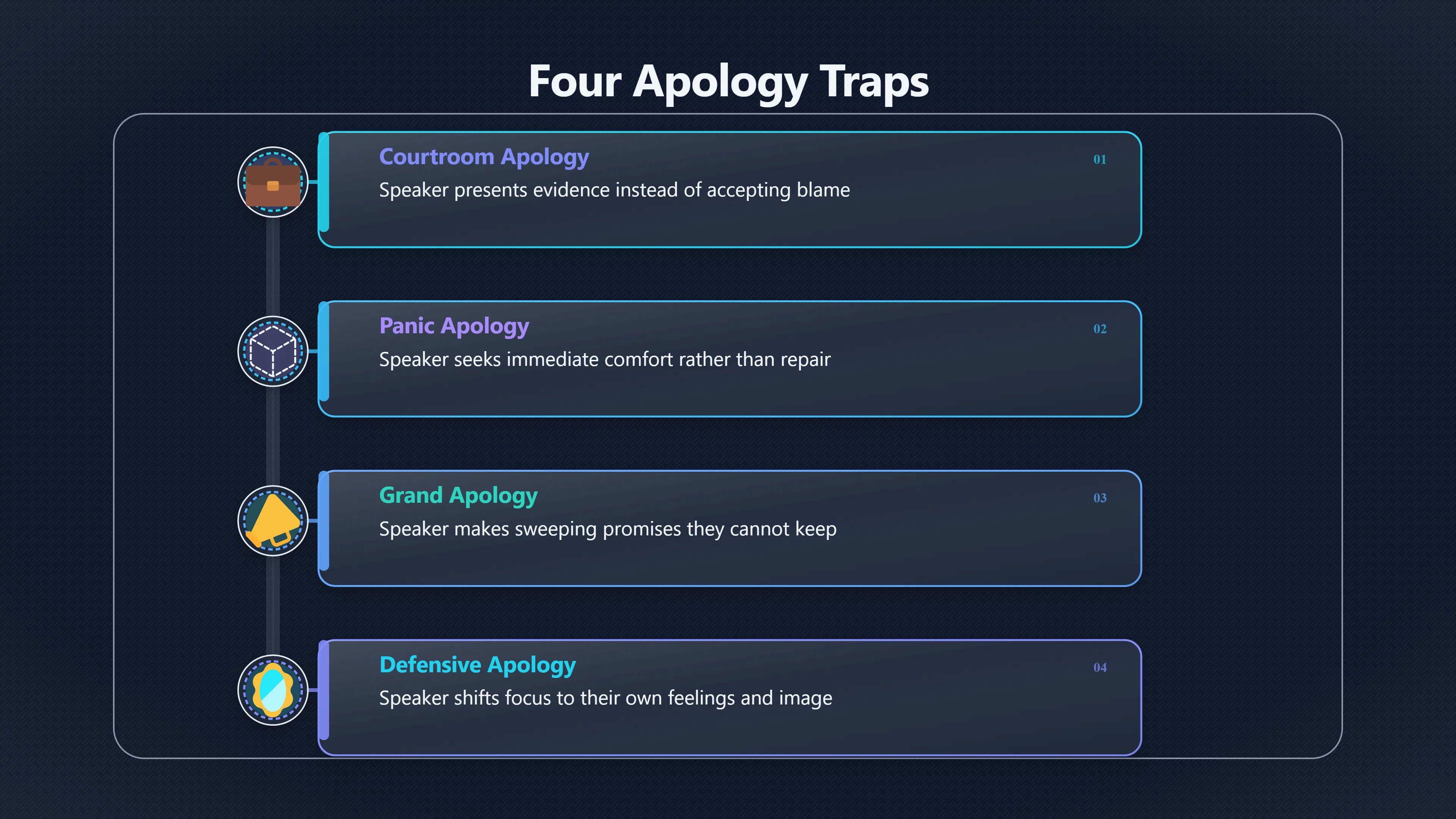
Courtroom, panic, and grand apologies can shift attention away from the person who was hurt.
On this page
- The courtroom apology and hidden self defense
- The panic apology and pressure for reassurance
- The grand apology and unrealistic promises
Page outline Jump by section
Introduction
A good apology is supposed to move attention towards the person who was hurt and the damage that needs repair. A bad apology often does the opposite. It may sound emotional, sincere, or even dramatic, yet its hidden function is to protect the apologiser from shame, anxiety, criticism, or consequences. When that happens, the conversation shifts away from repair and towards managing the apologiser’s feelings.
 This matters when apologising before resentment hardens. Early repair works because it helps the injured person feel seen and understood. Research on apology effectiveness consistently finds that acknowledging responsibility and offering repair carry more weight than elaborate explanations or self-protective language. When apologies become vehicles for self-defence, reassurance-seeking, or image management, they lose much of their repairing power.[NCMR]ncmr.lps.library.cmu.eduSix components of an apology were defined from previous research and presented to…Read more…[Ohio State News]news.osu.eduthe 6 elements of an effective apology according to scienceExpression of regret · 2. Explanation of what went wrong · 3. Acknowledgment of responsibility · 4. Declaration of repentance · 5. Offer…
The Courtroom Apology and Hidden Self-Defence
One of the most common apology failures is the courtroom apology. Instead of repairing harm, the speaker behaves as though they are standing trial.
The structure is familiar:
“I’m sorry, but let me explain what really happened.”
The apology becomes a legal defence brief. The speaker presents evidence, mitigating circumstances, intentions, context, and reasons why the offence was understandable. Sometimes these details are true and relevant. The problem is timing and emphasis. The injured person is still trying to establish that harm occurred, while the apologiser is already arguing for acquittal.
Research on effective apologies suggests that acknowledgement of responsibility is the strongest component, with offers of repair close behind. Defensive explanations are far less persuasive when they appear before responsibility has been accepted.[Phys.org]phys.orgThe six elements of an effective apology, according to…12 Apr 2016 — "Our findings showed that the most important component is an ackn…[Association for Psychological Science]psychologicalscience.orgAssociation for Psychological Science Effective Apologies Include Six ElementsAssociation for Psychological ScienceEffective Apologies Include Six ElementsMay 24, 2016 — Across two studies Lewicki and colleagues fou…
The hidden psychological mechanism is self-protection. People want to preserve an image of themselves as competent, fair, kind, or reasonable. Admitting wrongdoing threatens that image, so they instinctively reach for explanations. Yet explanations offered too early often sound like excuses, even when they are factually accurate. Experts on apology and conflict resolution repeatedly note that responsibility and empathy tend to repair trust more effectively than justification.[The Guardian]theguardian.comThe Guardian How sorry are you?Why learning to apologise well could save your relationshipsJune 28, 2025 — Apologizing effectively is a nuanced yet vital interpersonal…
A courtroom apology often produces a frustrating exchange:
- One person wants acknowledgement.
- The other person wants understanding.
- Neither feels heard.
The repair attempt stalls because the injured person experiences the explanation as resistance rather than accountability.
The Panic Apology and Pressure for Reassurance
Another self-focused pattern is the panic apology.
Unlike the courtroom apology, which protects reputation, the panic apology protects the apologiser from emotional discomfort. The speaker feels guilt, shame, embarrassment, or fear of rejection and wants immediate relief.
The apology therefore becomes a request disguised as remorse:
- “You’re not angry with me, are you?”
- “Please tell me we’re okay.”
- “I feel terrible.”
- “You know I’m not a bad person.”
These statements may be genuine, but they create a subtle burden. The injured person now has two jobs: process their own hurt and regulate the apologiser’s distress.
This can happen within seconds. A person says sorry, becomes visibly upset, and the conversation abruptly turns towards comforting them. The original injury fades into the background.
Relationship researchers often describe successful repair as reducing escalation and allowing genuine understanding. Defensive reactions and self-focused emotional management tend to move conflict in the opposite direction because they redirect attention away from the underlying issue.[The Gottman Institute]gottman.comThe Gottman InstituteThe Four Horsemen: Criticism, Contempt, Defensiveness…31 Mar 2026 — Defensiveness will only escalate the conflict…[The Gottman Institute]gottman.comThe Gottman InstituteThe Four Horsemen: Criticism, Contempt, Defensiveness…31 Mar 2026 — Defensiveness will only escalate the conflict…
There is also a difference between remorse and reassurance-seeking. Remorse says:
“I understand why that hurt.”
Reassurance-seeking says:
“Please help me stop feeling bad about hurting you.”
That distinction is easy to miss because both may involve tears, anxiety, or visible regret. Yet from the perspective of the injured person, the experiences are very different.
Online discussions about apologising for reassurance reveal a common pattern: the apology contains some genuine regret, but the primary emotional goal is obtaining comfort or reducing shame rather than repairing the impact of the behaviour.[Reddit]reddit.comThis usually happens when I have failed to give someone space.Read moreApologising for Reassurance: r/attachment_theoryJune 5, 2024 — I've noticed a bad tendency that I have, which is, to apologise for…
A practical test is simple: after apologising, can you tolerate a period in which the other person remains disappointed, angry, or uncertain? If not, the apology may be drifting into reassurance-seeking.

The Grand Apology and Unrealistic Promises
A third mistake is the grand apology.
This apology sounds impressive because it is large, emotional, and sweeping. The speaker makes dramatic declarations:
- “I’ll never do this again.”
- “I’m going to change everything.”
- “I promise this will never happen.”
- “I’ll make it up to you completely.”
The problem is that repair is often concrete while grand apologies are theatrical.
Research on apology effectiveness highlights offers of repair because they involve specific action. Vague promises of transformation can sound sincere in the moment but become damaging when reality catches up. Trust is restored through evidence, not declarations.[Phys.org]phys.orgThe six elements of an effective apology, according to…12 Apr 2016 — "Our findings showed that the most important component is an ackn…[Faculty &]facultyombuds.ncsu.eduFaculty & Staff Ombuds Office Apology ResearchFaculty & Staff Ombuds OfficeApology Research - How to do it WellMay 31, 2016 — According to Professor Lewicki – “Apologies really do…[Staff Ombuds Office]facultyombuds.ncsu.eduFaculty & Staff Ombuds Office Apology ResearchFaculty & Staff Ombuds OfficeApology Research - How to do it WellMay 31, 2016 — According to Professor Lewicki – “Apologies really do…
The grand apology frequently emerges from panic. The apologiser wants to eliminate the threat immediately, so they offer more than they can realistically deliver. The promise is less about future behaviour and more about reducing present tension.
Consider the difference:
Grand apology
“I swear I will never let you down again.”
Repair-focused apology[psychologytoday.com]psychologytoday.comthe power of apologyPsychology TodayThe Power of Apology1 Jul 2002 — Apology has the power to repair harm, mend relationships, soothe wounds and heal broken…
“I missed the deadline. I understand the impact. Here is what I will do this week to prevent that happening again.”
The second response is less dramatic but more credible. It treats trust as something rebuilt through behaviour rather than emotional performance.
Studies and expert commentary on apologies repeatedly emphasise behavioural change and repair over verbal intensity. Words matter, but they are most persuasive when they are connected to action.[Psychology Today]psychologytoday.comthe power of apologyPsychology TodayThe Power of Apology1 Jul 2002 — Apology has the power to repair harm, mend relationships, soothe wounds and heal broken…[Time]time.comAccording to Marjorie Ingall and experts cited in her book, effective apologies are carefully thought out and genuinely meant. The proces…
What Repair-Focused Apologies Do Instead
A repair-focused apology stays centred on the experience of the person who was affected.
It usually contains four features:
- Recognition of impact — demonstrating understanding of what happened and why it mattered.
- Responsibility — accepting one’s role without immediately shifting into defence.
- Repair — offering practical steps where appropriate.
- Patience — allowing the other person to have their reaction without demanding instant forgiveness.
These features align closely with findings that responsibility and repair are among the strongest components of effective apologies.[Phys.org]phys.orgThe six elements of an effective apology, according to…12 Apr 2016 — "Our findings showed that the most important component is an ackn…[Ohio State News]news.osu.eduthe 6 elements of an effective apology according to scienceExpression of regret · 2. Explanation of what went wrong · 3. Acknowledgment of responsibility · 4. Declaration of repentance · 5. Offer…
The key question is not, “How can I show how sorry I am?”
The more useful question is:
“What does the other person need in order to feel understood and see that I am taking this seriously?”
That shift changes the function of the apology. Instead of serving as emotional self-defence, it becomes an act of repair.
A Simple Warning Sign
When evaluating your own apology, listen for where the emotional spotlight falls.
If most of the conversation is about:
- your intentions,
- your guilt,
- your embarrassment,
- your anxiety,
- your reputation,
- your need to be forgiven,
then the apology may be serving you more than the person who was hurt.
If most of the conversation is about:
- the impact,
- the other person’s experience,
- responsibility,[phys.org]phys.orgThe six elements of an effective apology, according to…12 Apr 2016 — "Our findings showed that the most important component is an ackn…
- realistic repair,
- and future behaviour,
then the apology is much more likely to accomplish what apologies are meant to do: restore trust before resentment has time to harden. NCMR[Phys.org]phys.orgThe six elements of an effective apology, according to…12 Apr 2016 — "Our findings showed that the most important component is an ackn…
eBay marketplace picks
Marketplace Samples
Example marketplace items related to this page. Use the search link to explore similar finds on eBay.






Endnotes
1.
Source: ncmr.lps.library.cmu.edu
Link:https://ncmr.lps.library.cmu.edu/article/id/264/
Source snippet
Six components of an apology were defined from previous research and presented to...Read more...
2.
Source: phys.org
Link:https://phys.org/news/2016-04-elements-effective-science.html
Source snippet
The six elements of an effective apology, according to...12 Apr 2016 — "Our findings showed that the most important component is an ackn...
3.
Source: gottman.com
Link:https://www.gottman.com/blog/the-four-horsemen-recognizing-criticism-contempt-defensiveness-and-stonewalling/
Source snippet
The Gottman InstituteThe Four Horsemen: Criticism, Contempt, Defensiveness...31 Mar 2026 — Defensiveness will only escalate the conflict...
4.
Source: gottman.com
Title: The Gottman Institute The Four Horsemen: Defensiveness Take responsibility
Link:https://www.gottman.com/blog/the-four-horsemen-defensiveness/
Source snippet
The Four Horsemen: DefensivenessTake responsibility. The antidote to defensiveness is to accept responsibility for your role in the situa...
5.
Source: gottman.com
Title: criticism defensiveness cycle
Link:https://www.gottman.com/blog/criticism-defensiveness-cycle/
Source snippet
The Gottman InstituteThe Criticism Defensiveness Cycle7 Sept 2023 — This means taking responsibility for your part of the cycle and lower...
6.
Source: reddit.com
Title: This usually happens when I have failed to give someone space.Read more
Link:https://www.reddit.com/r/attachment_theory/comments/1d8u0na/apologising_for_reassurance/
Source snippet
Apologising for Reassurance: r/attachment_theoryJune 5, 2024 — I've noticed a bad tendency that I have, which is, to apologise for...
Published: June 5, 2024
7.
Source: time.com
Link:https://time.com/6264614/how-to-apologize-health-benefits/
Source snippet
According to Marjorie Ingall and experts cited in her book, effective apologies are carefully thought out and genuinely meant. The proces...
8.
Source: gottman.com
Title: how we used the aftermath of a fight to repair our relationship
Link:https://www.gottman.com/blog/how-we-used-the-aftermath-of-a-fight-to-repair-our-relationship/
Source snippet
The Gottman InstituteHow We Used the Aftermath of a Fight to Repair Our...9 Jan 2019 — As John Gottman's research has shown, it's not yo...
9.
Source: gottman.com
Link:https://www.gottman.com/blog/the-four-horsemen-the-antidotes/
Source snippet
The Four Horsemen: The AntidotesThe antidote is to accept responsibility, even if only for part of the conflict. Defensiveness: “It's not...
10.
Source: gottman.com
Title: its not my fault why defensiveness is damaging
Link:https://www.gottman.com/blog/its-not-my-fault-why-defensiveness-is-damaging/
Source snippet
'It's Not My Fault!': Why Defensiveness is DamagingMar 31, 2022 — Defensiveness is the "horsemen" that escalates conflict. See why it hur...
11.
Source: gottman.com
Title: r is for repair
Link:https://www.gottman.com/blog/r-is-for-repair/
Source snippet
3 Sept 2014 — Gottman describes a repair attempt as “any statement or action — silly or otherwise — that prevents negativity from escalat...
12.
Source: news.osu.edu
Title: the 6 elements of an effective apology according to science
Link:https://news.osu.edu/the-6-elements-of-an-effective-apology-according-to-science/
Source snippet
Expression of regret · 2. Explanation of what went wrong · 3. Acknowledgment of responsibility · 4. Declaration of repentance · 5. Offer...
13.
Source: psychologicalscience.org
Title: Association for Psychological Science Effective Apologies Include Six Elements
Link:https://www.psychologicalscience.org/news/minds-business/effective-apologies-include-six-elements.html
Source snippet
Association for Psychological ScienceEffective Apologies Include Six ElementsMay 24, 2016 — Across two studies Lewicki and colleagues fou...
Published: May 24, 2016
14.
Source: facultyombuds.ncsu.edu
Title: Faculty & Staff Ombuds Office Apology Research
Link:https://facultyombuds.ncsu.edu/apology-research-how-to-do-it-well/
Source snippet
Faculty & Staff Ombuds OfficeApology Research - How to do it WellMay 31, 2016 — According to Professor Lewicki – “Apologies really do...
Published: May 31, 2016
15.
Source: theguardian.com
Title: The Guardian How sorry are you?
Link:https://www.theguardian.com/science/2025/jun/29/learning-how-to-apologise-well-best-way-to-say-sorry
Source snippet
Why learning to apologise well could save your relationshipsJune 28, 2025 — Apologizing effectively is a nuanced yet vital interpersonal...
Published: June 28, 2025
16.
Source: psychologytoday.com
Title: the power of apology
Link:https://www.psychologytoday.com/gb/articles/200207/the-power-of-apology
Source snippet
Psychology TodayThe Power of Apology1 Jul 2002 — Apology has the power to repair harm, mend relationships, soothe wounds and heal broken...
17.
Source: Wikipedia
Link:https://en.wikipedia.org/wiki/Effectiveness
Source snippet
EffectivenessEffectiveness or effectivity [1] is the capability of producing a desired result or the ability to produce desired output...
18.
Source: khanacademy.org
Link:https://www.khanacademy.org/ela/new-6th-grade-reading-and-vocabulary/x8ddea1200317e822%3Awhat-defines-us/x8ddea1200317e822%3Aanalyzing-text-structure/v/effective-vocabulary-624a
Source snippet
Effective | Vocabulary (video) | VocabularySomething that is effective tends to, or has the quality of making things happen, of making ou...
19.
Source: katebennisstudio.com
Link:https://katebennisstudio.com/blog/defensiveness
Source snippet
Kate Bennis Studio2 Feb 2026 — What does Gottman advise as an antidote to defensiveness? “The antidote is to accept responsibility, even...
Additional References
20.
Source: merriam-webster.com
Link:https://www.merriam-webster.com/dictionary/effective
Source snippet
EFFECTIVE Definition & Meaning1. a: producing a decided, decisive, or desired effect an effective policy b: impressive, striking a gold...
21.
Source: dictionary.com
Link:https://www.dictionary.com/browse/effective
Source snippet
EFFECTIVE Definition & Meaningadjective adequate to accomplish a purpose; producing the intended or expected result: effective teaching m...
22.
Source: couplestherapyinc.com
Link:https://couplestherapyinc.com/gottman-repair-attempts/
Source snippet
Gottman Repair AttemptsHappy couples naturally offer repair attempts, according to premier relationship researcher John Gottman. A repair...
23.
Source: britannica.com
Link:https://www.britannica.com/dictionary/eb/qa/How-to-Use-Effective-and-Efficient
Source snippet
How to Use Effective and EfficientEffective means "producing a result that is wanted". Efficient means "capable of producing desired resu...
24.
Source: mylifepsychologists.com.au
Link:https://mylifepsychologists.com.au/relationship-conflict-the-art-of-repair/
Source snippet
Relationship Conflict: The Art of RepairAccording to Dr John Gottman, a renowned relationships researcher, repair attempts are the “happy...
25.
Source: scribd.com
Link:https://www.scribd.com/document/737313115/Apologizing-Effectively
Source snippet
Structure of Effective Apologies | PDF | PsychologyResearch identifies six key components that make an apology effective: an acknowledgme...
26.
Source: researchgate.net
Link:https://www.researchgate.net/publication/287124645_The_Art_of_the_ApologyThe_Structure_and_Effectiveness_of_Apologies_in_Trust_Repair
Source snippet
The Art of the ApologyThe Structure and Effectiveness...They argue that a maximally effective apology should consist of six components i...
27.
Source: emotionalaffair.org
Link:https://www.emotionalaffair.org/john-gottmans-four-horsemen/
Source snippet
Gottman argues that, “defensiveness is fundamentally an attempt to protect yourself and ward off a perceived attack.”...Read more...
28.
Source: facebook.com
Title: But that ignores a crucial emotional component and [limits]({{ ‘limits/’ | relative_url }}) opportunity
Link:https://www.facebook.com/psychologytoday/posts/after-a-mistake-or-indiscretion-its-tempting-to-quickly-confess-and-move-on-but-/10158233424798845/
Source snippet
After a mistake or indiscretion, it's tempting to quickly...After a mistake or indiscretion, it’s tempting to quickly confess and move on...
29.
Source: talktoangel.com
Title: gottman informed repair strategies for relationship conflicts
Link:https://www.talktoangel.com/blog/gottman-informed-repair-strategies-for-relationship-conflicts
Source snippet
Gottman-Informed Repair Strategies for Relationship...10 Feb 2026 — Repair attempts can be verbal or non-verbal, such as using humour, e...
Topic Tree