Within Better Change
How to Save Before You Spend
Automatic saving turns a financial intention into a default that happens before temptation arrives.
On this page
- Defaults and transfers
- Friction for impulse buys
- Feedback from balances
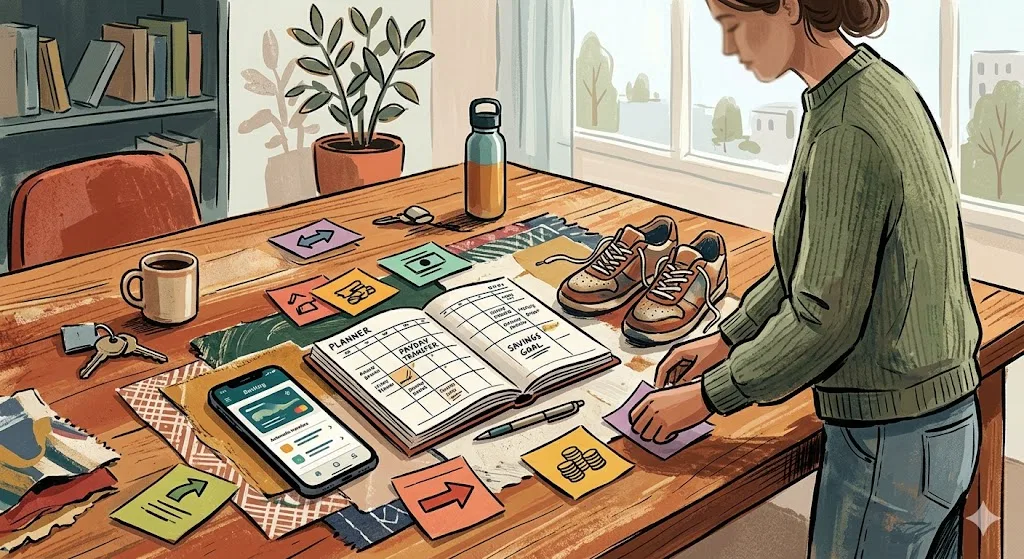
Page outline Jump by section
Introduction
Saving before spending is a practical self-improvement policy: decide the saving rule in advance, automate it as close to payday as possible, and let the remaining balance become the money available for ordinary spending. It works because it changes the moment of choice. Instead of asking a tired future self to resist purchases after money is visible and tempting, it makes saving the default before those temptations arrive. The core tools are simple: split pay into savings and spending accounts, schedule transfers, add friction to impulse buys, and review balances often enough to adjust the system. Evidence from automatic enrolment, payroll saving, emergency-savings research and behavioural economics suggests that defaults can strongly increase participation in saving, though they can also leave people under-saving if the default amount is too low or if saving pushes them into avoidable debt. NBER[American Economic Association]aeaweb.orgAmerican Economic Association Why Do Defaults Affect Behavior?Experimental Evidence…by J Blumenstock · 2018 · Cited by 216 — We report on an experiment examining why default options impact behavio…[MaPS]maps.org.ukPayroll-deducted saving schemesThis Nest Insight report, funded by MaPS and other partners, brings together evidence from trials with…
This is not about moralising spending. It is about designing a money routine that survives ordinary life: delayed trains, tired evenings, online offers, social pressure, irregular bills and the quiet optimism that “there will be something left at the end of the month”. Saving before spending replaces that hope with a working default.
Why saving first beats saving what is left
The common “save what remains” method asks savings to compete with every other desire in the month. Rent, food and bills come first, but so do takeaways, subscriptions, gifts, small upgrades and purchases that felt harmless at the time. By the end, saving becomes a residual category: whatever escaped attention.
Saving before spending reverses the order. The decision is made once, in a calm moment, then repeated automatically. The Consumer Financial Protection Bureau describes automatic transfers from pay or current accounts as a way to “pay yourself first” before funds are committed elsewhere, and its emergency-savings guidance treats automatic deposit as one of the easiest ways to build a reserve.[Consumer Financial Protection Bureau]consumerfinance.govSource details in endnotes.
The behavioural reason is straightforward. People are not equally disciplined at every point in the month. A payday balance feels abundant; later, a low balance feels restrictive. If savings leave immediately, the spending balance gives a truer signal of what is available. The account stops pretending that future rent, insurance, annual costs and emergency needs are all free money.
A useful saving-before-spending rule has three parts:[sciencedirect.com]sciencedirect.comSource details in endnotes.
- A destination: emergency fund, pension, ISA, debt overpayment, holiday fund, annual bills account or another named pot.
- A trigger: payday, invoice payment, benefit receipt or the day after regular income arrives.
- An amount: a fixed sum, a percentage, or a gradual increase such as adding 1 percentage point after each pay rise.
The point is not that everyone can save the same amount. It is that the saving decision should not depend on whatever mood, memory or temptation is present at the end of the month.
Defaults and transfers: make the desired action automatic
The strongest case for saving before spending comes from default design. When a good action is automatic unless someone opts out, participation often rises sharply. In retirement saving, automatic enrolment has been one of the clearest examples. Classic research on 401(k) plans found that automatic enrolment increased participation because employees were enrolled unless they actively chose otherwise; later experimental work on salary-linked savings found default enrolment increased participation by 40 percentage points, an effect comparable to a large matching incentive.[NBER]nber.orgOpen source on nber.org.
The UK’s workplace pension system shows the same principle at national scale. Automatic enrolment made pension saving a workplace norm by putting eligible workers into qualifying schemes unless they opted out. Government evaluation described the policy as a major change in workplace saving behaviour after staged implementation across employers.[GOV.UK]GOV.UKautomatic enrolment evaluation report 2019automatic enrolment evaluation report 2019
For everyday self-improvement, the lesson is not “copy pension policy exactly”. It is that defaults work because they remove repeated effort. A person who has to choose saving every month faces twelve opportunities to forget, postpone or bargain down the amount. A person with an automatic transfer faces one setup decision, then occasional review.
Practical default choices include:
- Split direct deposit: part of income goes straight into savings, with the remainder going into the spending account.
- Standing order on payday: money moves automatically to a separate savings account before discretionary spending begins.
- Payroll saving: the employer deducts a chosen amount from wages and sends it to a savings account or credit union.
- Automatic pension contribution increases: the contribution rate rises after a pay rise or on a scheduled annual date.
Payroll-linked saving is especially relevant because it moves the saving decision upstream. The Money and Pensions Service describes payroll saving as an automatic deduction from wages that makes saving easy and routine, similar in feel to pension contributions. Nest Insight’s workplace emergency-savings programme found that opt-out payroll saving can be a powerful way to help workers save consistently, and evidence submitted to Parliament stated that building accessible emergency savings alongside pensions did not appear to increase pension opt-outs or reduce pension contributions in those trials.[MaPS]maps.org.ukPayroll-deducted saving schemesThis Nest Insight report, funded by MaPS and other partners, brings together evidence from trials with…[NEST Insight]nestinsight.org.ukSource details in endnotes.
The important implementation detail is timing. A transfer scheduled three weeks after payday is not the same intervention as one scheduled on payday morning. Saving before spending works because it reaches the money before the spending environment does.
Friction for impulse buys: protect the saving rule after it runs
Automatic saving is only half the system. The other half is stopping saved money from being too easy to reclaim for impulse purchases. If savings can be raided with one tap, the “default” is weak; it has merely moved money between labels.
This is where friction helps. Friction is any small barrier that slows a purchase long enough for intention to catch up with impulse. Online retail, digital wallets, stored cards and buy-now-pay-later products are designed to reduce friction. That can be convenient for necessary purchases, but it also weakens the pause in which a person might ask, “Do I actually want this, and does it fit my plan?”
Evidence on modern payment systems supports that concern. Research on buy-now-pay-later adoption found that customers using BNPL at a retailer increased online order size by 6.42% on average, and the CFPB has identified consumer risks around BNPL including debt accumulation, inconsistent protections and overextension.[ScienceDirect]sciencedirect.comSource details in endnotes.
Friction does not need to be dramatic. The aim is not to make life miserable, but to make unplanned spending less automatic than saving. Useful barriers include:
- Remove saved cards from shopping sites and delivery apps.
- Use a separate savings bank from the current account, so withdrawals take effort or time.
- Disable one-click checkout where possible.
- Create a 24-hour rule for non-essential purchases above a chosen threshold.
- Unsubscribe from retailer emails that repeatedly create urgency.
- Keep emergency savings accessible but not visible in the everyday spending app.
- Use separate pots for annual bills and true emergencies, so a car repair does not feel like a failure of saving.
This is a self-improvement idea, not a purity test. Some people benefit from removing shopping apps entirely; others only need to delete stored payment details. The right amount of friction is the smallest barrier that reliably interrupts the unwanted pattern.
The boundary matters. Too much friction can backfire if money is genuinely needed quickly, especially for emergencies. An emergency fund should be harder to spend impulsively but still reachable when the boiler breaks, wages are delayed or a family member needs help. The design goal is “not casual”, not “impossible”.

Feedback from balances: let accounts tell the truth
Saving before spending works best when balances give clear feedback. A single account containing rent money, grocery money, holiday money, emergency savings and emotional-spending money is a confusing dashboard. It can look healthy on payday and still be unable to handle a bill two weeks later.
Separate balances make the system observable. A spending account shows what is available for the rest of the month. A bills account shows whether known obligations are covered. A savings account shows whether the buffer is growing. That visibility matters because self-improvement improves through feedback, not through guilt.
Emergency-savings research is a useful anchor here. The CFPB’s work links emergency savings with greater financial security and examines how consumers’ financial profiles vary by emergency-savings level. Its practical guidance emphasises that even a minor financial shock can become lasting debt when people lack savings.[Consumer Financial Protection Bureau]consumerfinance.govSource details in endnotes.
A 2025 Vanguard report found that having at least $2,000 in emergency savings was associated with a 21% higher financial well-being score compared with having none, and that three to six months of expenses was associated with a further increase. The figures are from an association, not proof that savings alone caused the whole improvement, but they make the practical point vivid: a visible buffer changes how financially safe life feels.[Vanguard]corporate.vanguard.comPDF] The relationship between emergency savings, financial well-beingPDF] The relationship between emergency savings, financial well-being
Good balance feedback answers three questions:
- Can I spend normally this week? The current account should answer this without mental arithmetic.
- Am I protected against near-term shocks? The emergency fund should show progress towards a realistic buffer.
- Is my automatic amount still right? Repeated overdrafts, credit-card borrowing or savings withdrawals mean the rule needs adjustment.
This is why balance review should be routine but not obsessive. A weekly check is often enough for ordinary cash flow. A monthly review can adjust transfer amounts, close leaks, cancel unused subscriptions or increase savings after income rises. The behaviour to avoid is daily panic-checking without changing the system.
The best version is flexible, not heroic
Saving before spending fails when it is set up as a heroic promise rather than a working policy. A transfer that is too high may create a satisfying savings balance and a hidden credit-card problem. Research on pension automatic enrolment has raised exactly this caution: additional retirement saving can be partly offset by increases in unsecured debt in some settings.[NBER]nber.orgOpen source on nber.org.
That does not mean automatic saving is bad. It means the amount must fit the full household picture. Saving £200 while borrowing £200 at high interest is not progress unless there is a very specific reason. For many people, the first target should be a small emergency buffer, then expensive debt reduction, then longer-term saving and investing.
There is also a default-rate problem. Defaults are powerful, but they can anchor people at the wrong level. Chicago Booth’s discussion of automatic enrolment notes that many plans historically used low initial contribution rates, and people often stayed with the default even when a higher rate might have suited them better. Automatic enrolment gets people started; it does not guarantee adequacy.[Chicago Booth]chicagobooth.eduSource details in endnotes.
A better design is adjustable by rule:
- Start with an amount that does not cause new borrowing.
- Increase the transfer after a pay rise, debt payoff or cancelled expense.
- Pause or reduce temporarily during income disruption.
- Keep emergency savings separate from long-term pension or investment money.
- Review the default every few months rather than treating it as permanent.
The Save More Tomorrow approach is useful here. Thaler and Benartzi’s programme asked employees to commit in advance to increasing future saving, often timed with pay rises, so the increase did not feel like an immediate cut in take-home pay. The broader lesson is practical: future increases can be easier to accept than present sacrifices.[JSTOR]jstor.orgSource details in endnotes.

What this looks like in real life
A workable saving-before-spending setup might look like this. Income arrives on the 28th. On the same day, a standing order sends money to an emergency fund. Another transfer moves one-twelfth of annual costs into a bills pot: insurance, car maintenance, Christmas, professional fees or school costs. Pension contributions already leave through payroll. The current account balance after those moves is the month’s true spending limit.
That structure changes the emotional experience of money. The person no longer has to decide whether to save after every purchase. They only need to live within the spending balance and review the automatic amounts when reality changes.
A second version suits irregular income. Each payment is divided by percentage: tax reserve, essential bills, emergency savings, long-term savings and spending. The trigger is not a calendar date but income receipt. The same principle holds: saving happens before the money is absorbed into ordinary spending.
A third version suits someone starting from financial strain. The first transfer may be tiny: £5 or £10 per payday into a separate buffer. That can sound too small to matter, but the early purpose is to build a reliable default and a visible streak. The amount can rise later. A habit that survives is more valuable than an impressive amount that collapses after one month.
Common mistakes that weaken the system
The first mistake is saving into the same account used for daily spending. The label may say “savings”, but if the money sits beside grocery and entertainment money, it is still psychologically available. Separate accounts make the rule easier to respect.
The second mistake is automating too late. If the transfer runs after two weeks of spending, it is no longer “save before spending”; it is “save if untouched money remains”. The trigger should sit next to income.
The third mistake is using round-up saving as the main strategy. Round-ups can be a pleasant extra, but they are still tied to spending. A study of round-up savings found that enrolment could increase discretionary spending, which is the opposite of what many savers intend. A fixed payday transfer is cleaner because it does not require more purchases to create more savings.[American Economic Association]aeaweb.orgAmerican Economic Association Why Do Defaults Affect Behavior?Experimental Evidence…by J Blumenstock · 2018 · Cited by 216 — We report on an experiment examining why default options impact behavio…
The fourth mistake is ignoring debt. If automatic saving causes overdraft fees, missed payments or high-interest borrowing, the rule needs redesign. Saving before spending should improve resilience, not create a more complicated version of the same shortfall.
The fifth mistake is treating the default as proof of virtue. A default is a tool. It needs observation. Balances, missed payments, debt levels and withdrawal frequency are feedback about whether the tool is working.
The takeaway: make saving the first transaction, not the final hope
Saving before spending works because it turns a financial intention into a default. The key move is not motivational; it is architectural. Money is routed to its purpose before the month’s noise begins, then protected with enough friction that impulse spending has to slow down.
The best system is simple enough to run automatically and flexible enough to survive real life. Transfer on payday. Separate savings from spending. Add friction where impulse buying usually happens. Watch balances for feedback. Raise the amount when circumstances improve, and lower it when the rule is creating avoidable debt.
The result is a quieter form of self improvement: fewer dramatic resolutions, fewer end-of-month regrets, and a financial environment that makes the intended behaviour more likely before willpower is even tested.
Amazon book picks
Further Reading
Books and field guides related to How to Save Before You Spend. Use these as the next step if you want deeper reading beyond the article.
The Automatic Millionaire
Directly promotes saving before spending through automation.
I Will Teach You to Be Rich
Includes practical systems for automatic saving and budgeting.
The Psychology of Money
Strong emphasis on saving behaviour and financial decision-making.
eBay marketplace picks
Marketplace Samples
Example marketplace items related to this page. Use the search link to explore similar finds on eBay.





Endnotes
1.
Source: nber.org
Link:https://www.nber.org/papers/w32100
2.
Source: nber.org
Link:https://www.nber.org/system/files/working_papers/w8651/w8651.pdf
3.
Source: GOV.UK
Title: automatic enrolment evaluation report 2019
Link:https://www.gov.uk/government/publications/automatic-enrolment-evaluation-report-2019/automatic-enrolment-evaluation-report-2019
4.
Source: thepensionsregulator.gov.uk
Link:https://www.thepensionsregulator.gov.uk/en/document-library/automatic-enrolment-detailed-guidance
5.
Source: committees.parliament.uk
Link:https://committees.parliament.uk/writtenevidence/161491/html/
6.
Source: sciencedirect.com
Link:https://www.sciencedirect.com/science/article/pii/S0022435924000654
7.
Source: corporate.vanguard.com
Title: [PDF] The relationship between emergency savings, financial well-being
Link:https://corporate.vanguard.com/content/dam/corp/research/pdf/relationship_between_emergency_savings_financial_well_being_financial_stress.pdf
8.
Source: jstor.org
Link:https://www.jstor.org/stable/10.1086/380085
9.
Source: committees.parliament.uk
Link:https://committees.parliament.uk/writtenevidence/64033/html/
10.
Source: committees.parliament.uk
Link:https://committees.parliament.uk/writtenevidence/161491/pdf/
11.
Source: committees.parliament.uk
Link:https://committees.parliament.uk/writtenevidence/66747/html/
12.
Source: sciencedirect.com
Link:https://www.sciencedirect.com/science/article/abs/pii/S0304387824001548
13.
Source: sciencedirect.com
Link:https://www.sciencedirect.com/science/article/abs/pii/S0167268119302744
14.
Source: sciencedirect.com
Link:https://www.sciencedirect.com/science/article/pii/S0167268124004906
15.
Source: sciencedirect.com
Link:https://www.sciencedirect.com/science/article/pii/S0167629622000881
16.
Source: sciencedirect.com
Link:https://www.sciencedirect.com/science/article/pii/S2405844024117744
17.
Source: nber.org
Link:https://www.nber.org/system/files/working_papers/w18220/w18220.pdf
18.
Source: assets.publishing.service.gov.uk
Link:https://assets.publishing.service.gov.uk/media/6358e5a08fa8f557d9a2d573/workplace-pensions-and-automatic-enrolment.pdf
19.
Source: GOV.UK
Link:https://www.gov.uk/government/publications/understanding-member-engagement-with-workplace-pensions/summary-understanding-member-engagement-with-workplace-pensions
20.
Source: aeaweb.org
Title: American Economic Association Why Do Defaults Affect Behavior?
Link:https://www.aeaweb.org/articles?id=10.1257%2Faer.20171676
Source snippet
Experimental Evidence...by J Blumenstock · 2018 · Cited by 216 — We report on an experiment examining why default options impact behavio...
21.
Source: maps.org.uk
Link:https://maps.org.uk/en/work-with-us/financial-wellbeing-in-the-workplace/payroll-deducted-saving-schemes
Source snippet
Payroll-deducted saving schemesThis Nest Insight report, funded by MaPS and other partners, brings together evidence from trials with...
22.
Source: consumerfinance.gov
Link:https://www.consumerfinance.gov/data-research/research-reports/emergency-savings-financial-security-insights-from-making-ends-meet-survey-and-consumer-credit-panel/
23.
Source: consumerfinance.gov
Title: looking easy way save money make it automatic
Link:https://www.consumerfinance.gov/about-us/blog/looking-easy-way-save-money-make-it-automatic/
24.
Source: consumerfinance.gov
Title: how save emergencies and future
Link:https://www.consumerfinance.gov/about-us/blog/how-save-emergencies-and-future/
25.
Source: nestinsight.org.uk
Link:https://www.nestinsight.org.uk/wp-content/uploads/2025/03/Easier-to-Save.pdf
26.
Source: files.consumerfinance.gov
Link:https://files.consumerfinance.gov/f/documents/cfpb_buy-now-pay-later-market-trends-consumer-impacts_report_2022-09.pdf
27.
Source: consumerfinance.gov
Link:https://www.consumerfinance.gov/an-essential-guide-to-building-an-emergency-fund/
28.
Source: chicagobooth.edu
Link:https://www.chicagobooth.edu/review/behavioral-economics-retirement-savings-crisis
29.
Source: aeaweb.org
Title: American Economic Association The Impossibility of Saving by Spending
Link:https://www.aeaweb.org/conference/2023/program/paper/D8QD5Z29
30.
Source: consumerfinance.gov
Title: consumer financial protection bureau releases research saving habits
Link:https://www.consumerfinance.gov/about-us/newsroom/consumer-financial-protection-bureau-releases-research-saving-habits/
31.
Source: nestinsight.org.uk
Link:https://www.nestinsight.org.uk/?p=7352
32.
Source: nestinsight.org.uk
Link:https://www.nestinsight.org.uk/research-projects/workplace-emergency-savings/
33.
Source: professionalpensions.com
Title: nest insight publishes sidecar savings trial findings
Link:https://www.professionalpensions.com/news/4113006/nest-insight-publishes-sidecar-savings-trial-findings
34.
Source: slvfed.bank
Title: emergency savings
Link:https://www.slvfed.bank/blog/post/emergency-savings
35.
Source: linkedin.com
Title: nest insight workplace emergency savings activity 7330151491258769408 Uj78
Link:https://www.linkedin.com/posts/nest-insight_workplace-emergency-savings-activity-7330151491258769408-Uj78
36.
Source: pnc.com
Title: pay yourself first
Link:https://www.pnc.com/insights/personal-finance/save/pay-yourself-first.html
Additional References
37.
Source: clear.dol.gov
Link:https://clear.dol.gov/study/save-more-tomorrow%E2%84%A2-using-behavioral-economics-increase-employee-saving-thaler-benartzi-2004
38.
Source: clear.dol.gov
Title: better or worse default effects and 401k savings behavior choi et al 2004
Link:https://clear.dol.gov/study/better-or-worse-default-effects-and-401k-savings-behavior-choi-et-al-2004
39.
Source: researchgate.net
Link:https://www.researchgate.net/publication/362685652_Rein_it_in_Nudge-based_interventions_to_cope_with_online_impulse_buying_among_young_adults
40.
Source: researchgate.net
Link:https://www.researchgate.net/publication/391345734_Buy_Now_Pay_Later_An_Analysis_of_Consumer_Financial_Protection_Bureau_Research_and_Regulatory_Actions
41.
Source: researchgate.net
Link:https://www.researchgate.net/publication/349072941_A_replication_study_of_the_credit_card_effect_on_spending_behavior_and_an_extension_to_mobile_payments
42.
Source: anderson.ucla.edu
Link:https://www.anderson.ucla.edu/sites/default/files/documents/areas/fac/accounting/Benartzi%20and%20Thaler%20Science.pdf
43.
Source: hbs.edu
Link:https://www.hbs.edu/faculty/Pages/item.aspx?num=62774
44.
Source: fair4allfinance.org.uk
Link:https://fair4allfinance.org.uk/buy-now-pay-later-and-financial-vulnerability/
45.
Source: nationalacademies.org
Link:https://www.nationalacademies.org/read/26874/chapter/10
46.
Source: thedecisionlab.com
Link:https://thedecisionlab.com/intervention/defaults-improve-savings
Topic Tree