Within Small Starts
When Is a Habit Ready to Grow?
The best time to increase a habit is when it survives normal bad days, not just when it feels easy once.
On this page
- Stability tests across ordinary difficult days
- Why feelings are weaker evidence than repetition
- What to do when an increase breaks the habit
Page outline Jump by section
Introduction
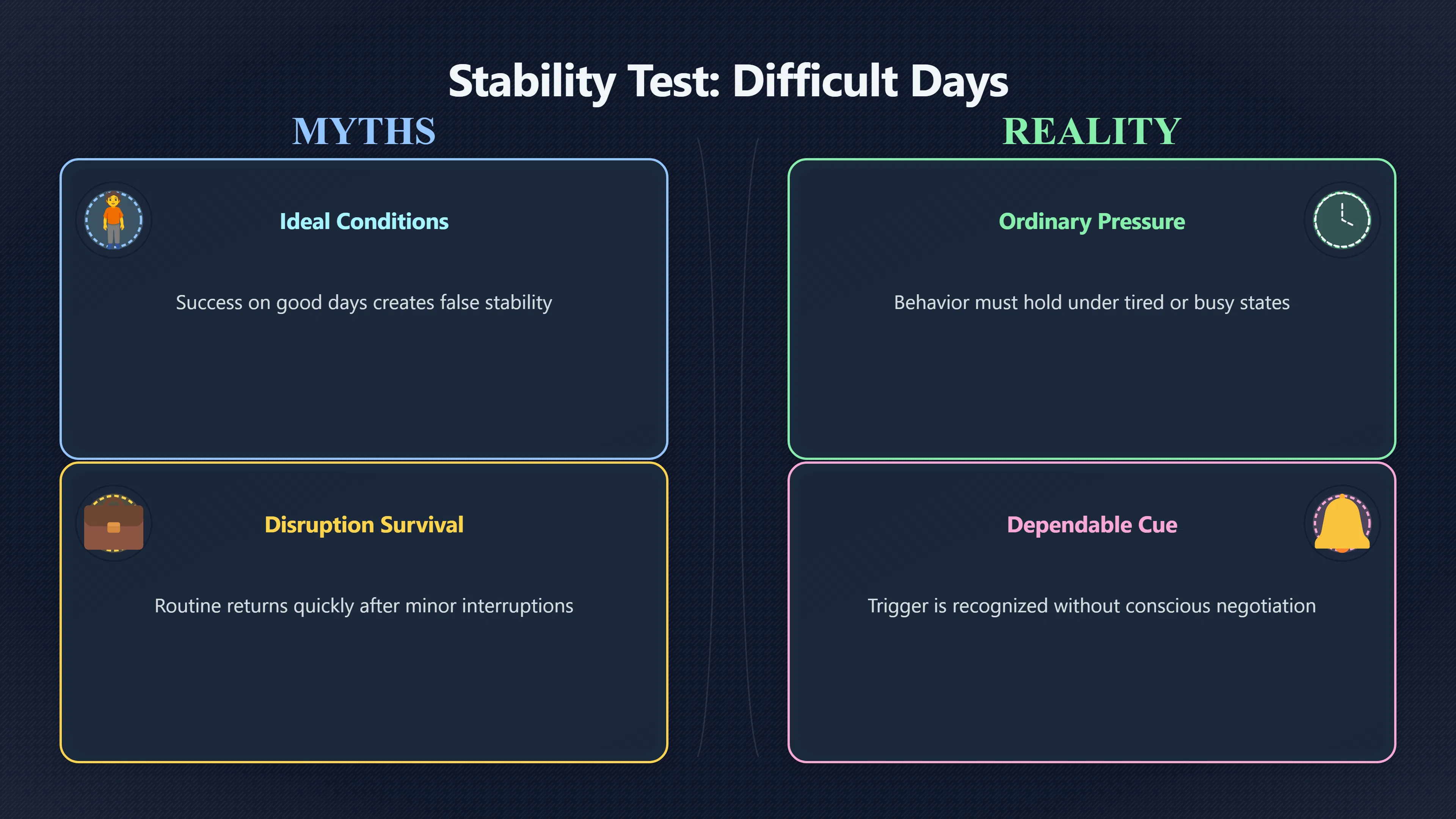
A small habit is ready to grow when it remains reliable under ordinary pressure, not when it feels effortless on a good day. Many people increase a habit too early because success in ideal conditions creates the illusion of stability. The better test is whether the behaviour still happens when you are tired, busy, distracted, stressed, travelling, or dealing with minor disruptions.
 In the context of starting small without staying small, the goal is not to protect a habit forever. It is to build a version that survives real life and then expand it at the right moment. Research on habit formation suggests that repetition in a stable context gradually increases automaticity, but the process varies widely between people and behaviours. What matters is not reaching a particular number of days but developing a behaviour that continues to occur with decreasing reliance on motivation.[Wiley Online Library]onlinelibrary.wiley.comWiley Online LibraryHow are habits formed: Modelling habit formation in the…by P Lally · 2010 · Cited by 3693 — To investigate the pro…
How to Tell Whether a Habit Is Stable Enough
The most useful question is not, “Does this feel easy?” but, “Does this still happen when conditions are worse than average?”
A habit that only succeeds on productive days is not yet stable. A habit that continues through normal fluctuations in energy and schedule has started to become dependable.
Practical signs that a habit is ready for a larger version include:
- You complete it consistently across several ordinary difficult days.
- Missing it feels unusual rather than normal.
- The cue that triggers it is easy to recognise.
- You spend less time negotiating with yourself before starting.
- The habit survives small disruptions and quickly returns after interruptions.
Habit research describes this process as increasing automaticity: the behaviour becomes more strongly linked to a cue and requires less conscious deliberation. Automaticity tends to rise gradually and then level off rather than appearing suddenly. Repositório ISPA[Cambridge University Press & Assessment]cambridge.orgWhen encountered, cues activate a single, specific well-learned behavioral response…
Consider someone building a reading habit. Reading two pages before bed may feel easy after one week because enthusiasm is high. That does not necessarily justify increasing the target. If the habit continues through a stressful work week, a family commitment, and a few low-energy evenings, the evidence for stability becomes much stronger.
Why Feelings Are Weaker Evidence Than Repetition
People often use the wrong signal when deciding whether to increase a habit. They ask whether the current version feels too easy.
Ease can be misleading.
A new runner may feel energetic after several successful sessions and immediately double training volume. A writer may experience a productive week and suddenly raise a daily target from 100 words to 1,000. In both cases, the feeling of readiness may reflect temporary motivation rather than genuine habit strength.
Research on habit formation consistently points to repetition in stable contexts as the key driver of automaticity. The behaviour becomes easier because it has been repeated, not because motivation permanently increased.[Wiley Online Library]onlinelibrary.wiley.comWiley Online LibraryHow are habits formed: Modelling habit formation in the…by P Lally · 2010 · Cited by 3693 — To investigate the pro…[PMC]pmc.ncbi.nlm.nih.govMaking health habitual: the psychology of 'habit-formation' and…by B Gardner · 2012 · Cited by 890 — More relevant research found t…
This is why repetition is generally better evidence than emotion. Motivation fluctuates from day to day. Behaviour repeated across different conditions provides a more reliable signal that the underlying routine is becoming established.
A useful rule is to trust patterns over feelings. One unusually easy week means little. Several weeks of successful repetition across varying circumstances mean much more.
Test the Habit on Ordinary Bad Days
The strongest growth signal is often successful performance during imperfect conditions.
Many habits are built and tested during periods when life is relatively calm. The challenge arrives when normal difficulties appear:
- Poor sleep
- Heavy workload
- Mild illness
- Travel
- Unexpected schedule changes
- Emotional stress
If the habit survives these conditions, it has demonstrated resilience.
This does not mean the behaviour must be performed perfectly. The important question is whether the core action remains intact. A person who normally walks for ten minutes but only manages five on a difficult day may still be protecting the habit loop. The routine remains alive even if performance temporarily drops.
Research examining real-world habit formation found substantial variation in how quickly habits become automatic, with some behaviours requiring much longer than others. The implication is that readiness should be judged by observed stability rather than a fixed timeline.[Wiley Online Library]onlinelibrary.wiley.comWiley Online LibraryHow are habits formed: Modelling habit formation in the…by P Lally · 2010 · Cited by 3693 — To investigate the pro…[ResearchGate]researchgate.net2010) demonstrated that new behavioural patterns require between 18 and 254 days to reach automaticity, with a median of approximately 6…
A Practical Rule for Raising the Bar
When a habit has remained consistent through several ordinary difficult days, increase only one variable at a time.
Possible variables include:
For example:
- Two minutes of stretching becomes five minutes.
- One paragraph of writing becomes two.
- A ten-minute walk becomes fifteen.
- Three practice sessions per week become four.
Small increases make it easier to identify what caused success or failure. Large jumps create confusion because several demands change simultaneously.
The objective is to move just beyond autopilot while preserving consistency. Growth should create a manageable challenge, not a complete redesign of the habit.

What If the Increase Breaks the Habit?
Failure after an increase does not automatically mean the habit was weak. It may simply mean the jump was too large.
A common mistake is treating habit growth as a one-way escalation. In practice, effective self-regulation often involves adjustment and recalibration rather than endless upward pressure. Research on goal adjustment and self-regulation suggests that flexibility can be adaptive when demands no longer match current circumstances.[Carnegie Mellon University]cmu.eduCarnegie Mellon University Adaptive Self-Regulation of Unattainable GoalsCarnegie Mellon UniversityAdaptive Self-Regulation of Unattainable GoalsDecember 1, 2003 — by C Wrosch · 2003 · Cited by 1570 — The overa…
When an increase causes the habit to collapse:
- Return temporarily to the last stable version.
- Re-establish consistency.
- Introduce a smaller increase.
- Monitor performance across difficult days again.
Imagine a person who maintains ten daily press-ups for a month and then jumps to fifty. If consistency disappears, the lesson is not necessarily that the habit failed. The lesson may be that the progression exceeded current capacity.
The best habit builders treat setbacks as information. The question becomes, “What increase can I sustain repeatedly?” rather than, “How much can I do at my most motivated?”
Growth Without Losing Reliability
The purpose of starting small is to create a behaviour that can survive real life. The purpose of raising the bar is to prevent that behaviour from becoming a permanent minimum.
The right moment to grow a habit arrives when repetition has become dependable enough that the current version feels normal even during ordinary disruptions. Stability across difficult days is stronger evidence than enthusiasm, confidence, or a temporary burst of motivation. Once that evidence exists, a modest increase keeps progress moving without sacrificing consistency.
A habit that grows at the pace of proven stability is usually slower than people expect, but it is also far more likely to last.[PMC]pmc.ncbi.nlm.nih.govMaking health habitual: the psychology of 'habit-formation' and…by B Gardner · 2012 · Cited by 890 — More relevant research found t…[Wiley Online Library]onlinelibrary.wiley.comWiley Online LibraryHow are habits formed: Modelling habit formation in the…by P Lally · 2010 · Cited by 3693 — To investigate the pro…
Amazon book picks
Further Reading
Books and field guides related to When Is a Habit Ready to Grow?. Use these as the next step if you want deeper reading beyond the article.
Atomic Habits
Rating: 3.5/5 from 7 Google Books ratings
Addresses progression after consistency is established.
eBay marketplace picks
Marketplace Samples
Example marketplace items related to this page. Use the search link to explore similar finds on eBay.



Endnotes
1.
Source: onlinelibrary.wiley.com
Link:https://onlinelibrary.wiley.com/doi/abs/10.1002/ejsp.674
Source snippet
Wiley Online LibraryHow are habits formed: Modelling habit formation in the...by P Lally · 2010 · Cited by 3693 — To investigate the pro...
2.
Source: pmc.ncbi.nlm.nih.gov
Link:https://pmc.ncbi.nlm.nih.gov/articles/PMC3505409/
Source snippet
Making health habitual: the psychology of 'habit-formation' and...by B Gardner · 2012 · Cited by 890 — More relevant research found t...
3.
Source: repositorio.ispa.pt
Title: IJSP 998 1009
Link:https://repositorio.ispa.pt/bitstream/10400.12/3364/1/IJSP_998-1009.pdf
Source snippet
Repositório ISPAModelling habit formation in the real worldby HWW POTTS · 2010 · Cited by 3693 — The aim of the present study was to inve...
4.
Source: cambridge.org
Link:https://www.cambridge.org/core/books/handbook-of-behavior-change/changing-behavior-using-habit-theory/5F222BC3AF6ADD9A8307BBB726D43F5C
Source snippet
When encountered, cues activate a single, specific well-learned behavioral response...
5.
Source: researchgate.net
Link:https://www.researchgate.net/publication/32898894_How_are_habits_formed_Modeling_habit_formation_in_the_real_world
Source snippet
(2010) demonstrated that new behavioural patterns require between 18 and 254 days to reach automaticity, with a median of approximately 6...
6.
Source: researchgate.net
Link:https://www.researchgate.net/publication/332776492_Using_Reinforced_Implementation_Intentions_to_Support_Habit_Formation
Source snippet
level of compliance but it is not necessarily the same in terms of automaticity.Read more...
7.
Source: researchgate.net
Title: We then
Link:https://www.researchgate.net/publication/366560197_Self-Regulatory_Strategy_Use_Efficacy_and_Strategy-Situation-Fit_in_Self-Control_Conflicts_of_Initiation_Persistence_and_Inhibition
Source snippet
(PDF) Self-Regulatory Strategy Use, Efficacy, and...11 Jan 2023 — A pilot study identified 22 different self-regulatory strategies that...
8.
Source: cambridge.org
Link:https://www.cambridge.org/core/books/handbook-of-behavior-change/planning-and-implementation-intention-interventions/E1C8DA422E9BA21E7D2C4881A04898D0
Source snippet
39 - Planning and Implementation Intention InterventionsSeveral reviews and meta-analyses have explored the effectiveness of implementati...
9.
Source: bpspsychub.onlinelibrary.wiley.com
Link:https://bpspsychub.onlinelibrary.wiley.com/doi/10.1111/bjhp.12795
Source snippet
implementation intentions with imagery increases...by A Divine · 2025 · Cited by 7 — Thus, reinforcing implementation intentions with me...
10.
Source: cmu.edu
Title: Carnegie Mellon University Adaptive Self-Regulation of Unattainable Goals
Link:https://www.cmu.edu/dietrich/psychology/pdf/scales/GAS_article.pdf
Source snippet
Carnegie Mellon UniversityAdaptive Self-Regulation of Unattainable GoalsDecember 1, 2003 — by C Wrosch · 2003 · Cited by 1570 — The overa...
Published: December 1, 2003
Additional References
11.
Source: oecd.org
Link:https://www.oecd.org/content/dam/oecd/en/topics/policy-issues/future-of-education-and-skills/learning-compass-constructs/Self-Regulation.pdf
Source snippet
Self-regulation/ self-controlSelf-regulation is a broad term, often defined as the “internally-directed capacity to regulate affect, atte...
12.
Source: blog.theteamw.com
Link:https://www.blog.theteamw.com/2011/03/18/100-things-you-should-know-about-people-84-average-time-to-form-a-habit-is-66-days/
Source snippet
Time To Form A Habit Is [66 Days]({{ '66-days/' | relative_url }}) – The Team W, Inc.18 Mar 2011 — The average amount of time it took for people to form a habit was 66 days...
13.
Source: pmc.ncbi.nlm.nih.gov
Title: Implementation intentions are simple and quick [techniques]({{ ‘techniques/’ | relative_url }})
Link:https://pmc.ncbi.nlm.nih.gov/articles/PMC12318445/
Source snippet
the Science of Habit Formation to Evidence-Based...by AG Harvey · 2021 · Cited by 56 — RFCBT (Watkins, 2018) incorporates implementation...
14.
Source: surrey.ac.uk
Title: does it really take 66 days form habit we asked expert dr pippa lally
Link:https://www.surrey.ac.uk/news/does-it-really-take-66-days-form-habit-we-asked-expert-dr-pippa-lally
Source snippet
Does it really take 66 days to form a habit?21 Jan 2026 — Dr Pippa Lally, expert in health psychology at the University of Surrey, tells...
15.
Source: workmate.com
Title: implementation intentions vs habit stacking for professionals
Link:https://www.workmate.com/blog/implementation-intentions-vs-habit-stacking-for-professionals
Source snippet
Nov 3, 2025 — Implementation intentions provide precise if-then plans that reliably improve follow-through for high-impulsivity professio...
16.
Source: scispace.com
Link:https://scispace.com/papers/using-reinforced-implementation-intentions-to-[support
Source snippet
level of compliance but it is not necessarily the same in terms of automaticity.Read more...
17.
Source: individualandsociety.org
Link:https://individualandsociety.org/journal/2022/2/self-regulation-as-a-link-between-goal-attainment-and-decision-making
Source snippet
elf-regulation as a not entirely researched link between decision-making and goal...
18.
Source: keelify.com
Title: The 66-day habit rule explained — what Lally’s data
Link:https://keelify.com/blog/66-day-habit-rule-explained
Source snippet
26 Apr 2026 — 66 days is the median time for a behavior to become automatic — not 21 days. The "21 days" claim is a 1960 plastic-s...
19.
Source: scienceofselfhelp.org
Link:https://scienceofselfhelp.org/articles-1/phillippa-lally-and-the-number-of-days-to-form-a
Source snippet
Habit26 Jul 2013 — The study suggests that some tasks take less time and some tasks more time before they are considered a habit, but the...
20.
Source: tandfonline.com
Title: Taylor & Francis Online How does habit form?
Link:https://www.tandfonline.com/doi/full/10.1080/23311908.2022.2041277
Source snippet
Guidelines for tracking real-world...by B Gardner · 2022 · Cited by 113 — This paper proposes methodological criteria for studies tracki...
Topic Tree