Within False Progress
When the App Becomes the Habit
Digital tools become false progress when streaks, logs and notifications matter more than the behaviour they were meant to support.
On this page
- Why engagement can replace behaviour change
- How streaks and logs can mislead
- App settings that push action back offline
Page outline Jump by section
Introduction
Habit-tracking apps can be useful. Self-monitoring is one of the most consistently supported behaviour-change techniques in research, and digital tools can make monitoring easier, more visible and more consistent. The problem begins when the tool becomes the target. Instead of helping someone exercise, read, sleep earlier or practise a skill, the app starts rewarding check-ins, streak protection, badge collection and notification responses. The user remains active inside the system while the underlying behaviour changes little. This is a classic form of self-improvement theatre: measurable engagement with a tool is mistaken for meaningful change in real life. Research on digital behaviour-change interventions repeatedly finds that tracking, feedback, prompts and goal setting can support behaviour change, but only when they remain connected to the behaviour itself rather than becoming an end in their own right. PMC[JMIR mHealth and uHealth]mhealth.jmir.orgJMIR mHealth and uHealthMobile Apps for Health Behavior Change in Physical Activity…by M Milne-Ives · 2020 · Cited by 525 — This syste…

Why Engagement Can Replace Behaviour Change
Many habit apps face a governance problem. The user’s goal is behaviour change. The app developer’s success metric is often engagement: daily active users, session frequency, retention and notification response rates. Those goals overlap, but they are not identical.
A person who opens a habit app every day creates excellent engagement data. Whether they are actually exercising, sleeping better or writing more is a different question. The danger appears when product design increasingly optimises for returning to the app rather than completing the behaviour outside it.
Gamification illustrates the tension. Research shows that points, rewards and game mechanics can increase motivation and make behaviour change easier. Gamification is not inherently deceptive. In many contexts it genuinely helps people persist with difficult habits.[PMC]pmc.ncbi.nlm.nih.govPMCDigital Behavior Change Intervention Designs for Habitby Y Zhu · 2024 · Cited by 79 — The results show that the most applied behavior change techniques were the self-monitoring of behavior…[ScienceDirect]sciencedirect.comThe Effectiveness of Gamification in Changing Health-…by B Alzghoul · 2024 · Cited by 29 — The studies demonstrated that gamification…
However, game mechanics can also shift attention. The user may start pursuing the reward signal rather than the behaviour the reward was intended to support. A fitness habit becomes a quest for maintaining a streak. A reading habit becomes a quest for recording another completion. A meditation practice becomes a quest for preserving a digital badge.
The distinction is subtle but important. Behaviour-change researchers generally treat self-monitoring as a means to an end. The desired outcome is the behaviour. The log exists to support it.[PMC]pmc.ncbi.nlm.nih.govGamification of Behavior Change: Mathematical Principle and…by F Lieder · 2024 · Cited by 24 — Gamification can make behavior chang…[PMC]pmc.ncbi.nlm.nih.govPotential associations between behavior change techniques…by M Milne-Ives · 2023 · Cited by 74 — Six BCTs were repeatedly associate…
When users begin caring more about maintaining app metrics than performing the underlying activity well, the relationship has reversed.
The Difference Between Tracking and Performing
A useful question is: what would happen if the app disappeared tomorrow?
If the behaviour would continue because it is embedded in routines, cues and environments, the app is acting as scaffolding.
If the behaviour would collapse because the main source of motivation is maintaining an in-app score, the app may have become the habit.
This distinction echoes behaviour-design frameworks such as BJ Fogg’s work, which emphasises making the target behaviour easier and better prompted in everyday life. The technology should help behaviour occur; it should not become a substitute activity that merely feels productive.[Tiny Habits]tinyhabits.comTiny HabitsTiny Habits: BJ FoggCreate any habit you want in your life using Tiny Habits: A breakthrough method created by Stanford behavi…[The Decision Lab]thedecisionlab.comFogg Behavior ModelThe Fogg Behavior Model (FBM) is a widely used framework for understanding behavior change, identifying three critical…
How Streaks and Logs Can Mislead
Streaks are powerful because they exploit several well-known psychological tendencies. People dislike losing progress. They enjoy visible evidence of consistency. A growing streak provides immediate feedback, while many real-world benefits arrive only after weeks or months.[EHM Tech]ehm-tech.comhabit streaks do they actually workEHM TechHabit Streaks: Why They Work and When They BackfireMar 10, 2026 — Research confirms that self-monitoring improves goal attainment…
That is often helpful. The problem emerges when the metric ceases to represent the underlying reality.
Consider several common examples:
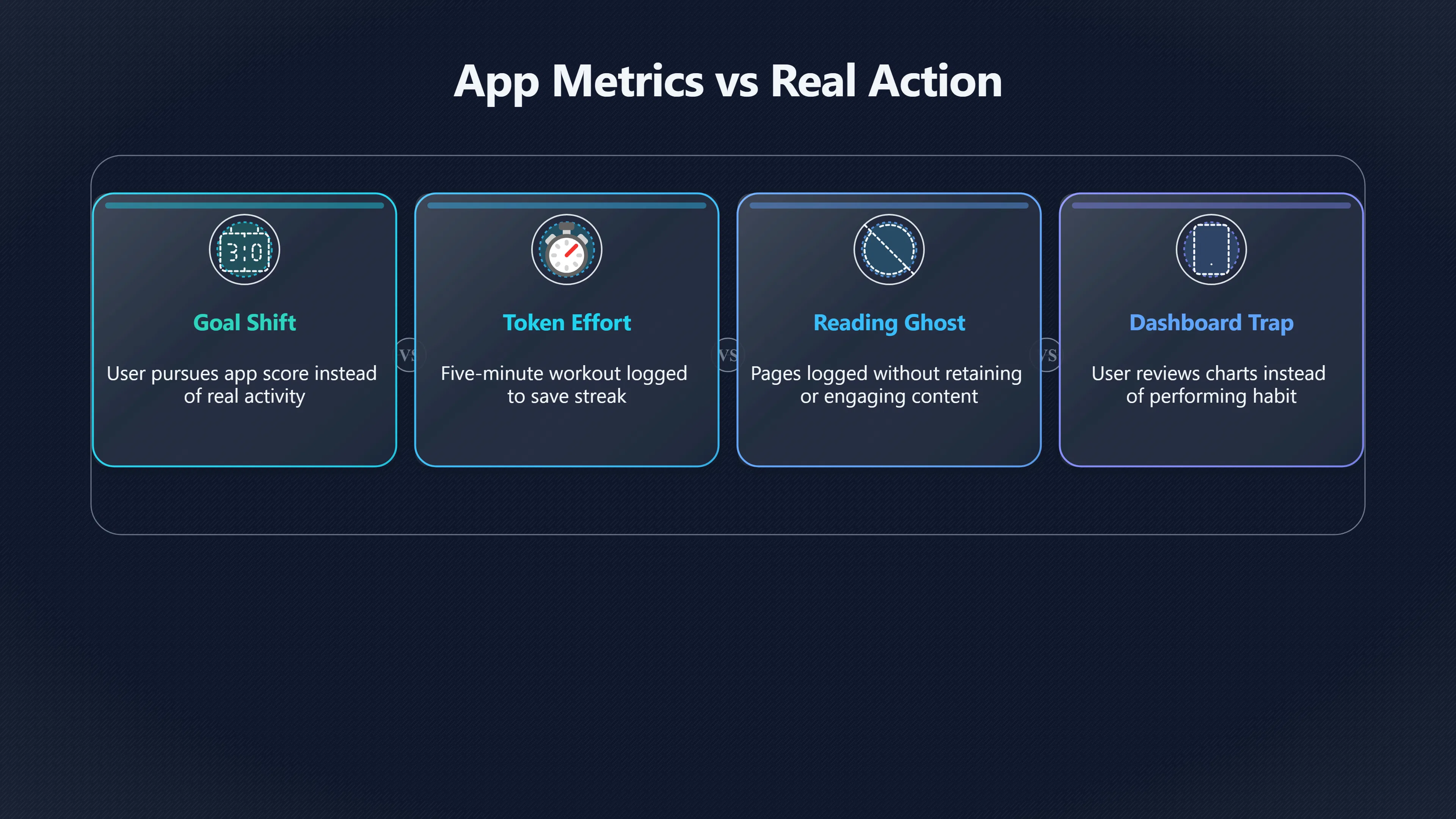
- A user records “workout completed” after a five-minute token effort performed mainly to preserve a streak.
- A reader logs pages without retaining or engaging with the material.
- Someone marks a habit as completed because they intended to do it or partially did it.
- A user spends more time reviewing dashboards and statistics than performing the behaviour being measured.
In each case, the digital record improves while the real-world outcome may stagnate.
This is a version of a broader measurement problem sometimes summarised by Goodhart’s Law: when a measure becomes a target, it can stop being a good measure. The streak was originally evidence that the habit existed. Once preserving the streak becomes the objective, users often discover ways to protect the metric without meaningfully advancing the behaviour.
The irony is that self-monitoring remains one of the most effective behaviour-change tools available. Large reviews consistently identify self-monitoring, feedback, goal setting and prompts as important components of successful interventions. PMC[JMIR mHealth and uHealth]mhealth.jmir.orgJMIR mHealth and uHealthMobile Apps for Health Behavior Change in Physical Activity…by M Milne-Ives · 2020 · Cited by 525 — This syste…
The lesson is not that logging is useless. The lesson is that logging is useful only when it stays honest.
When Analytics Become Entertainment
Many habit apps now provide charts, heat maps, completion percentages, historical trends and achievement systems. These features can help users spot patterns and identify obstacles. Yet they also create a new failure mode: analysis replacing action.
A user can spend twenty minutes reviewing habit data and leave with a strong feeling of progress despite having changed nothing that day. The dashboard creates a sense of involvement. The behaviour remains untouched.
This mirrors the broader pattern of self-improvement theatre. The person interacts with evidence about the habit rather than with the habit itself.
App Settings That Push Action Back Offline
The best use of a habit app is often surprisingly minimal. The app should reduce friction around the behaviour, not create a second hobby devoted to managing the app.
Several design choices help maintain that distinction.
Track Outcomes That Require Real Behaviour
Whenever possible, completion should correspond to something observable.
Instead of:
- “Thought about exercising”
Use:
- “Walked for twenty minutes”
- “Completed today’s training session”
The more objective the completion rule, the harder it becomes to collect points without performing the behaviour.
Reduce Celebration of App Usage
A useful habit tracker celebrates behaviours, not logins.
Notifications that ask “Have you done the habit?” keep attention on the target behaviour. Notifications that primarily encourage opening the app risk shifting attention toward engagement itself.
Prefer Automatic Verification Where Appropriate
Some modern systems integrate with activity trackers, health devices or other external measures. While imperfect, automatic recording can reduce the temptation to treat manual check-ins as the main accomplishment.[TechRadar]techradar.comAs many people abandon their resolutions by February, Habitify offers a structured and customizable way to build good habits like exercis…
The ideal situation is that the behaviour generates the record rather than the record generating the feeling of achievement.
Review Behaviour, Not Just Metrics
Periodic reflection questions are often more valuable than another streak counter:
- What made the habit easier this week?
- When did it fail?
- What environmental change would improve success?
These questions direct attention back to behaviour, context and obstacles rather than app performance.

Allow Streaks to Break Without Crisis
An app that treats a broken streak as catastrophic encourages metric preservation. An app that emphasises returning after a missed day encourages resilience.
Habit formation depends more on long-term consistency than on maintaining perfect records. Missing once is often less important than returning quickly.
The Practical Test
A habit app earns its place when it makes the desired behaviour more likely outside the app. Research on digital behaviour-change tools supports techniques such as self-monitoring, feedback, goal setting and prompts because they help people perform real actions.[PMC]pmc.ncbi.nlm.nih.govPMCAdherence to self‐monitoring and behavioral goals isby LE Burke · 2025 · Cited by 11 — Providing proximal feedback (FB) to self‐monitoring (SM) can improve adherence, as well as adherenc…[PMC]pmc.ncbi.nlm.nih.govPMCDigital Behavior Change Intervention Designs for Habitby Y Zhu · 2024 · Cited by 79 — The results show that the most applied behavior change techniques were the self-monitoring of behavior…
The practical test is simple: after several weeks, is the person spending more time exercising, studying, writing, sleeping or practising than before?
If the answer is yes, the app is functioning as useful scaffolding.
If the most obvious improvement is a longer streak, a prettier dashboard or more frequent app interaction, the tool may have become another form of self-improvement theatre. In that situation, the behaviour is no longer serving the goal. The goal is serving the app.
Amazon book picks
Further Reading
Books and field guides related to When the App Becomes the Habit. Use these as the next step if you want deeper reading beyond the article.
Indistractable
Addresses the difference between engaging with tools and achieving real-world outcomes.
Atomic Habits
Rating: 3.5/5 from 7 Google Books ratings
Keeps attention on behaviour change rather than habit-tracking tools.
Hooked
Helps readers understand how apps encourage repeated checking and streak behaviour.
eBay marketplace picks
Marketplace Samples
Example marketplace items related to this page. Use the search link to explore similar finds on eBay.



Endnotes
1.
Source: pmc.ncbi.nlm.nih.gov
Title: PMCDigital Behavior Change Intervention Designs for Habit
Link:https://pmc.ncbi.nlm.nih.gov/articles/PMC11161714/
Source snippet
by Y Zhu · 2024 · Cited by 79 — The results show that the most applied behavior change techniques were the self-monitoring of behavior...
2.
Source: mhealth.jmir.org
Link:https://mhealth.jmir.org/2020/3/e17046/
Source snippet
JMIR mHealth and uHealthMobile Apps for Health Behavior Change in Physical Activity...by M Milne-Ives · 2020 · Cited by 525 — This syste...
3.
Source: pmc.ncbi.nlm.nih.gov
Link:https://pmc.ncbi.nlm.nih.gov/articles/PMC10998180/
Source snippet
Gamification of Behavior Change: Mathematical Principle and...by F Lieder · 2024 · Cited by 24 — Gamification can make behavior chang...
4.
Source: sciencedirect.com
Link:https://www.sciencedirect.com/org/science/article/pii/S1874944524001035
Source snippet
The Effectiveness of Gamification in Changing Health-...by B Alzghoul · 2024 · Cited by 29 — The studies demonstrated that gamification...
5.
Source: pmc.ncbi.nlm.nih.gov
Link:https://pmc.ncbi.nlm.nih.gov/articles/PMC10545861/
Source snippet
Potential associations between behavior change techniques...by M Milne-Ives · 2023 · Cited by 74 — Six BCTs were repeatedly associate...
6.
Source: ehm-tech.com
Title: habit streaks do they actually work
Link:https://www.ehm-tech.com/habit/blog/habit-streaks-do-they-actually-work/
Source snippet
EHM TechHabit Streaks: Why They Work and When They BackfireMar 10, 2026 — Research confirms that self-monitoring improves goal attainment...
7.
Source: pmc.ncbi.nlm.nih.gov
Title: PMCAdherence to self‐monitoring and behavioral goals is
Link:https://pmc.ncbi.nlm.nih.gov/articles/PMC11897847/
Source snippet
by LE Burke · 2025 · Cited by 11 — Providing proximal feedback (FB) to self‐monitoring (SM) can improve adherence, as well as adherenc...
8.
Source: techradar.com
Link:https://www.techradar.com/computing/websites-apps/habitify
Source snippet
As many people abandon their resolutions by February, Habitify offers a structured and customizable way to build good habits like exercis...
9.
Source: sciencedirect.com
Link:https://www.sciencedirect.com/org/science/article/pii/S1438887124002619
Source snippet
Digital Behavior Change Intervention Designs for Habit...by Y Zhu · 2024 · Cited by 78 — Regarding self-monitoring, most studies automat...
10.
Source: mhealth.jmir.org
Link:https://mhealth.jmir.org/2019/12/e15707/
Source snippet
In addition, for SB, activity tracker...
11.
Source: tinyhabits.com
Link:https://tinyhabits.com/
Source snippet
Tiny HabitsTiny Habits: BJ FoggCreate any habit you want in your life using Tiny Habits: A breakthrough method created by Stanford behavi...
12.
Source: thedecisionlab.com
Link:https://thedecisionlab.com/reference-guide/psychology/fogg-behavior-model
Source snippet
Fogg Behavior ModelThe Fogg Behavior Model (FBM) is a widely used framework for understanding behavior change, identifying three critical...
13.
Source: Wikipedia
Link:https://en.wikipedia.org/wiki/Behavior
Source snippet
BehaviorBehavior (American English) or behaviour (British English) is the range of actions of organisms, individuals, systems or artif...
14.
Source: drpaulmccarthy.com
Title: This framework shows exactly why
Link:https://www.drpaulmccarthy.com/post/tiny-habits-the-breakthrough-method-for-building-life-changing-behaviors
Source snippet
Tiny Habits: The Breakthrough Method for Building Life-...Feb 10, 2026 — A powerful scientific framework by Stanford behavior scientist...
15.
Source: growthengineering.co.uk
Title: fogg behavior model
Link:https://www.growthengineering.co.uk/fogg-behavior-model/
Source snippet
Explore the Fogg Behavior Model for L&D. Learn to design experiences that truly change learner behavior...
16.
Source: gsb.stanford.edu
Title: building habits key lasting behavior change
Link:https://www.gsb.stanford.edu/insights/building-habits-key-lasting-behavior-change
Source snippet
Habits: The Key to Lasting Behavior Change18 Apr 2023 — In this episode, BJ Fogg reveals the secret to building habits that stick...
Additional References
17.
Source: researchgate.net
Link:https://www.researchgate.net/publication/278405715_Beyond_Self-Tracking_and_Reminders_Designing_Smartphone_Apps_That_Support_Habit_Formation
Source snippet
Designing Smartphone Apps That Support Habit Formation10 Dec 2025 — The most common BCTs in behavior change apps are, for example, self-m...
18.
Source: medium.com
Link:https://medium.com/design-bootcamp/designing-with-intention-applying-bj-foggs-behavioral-model-in-ai-experiences-05ea6dca3069
Source snippet
Applying BJ Fogg's Behavioral Model in AI ExperiencesFBM can help designers to build AI-driven experiences that not only engage users but...
19.
Source: reddit.com
Link:https://www.reddit.com/r/Habits/comments/1ou9f3q/built_a_habit_app_focused_on_behavior_change_not/
20.
Source: medium.com
Link:https://medium.com/design-bootcamp/case-study-designing-a-habit-tracking-app-17ee984a6791
Source snippet
Case study: Designing a habit tracking appFor instance, the results showed that features such as to-do lists, progress tracking, and dail...
21.
Source: scribd.com
Link:https://www.scribd.com/document/884899367/Gamifying-Productivity-Do-Habit-Tracking-Apps-Actually-Improve-Time-Management-for-Students
Source snippet
Gamifying Productivity for Students | PDF | MotivationThis research paper examines the effectiveness of gamified habit-tracking apps in i...
22.
Source: merriam-webster.com
Link:https://www.merriam-webster.com/dictionary/habit
Source snippet
HABIT Definition & Meaning7 days ago — The word habit most often refers to a usual way of behaving or a tendency that someone has settled...
23.
Source: uxdesign.cc
Title: how to design behaviours using bj foggs model 6723d5ff3b64
Link:https://uxdesign.cc/how-to-design-behaviours-using-bj-foggs-model-6723d5ff3b64
Source snippet
How to design behaviours, using BJ Fogg's model26 Feb 2020 — This post is a summary from his book “Tiny Habits” (2019) where he proposes...
24.
Source: emergent.sh
Link:https://emergent.sh/learn/best-habit-building-app-builder
Source snippet
Top 5 Habit Building Apps That Actually Work in 2026Jan 16, 2026 — Uncover the best habit building apps in 2026 for real behavior change...
25.
Source: news.delightpath.com
Title: CREATE Action Funnel: Understanding the psychology of user decisions.Read more
Link:https://news.delightpath.com/p/3-behavioral-models-to-design-habit
Source snippet
delightpath.com3 Behavioral Models to Design Habit-Forming Onboarding...23 May 2025 — BJ Fogg's Behavior Model: Aligning motivation, abi...
Published: May 2025
26.
Source: northbeam.io
Title: fogg behavior model motivation ability and prompts
Link:https://www.northbeam.io/blog/fogg-behavior-model-motivation-ability-and-prompts
Source snippet
Fogg Behavior Model: Motivation, Ability, and Prompts29 Oct 2025 — The Fogg Behavior Model explains that behavior occurs when Motivation...
Topic Tree