Within Health Habits
Do habits really take only 21 days?
Health habits usually build over weeks or months, so a missed artificial deadline is not proof that change has failed.
On this page
- Where the 21 day claim falls short
- What 66 days and longer estimates mean
- How to set patient habit expectations
Page outline Jump by section
Introduction
The idea that a new habit takes exactly 21 days to form is one of the most persistent claims in self-improvement. It is also one of the most misleading for beginners. The problem is not merely that the number is inaccurate. The deeper problem is that it creates a false deadline. When people reach day 21 and still need effort, reminders or motivation to perform a health behaviour, many conclude that they have failed.
 Research on health habit formation paints a very different picture. Habits generally develop gradually, with substantial variation between individuals and behaviours. Rather than becoming automatic after three weeks, many health habits require repeated practice over months before they feel natural. Understanding this difference can prevent unnecessary discouragement and help people build expectations that match how behaviour change actually works.[Wiley Online Library]onlinelibrary.wiley.comWiley Online LibraryHow are habits formed: Modelling habit formation in the…by P Lally · 2010 · Cited by 3559 — To investigate the pro…
Do habits really take only 21 days?
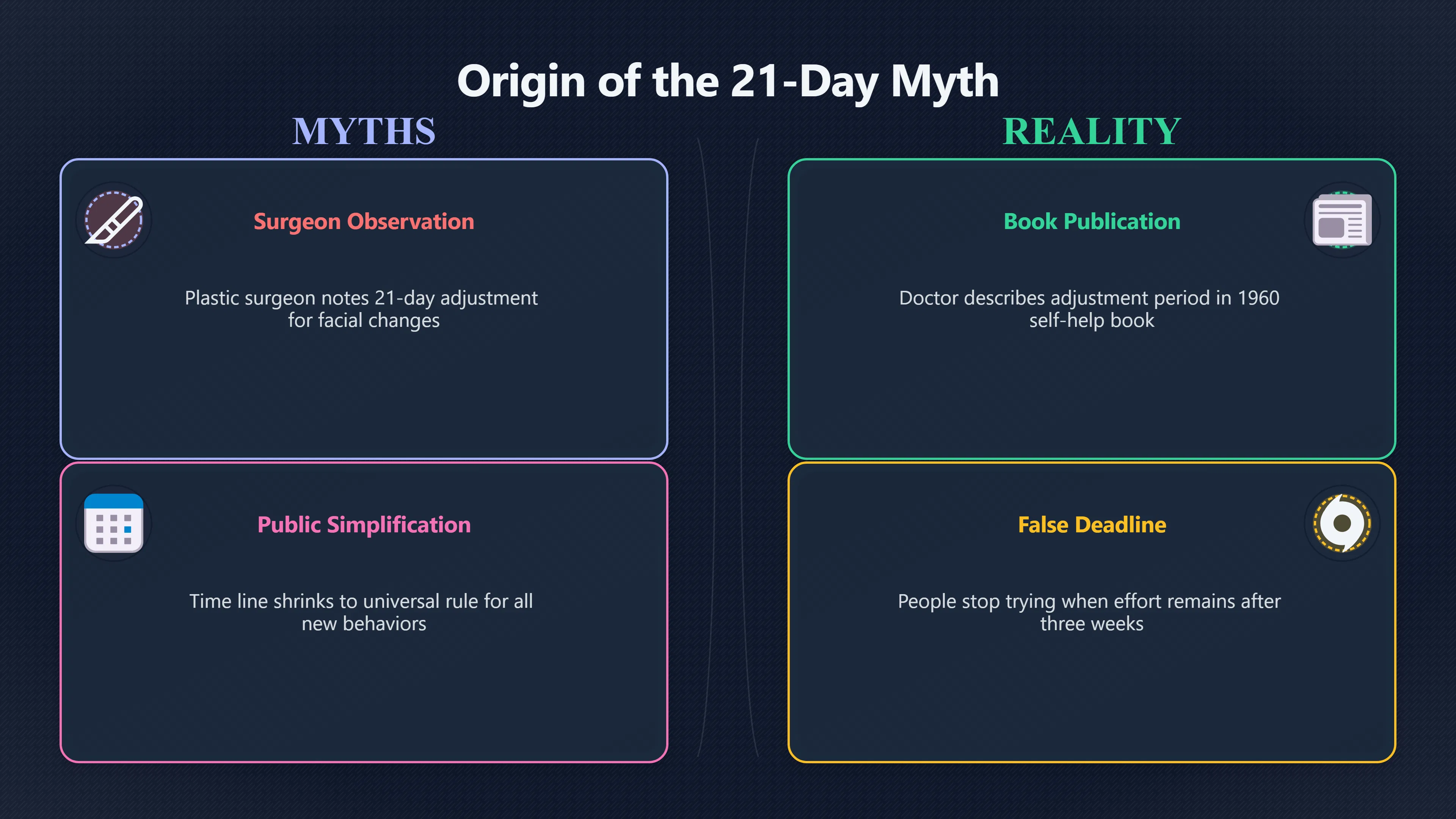
The famous 21-day figure did not originate from habit-formation research. It is usually traced to observations made by plastic surgeon and author Maxwell Maltz in the 1950s. Maltz noticed that patients often needed around 21 days to adjust psychologically to physical changes such as facial surgery or limb loss. He described this as a minimum adjustment period, not as a universal law of habit formation. Over time, the idea was simplified and repeated until it became the claim that any habit can be built in three weeks.[James Clear]jamesclear.comJames Clear How Long Does it Take to Form a Habit?Backed by Science.Maltz would perform an operation — like a nose job, for example — he found that it would take the patient about 21 days…[Women's]womenshealth.obgyn.msu.edudebunking 21 day myth about bad habitsthe 21 Day Myth about bad habitsThe myth seems to have originated in the 1960 book, Psycho-cybernetics, by Dr. Maxwell Maltz. The plastic…
The appeal is obvious. A short, precise timeline makes change seem manageable. Three weeks sounds achievable in a way that three or four months may not. Unfortunately, an attractive number is not the same thing as evidence.
Modern habit research has not found support for a universal 21-day rule. Instead, studies consistently show that habit formation follows a gradual curve and varies widely across people and behaviours.[Wiley Online Library]onlinelibrary.wiley.comWiley Online LibraryHow are habits formed: Modelling habit formation in the…by P Lally · 2010 · Cited by 3559 — To investigate the pro…
Where the 21-day claim falls short
The biggest weakness of the 21-day myth is that it encourages an all-or-nothing view of progress.
A beginner might decide to walk after lunch every day. By day 21, the walk may still require conscious effort. Because the person expects automaticity by that point, they interpret the effort as evidence that the habit has not worked. In reality, the behaviour may be developing normally.
Research led by Phillippa Lally and colleagues followed people attempting new eating, drinking and activity behaviours in everyday life. Rather than seeing a sudden transformation at a specific date, researchers observed gradual increases in automaticity over time. The process looked more like a slow strengthening of a cue-behaviour link than a switch being flipped.[Wiley Online Library]onlinelibrary.wiley.comWiley Online LibraryHow are habits formed: Modelling habit formation in the…by P Lally · 2010 · Cited by 3559 — To investigate the pro…
The myth also ignores differences between behaviours.
- Drinking a glass of water after breakfast is relatively simple.
- Flossing every evening requires more effort and consistency.
- Completing a demanding exercise routine requires even more planning, energy and recovery.
These behaviours do not become automatic at the same speed. Treating them as if they should all conform to a 21-day schedule creates unrealistic expectations from the start.[PubMed]pubmed.ncbi.nlm.nih.govTime to Form a Habit: A Systematic Review and Meta…by B Singh · 2024 · Cited by 69 — Four studies reported the median or mean ti…
Another problem is that the myth encourages streak-based thinking. If someone misses a day during a supposed 21-day challenge, they may feel they have ruined the process. Habit research suggests that occasional lapses are far less important than maintaining the broader pattern of repetition over time.[Wiley Online Library]onlinelibrary.wiley.comWiley Online LibraryHow are habits formed: Modelling habit formation in the…by P Lally · 2010 · Cited by 3559 — To investigate the pro…
What 66 days and longer estimates mean
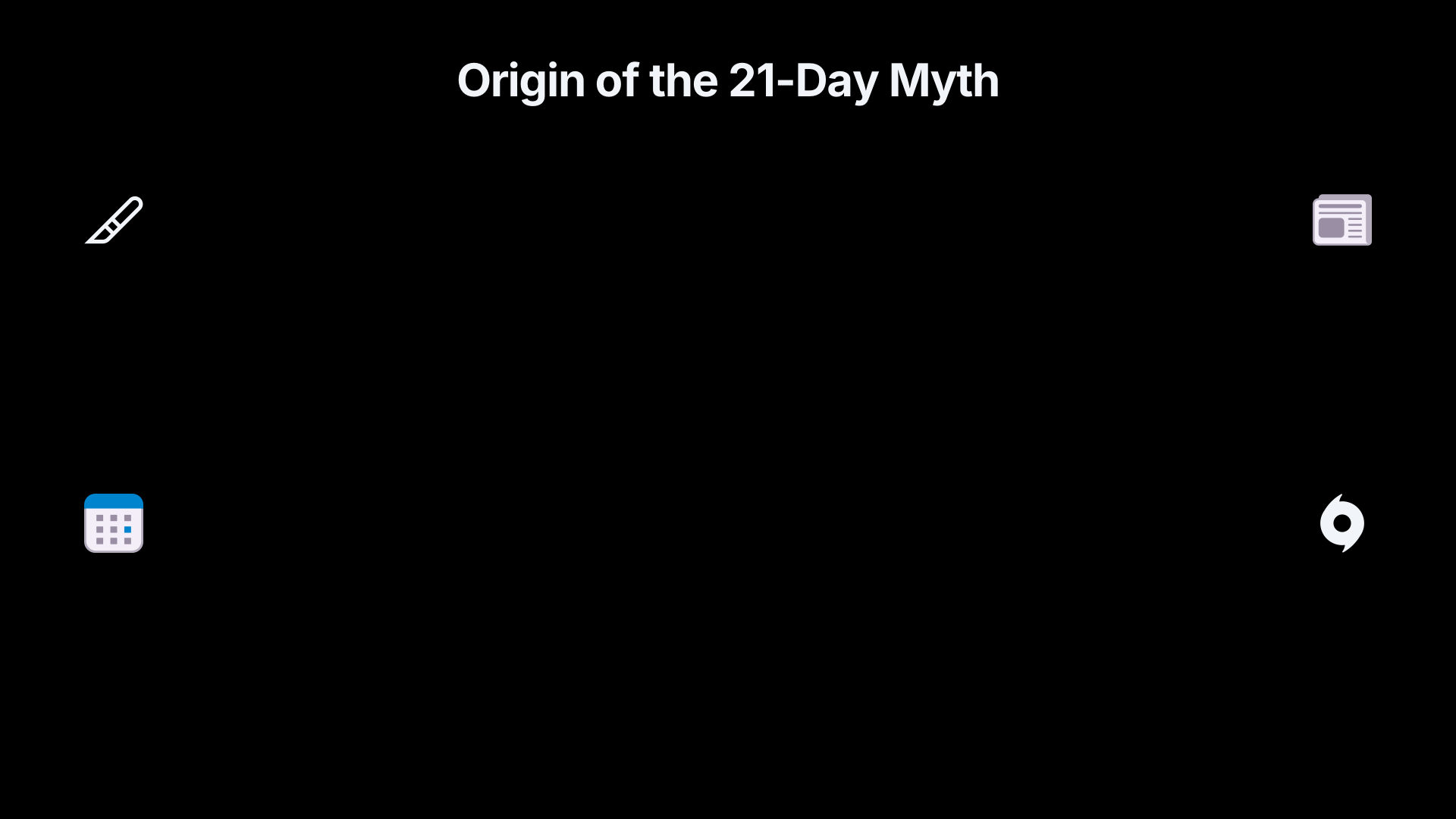
The number that often replaces the 21-day claim is 66 days. This figure comes from the Lally study and is frequently presented as if it were the new magic number. That interpretation is also mistaken.
The study found that participants reached maximum automaticity after an average of about 66 days, but the actual range was much broader. Some habits developed much faster, while others took far longer. Researchers reported substantial variation depending on the person and the behaviour involved.[Wiley Online Library]onlinelibrary.wiley.comWiley Online LibraryHow are habits formed: Modelling habit formation in the…by P Lally · 2010 · Cited by 3559 — To investigate the pro…[University College London]ucl.ac.ukhow long does it take form habitUniversity College LondonHow long does it take to form a habit?4 Aug 2009 — It takes an average 66 days to form a new habit, according to…
More recent evidence reinforces this variability. A 2024 systematic review and meta-analysis examining health-behaviour habit formation found reported median timelines of roughly 59–66 days, while average estimates ranged from 106–154 days. Individual estimates across studies ranged from as little as four days to as much as 335 days.[PubMed]pubmed.ncbi.nlm.nih.govTime to Form a Habit: A Systematic Review and Meta…by B Singh · 2024 · Cited by 69 — Four studies reported the median or mean ti…[MDPI]mdpi.comTime to Form a Habit: A Systematic Review and Meta…by B Singh · 2024 · Cited by 69 — Four studies reported the median or mean times to…
These findings do not mean that everyone should now expect five months instead of three weeks. They mean that habit formation is not governed by a single deadline.
The most useful interpretation is that:
- Health habits often begin strengthening within the first couple of months.
- Strong automaticity frequently takes longer.
- Different people progress at different rates.
- Behaviour complexity matters.
- Consistency matters more than hitting a specific calendar date.
This view is less exciting than a simple rule, but it is much closer to reality.[PubMed]pubmed.ncbi.nlm.nih.govTime to Form a Habit: A Systematic Review and Meta…by B Singh · 2024 · Cited by 69 — Four studies reported the median or mean ti…[ScienceDaily]sciencedaily.comMyth busted: Healthy habits take longer than 21 days to set inJan 24, 2025 — UniSA researchers found that new habits can begin forming wi…
How the myth creates avoidable failure
The practical harm of the 21-day myth is psychological rather than scientific.
Imagine two people starting the same health behaviour.
The first believes the behaviour should feel automatic after three weeks. When day 21 arrives and effort is still required, motivation drops. The person assumes something is wrong and may stop entirely.
The second expects habit formation to be gradual and uneven. On day 21, effort is still required, but that effort is interpreted as a normal stage of the process. The person continues repeating the behaviour.
The difference is not willpower. It is expectation.
Research and expert commentary repeatedly note that habit formation resembles a gradual learning process rather than a fixed countdown. When people understand this, temporary difficulty becomes evidence of being in the middle of the process rather than evidence of failure.[Scientific American]scientificamerican.comhow long does it really take to form a habitScientific AmericanHow Long Does It Really Take to Form a Habit?24 Jan 2024 — There's a myth that it takes 21 days to form a habit. Exper…[University of Surrey]surrey.ac.ukdoes it really take 66 days form habit we asked expert dr pippa lallyDoes it really take 66 days to form a habit?21 Jan 2026 — In 2010, Dr Pippa Lally, with colleagues at UCL, published a study that found t…
The myth can also push beginners towards unrealistic goals. Believing that a habit only needs to survive three weeks may encourage ambitious plans that are difficult to sustain. A slower, evidence-based perspective encourages choosing behaviours that can realistically be repeated for months if necessary.
How to set patient habit expectations
A more useful framework is to stop asking, “Will this be automatic by day 21?” and start asking, “Can I repeat this consistently enough for automaticity to grow over time?”
Several evidence-based expectations help:
Expect progress before automaticity. A behaviour can become easier long before it feels effortless.
Expect variation. A simple hydration habit and a complex exercise routine will not develop at the same speed.
Expect occasional lapses. Missing a day does not erase previous repetitions.
Expect gradual improvement. Automaticity typically increases over weeks and months rather than appearing suddenly.
Expect the process to outlast initial motivation. The goal of habit formation is not to stay highly motivated forever but to reduce the amount of motivation required.[Wiley Online Library]onlinelibrary.wiley.comWiley Online LibraryHow are habits formed: Modelling habit formation in the…by P Lally · 2010 · Cited by 3559 — To investigate the pro…[PubMed Central]pmc.ncbi.nlm.nih.govPubMed CentralMaking health habitual: the psychology of 'habit-formation' and…by B Gardner · 2012 · Cited by 856 — More relevant resea…
For people interested in self-improvement that works, this may be the most important lesson from the evidence. The failure is often not the health habit itself. The failure is the expectation that meaningful behavioural change should be complete after an arbitrary three-week deadline. When that deadline disappears, many apparent failures start to look like normal progress.[PubMed]pubmed.ncbi.nlm.nih.govTime to Form a Habit: A Systematic Review and Meta…by B Singh · 2024 · Cited by 69 — Four studies reported the median or mean ti…[ScienceDaily]sciencedaily.comMyth busted: Healthy habits take longer than 21 days to set inJan 24, 2025 — UniSA researchers found that new habits can begin forming wi…
Amazon book picks
Further Reading
Books and field guides related to Do habits really take only 21 days?. Use these as the next step if you want deeper reading beyond the article.
Atomic Habits
Rating: 3.5/5 from 7 Google Books ratings
Explains why lasting habits require more than a fixed number of days.
Psycho-Cybernetics
Rating: 4.0/5 from 5 Google Books ratings
Provides historical context for the 21-day claim.
eBay marketplace picks
Marketplace Samples
Example marketplace items related to this page. Use the search link to explore similar finds on eBay.






Endnotes
1.
Source: onlinelibrary.wiley.com
Link:https://onlinelibrary.wiley.com/doi/10.1002/ejsp.674
Source snippet
Wiley Online LibraryHow are habits formed: Modelling habit formation in the...by P Lally · 2010 · Cited by 3559 — To investigate the pro...
2.
Source: mdpi.com
Link:https://www.mdpi.com/2227-9032/12/23/2488
Source snippet
Time to Form a Habit: A Systematic Review and Meta...by B Singh · 2024 · Cited by 69 — Four studies reported the median or mean times to...
3.
Source: sciencedaily.com
Link:https://www.sciencedaily.com/releases/2025/01/250124151347.htm
Source snippet
Myth busted: Healthy habits take longer than 21 days to set inJan 24, 2025 — UniSA researchers found that new habits can begin forming wi...
4.
Source: mdpi.com
Title: 2076 328X
Link:https://www.mdpi.com/2076-328X/16/4/535
Source snippet
(2010) found that forming a habit took between 59 days and three months and followed a non-linear, asymptotic trajectory.Read more...
5.
Source: mdpi.com
Title: 2076 328X
Link:https://www.mdpi.com/2076-328X/14/12/1224
Source snippet
A Systematic Review with Meta-Analysesby J Wan · 2024 · Cited by 4 — This systematic review and meta-analysis demonstrated the effectiven...
6.
Source: opendeltas.com
Link:https://www.opendeltas.com/post/21-days-habit-formation-myth
Source snippet
The 21 Days Habit Formation Myth and Mindfulness Benefits11 Jun 2020 — In 1950, Maxwell Maltz a plastic surgeon, found that it would take...
7.
Source: pubmed.ncbi.nlm.nih.gov
Link:https://pubmed.ncbi.nlm.nih.gov/39685110/
Source snippet
Time to Form a Habit: A Systematic Review and Meta...by B Singh · 2024 · Cited by 69 — Four studies reported the median or mean ti...
8.
Source: jamesclear.com
Title: James Clear How Long Does it Take to Form a Habit?
Link:https://jamesclear.com/new-habit
Source snippet
Backed by Science.Maltz would perform an operation — like a nose job, for example — he found that it would take the patient about 21 days...
9.
Source: womenshealth.obgyn.msu.edu
Title: debunking 21 day myth about bad habits
Link:https://womenshealth.obgyn.msu.edu/blog/debunking-21-day-myth-about-bad-habits
Source snippet
the 21 Day Myth about bad habitsThe myth seems to have originated in the 1960 book, Psycho-cybernetics, by Dr. Maxwell Maltz. The plastic...
10.
Source: pmc.ncbi.nlm.nih.gov
Link:https://pmc.ncbi.nlm.nih.gov/articles/PMC3505409/
Source snippet
PubMed CentralMaking health habitual: the psychology of 'habit-formation' and...by B Gardner · 2012 · Cited by 856 — More relevant resea...
11.
Source: ucl.ac.uk
Title: how long does it take form habit
Link:https://www.ucl.ac.uk/news/2009/aug/how-long-does-it-take-form-habit
Source snippet
University College LondonHow long does it take to form a habit?4 Aug 2009 — It takes an average 66 days to form a new habit, according to...
12.
Source: pmc.ncbi.nlm.nih.gov
Link:https://pmc.ncbi.nlm.nih.gov/articles/PMC11641623/
Source snippet
PubMed CentralTime to Form a Habit: A Systematic Review and Meta-Analysis...by B Singh · 2024 · Cited by 95 — A widely cited idea in pop...
13.
Source: scientificamerican.com
Title: how long does it really take to form a habit
Link:https://www.scientificamerican.com/article/how-long-does-it-really-take-to-form-a-habit/
Source snippet
Scientific AmericanHow Long Does It Really Take to Form a Habit?24 Jan 2024 — There's a myth that it takes 21 days to form a habit. Exper...
14.
Source: surrey.ac.uk
Title: does it really take 66 days form habit we asked expert dr pippa lally
Link:https://www.surrey.ac.uk/news/does-it-really-take-66-days-form-habit-we-asked-expert-dr-pippa-lally
Source snippet
Does it really take 66 days to form a habit?21 Jan 2026 — In 2010, Dr Pippa Lally, with colleagues at UCL, published a study that found t...
15.
Source: studyfinds.com
Title: 21 days to form a habit?
Link:https://studyfinds.com/forming-habits-takes-months/
Source snippet
Science reveals why that number...Jan 24, 2025 — Contrary to popular belief, forming new health habits takes between 59-66 days (median...
Additional References
16.
Source: researchgate.net
Link:https://www.researchgate.net/publication/342245723_An_intervention_designed_to_investigate_habit_formation_in_a_novel_health_behaviour
Source snippet
An intervention designed to investigate habit formation in a...Time to Form a Habit: A Systematic Review and Meta-Analysis of Health Beh...
17.
Source: researchgate.net
Link:https://www.researchgate.net/publication/386593213_Time_to_Form_a_Habit_A_Systematic_Review_and_Meta-Analysis_of_Health_Behaviour_Habit_Formation_and_Its_Determinants
Source snippet
(PDF) Time to Form a Habit: A Systematic Review and...Dec 4, 2024 — Four studies reported the median or mean times to reach habit format...
18.
Source: healthline.com
Link:https://www.healthline.com/health/how-long-does-it-take-to-form-a-habit
Source snippet
Habit Formation: How Long It Takes and How to Start NowIt can take anywhere from 18 to 254 days for a person to form a new habit and an a...
19.
Source: reddit.com
Link:https://www.reddit.com/r/science/comments/1i9xaah/myth_busted_healthy_habits_take_longer_than_21/
Source snippet
Myth busted: Healthy habits take longer than 21 days to set inResearchers found that new habits can begin forming within about two months...
20.
Source: ouci.dntb.gov.ua
Link:https://ouci.dntb.gov.ua/en/works/7BYjKk39/
Source snippet
to Form a Habit: A Systematic Review and Meta...Four studies reported the median or mean times to reach habit formation, ranging from 59...
21.
Source: researchgate.net
Link:https://www.researchgate.net/profile/Gonzalo_Marchant/post/Do-you-know-what-the-recommendation-is-for-physical-activity-and-sedentary-behavior-to-health/attachment/59d620af79197b807797f284/AS%3A291995114328067%401446628468694/download/Phillippa%2BLally%2C%2BJane%2BWardle%2Band%2BBenjamin%2BGardner.%2BExperiences%2Bof%2Bhabits%2Bformation%2B2011..pdf
22.
Source: medium.com
Link:https://medium.com/%40vignesh-iift/the-most-freeing-habit-research-update-in-a-long-time-its-not-21-days-af0c3640b7f0
Source snippet
The most freeing habit research update in a long timeA 2024 systematic review and meta-analysis of health-behavior habit formation found...
23.
Source: linkedin.com
Title: Richard Edrich, Cert Ed, Pg C, MSc, FCIMSPA’s Post Review highlights that
Link:https://www.linkedin.com/posts/richard-edrich-021978a4_time-to-form-a-habit-a-systematic-review-activity-7275144874910257152-hvqy
Source snippet
Richard Edrich, Cert Ed, PgC, MSc, FCIMSPA's PostReview highlights that - based on certain health behaviours - new habit formation can ta...
24.
Source: researchgate.net
Title: Modeling habit formation in the real world | Request PDFLally et al
Link:https://www.researchgate.net/publication/32898894_How_are_habits_formed_Modeling_habit_formation_in_the_real_world
Source snippet
(2010) demonstrated that new behavioural patterns require between 18 and 254 days to reach automaticity, with a median of approximately 6...
25.
Source: m.economictimes.com
Title: The Economic Times Think you can build a habit in 21 days?
Link:https://m.economictimes.com/magazines/panache/think-you-can-build-a-habit-in-21-days-neuroscientist-busts-the-popular-myth-revealing-how-long-it-really-takes-the-truth-will-surprise-you/articleshow/124912395.cms
Source snippet
Neuroscientist busts the popular myth, revealing how long it really takes. The truth will surprise youNeuroscientist Dr. Wendy Suzuki fro...
Topic Tree