Within Techniques
When does tracking start getting in the way?
Tracking can reveal useful patterns, but too much measurement can make self-improvement feel like the main burden.
On this page
- What self monitoring is meant to change
- Signals that measurement is becoming the burden
- Use feedback to adjust rather than judge
Page outline Jump by section
Introduction
Self-monitoring is one of the most common behaviour change techniques in self-improvement. It includes habit trackers, food logs, budgeting spreadsheets, sleep diaries, step counters and similar tools that make behaviour visible. Within the Behaviour Change Technique Taxonomy, self-monitoring is not meant to be a motivational slogan. It is a specific technique: recording behaviour or its outcomes so that patterns can be observed and adjusted.[digitalwellbeing.org]digitalwellbeing.orgi BCT Taxonomy (v1): 93 hierarchically-clustered techniquesThe definitions of Behavior Change Techniques (BCTs): i) contain verbs…
 The central benefit is simple: people often misjudge what they actually do. Tracking creates feedback. The central risk is equally simple: tracking can become the activity that receives most of the attention, while the underlying behaviour changes very little. When that happens, self-improvement starts to feel like managing data rather than improving life.
What self-monitoring is meant to change
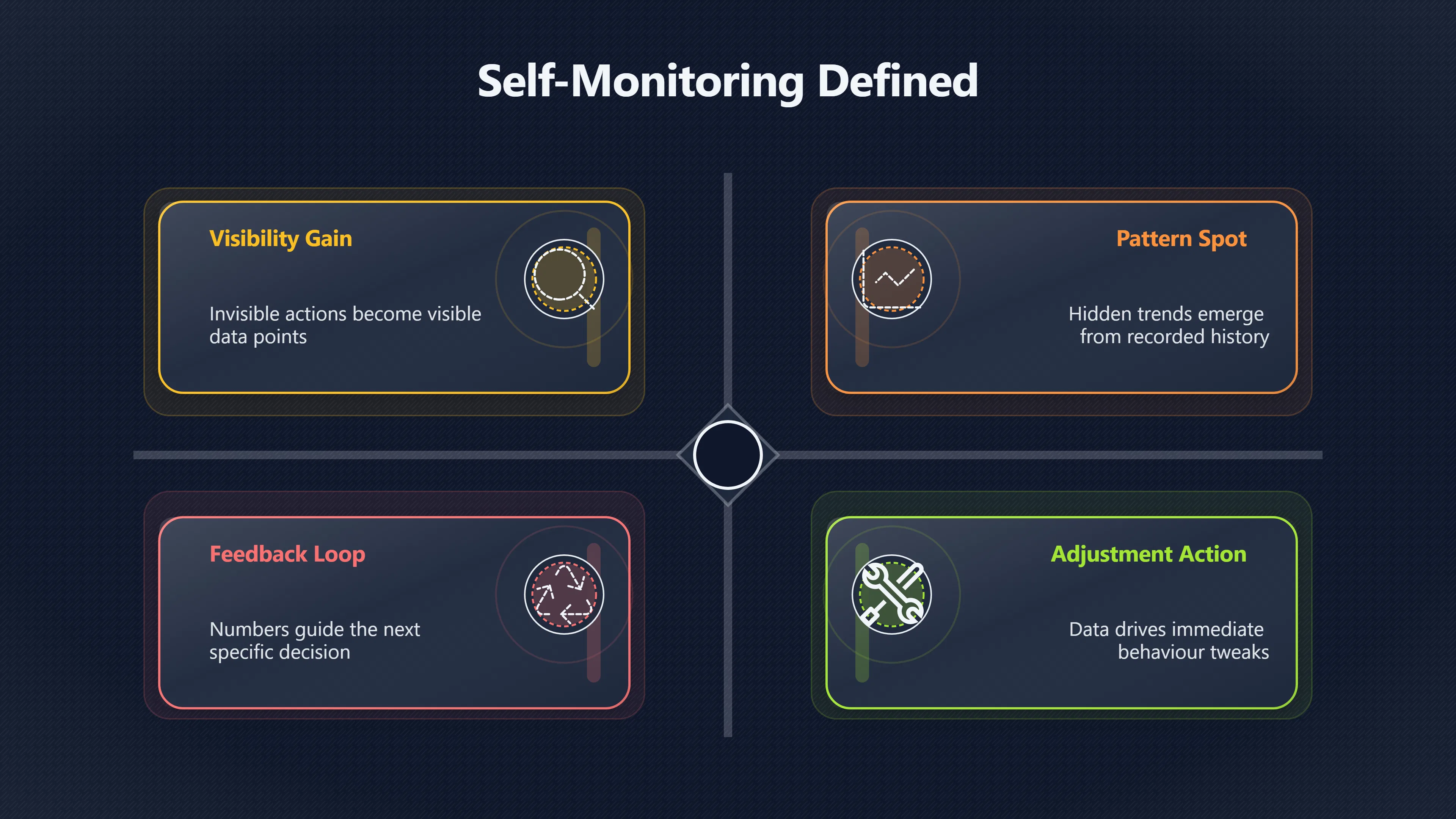
The purpose of self-monitoring is not record-keeping for its own sake. It is to increase awareness of behaviour and provide information that can guide the next decision. The Behaviour Change Technique Taxonomy defines self-monitoring as establishing a method for a person to record behaviour or its outcomes as part of a change strategy. Examples include recording daily exercise, tracking spending, or logging sleep.[digitalwellbeing.org]digitalwellbeing.orgi BCT Taxonomy (v1): 93 hierarchically-clustered techniquesThe definitions of Behavior Change Techniques (BCTs): i) contain verbs…
Research consistently finds that self-monitoring can improve awareness and often supports behaviour change, particularly when combined with feedback, goals or review processes. Reviews of physical activity interventions have found that monitoring is frequently associated with increased activity, while broader reviews of behaviour change techniques identify self-monitoring as one of the most commonly used and influential intervention components.[PMC]pmc.ncbi.nlm.nih.govPMCThe Use of Self-Monitoring and Technology to Increaseby EJ Page · 2020 · Cited by 77 — This review found that most of the studies reviewed showed an increase of physical activity when usi…[The Lancet]thelancet.comBenefits of physical activity interventions combining self…by T Vetrovsky · 2021 · Cited by 6 — Self-monitoring is a cornerstone of ma…
The mechanism is not mysterious:
- Behaviour that was previously invisible becomes visible.
- Patterns become easier to notice.
- Progress becomes easier to evaluate.
- Adjustments can be made sooner rather than after months of drift.
A spending diary may reveal that small purchases are driving overspending. A sleep log may show that late caffeine use matters more than expected. A step counter may expose how sedentary a typical workday really is. The value comes from discovering something actionable rather than merely generating numbers.[UCL Blogs]blogs.ucl.ac.ukthe costs and benefits of self monitoring for health and wellnessUCL BlogsThe costs and benefits of self-monitoring for health and wellness21 Sept 2018 — Self-monitoring can reveal problematic behaviour…
Why tracking often works at the beginning
Tracking is particularly useful during periods of uncertainty.
When someone starts a new habit, they usually lack reliable information. They may overestimate consistency, underestimate obstacles, or misunderstand what influences results. Monitoring helps create a clearer picture of reality.
This is why many successful interventions use tracking early. It acts as a learning tool. Rather than asking, “Am I disciplined?”, the person asks, “What actually happened this week?” That shift moves attention from self-judgement towards observation.[PMC]pmc.ncbi.nlm.nih.govPMCThe Use of Self-Monitoring and Technology to Increaseby EJ Page · 2020 · Cited by 77 — This review found that most of the studies reviewed showed an increase of physical activity when usi…
In practical terms, tracking tends to be most valuable when:
- A behaviour is difficult to estimate accurately.
- Patterns are not yet obvious.
- Progress is slow enough that memory becomes unreliable.
- Decisions need feedback from previous attempts.
For example, someone trying to reduce social media use may discover that usage spikes during specific times of day. Someone attempting to exercise more may learn that morning sessions succeed far more often than evening sessions. These discoveries often matter more than the numerical totals themselves.
Signals that measurement is becoming the burden
The danger appears when the tool begins to replace the purpose.
A useful question is: if the tracker disappeared tomorrow, would the behaviour continue? If the answer is no, the person may be maintaining a tracking habit more successfully than the target habit.
Several warning signs commonly appear.
Recording feels more important than doing
The original goal might be exercising, reading, saving money or sleeping better. Over time, attention shifts towards maintaining perfect records.
A missed entry begins to feel like failure even when the behaviour occurred. The spreadsheet becomes the project.
Metrics become a source of self-worth
Numbers are useful indicators. They are poor measures of personal value.
When a low step count, missed streak or imperfect chart creates disproportionate guilt, the metric has started serving as a judgement system rather than a feedback system. Critics of intensive self-tracking note that people can become fixated on numerical targets and increasingly evaluate themselves through data rather than through broader wellbeing or progress.[The Guardian]theguardian.comThis phenomenon, driven by the availability of smartphones, fitness trackers, and health monitors, raises questions about the efficacy an…

The tracking workload keeps expanding
A simple habit tracker grows into multiple apps, dashboards, categories and daily reviews.
The amount of monitoring rises while behavioural gains flatten. At that point, the person may be optimising measurement rather than outcomes.
Activity becomes less enjoyable without measurement
Research on self-tracking has documented cases where activities become less satisfying when they are not being recorded. Some users report feeling that exercise, for example, is less meaningful if it is not captured by a device.[Arno]arno.uvt.nlOpen source on uvt.nl.
That is a subtle shift. The behaviour no longer feels valuable on its own; it feels valuable because it generates data.
The trap of optimising the tracker
Many digital behaviour-change systems depend heavily on engagement. Users receive streaks, badges, graphs and reminders. These can be useful, but they can also create a conflict.
A person may become highly engaged with the tool while only modestly engaged with the behaviour it was designed to support. Researchers examining behaviour-change technologies have warned that systems sometimes optimise continued interaction with the technology itself rather than helping users internalise the underlying behaviour.[arXiv]arxiv.orgDesigning for Sustained Motivation: A Review of Self-Determination Theory in Behaviour Change TechnologiesJanuary 31, 2024…
This distinction matters.
Consider two people who both track reading:
- One uses tracking to notice when reading is slipping and adjusts accordingly.
- The other spends significant time managing categories, statistics and reading goals while reading little more than before.
Both appear committed. Only one is using tracking primarily as feedback.
The same issue appears in fitness, productivity and personal finance. The tracker can create a feeling of progress that partially substitutes for actual progress.
Use feedback to adjust rather than judge
The healthiest use of self-monitoring treats information as guidance, not as a verdict.
Instead of asking, “Did I succeed?” a more useful question is, “What does this tell me about the next attempt?”
For example:
- A missed workout suggests reviewing timing, location or preparation.
- A week of poor sleep suggests examining routines or environmental factors.
- Overspending suggests investigating specific spending situations.
The emphasis is on adaptation.
Research on self-regulation consistently points to monitoring as part of a larger feedback loop rather than a standalone solution. Monitoring creates awareness, but awareness becomes valuable only when it informs adjustment.[PMC]pmc.ncbi.nlm.nih.govPMCThe Use of Self-Monitoring and Technology to Increaseby EJ Page · 2020 · Cited by 77 — This review found that most of the studies reviewed showed an increase of physical activity when usi…
A practical rule is that every measurement should have a plausible action attached to it. If a number cannot influence a future decision, it may not need to be tracked.

When it is time to reduce tracking
Many people assume that more tracking is always better. Often the opposite is true.
Once a behaviour becomes stable and predictable, intensive monitoring may no longer provide much new information. The tracker has done its job. At that stage, lighter monitoring can preserve awareness without creating dependence.
Useful transitions include:
- Moving from daily reviews to weekly reviews.
- Tracking only key indicators rather than every detail.
- Using occasional check-ins instead of continuous logging.
- Keeping records only when behaviour starts drifting again.
This approach recognises that tracking is a means rather than an end.
The most successful form of self-monitoring eventually becomes less visible. The behaviour starts happening with less effort, less attention and less measurement. When that occurs, the tracker has fulfilled its purpose. The goal was never to create a perfect spreadsheet. The goal was to change what happens when the spreadsheet is closed.
Amazon book picks
Further Reading
Books and field guides related to When does tracking start getting in the way?. Use these as the next step if you want deeper reading beyond the article.
Atomic Habits
Rating: 3.5/5 from 7 Google Books ratings
Discusses tracking, feedback and when measurement helps.
eBay marketplace picks
Marketplace Samples
Example marketplace items related to this page. Use the search link to explore similar finds on eBay.


Endnotes
1.
Source: digitalwellbeing.org
Link:https://digitalwellbeing.org/wp-content/uploads/2016/11/BCTTv1_PDF_version.pdf
Source snippet
i BCT Taxonomy (v1): 93 hierarchically-clustered techniquesThe definitions of Behavior Change Techniques (BCTs): i) contain verbs...
2.
Source: pmc.ncbi.nlm.nih.gov
Title: PMCThe Use of Self-Monitoring and Technology to Increase
Link:https://pmc.ncbi.nlm.nih.gov/articles/PMC7490310/
Source snippet
by EJ Page · 2020 · Cited by 77 — This review found that most of the studies reviewed showed an increase of physical activity when usi...
3.
Source: pmc.ncbi.nlm.nih.gov
Link:https://pmc.ncbi.nlm.nih.gov/articles/PMC7571594/
Source snippet
Self-Regulation Mechanisms in Health Behaviour Changeby EA Hennessy · 2020 · Cited by 248 — Self-regulation is one primary mechanism i...
4.
Source: pmc.ncbi.nlm.nih.gov
Link:https://pmc.ncbi.nlm.nih.gov/articles/PMC8493454/
Source snippet
With the development of tracking...Read more...
5.
Source: arxiv.org
Link:https://arxiv.org/abs/2402.00121
Source snippet
Designing for Sustained [Motivation]({{ 'motivation/' | relative_url }}): A Review of Self-Determination Theory in Behaviour Change TechnologiesJanuary 31, 2024...
Published: January 31, 2024
6.
Source: self.inc
Link:https://www.self.inc/
Source snippet
Build Credit, Build Savings and Access CashBuild credit and savings with Self. The Credit Builder Account and Self Visa® Credit Ca...
7.
Source: thelancet.com
Link:https://www.thelancet.com/journals/lancet/article/PIIS0140-6736%2821%2902630-1/fulltext
Source snippet
Benefits of physical activity interventions combining self...by T Vetrovsky · 2021 · Cited by 6 — Self-monitoring is a cornerstone of ma...
8.
Source: blogs.ucl.ac.uk
Title: the costs and benefits of self monitoring for health and wellness
Link:https://blogs.ucl.ac.uk/cbc-digi-hub-blog/2018/09/21/the-costs-and-benefits-of-self-monitoring-for-health-and-wellness/
Source snippet
UCL BlogsThe costs and benefits of self-monitoring for health and wellness21 Sept 2018 — Self-monitoring can reveal problematic behaviour...
9.
Source: theguardian.com
Link:https://www.theguardian.com/lifeandstyle/2025/feb/22/the-bot-asked-me-four-times-a-day-how-i-was-feeling-is-tracking-everything-actually-good-for-us
Source snippet
This phenomenon, driven by the availability of smartphones, fitness trackers, and health monitors, raises questions about the efficacy an...
10.
Source: Wikipedia
Link:https://en.wikipedia.org/wiki/Self
Source snippet
SelfIn philosophy, the self is an individual's own being, knowledge, and values, and the relationship between these attributes. The fi...
Additional References
11.
Source: phwwhocc.co.uk
Link:https://phwwhocc.co.uk/wp-content/uploads/2024/02/Identifying-and-Applying-Behaviour-Change-Techniques-1.pdf
Source snippet
Identifying and Applying Behaviour Change TechniquesWhilst the BCTs identified within the Taxonomy aren't new, some of them such as “goal...
12.
Source: ijsmsjournal.org
Link:https://ijsmsjournal.org/2024/volume-7%20issue-1/ijsms-v7i1p115.pdf
Source snippet
Personal Growth and Habit TrackingThe relationship among individuals increase and dependency monitoring lies inside the reputation that i...
13.
Source: merriam-webster.com
Link:https://www.merriam-webster.com/dictionary/self
Source snippet
SELF Definition & Meaning1. a (1): an individual's typical character or behavior her true self was revealed (2): an individual's tempor...
14.
Source: selfincorp.org
Link:https://www.selfincorp.org/
Source snippet
Self Inc.SELF, Inc. is a comprehensive range of housing services, including shelters, transitional housing, and permanent supportive hous...
15.
Source: theoryandtechniquetool.humanbehaviourchange.org
Link:https://theoryandtechniquetool.humanbehaviourchange.org/tool
Source snippet
Theory and Techniques ToolThe Theory and Techniques ToolExplore the links between 74 Behaviour Change Techniques (BCTs) and 26 Mechanisms...
16.
Source: arno.uvt.nl
Link:https://arno.uvt.nl/show.cgi?fid=162593
17.
Source: openaccess.city.ac.uk
Title: Michie et al Annals of Behavioral Medicine 2013 BCT Taxonomy v1
Link:https://openaccess.city.ac.uk/3293/1/Michie%20et%20al%20Annals%20of%20Behavioral%20Medicine%202013%20-%20BCT%20Taxonomy%20v1.pdf
Source snippet
City Research OnlineMichie et al Annals of Behavioral Medicine 2013by S Michie · 2013 · Cited by 8746 — We anticipate that further refine...
18.
Source: reddit.com
Link:https://www.reddit.com/r/Habits/comments/1q2vg3x/why_habit_trackers_dont_work_for_personal_growth/
Source snippet
Habits are too specific to capture real personal growth · 2. Losing streaks makes you feel like you failed — even when you didn't · 3. St...
19.
Source: nesslabs.com
Link:https://nesslabs.com/habit-trackers
Source snippet
r diverse practical and emotional needs, and that more flexible, customisable...Read more...
20.
Source: researchgate.net
Link:https://www.researchgate.net/publication/335156630_Effectiveness_of_interventions_using_self-monitoring_to_reduce_sedentary_behavior_in_adults_A_systematic_review_and_meta-analysis
Source snippet
Effectiveness: Interventions using self-monitoring techniques show potential in reducing sedentary behavior in adults. A review of 19 stu...
Topic Tree