Within Cues
When Reminders Become Easy to Ignore
Too many reminders can turn helpful cues into background noise, making habits easier to dismiss instead of easier to do.
On this page
- Why prompts lose salience
- The cost of too many habit alerts
- How to choose fewer stronger cues
Page outline Jump by section
Introduction
Digital reminders seem like an obvious way to make habits easier. If a prompt appears at the right moment, it can bridge the gap between intention and action. Yet many people discover the opposite outcome: the more reminders they create, the less attention they pay to any of them.
 This problem is often called notification overload or cue fatigue. A reminder that was once useful becomes part of the background. The phone buzzes, a banner appears, a smartwatch vibrates, and the brain learns that most alerts do not require immediate action. Over time, even well-designed habit prompts can be dismissed automatically. Research on digital behaviour change suggests that prompts and cues can support engagement, but their effectiveness depends heavily on timing, relevance, and user burden rather than sheer frequency.[PMC]pmc.ncbi.nlm.nih.govPMCThe Effectiveness of Prompts to Promote Engagementby G Alkhaldi · 2016 · Cited by 342 — Digital interventions have been effective in improving numerous health outcomes and health behav…
For people pursuing self-improvement that works, the lesson is counterintuitive: stronger habits often come from fewer reminders, not more.
Why Prompts Lose Salience
A cue works because it stands out. When the same signal appears repeatedly without producing meaningful action, the brain adapts.
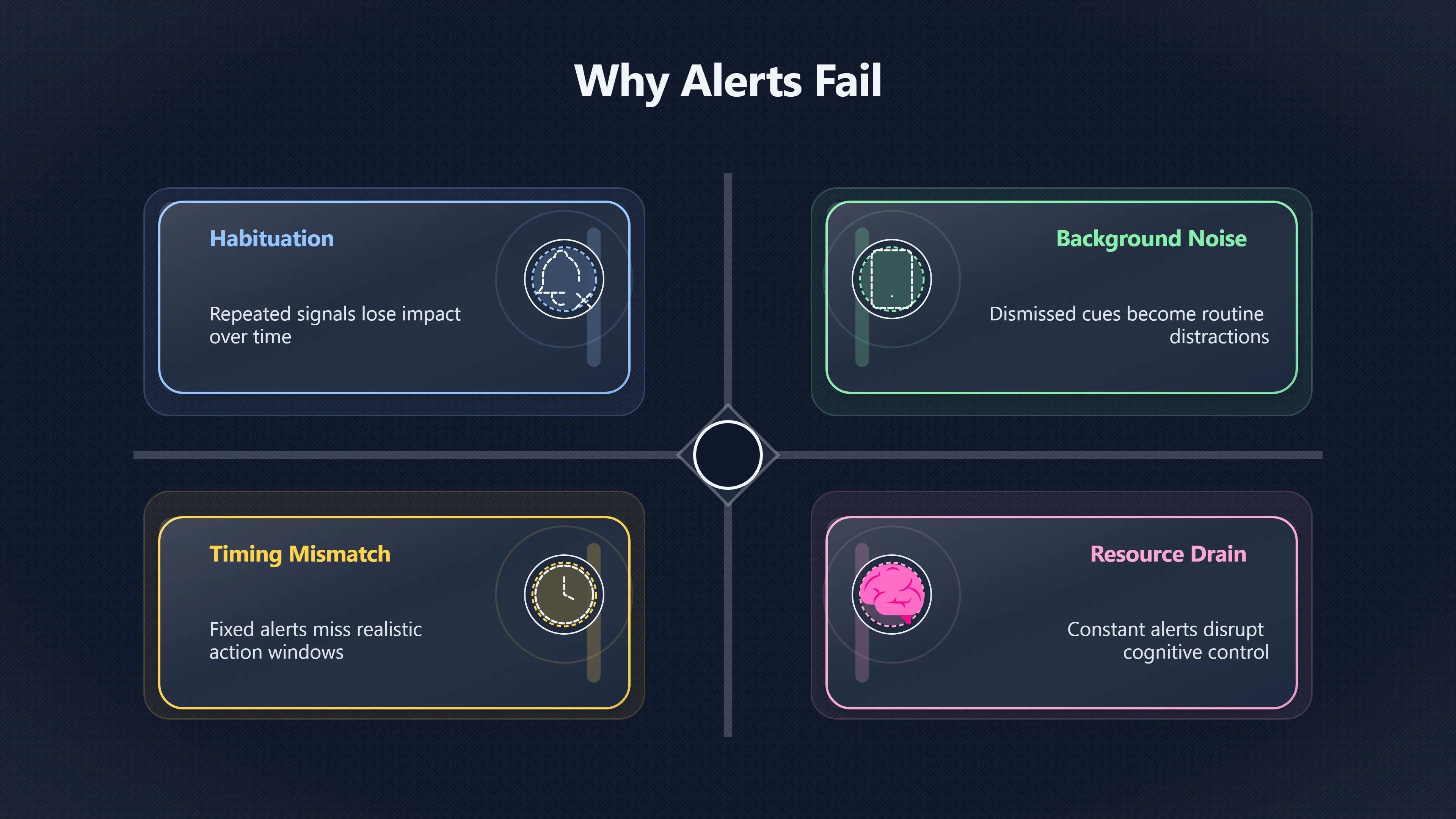
Psychologists refer to this process as habituation. A stimulus that initially captures attention gradually loses its impact through repeated exposure. In the context of digital reminders, this means the first few alerts may feel noticeable, but dozens of similar alerts become easy to ignore. Research on alert fatigue in healthcare and digital systems shows that excessive alert exposure can lead people to stop noticing or responding to signals altogether.[PMC]pmc.ncbi.nlm.nih.govPMCThe Effectiveness of Prompts to Promote Engagementby G Alkhaldi · 2016 · Cited by 342 — Digital interventions have been effective in improving numerous health outcomes and health behav…
The problem is not simply that reminders become annoying. It is that they stop functioning as cues. Once a notification is routinely dismissed, the brain starts treating it as background noise rather than actionable information.
A common example is the daily habit reminder that arrives at the same time regardless of circumstances. A prompt to exercise at 6 p.m. may be useful on some days, but if it frequently arrives during meetings, commuting, or family responsibilities, the user learns that the alert is rarely actionable. The reminder becomes associated with dismissal rather than behaviour.
Studies examining smartphone notifications have also found that alerts compete for limited attentional resources and can disrupt cognitive control and task focus. When notifications become a constant feature of the environment, their ability to direct behaviour weakens.[PMC]pmc.ncbi.nlm.nih.govPMCThe Effectiveness of Prompts to Promote Engagementby G Alkhaldi · 2016 · Cited by 342 — Digital interventions have been effective in improving numerous health outcomes and health behav…
The Difference Between Seeing and Acting
One reason habit reminders fail is that being aware of a task is not the same as being ready to perform it.
Many digital prompts communicate only that a habit exists:
- Drink water.
- Read for ten minutes.
- Practise a language.
- Meditate.
They do not necessarily create a realistic opportunity to act.
Behaviour change research consistently finds that prompts work better when tied to a specific context, behaviour, or next step rather than serving as generic reminders. Effective interventions often combine prompts with clear behavioural targets, self-monitoring, or contextual triggers. JMIR[PMC]pmc.ncbi.nlm.nih.govPMCThe Effectiveness of Prompts to Promote Engagementby G Alkhaldi · 2016 · Cited by 342 — Digital interventions have been effective in improving numerous health outcomes and health behav…
A reminder that says “Take a five-minute walk now” while the user is already standing up to make coffee has a stronger cue-action connection than a generic notification that appears during an unrelated activity.
The Cost of Too Many Habit Alerts
The hidden cost of excessive reminders is not merely distraction. It is the erosion of trust in the cue system itself.
Every notification asks a question: “Should I pay attention to this?” When most alerts are low-value, irrelevant, or poorly timed, people become more selective. That selectivity is rational, but it means genuinely useful prompts are filtered alongside unhelpful ones.
Evidence from notification research shows that users facing high volumes of alerts often adopt defensive behaviours such as muting notifications, disabling categories of alerts, or ignoring them by default. ACM Digital Library[MDPI]mdpi.comDigital Overload among College Students: Implications for…by AC Smith · 2021 · Cited by 72 — This study aimed to explore the influence…
The Reuters Institute’s research on mobile news alerts provides a useful parallel. As notification volume increased, many users disabled alerts because they perceived them as too frequent or insufficiently relevant. The result was not greater engagement but reduced attention to future notifications.[The Guardian]theguardian.comSome users reportedly receive up to 50 notifications a day, often from multiple sources about the same story. This overload has prompted…
The same pattern can appear in personal habit systems.
Imagine someone who has reminders for:
- Water intake every hour.
- Stretching every two hours.
- Reading after work.
- Journalling before bed.
- Language practice in the evening.
- Weekly planning.
- Gratitude exercises.
Individually, each reminder seems reasonable. Collectively, they create competition. Every alert reduces the distinctiveness of the others.

When Reminders Create Learned Dismissal
One of the most overlooked risks is that people can develop a habit of ignoring habit reminders.
A cue is supposed to trigger a desired behaviour. However, repeated exposure without action can strengthen a different response:
Notification appears → swipe away.
If this response becomes automatic, the notification system begins reinforcing the wrong habit.
Researchers studying engagement with digital behaviour-change interventions have repeatedly noted that maintaining engagement requires reducing user burden and avoiding excessive prompting. More notifications do not necessarily produce more participation. In some cases, they can reduce it by increasing fatigue and disengagement.[PMC]pmc.ncbi.nlm.nih.govPMCThe Effectiveness of Prompts to Promote Engagementby G Alkhaldi · 2016 · Cited by 342 — Digital interventions have been effective in improving numerous health outcomes and health behav…[UCL Blogs]blogs.ucl.ac.ukUCL BlogsDesigning for engagement with digital behaviour change…14 Feb 2022 — Indeed, reducing participant burden is key to sustaining…
This helps explain why many habit-tracking applications initially feel motivating but lose influence after several weeks. The reminders remain, but the user’s behavioural response has shifted from action to dismissal.
How to Choose Fewer, Stronger Cues
The most effective solution is usually not better wording or more motivational messages. It is reducing the number of cues competing for attention.
A useful cue should satisfy three conditions:
- It appears when action is realistically possible.
- It points to a specific next behaviour.
- It is uncommon enough to remain noticeable.
When evaluating habit reminders, a practical question is: “If this alert disappeared, would I miss it?” If the answer is no, the reminder may be adding noise rather than support.
Prioritise High-Leverage Habits
Many people assign reminders to every habit they want. A better approach is to reserve digital prompts for behaviours that genuinely need external support.
For example, medication adherence, a scheduled workout, or a weekly review may justify dedicated reminders because timing matters and forgetting has meaningful consequences.
Lower-stakes habits often benefit more from environmental cues than digital alerts. Leaving a book on a pillow, placing vitamins beside a toothbrush, or keeping a water bottle on a desk creates a visible trigger without adding another interruption.
Match the Cue to the Moment
Research on notification response patterns suggests that context strongly influences whether people engage with alerts. Poorly timed notifications are more likely to be ignored, regardless of content.[arXiv]arxiv.orgSource details in endnotes.
Instead of asking, “When do I want to do this habit?”, it is often more useful to ask, “When am I naturally able to do this habit?”
A reminder to stretch immediately after closing a laptop may outperform a reminder scheduled for a fixed clock time. The first appears during a behavioural transition; the second may arrive during any number of competing activities.
Protect Cue Credibility
The strongest reminder systems treat attention as a scarce resource.
Each alert should earn its place by being:
- Relevant.
- Actionable.
- Timely.
- Rare enough to remain meaningful.
When people know that a notification usually matters, they respond differently. The cue retains credibility. Instead of becoming part of the digital background, it remains a genuine signal.
The Real Goal Is Not More Reminders
The purpose of a habit cue is not to create awareness that a habit exists. Most people already know they should exercise, read, sleep earlier, or practise a skill. The challenge is acting at the right moment.
Notification overload undermines that goal by turning potentially useful signals into routine noise. As reminders multiply, attention fragments, dismissal becomes automatic, and cues lose their ability to trigger behaviour.[PMC]pmc.ncbi.nlm.nih.govPMCThe Effectiveness of Prompts to Promote Engagementby G Alkhaldi · 2016 · Cited by 342 — Digital interventions have been effective in improving numerous health outcomes and health behav…[PMC]pmc.ncbi.nlm.nih.govPMCThe Effectiveness of Prompts to Promote Engagementby G Alkhaldi · 2016 · Cited by 342 — Digital interventions have been effective in improving numerous health outcomes and health behav… The most reliable habit systems therefore treat prompts sparingly. A small number of well-timed cues connected to realistic actions usually outperform a large collection of alerts competing for attention. In habit formation, effectiveness comes less from constant prompting than from preserving the power of the prompt when it appears.
Amazon book picks
Further Reading
Books and field guides related to When Reminders Become Easy to Ignore. Use these as the next step if you want deeper reading beyond the article.
Digital Minimalism
Directly addresses excessive notifications and intentional technology use.
Atomic Habits
Rating: 3.5/5 from 7 Google Books ratings
Extensively covers cues, environment design and behaviour triggers.
eBay marketplace picks
Marketplace Samples
Example marketplace items related to this page. Use the search link to explore similar finds on eBay.


Endnotes
1.
Source: pmc.ncbi.nlm.nih.gov
Title: PMCThe Effectiveness of Prompts to Promote Engagement
Link:https://pmc.ncbi.nlm.nih.gov/articles/PMC4723726/
Source snippet
by G Alkhaldi · 2016 · Cited by 342 — Digital interventions have been effective in improving numerous health outcomes and health behav...
2.
Source: pmc.ncbi.nlm.nih.gov
Link:https://pmc.ncbi.nlm.nih.gov/articles/PMC10498822/
Source snippet
Behavior Change [Techniques]({{ 'techniques/' | relative_url }}) in Digital Health...by JL Mair · 2023 · Cited by 137 — This narrative umbrella review aimed to identify the m...
3.
Source: pmc.ncbi.nlm.nih.gov
Link:https://pmc.ncbi.nlm.nih.gov/articles/PMC12919987/
Source snippet
This occurred mainly for passive alerts...Read more...
4.
Source: pmc.ncbi.nlm.nih.gov
Link:https://pmc.ncbi.nlm.nih.gov/articles/PMC9671478/
Source snippet
The effects of smartphone notifications on cognitive control...by JD Upshaw · 2022 · Cited by 48 — The current study investigated the...
5.
Source: arxiv.org
Link:https://arxiv.org/abs/2207.03405
6.
Source: jmir.org
Link:https://www.jmir.org/2024/1/e54375/
Source snippet
Digital Behavior Change Intervention Designs for Habit...by Y Zhu · 2024 · Cited by 67 — The results show that the most applied beha...
7.
Source: dl.acm.org
Link:https://dl.acm.org/doi/full/10.1145/3743703
Source snippet
ACM Digital LibraryUnderstanding Smartphone Users' Preferences and...by UD Chen · 2025 · Cited by 3 — To help users manage the overwhelm...
8.
Source: mdpi.com
Link:https://www.mdpi.com/2076-0760/10/8/279
Source snippet
Digital Overload among College Students: Implications for...by AC Smith · 2021 · Cited by 72 — This study aimed to explore the influence...
9.
Source: mhealth.jmir.org
Link:https://mhealth.jmir.org/2023/1/e38342
Source snippet
Objective: Our objective was to estimate the causal effect...Read more...
10.
Source: dl.acm.org
Link:https://dl.acm.org/doi/10.1145/3715668.3736353
Source snippet
Notifications that Empathise with Fatigue in...5 Jul 2025 — In this study, we explore the lived experience of individuals with diabetes...
11.
Source: arxiv.org
Link:https://arxiv.org/html/2507.14702v1
Source snippet
A Notification Based Nudge for Handling Excessive...19 Jul 2025 — In this study, we proposed a notification-based intervention approach...
12.
Source: theguardian.com
Link:https://www.theguardian.com/media/2025/jun/20/increase-alert-fatigue-phone-users-disable-news-notifications-study-finds
Source snippet
Some users reportedly receive up to 50 notifications a day, often from multiple sources about the same story. This overload has prompted...
13.
Source: blogs.ucl.ac.uk
Link:https://blogs.ucl.ac.uk/cbc-digi-hub-blog/2022/02/14/designing-for-engagement-with-digital-behaviour-change-interventions-state-of-the-art-and-chartering-new-territories/
Source snippet
UCL BlogsDesigning for engagement with digital behaviour change...14 Feb 2022 — Indeed, reducing participant burden is key to sustaining...
Additional References
14.
Source: researchgate.net
Link:https://www.researchgate.net/publication/281953046_Theory-based_strategies_for_enhancing_the_impact_and_usage_of_digital_health_behaviour_change_interventions_A_review
Source snippet
(PDF) Theory-based strategies for enhancing the impact...by LG Morrison · 2015 · Cited by 162 — This paper provides a critical review of...
15.
Source: researchgate.net
Link:https://www.researchgate.net/publication/401241990_Push_Notifications_and_Habit_Formation_Behavioral_Impact_on_Daily_Language_Practice_Consistency
Source snippet
Push Notifications and Habit Formation: Behavioral Impact...27 Feb 2026 — Push notifications are widely used to influence digital behavi...
16.
Source: medium.com
Link:https://medium.com/design-bootcamp/attention-capture-and-notification-fatigue-in-digital-products-ec8637ae63a1
Source snippet
Attention Capture and Notification Fatigue in Digital ProductsNotification systems capture attention through alerts, red dots, and urgenc...
17.
Source: linkedin.com
Link:https://www.linkedin.com/top-content/user-experience/ux-writing-for-app-notifications/reducing-notification-fatigue/
Source snippet
Reducing Notification FatigueReducing notification fatigue means cutting down on the stress and distraction caused by constant digital al...
18.
Source: facebook.com
Link:https://www.facebook.com/erienewsnow/posts/phone-users-bombarded-by-news-alerts-are-switching-them-off-study-shows/1159891869513770/
Source snippet
Phone users, bombarded by news alerts, are switching...20 Jun 2025 — Digital addiction increases loneliness, anxiety and depression: study...
19.
Source: meistertask.com
Title: notification fatigue the productivity killer explained
Link:https://www.meistertask.com/blog/notification-fatigue-the-productivity-killer-explained
Source snippet
Notification fatigue: the productivity killer explained27 Mar 2026 — Notification fatigue is a state of mental and operational exhaustion...
20.
Source: researchgate.net
Link:https://www.researchgate.net/publication/334853935_The_influence_of_concurrent_mobile_notifications_on_individual_responses
Source snippet
most smartphone users' needs and preferences (Jonas & Katsumi, 2013).Read more...
21.
Source: bmjopen.bmj.com
Title: (BCW) AND BEHAVIOUR CHANGE TECHNIQUES TAXONOMY (BCTv1).Read more
Link:https://bmjopen.bmj.com/content/bmjopen/8/5/e019865/DC2/embed/inline-supplementary-material-2.pdf?download=true
Source snippet
analysis of reduce maintenance intervention...APPENDIX 2: BEHAVIOURAL ANALYSIS OF REDUCE MAINTENANCE INTERVENTION USING THE BEHAVIOUR CH...
22.
Source: health.org.uk
Title: Behavioural Insights In Health Care
Link:https://www.health.org.uk/sites/default/files/BehaviouralInsightsInHealthCare.pdf
Source snippet
by C Perry · 2015 · Cited by 31 — Prompts, cues and reminders have been demonstrated to be generally e...
23.
Source: speakwiseapp.com
Title: notification overload statistics
Link:https://speakwiseapp.com/blog/notification-overload-statistics
Source snippet
Instead, they have made us anxious, fragmented, and perpetually distracted. Every buzz, badge...Read more...
Topic Tree