Within Ego Depletion
Does Sugar Really Refuel Willpower?
Sugar may sound like a simple willpower fix, but the glucose story shows why vivid biological explanations can become bad advice.
On this page
- Why glucose made ego depletion seem concrete
- Why simple sugar fixes did not hold up
- How to avoid refuelling the wrong problem
Page outline Jump by section
Introduction
One of the most influential ideas in the ego depletion era was not simply that willpower could run out, but that it ran on a specific fuel: glucose. The claim was memorable, intuitive and easy to turn into advice. If self-control consumes glucose, then a drop in blood sugar might explain why people become impulsive, and a sugary drink might restore discipline. For a time, this seemed to give willpower a concrete biological mechanism rather than a metaphor.[PubMed]pubmed.ncbi.nlm.nih.govThe physiology of willpower: linking blood glucose to self-…by MT Gailliot · 2007 · Cited by 1241 — This review suggests that bl…
 The problem is that the glucose story turned out to be far less convincing than it first appeared. Follow-up research challenged both the idea that acts of self-control meaningfully deplete glucose and the idea that consuming sugar reliably restores self-control. The resulting debate became a revealing example of how an appealing biological explanation can generate practical advice long before the underlying mechanism is secure.[Northwestern Psychology]psychology.northwestern.edumolden psychological science 2012Northwestern PsychologyPsychological Scienceby DC Molden · 2012 · Cited by 452 — In four experiments, we found that (a) exerting self-con…[PubMed]pubmed.ncbi.nlm.nih.govThe physiology of willpower: linking blood glucose to self-…by MT Gailliot · 2007 · Cited by 1241 — This review suggests that bl…
Why glucose made ego depletion seem concrete
The original strength model of self-control compared willpower to a muscle. By itself, that metaphor was useful but incomplete. Researchers therefore searched for a physical resource that could explain why self-control sometimes appeared to weaken after effort.
A major step came in 2007 when Matthew Gailliot, Roy Baumeister and colleagues proposed that glucose was the resource being depleted. Their argument was straightforward: the brain depends heavily on glucose for energy, self-control requires mental effort, and exerting self-control appeared to coincide with lower blood-glucose levels. Some experiments also suggested that consuming glucose improved performance on later self-control tasks.[PubMed]pubmed.ncbi.nlm.nih.govThe physiology of willpower: linking blood glucose to self-…by MT Gailliot · 2007 · Cited by 1241 — This review suggests that bl…
This theory was attractive for several reasons:
- It provided a biological explanation for an otherwise abstract psychological theory.
- It seemed to connect everyday experience to physiology. People often feel mentally drained when hungry.
- It suggested a practical intervention: replenish glucose and restore self-control.
- It transformed willpower from a metaphorical resource into something that appeared measurable.[PubMed]pubmed.ncbi.nlm.nih.govThe physiology of willpower: linking blood glucose to self-…by MT Gailliot · 2007 · Cited by 1241 — This review suggests that bl…
The idea spread rapidly through popular psychology, business writing and self-help culture. The message often became simplified into a rule of thumb: if you are struggling with discipline, refuel.
Why simple sugar fixes did not hold up
The glucose account began to weaken when researchers looked more closely at the proposed mechanism.
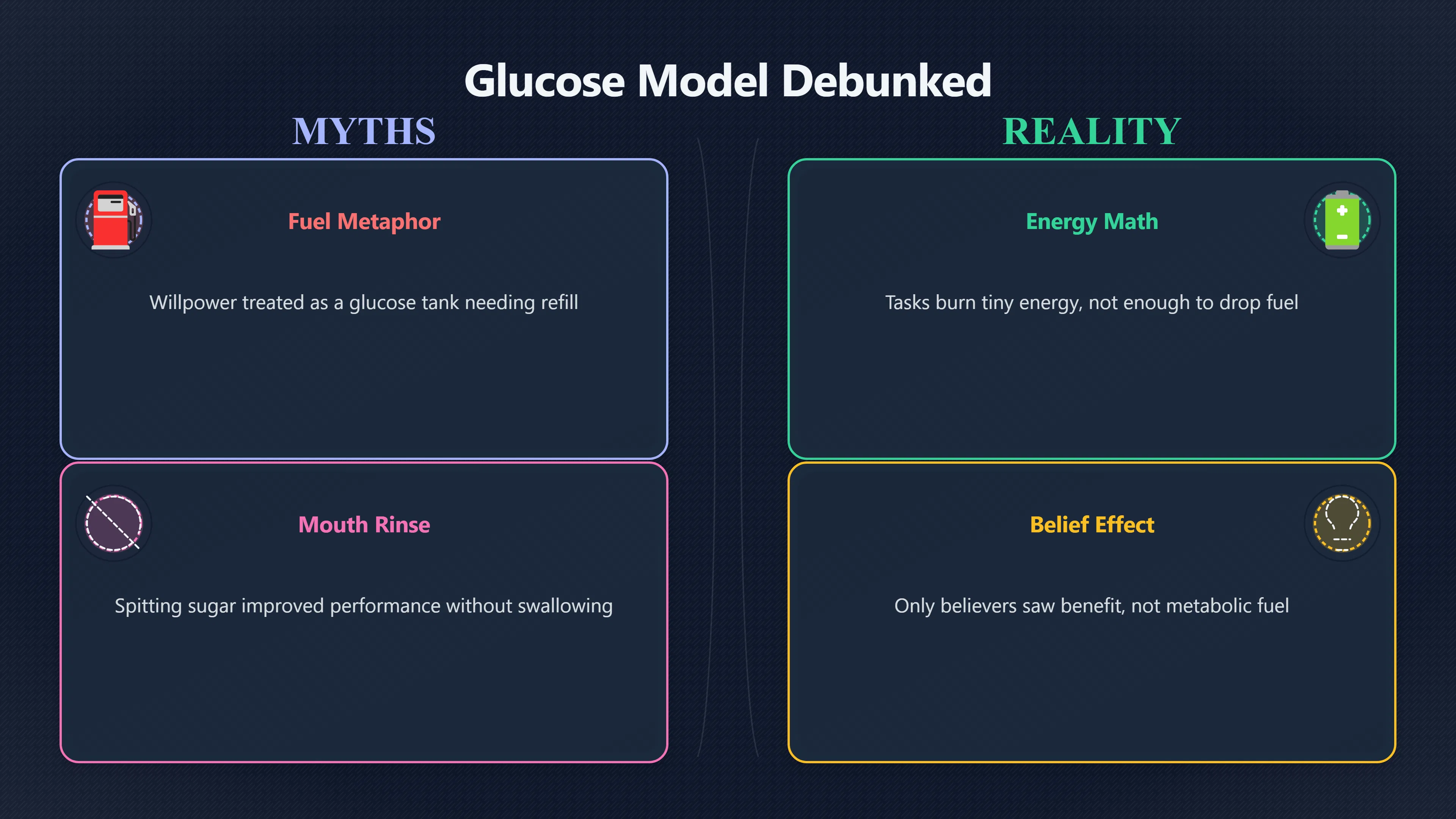
The energy maths never looked convincing
One challenge was physiological. The brain already consumes a large amount of energy continuously, but the extra energy required for a short self-control task appears to be tiny. Critics argued that it was difficult to explain how a few minutes of resisting temptation could burn enough glucose to create a meaningful fuel shortage.[PMC]pmc.ncbi.nlm.nih.govSix Questions for the Resource Model of Control (and Some…by M Inzlicht · 2015 · Cited by 228 — The central prediction of the resou…
Researchers also tested whether self-control tasks actually caused the predicted changes in glucose metabolism. Daniel Molden and colleagues found little evidence that exerting self-control increased carbohydrate metabolism in the way the glucose model required. Their experiments suggested that the metabolic story was overstated.[Northwestern Psychology]psychology.northwestern.edumolden psychological science 2012Northwestern PsychologyPsychological Scienceby DC Molden · 2012 · Cited by 452 — In four experiments, we found that (a) exerting self-con…[Sage Journals]journals.sagepub.comSage JournalsThe Bitter Truth About Sugar and Willpowerby MA Vadillo · 2016 · Cited by 163 — The idea behind ego depletion is that willpo…
The mouth-rinse findings changed the story
Perhaps the most surprising evidence came from studies showing that people sometimes improved on self-control tasks after merely rinsing their mouths with a glucose solution and spitting it out. In some experiments, participants did not swallow enough glucose for meaningful metabolic replenishment, yet performance appeared to improve. Sage Journals ScienceDaily If glucose had to be burned as fuel[sciencedaily.com]sciencedaily.comTake control: Exploring how self-discipline works and how…Oct 19, 2012 — These results provide additional evidence to sugg…, this result made little sense. Researchers began exploring a different possibility: glucose might act as a motivational or signalling cue rather than an energy refill. Simply detecting carbohydrates in the mouth could activate reward and motivation systems that influence effort allocation.[Sage Journals]journals.sagepub.comSage JournalsThe Bitter Truth About Sugar and Willpowerby MA Vadillo · 2016 · Cited by 163 — The idea behind ego depletion is that willpo…[Sage Journals]journals.sagepub.comSage JournalsThe Bitter Truth About Sugar and Willpowerby MA Vadillo · 2016 · Cited by 163 — The idea behind ego depletion is that willpo…
The implication was important. Even if some sugar-related effects existed, they might not demonstrate that willpower literally runs on glucose.

Replications became increasingly mixed
As more researchers tested the glucose model, findings became inconsistent.[sciencedaily.com]sciencedaily.comTake control: Exploring how self-discipline works and how…Oct 19, 2012 — These results provide additional evidence to sugg…
Some studies failed to reproduce the claimed benefits of sugar consumption or glucose rinsing. Others found effects under some conditions but not others. Several replication attempts reported no meaningful improvement in self-control after glucose ingestion.[ScienceDirect]sciencedirect.comScienceDirect Sweet delusionGlucose drinks fail to counteract ego…by F Lange · 2014 · Cited by 139 — Despite applying powerful research designs, no effect of suga…[White Rose Research Online]eprints.whiterose.ac.ukWhite Rose Research OnlineNo effects of ingesting or rinsing sucrose on depleted self-…by NB Boyle · 2016 · Cited by 20 — Keywords: Se…
A 2016 meta-analysis examining glucose and self-control found a much more uncertain picture than the early literature suggested. Reviews of the evidence concluded that the glucose mechanism lacked strong empirical support and that positive findings were mixed and difficult to interpret.[ScienceDirect]sciencedirect.comScienceDirect Sweet delusionGlucose drinks fail to counteract ego…by F Lange · 2014 · Cited by 139 — Despite applying powerful research designs, no effect of suga…[PubMed By this point]pubmed.ncbi.nlm.nih.govThe physiology of willpower: linking blood glucose to self-…by MT Gailliot · 2007 · Cited by 1241 — This review suggests that bl…, the debate had shifted. Researchers were no longer asking whether sugar obviously refuels willpower. They were asking whether the entire glucose explanation had been oversold.
The surprising role of beliefs
One of the most intriguing twists came from research on people’s beliefs about willpower itself.
Veronika Job and colleagues found that the effects of glucose depended partly on what participants believed. Individuals who viewed willpower as a limited resource showed different responses to glucose than those who believed mental effort was not quickly exhausted. In some cases, the expected glucose benefit appeared only among people who already accepted the limited-resource view. PMC[sonar]sonar.chIt has been widely assumed that basic physiological…Read more… This did not mean beliefs create energy from nothing. Rather, it suggested that motivation, expectations and interpretation might play a larger role than a simple fuel-tank model allows.
The finding was especially damaging to the popular version of the glucose story. If a sugar effect partly depends on beliefs, then the explanation cannot be reduced to pure metabolic replenishment.
How to avoid refuelling the wrong problem
The practical mistake created by the glucose story was not merely scientific. It encouraged people to diagnose every lapse of self-control as a fuel shortage.
That diagnosis often points to the wrong solution.
When someone struggles to maintain a habit, avoid distractions or follow through on a goal, the bottleneck is frequently:
- A poorly designed environment.
- Decision overload.
- Stress and fatigue.
- Competing incentives.
- Lack of planning.
- Weak routines.
- Low motivation for the specific task.[PMC]pmc.ncbi.nlm.nih.govBeliefs about willpower determine the impact of glucose on…by V Job · 2013 · Cited by 240 — Replicating past research, we found tha…
A sugary snack may temporarily change mood, reward sensitivity or energy levels, but that is different from solving the underlying behavioural problem.
The most useful lesson for self-improvement is therefore narrower than the original glucose theory. Physical needs matter. Severe hunger, sleep deprivation and low energy can make self-control harder. But everyday failures of discipline are rarely fixed by treating willpower as a glucose tank that simply needs topping up. PMC[PubMed]pubmed.ncbi.nlm.nih.govThe physiology of willpower: linking blood glucose to self-…by MT Gailliot · 2007 · Cited by 1241 — This review suggests that bl…
The glucose episode is valuable because it illustrates a broader warning. A vivid biological story can feel more scientific than it really is. The idea that “willpower runs on sugar” was memorable precisely because it offered a simple mechanism and a simple remedy. Yet the evidence increasingly suggested that self-control depends on a more complex mix of attention, motivation, expectations, habits and context than any single fuel metaphor can capture.[ScienceDirect]sciencedirect.comScienceDirect Sweet delusionGlucose drinks fail to counteract ego…by F Lange · 2014 · Cited by 139 — Despite applying powerful research designs, no effect of suga…[Northwestern Psychology]psychology.northwestern.edumolden psychological science 2012Northwestern PsychologyPsychological Scienceby DC Molden · 2012 · Cited by 452 — In four experiments, we found that (a) exerting self-con…
Amazon book picks
Further Reading
Books and field guides related to Does Sugar Really Refuel Willpower?. Use these as the next step if you want deeper reading beyond the article.
The Willpower Instinct
Discusses biological and psychological explanations for willpower.
Atomic Habits
Rating: 3.5/5 from 7 Google Books ratings
Provides alternatives to relying on raw willpower.
eBay marketplace picks
Marketplace Samples
Example marketplace items related to this page. Use the search link to explore similar finds on eBay.




Endnotes
1.
Source: psychology.northwestern.edu
Title: molden psychological science 2012
Link:https://psychology.northwestern.edu/documents/faculty-publications/molden-%20psychological%20science-2012.pdf
Source snippet
Northwestern PsychologyPsychological Scienceby DC Molden · 2012 · Cited by 452 — In four experiments, we found that (a) exerting self-con...
2.
Source: pmc.ncbi.nlm.nih.gov
Link:https://pmc.ncbi.nlm.nih.gov/articles/PMC5621751/
Source snippet
Six Questions for the Resource Model of Control (and Some...by M Inzlicht · 2015 · Cited by 228 — The central prediction of the resou...
3.
Source: sciencedaily.com
Link:https://www.sciencedaily.com/releases/2012/10/121019141256.htm
Source snippet
Take control: Exploring how self-discipline works and how...Oct 19, 2012 — These results provide additional evidence to sugg...
4.
Source: sciencedirect.com
Title: ScienceDirect Sweet delusion
Link:https://www.sciencedirect.com/science/article/abs/pii/S0195666313005072
Source snippet
Glucose drinks fail to counteract ego...by F Lange · 2014 · Cited by 139 — Despite applying powerful research designs, no effect of suga...
5.
Source: sciencedirect.com
Title: Section snippets.Read more
Link:https://www.sciencedirect.com/science/article/abs/pii/S0195666316302884
Source snippet
Testing the role of glucose in self-control: A meta-analysisby J Dang · 2016 · Cited by 76 — The current meta-analysis also...
6.
Source: pmc.ncbi.nlm.nih.gov
Link:https://pmc.ncbi.nlm.nih.gov/articles/PMC3773743/
Source snippet
Beliefs about willpower determine the impact of glucose on...by V Job · 2013 · Cited by 240 — Replicating past research, we found tha...
7.
Source: sonar.ch
Link:https://sonar.ch/global/documents/141355
Source snippet
It has been widely assumed that basic physiological...Read more...
8.
Source: sciencedirect.com
Link:https://www.sciencedirect.com/science/article/pii/S2352250X24000952
Source snippet
Self-control and limited willpower: Current status of ego...by RF Baumeister · 2024 · Cited by 123 — Ego depletion theory p...
9.
Source: pubmed.ncbi.nlm.nih.gov
Link:https://pubmed.ncbi.nlm.nih.gov/18453466/
Source snippet
The physiology of willpower: linking blood glucose to self-...by MT Gailliot · 2007 · Cited by 1241 — This review suggests that bl...
10.
Source: pubmed.ncbi.nlm.nih.gov
Link:https://pubmed.ncbi.nlm.nih.gov/27485134/
Source snippet
Limited Evidential Value of the Glucose Model of Ego...by MA Vadillo · 2016 · Cited by 162 — To present ego depletion as more than a con...
11.
Source: journals.sagepub.com
Link:https://journals.sagepub.com/doi/abs/10.1177/0956797616654911
Source snippet
Sage JournalsThe Bitter Truth About Sugar and Willpowerby MA Vadillo · 2016 · Cited by 163 — The idea behind ego depletion is that willpo...
12.
Source: journals.sagepub.com
Link:https://journals.sagepub.com/doi/10.1177/0956797612439069
Source snippet
Sage JournalsMotivational Versus Metabolic Effects of Carbohydrates on...Sep 12, 2012 — Self-control consumes energy through carbohydrat...
13.
Source: journals.sagepub.com
Link:https://journals.sagepub.com/doi/abs/10.1177/0956797612439069
Source snippet
Sage JournalsMotivational Versus Metabolic Effects of Carbohydrates on...by DC Molden · 2012 · Cited by 453 — Self-control consumes ener...
14.
Source: journals.sagepub.com
Link:https://journals.sagepub.com/doi/10.1177/0956797612450034
Source snippet
Sage JournalsRinsing the Mouth with Glucose Enhances Self-ControlOct 22, 2012 — They had participants engage in a self-control task, rins...
15.
Source: journals.sagepub.com
Link:https://journals.sagepub.com/doi/10.1177/0956797616654911
Source snippet
Sage JournalsThe Bitter Truth About Sugar and Willpower11 Jul 2016 — Results from these studies suggest that the signal of glucose from t...
16.
Source: eprints.whiterose.ac.uk
Link:https://eprints.whiterose.ac.uk/id/eprint/93247/3/Boyle_et_al_2015Physiology%26_Behaviour.pdf
Source snippet
White Rose Research OnlineNo effects of ingesting or rinsing sucrose on depleted self-...by NB Boyle · 2016 · Cited by 20 — Keywords: Se...
17.
Source: pubmed.ncbi.nlm.nih.gov
Link:https://pubmed.ncbi.nlm.nih.gov/25450895/
Source snippet
attempts to replicate effects of self control...by NLD Chatzisarantis · 2015 · Cited by 26 — The hypothesis that sugar-containing drinks...
18.
Source: Wikipedia
Title: Ego depletion
Link:https://en.wikipedia.org/wiki/Ego_depletion
Source snippet
Ego depletionEgo depletion is the idea that self-control or willpower draws upon conscious mental resources that can be taxed to exhau...
Additional References
19.
Source: researchgate.net
Link:https://www.researchgate.net/publication/303445162_The_Bitter_Truth_About_Sugar_and_Willpower_The_Limited_Evidential_Value_of_the_Glucose_Model_of_Ego_Depletion
Source snippet
The Limited Evidential Value of the Glucose Model of Ego...Jul 12, 2016 — The idea behind ego depletion is that willpower draws on a lim...
20.
Source: academia.edu
Title: No effects of ingesting or rinsing sucrose on depleted self control performance
Link:https://www.academia.edu/115957569/No_effects_of_ingesting_or_rinsing_sucrose_on_depleted_self_control_performance?force_claim_to_highlight=true
Source snippet
No effects of ingesting or rinsing sucrose on depleted self-...Mar 8, 2024 — Self-control tasks appear to deplete a limited resource res...
21.
Source: psychologicalscience.org
Title: Association for Psychological Science Take Control!
Link:https://www.psychologicalscience.org/news/releases/take-control-exploring-how-self-discipline-works-and-how-we-might-boost-it.html
Source snippet
Exploring How Self-Discipline Works and...Oct 19, 2012 — According to this model, self-control relies on carbohydrate metabolism; we dep...
22.
Source: kclpure.kcl.ac.uk
Title: the bitter truth about sugar and willpower the limited evidential
Link:https://kclpure.kcl.ac.uk/portal/en/publications/the-bitter-truth-about-sugar-and-willpower-the-limited-evidential/
Source snippet
bitter truth about sugar and willpower: The limited...by MA Vadillo · 2016 · Cited by 163 — Ego depletion is the idea that willpower dra...
23.
Source: facebook.com
Link:https://www.facebook.com/groups/853552931365745/posts/4484610258259976/
Source snippet
ego- depletion effect that can be replicated?... We also tested the restoring effect of glucose rinsing on subsequent self-control perfo...
24.
Source: researchgate.net
Link:https://www.researchgate.net/publication/6524614_Self-Control_Relies_on_Glucose_as_a_Limited_Energy_Source_Willpower_Is_More_Than_a_Metaphor
Source snippet
A single act of self-control causes glucose to drop below optimal levels.Read more...
25.
Source: robkurzban.com
Link:https://www.robkurzban.com/blog/2014/1/16/no-sugar-coating-problems-for-the-glucose-model
Source snippet
No Sugar Coating Problems for the Glucose ModelJan 16, 2014 — Sweet delusion: Glucose drinks fail to counteract ego depletion...
26.
Source: egoshoes.com
Link:https://egoshoes.com/eu
Source snippet
iercest and freshest range of women's shoes & clothing on the...Read more...
27.
Source: apa.org
Link:https://www.apa.org/topics/personality/willpower
Source snippet
ted by self-control tasks showed decreased activity in the...Read more...
28.
Source: scispace.com
Title: Running head: ORAL GLUCOSE AND SELF-CONTROL
Link:https://scispace.com/pdf/the-sweet-taste-of-success-the-presence-of-glucose-in-the-1qdlzo7ptv.pdf
Source snippet
ego-depletion, we hypothesize that a glucose mouth rinse prior to engaging in a self-control task will moderate the deleterious effects o...
Topic Tree