Within The Idea That A Habit Forms In 21 Days
Treat the First Month as Debugging
The first month works better as a test period for finding friction than as a verdict on motivation or character.
On this page
- What early habit failures usually reveal
- How to spot friction in timing, tools and cues
- How to revise the system before judging the goal
Page outline Jump by section
Introduction
The first month of a new habit is often misunderstood. Many people treat it as a pass–fail test of discipline: if the behaviour still feels difficult after a few weeks, they assume they lack motivation or willpower. Research on habit formation suggests a different interpretation. Early habit building is usually a period of learning, adjustment and troubleshooting. Automaticity develops gradually, often over far longer than 21 days, and the first few weeks provide valuable information about where a habit is breaking down rather than whether the goal itself is impossible.[University College London]ucl.ac.ukUniversity College London How long does it take to form a habit?University College LondonHow long does it take to form a habit?August 4, 2009 — 4 Aug 2009 — It takes an average 66 days to form a new ha…
 Seen this way, the first month is less like an exam and more like a debugging phase. Every missed workout, forgotten journal entry or skipped reading session can reveal something about the design of the habit: the timing, the environment, the cue, the required effort, or the fit with everyday life.
What Early Habit Failures Usually Reveal
When a habit fails repeatedly in its first month, the most useful question is not “Why am I so inconsistent?” but “What obstacle keeps appearing?”
Habit researchers describe habits as behaviours that become linked to stable cues through repetition. The behaviour is eventually triggered by the context rather than by a conscious motivational decision. If the context is unstable or the cue is weak, habit formation becomes much harder.[Cykelvæksthuset]cykelvaeksthuset.dkCykelvæksthuset Promoting habit formationCykelvæksthusetPromoting habit formationMay 5, 2017 — by P Lally · 2013 · Cited by 1265 — Habits are automatic behavioural responses to e…
Many apparent motivation problems are actually design problems:
- The behaviour is too large. A plan to exercise for an hour every day may fail because the required effort is too high for busy weekdays.
- The cue is unreliable. A habit attached to an event that does not happen consistently has no stable trigger.
- The environment creates resistance. Equipment is difficult to access, distractions are nearby, or the desired action requires too many preparation steps.
- The timing conflicts with reality. A morning routine may look ideal on paper but collide with family responsibilities or commuting demands.
- The reward is too delayed. Benefits such as fitness, savings or skill development may arrive months later, making repetition harder in the early stage.
These failures do not necessarily indicate a lack of commitment. They often identify specific points where the system needs adjustment. Behavioural scientists Wendy Wood, Benjamin Gardner and others have emphasised the importance of repeated actions occurring in consistent contexts. Without that consistency, automaticity develops slowly or not at all.[Compass]compass.onlinelibrary.wiley.comWhat is habit and how can it be used to change real‐world…by B Gardner · 2024 · Cited by 85 — Habit formation approaches need n…[2Cykelvæksthuset]cykelvaeksthuset.dkCykelvæksthuset Promoting habit formationCykelvæksthusetPromoting habit formationMay 5, 2017 — by P Lally · 2013 · Cited by 1265 — Habits are automatic behavioural responses to e…
How to Spot Friction in Timing, Tools and Cues
The first month becomes valuable when it is used to locate friction rather than hide it.
A practical approach is to observe every missed repetition and classify the reason. Patterns usually emerge surprisingly quickly.
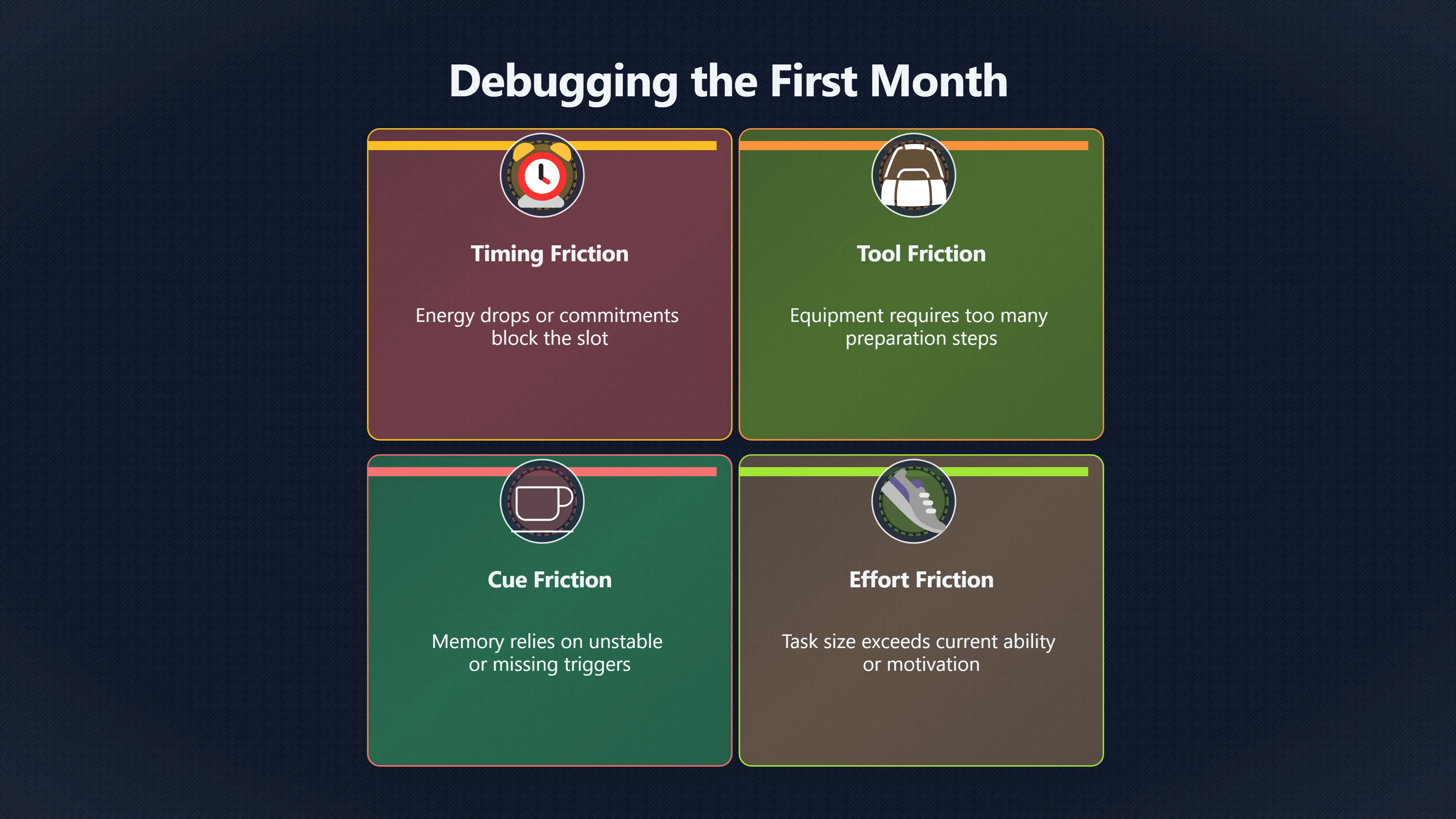
Timing Friction
Timing friction occurs when the habit competes with existing commitments or fluctuating energy levels.
For example, someone who intends to read for 30 minutes before bed may discover that they are consistently exhausted by the time they reach the bedroom. The problem may not be reading itself. The problem may be the chosen time slot.
Signs of timing friction include:
- Repeatedly postponing the behaviour.
- Frequently running out of time.
- Succeeding on weekends but failing on weekdays.
- Performing the habit easily at another time of day.
The debugging response is to experiment with timing rather than increase self-criticism.
Tool Friction
Tool friction appears when the behaviour requires too much preparation.
Consider a person attempting a daily stretching habit. If they must locate equipment, clear floor space and change clothes before starting, each extra step increases resistance.
Small environmental changes can dramatically reduce friction:
- Leaving workout clothes ready the night before.
- Keeping a water bottle visible on a desk.
- Placing a book on a pillow as a bedtime reading cue.
- Preparing healthy food in advance rather than during moments of hunger.
Habit researchers describe environmental cues as central to habit development because repeated exposure strengthens cue-behaviour associations.[Cykelvæksthuset]cykelvaeksthuset.dkCykelvæksthuset Promoting habit formationCykelvæksthusetPromoting habit formationMay 5, 2017 — by P Lally · 2013 · Cited by 1265 — Habits are automatic behavioural responses to e…

Cue Friction
A habit without a reliable cue often depends on memory and motivation.
Research on implementation intentions—specific “if-then” plans—suggests that linking actions to clear situations can improve the translation of intentions into behaviour. Instead of “I will meditate daily,” a stronger cue is “After I make my morning tea, I will meditate for two minutes.”[Cancer Control]cancercontrol.cancer.govCancer ControlImplementation Intentionsby PM Gollwitzer — Implementation intentions are formed for the purpose of enhancing the translati…
The cue should be:
- Easy to notice.
- Already present in daily life.
- Consistent across most days.
- Close in time to the desired behaviour.
The more stable the cue, the easier it becomes to repeat the behaviour in the same context.[cambridge]cambridge.orgWhen encountered, cues activate a single, specific well-learned behavioral response.Read more… University Press & Assessment
A Simple Debugging Method for the First 30 Days
Rather than measuring success solely by streak length, use the first month to collect information.
After each missed opportunity, record a short explanation. Keep it factual rather than emotional.
Examples:
- “Meeting ran late.”
- “Forgot because there was no reminder.”
- “Equipment was in another room.”
- “Too tired after work.”
- “Could not start because task felt too large.”
At the end of each week, look for recurring causes.
If most failures point to the same issue, that issue becomes the next experiment. The goal is not perfection. The goal is to identify the highest-friction part of the system and reduce it.
This approach mirrors broader behaviour design frameworks that emphasise improving ability and prompts instead of relying exclusively on motivation. According to the Fogg Behaviour Model, behaviour occurs when motivation, ability and a prompt converge at the same moment. If a behaviour repeatedly fails to occur, one of those elements is usually missing.[Fogg Behavior Model]productmindset.substack.comBehavior Model - Product Mindset's Newsletter - SubstackFogg's behavior model is made up of three elements that predict behavior: motivat…[Behavior Design Lab]behaviordesign.stanford.eduBehavior Design LabFogg Behavior ModelThe Fogg Behavior Model shows that three elements must converge at the same moment for a behavior t…
How to Revise the System Before Judging the Goal
One of the biggest mistakes in self-improvement is abandoning a worthwhile goal before improving the system that supports it.
Suppose a person wants to build a running habit.
After three weeks they have only run six times. A verdict-oriented mindset might conclude: “I’m not a runner.”
A debugging mindset asks different questions:
- Is the route inconvenient?
- Is the planned distance too ambitious?
- Is the cue unreliable?
- Would preparing clothes in advance help?
- Would a ten-minute run work better than a thirty-minute run?
- Is another time of day more practical?
The goal remains unchanged. The implementation changes.
This distinction matters because habits emerge from repeated performance under workable conditions. The first version of a habit is rarely the final version. Researchers studying real-world habit formation consistently find gradual development rather than instant automaticity, suggesting that adjustment and repetition are normal parts of the process.[University College London]ucl.ac.ukUniversity College London How long does it take to form a habit?University College LondonHow long does it take to form a habit?August 4, 2009 — 4 Aug 2009 — It takes an average 66 days to form a new ha…[PMC]pmc.ncbi.nlm.nih.govhealth habitual: the psychology of 'habit-formation' and…by B Gardner · 2012 · Cited by 896 — Psychological theory and evidence around…
What Progress Looks Like During a Debug Month
A successful first month does not necessarily produce a fully automatic habit.
More realistic signs of progress include:
- Fewer missed opportunities caused by forgetfulness.
- Faster initiation of the behaviour.
- Reduced preparation effort.
- Greater consistency of timing and context.
- Clearer understanding of what causes failures.
- Improved confidence in the system design.
These changes indicate that the habit is becoming easier to perform, even if it still requires conscious effort.
The key insight is that the first month should not answer the question, “Am I capable of this?” It should answer the question, “What makes this behaviour harder than it needs to be?” Once that friction is identified and reduced, the months that follow are far more likely to produce the automaticity that habit formation research describes.[Cykelvæksthuset]cykelvaeksthuset.dkCykelvæksthuset Promoting habit formationCykelvæksthusetPromoting habit formationMay 5, 2017 — by P Lally · 2013 · Cited by 1265 — Habits are automatic behavioural responses to e…[PMC]pmc.ncbi.nlm.nih.govApplying the Science of Habit Formation to Evidence-Based…by AG Harvey · 2021 · Cited by 53 — We propose that there is an urgent ne…
Amazon book picks
Further Reading
Books and field guides related to Treat the First Month as Debugging. Use these as the next step if you want deeper reading beyond the article.
Atomic Habits
Rating: 3.5/5 from 7 Google Books ratings
Encourages system adjustment and learning from failures.
eBay marketplace picks
Marketplace Samples
Example marketplace items related to this page. Use the search link to explore similar finds on eBay.







Endnotes
1.
Source: pmc.ncbi.nlm.nih.gov
Link:https://pmc.ncbi.nlm.nih.gov/articles/PMC3505409/
Source snippet
health habitual: the psychology of 'habit-formation' and...by B Gardner · 2012 · Cited by 896 — Psychological theory and evidence around...
2.
Source: cambridge.org
Link:https://www.cambridge.org/core/books/handbook-of-behavior-change/changing-behavior-using-habit-theory/5F222BC3AF6ADD9A8307BBB726D43F5C
Source snippet
When encountered, cues activate a single, specific well-learned behavioral response.Read more...
3.
Source: cancercontrol.cancer.gov
Link:https://cancercontrol.cancer.gov/brp/research/constructs/implementation-intentions
Source snippet
Cancer ControlImplementation Intentionsby PM Gollwitzer — Implementation intentions are formed for the purpose of enhancing the translati...
4.
Source: pmc.ncbi.nlm.nih.gov
Link:https://pmc.ncbi.nlm.nih.gov/articles/PMC12318445/
Source snippet
Applying the Science of Habit Formation to Evidence-Based...by AG Harvey · 2021 · Cited by 53 — We propose that there is an urgent ne...
5.
Source: dictionary.cambridge.org
Link:https://dictionary.cambridge.org/dictionary/english/habit
Source snippet
English [meaning]({{ 'meaning/' | relative_url }}) - Cambridge Dictionarysomething that you do often and regularly, sometimes without knowing that you are doing it...
6.
Source: ucl.ac.uk
Title: University College London How long does it take to form a habit?
Link:https://www.ucl.ac.uk/news/2009/aug/how-long-does-it-take-form-habit
Source snippet
University College LondonHow long does it take to form a habit?August 4, 2009 — 4 Aug 2009 — It takes an average [66 days]({{ '66-days/' | relative_url }}) to form a new ha...
Published: August 4, 2009
7.
Source: cykelvaeksthuset.dk
Title: Cykelvæksthuset Promoting habit formation
Link:https://www.cykelvaeksthuset.dk/media/az3linp0/promoting-habit-formation.pdf
Source snippet
CykelvæksthusetPromoting habit formationMay 5, 2017 — by P Lally · 2013 · Cited by 1265 — Habits are automatic behavioural responses to e...
Published: May 5, 2017
8.
Source: compass.onlinelibrary.wiley.com
Link:https://compass.onlinelibrary.wiley.com/doi/10.1111/spc3.12975
Source snippet
What is habit and how can it be used to change real‐world...by B Gardner · 2024 · Cited by 85 — Habit formation approaches need n...
9.
Source: behaviormodel.org
Link:https://www.behaviormodel.org/
Source snippet
Fogg Behavior ModelFogg Behavior Model - BJ FoggThe Fogg Behavior Model shows that three elements must converge at the same moment for a...
10.
Source: behaviordesign.stanford.edu
Link:https://behaviordesign.stanford.edu/resources/fogg-behavior-model
Source snippet
Behavior Design LabFogg Behavior ModelThe Fogg Behavior Model shows that three elements must converge at the same moment for a behavior t...
11.
Source: behaviormodel.org
Link:https://www.behaviormodel.org/prompts
Source snippet
Fogg Behavior ModelPrompts in the Fogg Behavior ModelLearn how prompts activate behavior in the Fogg Behavior Model and how to design eff...
12.
Source: Wikipedia
Link:https://en.wikipedia.org/wiki/Habit
Source snippet
HabitA habit is a routine of behavior that is repeated regularly and tends to occur subconsciously. Good Habits Poster. The concept of...
13.
Source: northbeam.io
Title: fogg behavior model motivation ability and prompts
Link:https://www.northbeam.io/blog/fogg-behavior-model-motivation-ability-and-prompts
Source snippet
Fogg Behavior Model: Motivation, Ability, and Prompts29 Oct 2025 — The Fogg Behavior Model explains that behavior occurs when Motivation...
14.
Source: readingraphics.com
Link:https://readingraphics.com/book-summary-tiny-habits/
Source snippet
Summary - Tiny Habits (B.J. Fogg)In this Tiny Habits summary, you'll learn Dr. Fogg's proven framework to understand human behavior and d...
15.
Source: thedecisionlab.com
Link:https://thedecisionlab.com/reference-guide/psychology/fogg-behavior-model
Source snippet
Fogg Behavior ModelIt involves manipulating motivation, ability, and prompts to encourage desired actions and facilitate positive behavio...
16.
Source: productmindset.substack.com
Title: fogg behavior model
Link:https://productmindset.substack.com/p/fogg-behavior-model
Source snippet
Behavior Model - Product Mindset's Newsletter - SubstackFogg's behavior model is made up of three elements that predict behavior: motivat...
Additional References
17.
Source: medium.com
Link:https://medium.com/design-bootcamp/designing-with-intention-applying-bj-foggs-behavioral-model-in-ai-experiences-05ea6dca3069
Source snippet
Applying BJ Fogg's Behavioral Model in AI ExperiencesHow Understanding Motivation, Ability, and Prompts Can Enhance User Engagement and D...
18.
Source: ebsco.com
Link:https://www.ebsco.com/research-starters/psychology/habit-psychology
Source snippet
Habit (psychology) | Psychology | Research StartersA habit is defined as an automatic behavior acquired through repetition, often occurri...
19.
Source: thrivestreetadvisors.com
Link:https://www.thrivestreetadvisors.com/leadership-library/tiny-habits
Source snippet
Tiny HabitsFogg gives a model for how to develop sustainable habits via tiny steps.... The Action Prompt is one way you hack your behavi...
20.
Source: tinyhabits.com
Link:https://tinyhabits.com/
Source snippet
Tiny Habits: BJ FoggCreate any habit you want in your life using Tiny Habits: A breakthrough method created by Stanford behavior scientis...
21.
Source: oneyoufeed.net
Link:https://www.oneyoufeed.net/why-[willpower
Source snippet
Fogg shares practical strategies for designing habits that fit individual contexts, explains his behavior model, and discusses how positi...
22.
Source: drpaulmccarthy.com
Title: tiny habits the breakthrough method for building life changing behaviors
Link:https://www.drpaulmccarthy.com/post/tiny-habits-the-breakthrough-method-for-building-life-changing-behaviors
Source snippet
Tiny Habits: The Breakthrough Method for Building Life-...10 Feb 2026 — Use the B=MAP formula: Every behavior needs Motivation, Ability...
23.
Source: jamesclear.com
Title: Habits Guide: How to Build Good Habits and Break Bad Ones How do habits work?
Link:https://jamesclear.com/habits
Source snippet
How do you change your habits? How do you hold yourself accountable? This complete habits guide contains everything you need to know...
24.
Source: goalsandprogress.com
Link:https://goalsandprogress.com/home-environment-design-for-better-habits/
Source snippet
Environment Design for Habits: Set Up Your Home for ChangeEnvironment design for habits uses choice architecture, friction, and cue place...
25.
Source: mariashriver.com
Link:https://mariashriver.com/stanford-researcher-bj-fogg-on-the-tiny-habits-that-lead-to-big-breakthroughs/
Source snippet
Stanford Researcher BJ Fogg on the 'Tiny Habits' That Lead to...There's Motivation to do the behavior, Ability to do the behavior, and a...
26.
Source: scienceofselfhelp.org
Link:https://scienceofselfhelp.org/articles-1/phillippa-lally-and-the-number-of-days-to-form-a
Source snippet
Habit26 Jul 2013 — The study suggests that some tasks take less time and some tasks more time before they are considered a habit, but the...
Topic Tree