Within Better Change
Why the Habit Starts the Night Before
Cycle commuting shows how a supporting action can make the main behaviour more likely.
On this page
- Packing clothes and gear
- Choosing commute days
- Weather and route backups
Page outline Jump by section
Introduction
Cycling to work becomes much easier when the habit starts the night before. The practical lesson is not “be more motivated in the morning”; it is “remove as many morning decisions as possible”. A packed bag, charged lights, checked weather forecast, chosen route and ready set of work clothes turn a vague intention into a prepared commute. That matters because cycle commuting has real health value, but it is also unusually sensitive to small barriers: rain, forgotten shoes, a flat light battery, a laptop that will not fit, or a morning meeting that makes the ride feel risky.
Within self improvement that works, cycle commuting is a useful case because the supporting action is separate from the main behaviour. The main behaviour is riding to work. The supporting behaviour is preparing the night before. Behaviour-change research distinguishes between wanting to act and having a concrete plan for when, where and how to act; action planning and coping planning are specifically designed to bridge that intention–behaviour gap.[D-NB]d-nb.infoPlanning mediates between intentions and physical activityDecember 17, 2012 — by U Scholz · Cited by 306 — Action planning and coping…
Why the Ride Is Won or Lost Before Breakfast
A morning cycle commute looks like one decision, but it is really a chain of small decisions: what to wear, whether the weather is tolerable, where the keys are, whether the lights are charged, whether the laptop is protected, whether there is a clean shirt at work, whether there is enough time, and whether the route still feels safe. Each unresolved question adds friction. The night-before routine works because it moves those decisions to a calmer moment.
This is a classic implementation problem. An implementation intention is a specific “if–then” plan that connects a cue to an action, while action planning names the when, where and how of a behaviour. Research on planning and physical activity finds that planning can help translate good intentions into actual behaviour, especially when it includes both action planning and coping planning: the plan for doing the behaviour and the plan for dealing with barriers.[D-NB]d-nb.infoPlanning mediates between intentions and physical activityDecember 17, 2012 — by U Scholz · Cited by 306 — Action planning and coping…
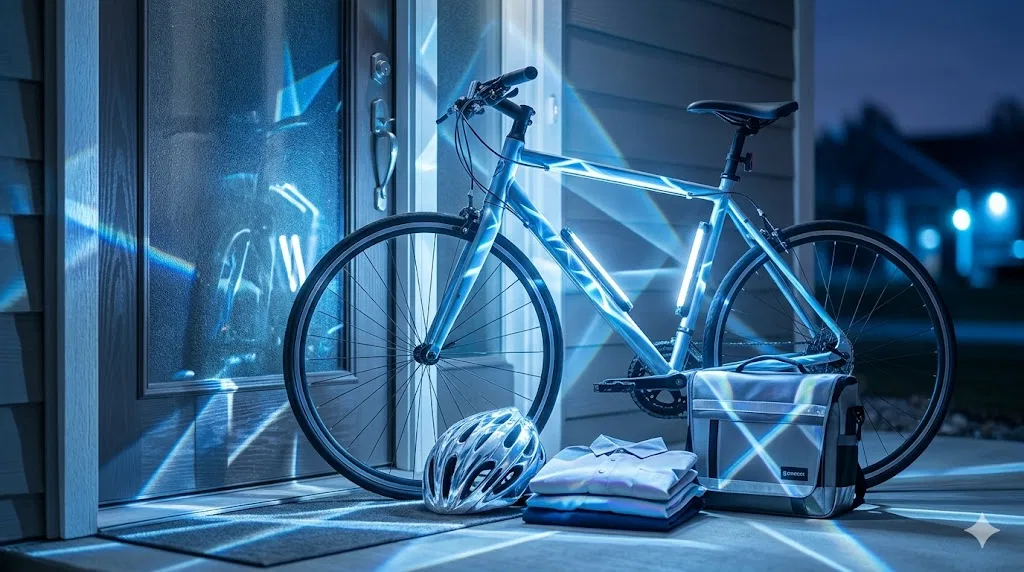
For commuting, the useful plan is not just “I will cycle more”. It is more like: “On Monday and Thursday, after dinner, I will pack my work clothes, check the forecast, charge my lights and put my bike bag by the door.” That supporting habit makes the morning version of the decision much simpler: get dressed, take the bag, leave.
The health case for making the ride repeatable is strong enough to justify this small logistical ritual. A large UK Biobank study published in the BMJ found that cycle commuting was associated with lower risk of cardiovascular disease, cancer and all-cause mortality compared with non-active commuting, while a later Scottish study found population-level health benefits from active commuting, including associations with lower mental-health medication prescribing. These are observational findings rather than proof that cycling alone caused every difference, but they show why a reliable commute habit is worth designing carefully.[BMJ]bmj.comAssociation between active commuting and incident…by CA Celis-Morales · 2017 · Cited by 729 — Cycle commuting was associated with a…
Packing Clothes and Gear
The most common night-before mistake is packing for the ride but not for the arrival. Cycle commuting has two endpoints: the road and the workplace. A good preparation routine covers both.
The simplest system is a permanent commute bag or pannier checklist. For many riders, that means work clothes, shoes, underwear, deodorant, towel if needed, laptop protection, keys, pass, wallet, lock, lights, waterproof layer and a small repair kit. Cycling UK notes that arriving fresh is often managed by riding at a relaxed pace, using breathable clothing, using an e-bike, or cycling in separate clothes and changing on arrival.[Cycling UK]cyclinguk.orgSource details in endnotes.
The exact clothing system depends on distance, terrain, workplace and weather. For a short flat ride, everyday clothes plus a waterproof jacket may be enough. For a longer or sweatier commute, separate cycling clothes and office clothes are more reliable. Recent UK commuter guidance makes the same distinction: short city rides can often be handled in practical everyday clothing, while longer commutes benefit from more bike-specific layers, padded shorts or undershorts, and proper weather protection.[Cyclescheme]cyclescheme.co.ukSource details in endnotes.
A practical night-before packing routine should answer four questions:
- What will I ride in? Choose clothes for the temperature, rain risk and wind, not just the morning temperature indoors.
- What will I work in? Pack the full outfit, including shoes, socks and anything easy to forget.
- What must arrive dry? Put laptop, papers and clothing in a waterproof bag, liner or dry bag if rain is possible.
- What can stay at work? Shoes, toiletries, a spare shirt, a lock or towel can be stored at work to reduce daily packing.
Lights deserve special treatment because they are both practical and legal. In the UK, the Highway Code says that at night a cycle must have a white front light, a red rear light, a red rear reflector and amber pedal reflectors if manufactured after 1 October 1985; it also recommends a steady front lamp in areas without street lighting. That makes charging lights the night before more than a convenience.[GOV.UK]GOV.UKThe Highway CodeThe Highway Code
Choosing Commute Days
The fastest way to kill a new cycle commute is to demand daily perfection too soon. A better habit design is to choose commute days deliberately. Two predictable cycling days a week are usually more useful than five aspirational days that collapse under meetings, rain and tiredness.
This fits the broader self-improvement principle: make the target specific, repeatable and realistic. “Cycle to work on Mondays and Thursdays” is a stronger behaviour than “cycle more”. It also makes night-before preparation easier because the cue is stable. Sunday and Wednesday evenings become the preparation windows; Monday and Thursday mornings become the ride windows.
The best early commute days have three features. They have enough time in the morning, no high-stakes first appointment, and a reasonable weather outlook. BikeWalk NC’s beginner advice captures this gradual approach well: start by storing clothes or supplies at work and ride on a day with ideal weather and no schedule conflicts, then build up equipment and confidence over time.[BikeWalkNC]bikewalknc.orgSource details in endnotes.
This is not weakness; it is behaviour design. Commuting is a repeated behaviour embedded in work obligations, not a motivational challenge in isolation. A person who cycles once a week for three months has built more evidence of identity, route knowledge and practical confidence than someone who announces a daily commute and quits after the first chaotic morning.
A useful progression looks like this:
- Trial ride: Do the route on a non-work day or quiet morning to learn timings and awkward junctions.
- One easy workday: Choose a fair-weather day with spare arrival time.
- Two fixed days: Add a second predictable day once packing and arrival feel routine.
- Flexible third day: Add an optional day when weather, workload and energy line up.
- Normalised routine: Keep a default schedule but allow planned exceptions.
The point is not to make cycling fragile by waiting for perfect conditions. It is to create enough early success that the habit can survive imperfect conditions later.
Weather and Route Backups
Weather is one of the biggest reasons cycle commuting needs a night-before routine. Bad weather in the morning feels like a reason to abandon the ride; known weather the night before becomes a planning variable. The Met Office advises cyclists to keep a close eye on forecasts and weather warnings, especially in winter, when road conditions and visibility can change the safety of a journey.[Met Office]weather.metoffice.gov.ukSource details in endnotes.
The night-before weather check should cover the return journey as well as the morning ride. Many commuters remember the outbound weather and forget that they also need to get home. A practical check includes rain, wind, temperature, visibility and warnings. Rain may call for waterproof trousers or a dry bag; wind may call for a less exposed route; cold may call for gloves; darkness may call for extra lighting and reflective details.
The route deserves the same treatment. The best route by car is often not the best route by bike. A slightly longer route with quieter roads, cycle lanes, better lighting or fewer hostile junctions may be more sustainable than the shortest line on a map. Google Maps and other route tools can help, but commuter cyclists often need to test alternatives because routing apps may not fully capture surface quality, junction stress, traffic speed or personal comfort.[Bike to Everything]biketoeverything.comBike to Everything How to Plan a Fun Bike Route with Google MapsBike to Everything How to Plan a Fun Bike Route with Google Maps
A good backup plan is specific enough to use when tired. Examples include:
- Rain backup: waterproof jacket and trousers already packed; laptop inside a dry bag.
- Wind backup: quieter sheltered route, even if it adds five minutes.
- Darkness backup: fully charged lights, reflective layer, well-lit route.
- Time-pressure backup: cycle to a train station or ride one way only.
- Mechanical backup: spare tube or repair kit, plus a public-transport option.
- Work-clothes backup: spare shirt, shoes or toiletries stored at work.
This is coping planning in everyday form. It does not pretend barriers will disappear. It decides in advance which barriers matter and what the rider will do when they appear.
The Night-Before Routine That Makes Cycling More Likely
The routine should be short enough to repeat on an ordinary evening. If preparation feels like a second workout, it will not last. The aim is a five-to-ten-minute reset that makes the morning commute boringly straightforward.
A strong routine might look like this:
- Check tomorrow’s calendar. Confirm the ride fits the first meeting, school run, delivery, appointment or social plan.
- Check weather both ways. Look at morning and evening conditions, not just the start time.
- Choose the route. Pick the normal route or a backup based on light, wind, rain and time.
- Pack work clothes. Include shoes, socks, underwear and anything needed to look work-ready.
- Prepare ride clothing. Lay out layers, gloves, waterproofs or reflective items.
- Charge and fit lights. Put them on the bike or next to keys so they cannot be forgotten.
- Pack the bag. Protect laptop and papers; add lock, pass, wallet, repair basics and snacks if needed.
- Set the bike ready. Quick check of tyres, brakes and chain; place bike where departure is easy.
- Put the bag by the door. The final cue should be visible in the morning.
The key design feature is that the routine ends with a visible prompt. A packed pannier by the door, helmet on the bag, or lights beside the keys turns tomorrow’s intention into a physical cue. Behaviour-change taxonomies treat prompts, cues, action planning and restructuring the physical environment as distinct behaviour-change techniques because they change the conditions under which action happens.[PubMed]pubmed.ncbi.nlm.nih.govhabit strength moderates implementation intention effects…by TL Webb · 2009 · Cited by 333 — In summary, habit strength moderate…
What This Case Teaches About Self Improvement That Works
Cycle commuting with night-before preparation shows why effective self improvement often looks unglamorous. The visible achievement is riding to work. The hidden achievement is designing the evening before so the ride becomes the path of least resistance.
This case also shows why “discipline” is usually too vague to be useful. A person who forgets work shoes is not necessarily undisciplined. They may have a system problem. A person who abandons cycling because of rain may not lack commitment. They may need waterproof storage, a weather threshold, and a bus backup. A person who keeps driving because mornings are rushed may not need more inspiration. They may need to choose two commute days and pack before bed.
The wider lesson is portable. Many habits depend on a prior habit: the workout depends on laying out clothes; the healthy lunch depends on shopping; the focused morning depends on closing tabs the night before; the cycle commute depends on packing the bag. The supporting action is smaller, earlier and less emotionally loaded than the main behaviour, which makes it easier to practise.
A sustainable cycle commute is therefore not built from one heroic morning. It is built from repeated evenings in which the rider removes friction, anticipates barriers and makes tomorrow’s good choice easier to take.
Amazon book picks
Further Reading
Books and field guides related to Why the Habit Starts the Night Before. Use these as the next step if you want deeper reading beyond the article.
Atomic Habits
Rating: 3.5/5 from 7 Google Books ratings
Directly supports night-before preparation habits.
The Cyclist's Training Bible
Provides structure, planning, and consistency for regular riding.
eBay marketplace picks
Marketplace Samples
Example marketplace items related to this page. Use the search link to explore similar finds on eBay.


Endnotes
1.
Source: d-nb.info
Link:https://d-nb.info/1104173190/34
Source snippet
Planning mediates between intentions and physical activityDecember 17, 2012 — by U Scholz · Cited by 306 — Action planning and coping...
Published: December 17, 2012
2.
Source: bmj.com
Link:https://www.bmj.com/content/357/bmj.j1456
Source snippet
Association between active commuting and incident...by CA Celis-Morales · 2017 · Cited by 729 — Cycle commuting was associated with a...
3.
Source: GOV.UK
Title: The Highway Code
Link:https://www.gov.uk/guidance/the-highway-code/rules-for-cyclists-59-to-82
4.
Source: cyclinguk.org
Link:https://www.cyclinguk.org/lighting-regulations
5.
Source: bikewalknc.org
Link:https://www.bikewalknc.org/bicycle-commuting/
6.
Source: weather.metoffice.gov.uk
Link:https://weather.metoffice.gov.uk/warnings-and-advice/seasonal-advice/travel/winter-weather-and-cycling
7.
Source: bmj.com
Link:https://www.bmj.com/content/357/bmj.j1944
8.
Source: blogs.bmj.com
Title: pedal power the health benefits of cycling outweigh the risks by far
Link:https://blogs.bmj.com/bjsm/2018/12/12/pedal-power-the-health-benefits-of-cycling-outweigh-the-risks-by-far/
9.
Source: bmjpublichealth.bmj.com
Link:https://bmjpublichealth.bmj.com/content/2/1/e001295
10.
Source: metoffice.gov.uk
Title: climate action taking corporate responsibility
Link:https://www.metoffice.gov.uk/blog/2023/climate-action-taking-corporate-responsibility
11.
Source: weather.metoffice.gov.uk
Link:https://weather.metoffice.gov.uk/forecast/gcpvj0v07
12.
Source: metoffice.gov.uk
Link:https://www.metoffice.gov.uk/
13.
Source: play.google.com
Link:https://play.google.com/store/apps/details?hl=en&id=uk.gov.metoffice.weather.android
14.
Source: GOV.UK
Title: www.gov.uk Pedal cycles
Link:https://www.gov.uk/government/publications/pedal-cycles-lighting/pedal-cycles-lighting
15.
Source: pubmed.ncbi.nlm.nih.gov
Link:https://pubmed.ncbi.nlm.nih.gov/18851764/
Source snippet
habit strength moderates implementation intention effects...by TL Webb · 2009 · Cited by 333 — In summary, habit strength moderate...
16.
Source: pmc.ncbi.nlm.nih.gov
Title: Pub Med Central Health benefits of pedestrian and cyclist commuting
Link:https://pmc.ncbi.nlm.nih.gov/articles/PMC11812918/
Source snippet
more...
17.
Source: cyclinguk.org
Link:https://www.cyclinguk.org/article/beginners-guide-commuting
18.
Source: cyclescheme.co.uk
Link:https://www.cyclescheme.co.uk/community/how-to/look-smart-no-sweat
19.
Source: biketoeverything.com
Title: Bike to Everything How to Plan a Fun Bike Route with Google Maps
Link:https://biketoeverything.com/2020/06/10/how-to-plan-a-fun-bike-route-with-google-maps/
20.
Source: pubmed.ncbi.nlm.nih.gov
Link:https://pubmed.ncbi.nlm.nih.gov/28424154/
21.
Source: forum.cyclinguk.org
Link:https://forum.cyclinguk.org/viewtopic.php?t=113916
22.
Source: transport.ed.ac.uk
Title: highway code
Link:https://transport.ed.ac.uk/cycling/safety/highway-code
23.
Source: cyclescheme.co.uk
Link:https://www.cyclescheme.co.uk/community/how-to/how-to-weatherproof-your-commute
Additional References
24.
Source: cyclingweekly.com
Link:https://www.cyclingweekly.com/group-tests/commuting-to-work-by-bike-what-to-wear-throughout-the-year-463755
Source snippet
For short city commutes, casual bike-friendly clothing such as waterproof jackets and trousers may suffice. However, for longer commutes...
25.
Source: youtube.com
Title: Everything You Need To Take On A Bike Ride (& How To Carry It)
Link:https://www.youtube.com/watch?v=DkDUoHPJ6yI
Source snippet
"How to pack" bike commute clothes pack bag morning preparation How to carry your work clothes on a bicycle...
26.
Source: nature.com
Link:https://www.nature.com/nature-index/topics/l4/active-commuting-and-health-outcomes
27.
Source: youtube.com
Title: 7 Hacks To Make Commuting By Bike Work For You | Cycle Commuting Made Easy
Link:https://www.youtube.com/watch?v=lWInrzfAf14
Source snippet
How to carry your work clothes on a bicycle...
28.
Source: youtube.com
Title: 6 HACKS to make Commuting by Bike WORK FOR YOU!
Link:https://www.youtube.com/watch?v=W8P9rdOU660
Source snippet
7 Hacks To Make Commuting By Bike Work For You | Cycle Commuting Made Easy...
29.
Source: kops.uni-konstanz.de
Link:https://kops.uni-konstanz.de/bitstreams/23250a50-e2a8-4b49-b831-9c2e0c055721/download
Source snippet
Planning, self-efficacy, and action control in the adoption...by FF Sniehotta · 2005 · Cited by 2069 — Gollwitzer (1999) calls such...
30.
Source: researchgate.net
Link:https://www.researchgate.net/publication/360690716_Adults%27_self-reported_barriers_and_enablers_to_riding_a_bike_for_transport_a_systematic_review
31.
Source: researchgate.net
Link:https://www.researchgate.net/publication/316271734_Active_commuting_is_beneficial_for_health
32.
Source: activetravelstudies.org
Link:https://activetravelstudies.org/articles/
33.
Source: surlybikes.com
Link:https://surlybikes.com/pages/bike-commuting-101-8-tips-for-your-commute-to-work?srsltid=AfmBOopEwANNWy9vKyZxJmuXVma8Jbt14r3sTeX5ZlehecysZ5NUDWki
Topic Tree