Within Accountability
The study group that actually helps learning
Study groups work better when members test recall, explain answers and review mistakes instead of rereading together.
On this page
- Why co working is not enough
- Collaborative retrieval and attention
- Error review, explanation and next tasks
Page outline Jump by section
Introduction
A study group becomes genuinely useful when it changes how members learn rather than simply giving them a place to sit. One of the strongest findings in learning science is that actively retrieving information from memory produces better long-term retention than rereading or reviewing notes. This is often called the testing effect or retrieval practice. Across many studies and educational settings, learners who repeatedly try to recall information outperform those who mainly restudy it. PubMed Central[The Learning Scientists]learningscientists.orgThe Learning ScientistsNew Meta-analysis of 217 Retrieval Practice StudiesFeb 9, 2017 — Retrieval practice was consistently found to be b…
 That insight has an important implication for accountability-based study groups. The best group is not one that spends an hour silently reading together. It is one that regularly asks members to recall, explain, apply and correct information from memory. A retrieval-focused group creates accountability around learning itself, not just attendance. Members arrive prepared to test what they know, expose gaps in understanding and leave with clear next actions.
Why co-working is not enough
Many study groups drift into what feels productive but often has limited impact on learning. Members gather in the same room, open books and work quietly. The social environment may increase study time, which is valuable, but simply being present does not guarantee durable learning.
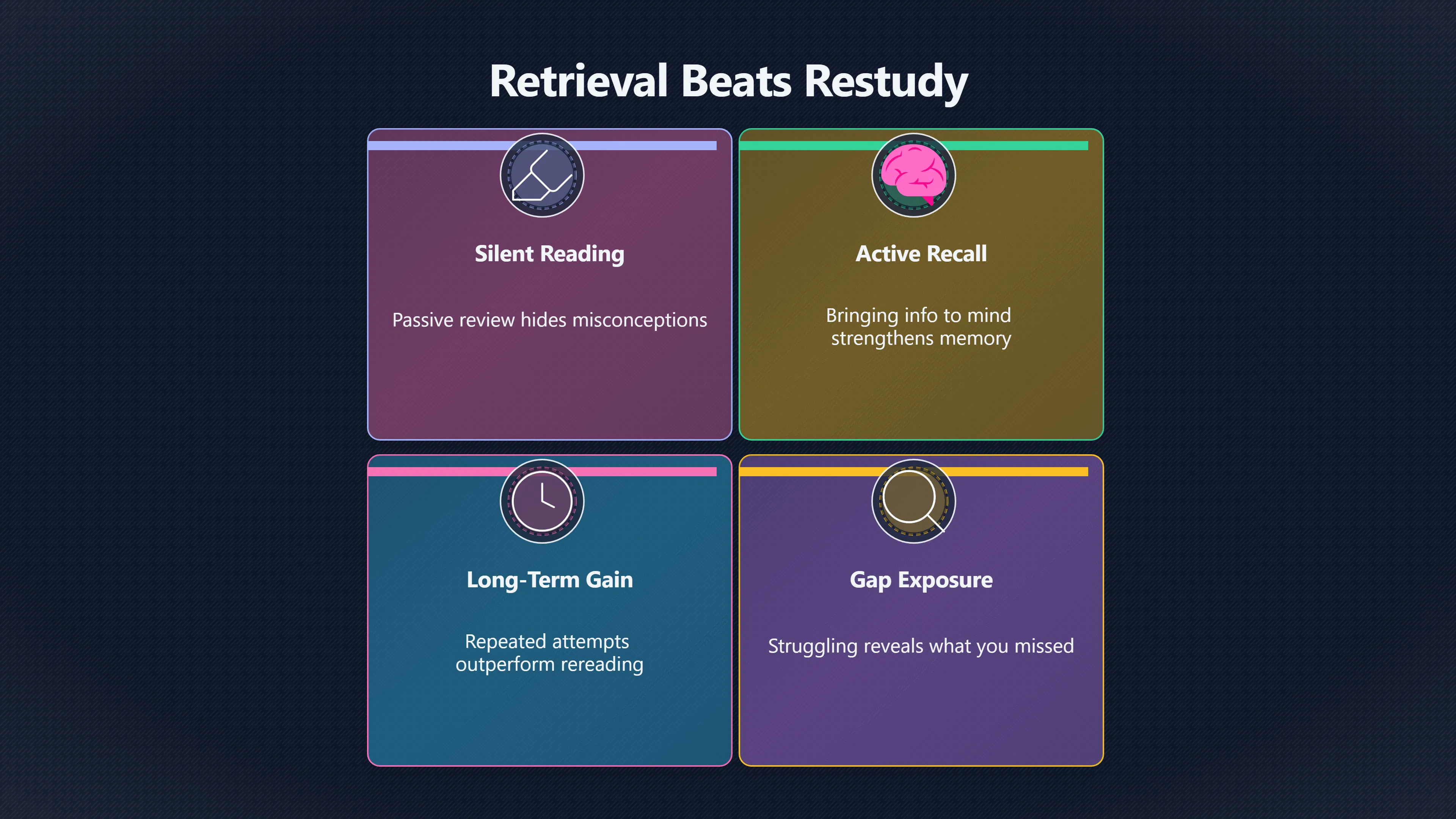
Retrieval practice works differently. Instead of looking at information again, learners attempt to bring it to mind without immediate support from notes. The effort involved in recalling information strengthens later access to that knowledge and often reveals misconceptions that passive review hides. Research spanning more than a century of educational psychology consistently finds advantages for retrieval over restudying. PubMed Central 3EEF[The Learning Scientists]learningscientists.orgThe Learning ScientistsNew Meta-analysis of 217 Retrieval Practice StudiesFeb 9, 2017 — Retrieval practice was consistently found to be b…
This means that a study group should judge success by the quality of recall attempts rather than by hours spent together. A member who struggles through ten difficult questions from memory may learn more than someone who spends the same period rereading highlighted pages.
For accountability purposes, retrieval practice also creates observable evidence of progress. It is easier to review what someone could explain, solve or recall than to evaluate how carefully they reread a chapter.
Collaborative retrieval keeps attention on the task
A common challenge in group study is that attention drifts. Conversations move away from the material, phones appear, and the session gradually becomes social rather than educational.
Retrieval-based activities naturally create more engagement because participants must actively generate answers. Recent research comparing collaborative and individual retrieval practice found that collaborative retrieval reduced mind-wandering during learning. Participants working together on recall tasks reported being off-task less frequently while still showing learning benefits after the collaborative session.[PubMed Central]pmc.ncbi.nlm.nih.govPubMed CentralRetrieval practice enhances new learning: the forward effect of…by B Pastötter · 2014 · Cited by 270 — Regarding the bac…
The mechanism is straightforward. When group members know they may be asked to answer a question, explain a concept or contribute to a discussion, attention has a clear target. The session becomes interactive rather than passive.
Several formats work particularly well:
- Round-robin questioning: each member asks and answers questions in turn.
- Blank-page recall: members write everything they remember about a topic before comparing responses.
- Peer quizzing: one person acts as questioner while others answer from memory.
- Concept explanation: members explain an idea without notes while others listen for gaps or errors.
- Problem solving from memory: the group works through examples before consulting reference material.
The common feature is that information must be produced, not merely recognised.
Why explanation improves retrieval
A retrieval group gains additional value when members explain answers rather than simply stating them.
Explaining requires learners to organise knowledge into a coherent structure. If someone can define a concept but cannot explain why it matters or how it connects to related ideas, the group quickly discovers the weakness. Peer explanation therefore functions as both retrieval practice and a diagnostic tool.
Research on peer instruction and collaborative learning suggests that structured explanation and discussion can improve learning outcomes beyond passive listening. When learners must justify their reasoning to others, they often notice misunderstandings that would otherwise remain hidden.[APS Links]link.aps.orgAPS LinksComparing retrieval-based practice and peer instruction in…by T Zu · 2019 · Cited by 24 — In this study, we compared the effe…[ResearchGate]researchgate.netA meta -analysis of the effect of Peer Instruction on learning…Peer Instruction has a positive impact on learning compared to traditio…
A useful rule for study groups is that answers should rarely end with the correct fact alone. Members should be encouraged to continue with questions such as:
- Why is that answer correct?
- How would you explain it to a beginner?
- What mistake might someone make here?
- What example illustrates the idea?
- How does this connect to last week’s material?
These prompts turn recall into understanding.

Review mistakes, not just correct answers
One of the most valuable moments in a retrieval-focused study group occurs immediately after an incorrect answer.
Many learners experience mistakes as evidence of failure. Learning research suggests the opposite interpretation is often more useful. A failed retrieval attempt reveals exactly where understanding is incomplete. Once corrected, that information can guide future study more efficiently than vague confidence judgments. [Pooja K. Agarwal, Ph.D.]
Groups benefit from treating errors as shared learning opportunities rather than personal shortcomings. A practical review sequence is:
- Attempt retrieval without notes.
- Compare answers.
- Identify disagreements or uncertainty.
- Check authoritative sources.
- Explain the correct answer.
- Record the gap for future review.
This process helps prevent the common pattern in which members celebrate correct responses but move too quickly past misunderstandings.
Some research on collaborative testing and practice testing suggests that group-based retrieval activities can produce meaningful gains in later retention, especially when learners actively engage with answers and corrections rather than merely observing others.[Sage Journals]journals.sagepub.comSage JournalsThe Effects of Collaborative Practice Testing on Memory for…Jan 31, 2025 — The present research suggests that collaborati…
A simple retrieval-group structure
A retrieval-focused study group does not need elaborate rules. A sixty-minute session can follow a straightforward pattern:
10 minutes: individual recall
Each member writes answers, definitions, concepts or problems from memory without using notes.
20 minutes: collaborative retrieval[pmc.ncbi.nlm.nih.gov]pmc.ncbi.nlm.nih.govPubMed CentralCollaborative Retrieval Practice Reduces Mind-Wandering…by AG Knopps · 2023 · Cited by 9 — The results showed that engag…
Members compare answers, quiz one another and attempt increasingly difficult questions.
20 minutes: explanation and error review
The group analyses disagreements, explains reasoning and checks uncertain answers against reliable materials.
10 minutes: next tasks
Each person identifies:
- Topics they could not recall confidently.
- Questions requiring further study.
- A specific retrieval task to complete before the next meeting.
This structure keeps accountability tied to learning behaviour rather than attendance alone.

What successful retrieval groups look like
The strongest study groups are not necessarily the most social, the most disciplined or the most knowledgeable. They are the groups that repeatedly create opportunities for effortful recall, honest error correction and clear follow-through.
Members arrive expecting to be tested in a low-stakes way. They explain ideas rather than merely recognising them. They review mistakes openly rather than hiding them. They leave with specific gaps identified and concrete retrieval tasks for the next session.
Within an accountability partnership or study group, retrieval practice turns learning into something visible and reviewable. Instead of asking, “Did we study?”, the group can ask a far more useful question: “What could we actually remember and explain today that we could not explain last week?” That shift moves the group from co-working towards genuine learning.
eBay marketplace picks
Marketplace Samples
Example marketplace items related to this page. Use the search link to explore similar finds on eBay.


Endnotes
1.
Source: link.aps.org
Link:https://link.aps.org/doi/10.1103/PhysRevPhysEducRes.15.010105
Source snippet
APS LinksComparing retrieval-based practice and peer instruction in...by T Zu · 2019 · Cited by 24 — In this study, we compared the effe...
2.
Source: researchgate.net
Link:https://www.researchgate.net/publication/320069708A_meta-analysis_of_the_effect_of_Peer_Instruction_on_learning_gain_Identification_of_informational_and_cultural_moderators
Source snippet
A meta -analysis of the effect of Peer Instruction on learning...Peer Instruction has a positive impact on learning compared to traditio...
3.
Source: retrievalpractice.org
Title: Pooja K
Link:https://www.retrievalpractice.org/why-it-works
Source snippet
Agarwal, Ph.D.What is retrieval practice? - RetrievalPractice.orgRetrieval practice is a strategy in which bringing information to mind e...
4.
Source: researchgate.net
Link:https://www.researchgate.net/publication/347076022_Retrieval_Practice_Beneficial_for_All_Students_or_Moderated_by_Individual_Differences
Source snippet
ced long-term memory retention when compared to several other [techniques]({{ 'techniques/' | relative_url }}). Read more...
5.
Source: pmc.ncbi.nlm.nih.gov
Link:https://pmc.ncbi.nlm.nih.gov/articles/PMC3983480/
Source snippet
PubMed CentralRetrieval practice enhances new learning: the forward effect of...by B Pastötter · 2014 · Cited by 270 — Regarding the bac...
6.
Source: learningscientists.org
Link:https://www.learningscientists.org/blog/2017/2/9-1
Source snippet
The Learning ScientistsNew Meta-analysis of 217 Retrieval Practice StudiesFeb 9, 2017 — Retrieval practice was consistently found to be b...
7.
Source: pmc.ncbi.nlm.nih.gov
Link:https://pmc.ncbi.nlm.nih.gov/articles/PMC12894256/
Source snippet
PubMed CentralTesting the testing effect on prolific: when retrieval practice...by K Sigayret · 2026 · Cited by 1 — The testing effect—w...
8.
Source: pmc.ncbi.nlm.nih.gov
Link:https://pmc.ncbi.nlm.nih.gov/articles/PMC10929687/
Source snippet
PubMed CentralCollaborative Retrieval Practice Reduces Mind-Wandering...by AG Knopps · 2023 · Cited by 9 — The results showed that engag...
9.
Source: journals.sagepub.com
Link:https://journals.sagepub.com/doi/10.1177/00986283251316581
Source snippet
Sage JournalsThe Effects of Collaborative Practice Testing on Memory for...Jan 31, 2025 — The present research suggests that collaborati...
10.
Source: 2366135.fs1.hubspotusercontent-na1.net
Title: Retrieval Practice Myths, Mutations & Mistakes
Link:https://2366135.fs1.hubspotusercontent-na1.net/hubfs/2366135/Retrieval%20Practice%20-%20Myths%2C%20Mutations%20%26%20Mistakes.pdf
Source snippet
Practice - Myths, Mutations & MistakesRetrieval practice is a strategy supported by evidence and can be used to enhance learning and prog...
11.
Source: education-ni.gov.uk
Title: Retrieval Practice
Link:https://www.education-ni.gov.uk/sites/default/files/2025-04/May%20Newsletter%20-%20Retrieval%20Practice%20%20What%20it%20is%2C%20Why%20it%20Works%20and%20How%20to%20Do%20It%20Better.PDF
Source snippet
Retrieval Practice has consistently been found to be one of the most effective learning strategies in all of cognitive psycho...
Additional References
12.
Source: nature.com
Link:https://www.nature.com/nature-index/topics/l4/collaborative-learning-strategies-in-higher-education
Source snippet
Collaborative Learning Strategies in Higher EducationRetrieval practice: A learning strategy that involves actively recalling information...
13.
Source: centerforengagedlearning.org
Link:https://www.centerforengagedlearning.org/why-letting-your-students-collaborate-on-exams-isnt-a-bad-idea/
Source snippet
Why Letting Your Students Collaborate on Exams isn't a...by D Buck — Now, the above research really just shows that the testing effect e...
14.
Source: ctl.wustl.edu
Link:https://ctl.wustl.edu/resources/using-retrieval-practice-to-increase-student-learning/
Source snippet
Retrieval practice is the strategy of recalling facts, concepts, or events from memory in order to enhance learning.Read more...
15.
Source: educationendowmentfoundation.org.uk
Title: does research on retrieval practice translate into classroom practice
Link:https://educationendowmentfoundation.org.uk/news/does-research-on-retrieval-practice-translate-into-classroom-practice
Source snippet
EEFEEF Blog: Does research on 'retrieval practice' translate...5 Dec 2019 — Retrieval practice is strongly supported by over 100 years...
16.
Source: evidencebased.education
Title: retrieval practice and technology five key principles
Link:https://evidencebased.education/resource/retrieval-practice-and-technology-five-key-principles/
Source snippet
Retrieval Practice and Technology: Five Key Principles1 Apr 2025 — Learn how retrieval practice can enhance teaching and learning with ne...
17.
Source: online.ucpress.edu
Title: Repeated Retrieval Practice to Foster Students
Link:https://online.ucpress.edu/collabra/article/7/1/28881/118716/Repeated-Retrieval-Practice-to-Foster-Students
Source snippet
Retrieval Practice to Foster Students' Critical...Oct 7, 2021 — The present experiment investigated whether repeated retrieval practice...
18.
Source: resolve.cambridge.org
Link:https://resolve.cambridge.org/core/journals/canadian-journal-of-linguistics-revue-canadienne-de-linguistique/article/improved-student-learning-through-active-retrieval-practice-and-randomsampled-exams/0BC0D7C392693E4CCD52C78D8077E320
Source snippet
student learning through active retrieval practice...16 Dec 2024 — One pedagogical finding that has gained recent attention is the utili...
19.
Source: tandfonline.com
Link:https://www.tandfonline.com/doi/full/10.1080/09500693.2023.2283906
Source snippet
Retrieval-based learning versus discussion; which review...by A Jakobsson · 2024 · Cited by 16 — The aim of this study was to compare tw...
20.
Source: wgu.edu
Link:https://www.wgu.edu/blog/peer-learning2208.html
Source snippet
Peer Learning in Education: Overview, Benefits, and...Mar 2, 2026 — Peer learning is an educational approach where students interact wit...
21.
Source: pmc.ncbi.nlm.nih.gov
Link:https://pmc.ncbi.nlm.nih.gov/articles/PMC12292765/
Source snippet
Use of Retrieval Practice in the Health Professions - PMCby MJ Serra · 2025 · Cited by 12 — Retrieval practice, or the active recall of i...
Topic Tree