Within Identity
Do identity labels actually help habits stick?
Identity labels can support change when they grow from repeated evidence instead of replacing concrete action.
On this page
- What identity labels add to motivation
- Why behavioural evidence has to come first
- How to use labels without self pressure
Page outline Jump by section
Introduction
Identity labels such as “runner”, “writer” or “disciplined person” can help habits stick, but usually not for the reason people assume. They work best when they summarise a pattern of behaviour that already exists, even in a small form, rather than acting as a substitute for action. In practical self-improvement, the most useful identity label is often a description of repeated evidence: “I am someone who writes regularly because I have written this week” rather than “I am a writer” with no supporting behaviour. Research on habit and identity suggests a reciprocal relationship. Identity can encourage action, and repeated action can strengthen identity, creating a reinforcing loop. The mistake is treating identity as the starting point and behaviour as optional. The stronger pattern is usually the reverse: behaviour creates evidence, evidence supports identity, and identity then makes future behaviour easier. PMC[PubMed]pubmed.ncbi.nlm.nih.govand Identity: Behavioral, Cognitive, Affective…by B Verplanken · 2019 · Cited by 153 — When habits relate to feelings of identity this…
What identity labels add to motivation
Identity labels can make habits feel meaningful in a way that simple targets often do not. A target answers, “What am I trying to do?” An identity answers, “What kind of person does this?”
This matters because people tend to prefer actions that fit their self-concept. When a behaviour feels consistent with who they believe they are, less mental effort is required to justify it. A person who thinks, “I am a runner” does not need to renegotiate the value of every training session. The run becomes an expression of identity rather than a standalone task. Research on identity and behaviour consistently finds positive associations between identity and action, suggesting that people are more likely to perform behaviours that fit an important part of their self-image. Taylor & Francis Online[MDPI]mdpi.com2076 328XHowever, as identity is associated with a range of behaviours, a person's identification with…
Identity labels can also help during moments of choice. Many habits are not difficult because they require exceptional effort; they are difficult because they require repeated decisions. Identity functions as a shortcut. Instead of repeatedly asking, “Should I do this today?”, a person asks, “What would someone like me do?” This can reduce friction and decision fatigue.[Medium]medium.comWhether the behavior is related to what we eat, how we treat others, or how…Read more…
A useful example is someone trying to build a reading habit. A goal-focused approach might be, “Read twenty books this year.” An identity-focused approach becomes, “I am the sort of person who reads regularly.” The second framing does not automatically create behaviour, but it gives each reading session a broader meaning. Missing one day is no longer just missing a task; reading becomes part of maintaining a valued self-image.
Why behavioural evidence has to come first
The strongest evidence from habit research points to repetition as the foundation of habit formation. Habits develop through repeated actions in stable contexts until behaviour becomes increasingly automatic. Identity may support this process, but repetition remains the core mechanism. PMC[2arXiv]arxiv.orgarXiv Theory-based Habit Modeling for Enhancing Behavior PredictionarXiv Theory-based Habit Modeling for Enhancing Behavior Prediction
This is why identity labels help most when they are earned through evidence. A person who has completed ten short runs possesses evidence that supports the label “runner”. A person who has written every morning for two weeks possesses evidence that supports the label “writer”. The label becomes credible because it reflects observable behaviour.
Research by Bas Verplanken and colleagues suggests that habits and identity can become closely connected. Motivations linked to identity may encourage repeated action, while repeated actions can themselves become integrated into identity. In other words, identity and habit reinforce each other, but the reinforcement loop depends on actual behaviour occurring.[PMC]pmc.ncbi.nlm.nih.govby B Verplanken · 2019 · Cited by 150 — Habits may become part of self-identities through various psychological processes. One such pr…
This helps explain why identity declarations alone often fail. Saying “I am a healthy person” creates little lasting change if eating patterns, routines and environments remain unchanged. The brain receives contradictory evidence. Over time, observable actions usually outweigh aspirational labels.
A practical rule is simple: treat behaviour as proof. Every repetition becomes a small vote for an identity. This idea is popular in habit literature because it aligns with a broader psychological principle: people often infer aspects of who they are from what they repeatedly do.[James Clear]jamesclear.comJames ClearIdentity-Based Habits: How to Actually Stick to Your Goals…The key to building lasting habits is focusing on creating a new…[Medium]medium.comIdentity-Based Habits: How to Actually Stick to Your GoalsThe key to building lasting habits is focusing on creating a new identity…
How identity labels strengthen habits after the first wins
Once some behavioural evidence exists, identity labels can begin to provide benefits that go beyond motivation.
They make consistency more valuable
When behaviour is tied to identity, consistency carries extra meaning. A missed workout is no longer just a missed workout; it becomes a moment that feels inconsistent with the kind of person someone wants to be. This does not guarantee perfect adherence, but it can increase the desire to return quickly to the habit.
The effect is often visible in long-term exercisers. Many continue training even when enthusiasm fluctuates because exercise has become part of their identity, not merely a project with a finish line.[PMC]pmc.ncbi.nlm.nih.govPMCIdentity-based motivation: Implications for interventionby D Oyserman · 2010 · Cited by 913 — The identity-based motivation model predicts that what an identity means, and therefore what is…
They help habits survive after goals are achieved
Goals end. Identities do not.
Someone training for a 10-kilometre race may stop running after the event if running was only a means to an outcome. Someone who sees themselves as a runner has a reason to continue once the goal disappears. Identity can therefore help maintain behaviours after external incentives fade.[James Clear]jamesclear.comJames ClearIdentity-Based Habits: How to Actually Stick to Your Goals…The key to building lasting habits is focusing on creating a new…
They create coherence across situations
Identity labels can influence multiple related behaviours at once. A person who adopts the identity of “someone who takes care of their health” may find it easier to exercise, sleep adequately and prepare nutritious meals because those actions support the same self-concept.
This does not mean identity automatically produces good choices. Identity-based motivation research notes that identities are flexible and context-dependent. What feels identity-congruent can vary from moment to moment. The advantage comes when a useful identity is repeatedly reinforced through action.[PMC]pmc.ncbi.nlm.nih.govApplying the Science of Habit Formation to Evidence-Based…by AG Harvey · 2021 · Cited by 54 — A habit is defined as a learned actio…
How to use labels without self-pressure
Identity labels become less useful when they turn into rigid standards.
A common mistake is choosing a grand identity too early. Someone who has written three pages may declare, “I am a professional writer.” When reality does not match the label, the gap can create pressure, self-criticism or embarrassment. The label becomes something to defend rather than something supported by evidence.
A more effective approach is to use identity labels in a lightweight way:
- Choose identities linked to behaviours you can perform regularly.
- Let small actions justify the label.
- Use the label as direction, not proof of worth.
- Focus on being the type of person who returns after mistakes.
- Allow the identity to strengthen gradually as evidence accumulates.
For example, “I am becoming someone who exercises regularly” is often more useful than “I am an athlete” when the habit is still fragile. The identity remains connected to action rather than status.
There is also value in avoiding overly fixed labels. If a person defines themselves entirely as a runner, an injury can threaten both the habit and the identity. Flexible identities such as “I am someone who looks after my fitness” can survive setbacks more easily because they allow alternative behaviours.
The practical mechanism that makes identity labels work
The key mechanism is not positive thinking. It is evidence accumulation.
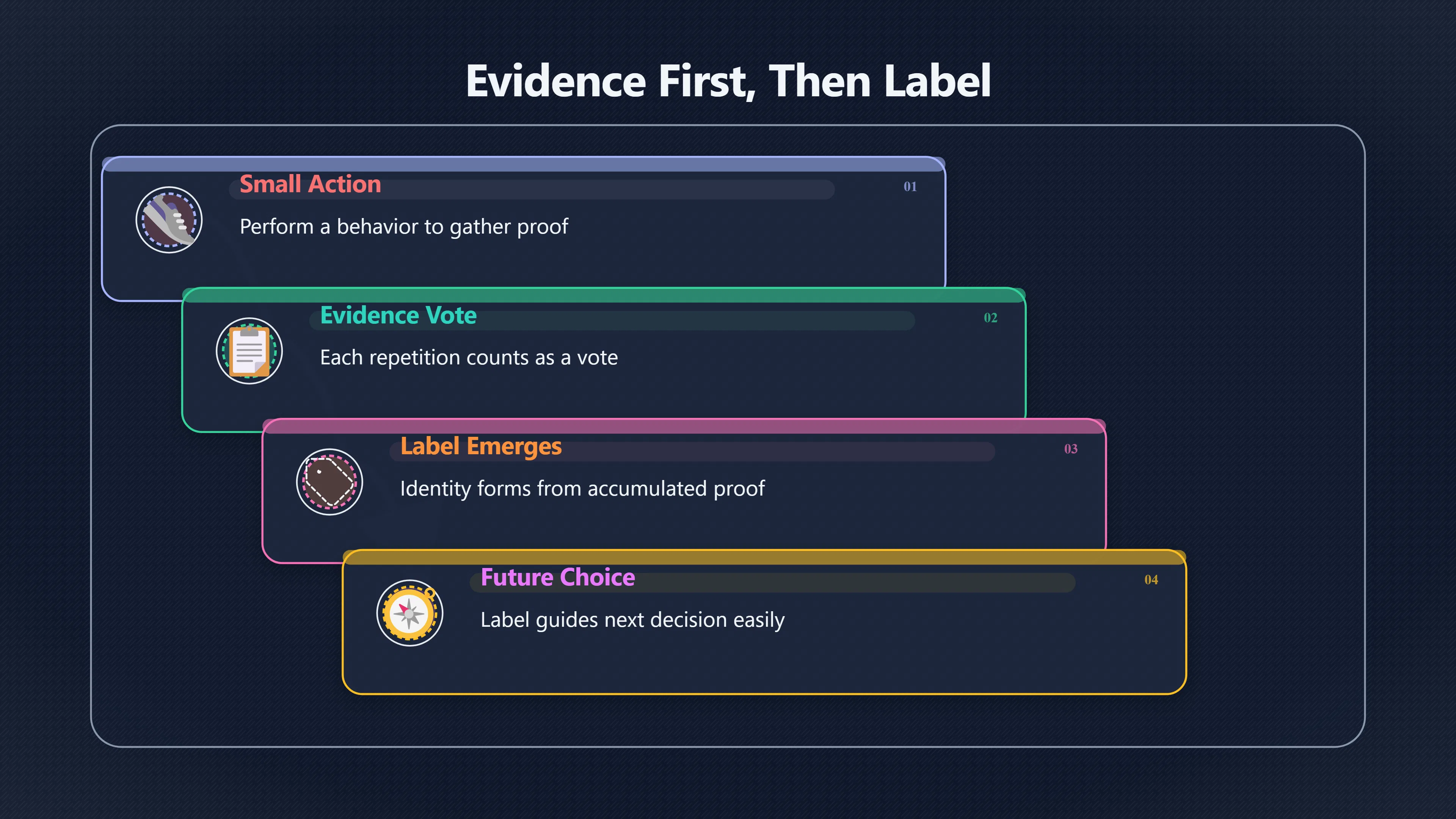
Each completed behaviour provides information about who a person is. As evidence accumulates, the identity becomes more believable. As the identity becomes more believable, behaviours that match it feel more natural and require less internal persuasion. The process forms a feedback loop:
- Perform a small behaviour.
- Treat that behaviour as evidence.
- Allow a modest identity label to emerge.
- Use the label to guide future choices.
- Repeat.
Within the broader debate of identity change versus behaviour design, this is where identity labels earn their place. They are most effective when they sit on top of repeated action rather than replacing it. Behaviour design creates the evidence. Identity gives that evidence meaning. Together, they can make habits feel less like temporary projects and more like expressions of who a person is becoming. PMC 3PMC[PubMed]pubmed.ncbi.nlm.nih.govand Identity: Behavioral, Cognitive, Affective…by B Verplanken · 2019 · Cited by 153 — When habits relate to feelings of identity this…
Amazon book picks
Further Reading
Books and field guides related to Do identity labels actually help habits stick?. Use these as the next step if you want deeper reading beyond the article.
Atomic Habits
Rating: 3.5/5 from 7 Google Books ratings
Directly discusses identity labels and habit persistence.
Psycho-Cybernetics
Rating: 4.0/5 from 5 Google Books ratings
Focuses on how self-image influences behaviour.
eBay marketplace picks
Marketplace Samples
Example marketplace items related to this page. Use the search link to explore similar finds on eBay.




Endnotes
1.
Source: pmc.ncbi.nlm.nih.gov
Link:https://pmc.ncbi.nlm.nih.gov/articles/PMC6635880/
Source snippet
by B Verplanken · 2019 · Cited by 150 — Habits may become part of self-identities through various psychological processes. One such pr...
2.
Source: pmc.ncbi.nlm.nih.gov
Title: PMCIdentity-based motivation: Implications for intervention
Link:https://pmc.ncbi.nlm.nih.gov/articles/PMC3079278/
Source snippet
by D Oyserman · 2010 · Cited by 913 — The identity-based motivation model predicts that what an identity means, and therefore what is...
3.
Source: mdpi.com
Title: 2076 328X
Link:https://www.mdpi.com/2076-328X/15/5/623
Source snippet
However, as identity is associated with a range of behaviours, a person's identification with...
4.
Source: medium.com
Link:https://medium.com/mind-cafe/the-key-to-behavior-change-is-identity-change-1e5df710328c
Source snippet
Whether the behavior is related to what we eat, how we treat others, or how...Read more...
5.
Source: pmc.ncbi.nlm.nih.gov
Link:https://pmc.ncbi.nlm.nih.gov/articles/PMC12318445/
Source snippet
Applying the Science of Habit Formation to Evidence-Based...by AG Harvey · 2021 · Cited by 54 — A habit is defined as a learned actio...
6.
Source: arxiv.org
Title: arXiv Theory-based Habit Modeling for Enhancing Behavior Prediction
Link:https://arxiv.org/abs/2101.01637
7.
Source: medium.com
Link:https://medium.com/%40jamesclear/identity-based-habits-how-to-actually-stick-to-your-goals-bc8cde3c8e22
Source snippet
Identity-Based Habits: How to Actually Stick to Your GoalsThe key to building lasting habits is focusing on creating a new identity...
8.
Source: medium.com
Link:https://medium.com/%40ann_p/you-become-what-you-repeat-the-science-of-identity-based-habit-change-d2975a17bc83
Source snippet
behavior comes from beliefs. But actually, it works both ways...
9.
Source: medium.com
Link:https://medium.com/%40jordancarterwrites/identity-based-habit-formation-transforming-who-i-am-one-small-action-at-a-time-29d48535645f
Source snippet
Here's how I started putting all this into my own life. · 1. Choose My Target Identity · 2. Align My Language.Read more...
10.
Source: kartik-perisetla.medium.com
Title: identity based habits 623382ab1cb2
Link:https://kartik-perisetla.medium.com/identity-based-habits-623382ab1cb2
Source snippet
based habits - Kartik Perisetla - MediumIdentity based habits is concerned with changing your beliefs about yourself, world around you, j...
11.
Source: pubmed.ncbi.nlm.nih.gov
Link:https://pubmed.ncbi.nlm.nih.gov/31354563/
Source snippet
and Identity: Behavioral, Cognitive, Affective...by B Verplanken · 2019 · Cited by 153 — When habits relate to feelings of identity this...
12.
Source: jamesclear.com
Link:https://jamesclear.com/identity-based-habits
Source snippet
James ClearIdentity-Based Habits: How to Actually Stick to Your Goals...The key to building lasting habits is focusing on creating a new...
13.
Source: youtube.com
Link:https://www.youtube.com/watch?v=yULiCnWwKTM
Source snippet
Craig Groeschel•95K views · 14:59 · Go to channel BetterSelf · Identity-Based Habits...
Additional References
14.
Source: tumcso.com
Link:https://www.tumcso.com/teaching/courses/courses/work-and-life-skills-ss-23/work-life-skills-23/habits-page-by-eva-schroeder/drive-change/identity-based-habits
Source snippet
Identity-Based HabitsBy reshaping our identity, which is our perception of ourselves, it becomes easier to align our actions with this ne...
15.
Source: linkedin.com
Link:https://www.linkedin.com/top-content/training-development/habit-formation-for-growth/strategies-for-building-identity-based-habits/
Source snippet
Strategies for Building Identity-Based HabitsStrategies for building identity-based habits focus on creating routines that align with the...
16.
Source: reddit.com
Link:https://www.reddit.com/r/GetMotivated/comments/56ggb5/text_identitybased_habits_how_to_actually_stick/
Source snippet
[Text] Identity-Based Habits: How to Actually Stick to Your...The key to building lasting habits is focusing on creating a new identity...
17.
Source: scribd.com
Link:https://www.scribd.com/document/885406096/Identity-Based-Habits
Source snippet
into one's self-concept, leading to natural and automatic behavior...Read more...
18.
Source: reddit.com
Link:https://www.reddit.com/r/getdisciplined/comments/1uor9w/identity_based_habits_this_article_has_had_a/
Source snippet
d cause a subconscious change in a way you're prone to behave and...Read more...
19.
Source: theunforgettable.me
Title: identity based habits leadership transformation
Link:https://www.theunforgettable.me/post/identity-based-habits-leadership-transformation
Source snippet
Identity-Based Habits: Why Who You Are Drives What You Do6 Jun 2025 — A: Regular habits focus on outcomes; identity-based habits focus on...
20.
Source: productivepatty.com
Title: identity based habits the key to lasting change
Link:https://www.productivepatty.com/identity-based-habits-the-key-to-lasting-change/
Source snippet
Identity-Based Habits: The Key to Lasting ChangeDec 6, 2025 — Identity-based habits represent a behavioral change approach that connects...
21.
Source: tandfonline.com
Title: Some findings showed predictive links between
Link:https://www.tandfonline.com/doi/full/10.1080/15283488.2023.2209586
Source snippet
Taylor & Francis OnlineFull article: The Role of Identity in Human Behavior Researchby KL Alfrey · 2023 · Cited by 56 — Overall, the stud...
22.
Source: semanticscholar.org
Link:https://www.semanticscholar.org/paper/Habit-and-Identity%3A-Behavioral%2C-Cognitive%2C-and-of-Verplanken-Sui/4142e140f4052948d921f48939ba7f718278b1f7
Source snippet
Habit and Identity: Behavioral, Cognitive, Affective, and...Jul 10, 2019 — The results suggest that habits may serve to define who the a...
23.
Source: psychologytoday.com
Title: the identity hack to behavioral change
Link:https://www.psychologytoday.com/gb/blog/all-about-addiction/202503/the-identity-hack-to-behavioral-change
Source snippet
31 Mar 2025 — Most people fail at change because they focus on behavior, not identity. Identity-based change lasts longer and works bette...
Topic Tree