Within Environment
Why automatic saving beats repeated resolve
Automatic transfers make saving the path of least resistance instead of a daily test of discipline.
On this page
- How defaults remove repeated money decisions
- Payday transfers and separate accounts
- When automation needs review rather than blind trust
Page outline Jump by section
Introduction
Saving money is often described as a test of self-control: spend less today so that you have more tomorrow. In practice, many people discover that good intentions lose repeatedly to convenience. Bills arrive, tempting purchases appear, and each month requires another decision to save rather than spend. Automatic saving changes the structure of the problem. Instead of relying on repeated acts of discipline, it makes saving the default outcome.
 This is a classic example of environment design. Rather than asking people to win the same internal argument over and over again, automatic transfers move money before spending decisions occur. Research on defaults, automatic enrolment and payroll savings consistently shows that people save more when saving happens automatically and requires action to stop rather than action to start. NBER[NCBI]ncbi.nlm.nih.govNCBIRetirement BenefitsBenefits - Behavioral Economics - NCBI - NIHHowever, the authors found that making automatic enrollment the default dramatically increase…
How defaults remove repeated money decisions
The central advantage of automatic saving is not mathematical. It is psychological and behavioural.
Every discretionary saving decision creates an opportunity to delay, rationalise or forget. A person may intend to transfer money into savings after payday, but other demands compete for attention. By the time they remember, the money has often been absorbed into ordinary spending.
Automatic defaults remove those repeated choices. A transfer is scheduled in advance, often on the day income arrives. The saving occurs before the individual decides what to buy, reducing the need for ongoing self-control.
Behavioural economists have documented the power of defaults in many settings, but retirement saving has provided some of the strongest evidence. Studies of automatic enrolment found that participation rates rose dramatically when workers were enrolled by default and had to opt out rather than opt in. In one influential example, participation increased from roughly 49% to 86% after automatic enrolment was introduced.[National Academies]nationalacademies.orgNational AcademiesChapter: 6 Retirement BenefitsHowever, the authors found that making automatic enrollment the default dramatically incr…[CEPR]cepr.orgauto enrollment changes who passive saverAuto-enrollment changes who is a passive saverFeb 11, 2020 — A subsequent change of the default to auto-enrollment increases the part…
The lesson extends beyond pensions. The broader finding is that people frequently accept default arrangements, especially when taking action requires effort or attention. Saving becomes easier when the system assumes saving will happen unless someone actively intervenes.[PMC]pmc.ncbi.nlm.nih.govPMCOptimal Defaults and Active DecisionsUnder “standard enrollment,” employees are by default not enrolled and can choose to opt into the plan.Read more…
From an environment-design perspective, the important change is that the desired behaviour occurs before motivation has a chance to fluctuate.
Why convenience usually favours spending
Money habits are especially sensitive to convenience because spending offers immediate rewards while saving delays gratification.
Behavioural research has repeatedly found that people place disproportionate weight on immediate outcomes relative to future ones. This tendency helps explain why many individuals sincerely intend to save more yet struggle to act consistently. Automatic systems work because they move the decision into the present and then execute it in the future without requiring further effort. UCLA Anderson School of Management[Chicago Journals]journals.uchicago.eduChicago JournalsUsing Behavioral Economics to Increase Employee SavingThe program is called Save More Tomorrow™ (or SMarT), and the basic…
Consider two scenarios:
- In the first, a person receives their salary and plans to save whatever remains at the end of the month.
- In the second, a predetermined amount moves to savings immediately after payday.
The second arrangement changes the default environment. The money available for spending is lower from the start, so everyday decisions adapt around the remaining balance. Many people experience this as surprisingly painless because they never become accustomed to treating the transferred amount as spendable income.
This is why automatic saving often succeeds where budgeting intentions fail. The key mechanism is not stronger motivation. It is reduced exposure to temptation.
Payday transfers and separate accounts
One of the most effective implementations is the combination of automatic transfers and account separation.
A transfer scheduled for payday captures money before it is mixed with everyday spending funds. Separate accounts create a mental and practical boundary that makes savings less likely to be spent impulsively.
Payroll-deducted savings programmes apply this principle directly. Contributions are removed from pay before reaching a primary spending account, making saving the path of least resistance. Organisations promoting workplace financial wellbeing have highlighted payroll deduction as a particularly effective method because it reduces friction and helps people accumulate funds consistently.[MaPS]maps.org.ukPayroll-deducted saving schemesWorkplace savings deducted from payroll can help your employees save and build financial security for…[NEST Insight]nestinsight.org.ukPayroll savings schemesPayroll savings schemes aim to help people save by automatically diverting a proportion of their salary into a sav…
Evidence from workplace and retirement savings programmes repeatedly shows that payroll deduction dramatically increases participation and accumulated balances compared with systems that require individuals to initiate transfers themselves.[Pew Charitable Trusts]pew.orgstate automated savings programsPew Charitable TrustsState Automated Savings ProgramsNov 1, 2022 — Research shows that workers are 15 times more likely to save for retir…[NBER]nber.orgDEFAULT EFFECTS AND 401(K) SAVINGS BEHAVIOR…by JJ Choi · 2001 · Cited by 1065 — As a result, automatic enrollment has a dramatic i…
The practical pattern is straightforward:

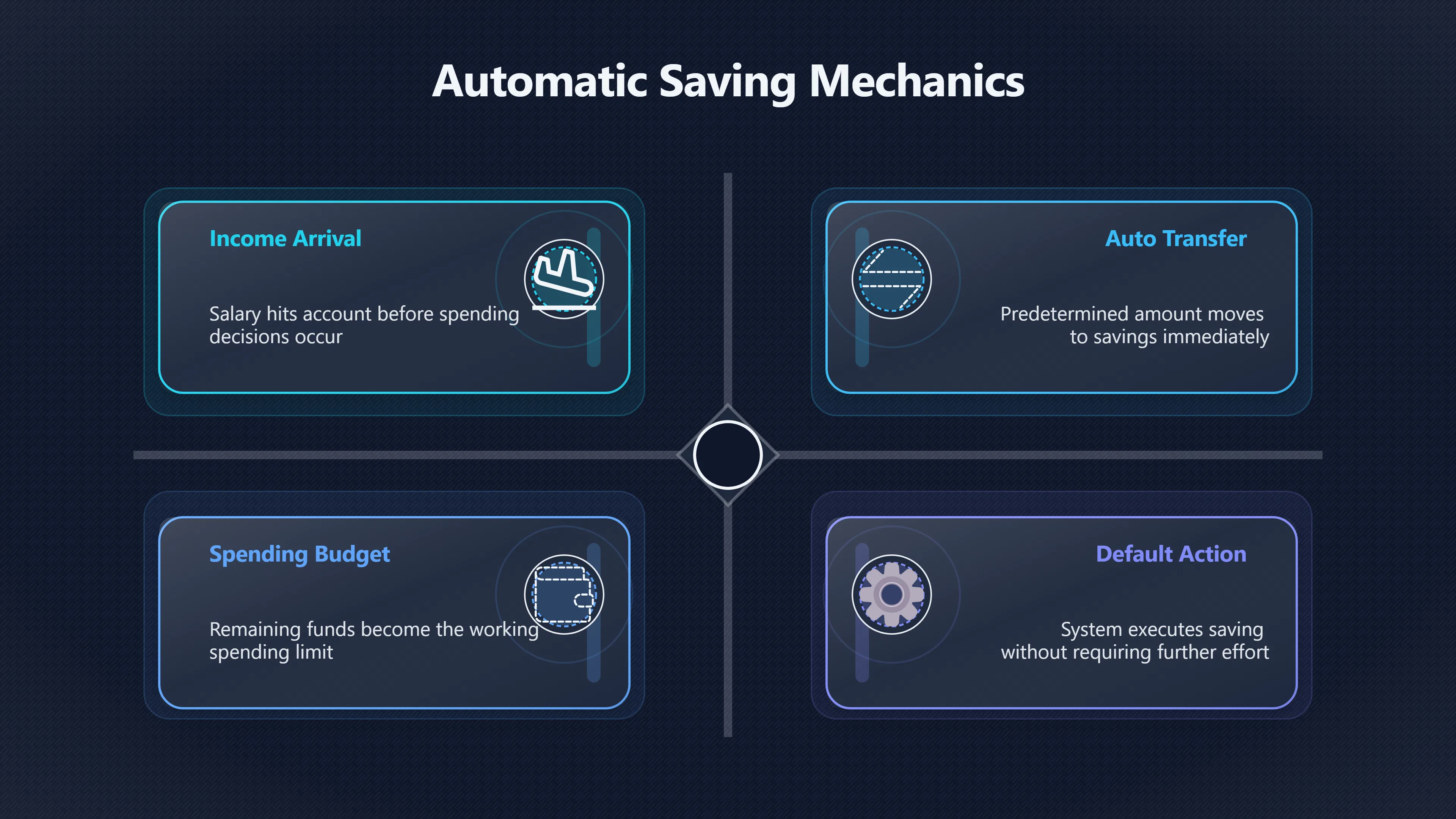
- Income arrives.
- A predetermined amount is transferred automatically.
- Remaining funds become the working spending budget.
Because the transfer happens first, saving no longer competes directly with every subsequent purchase decision.
Saving more tomorrow instead of saving more today
A common objection to automatic saving is that people fear committing to a contribution level that feels uncomfortable.
One influential solution is the “Save More Tomorrow” approach developed by Richard Thaler and Shlomo Benartzi. Instead of asking workers to sacrifice current income immediately, the programme allows them to commit in advance to increasing savings when future pay rises occur. UCLA Anderson School of Management[Clearance Verification]clear.dol.gov2004). Save More Tomorrow™: Using behavioral economics to increase employee saving. Journal of Political Economy, 112(S1), S164-S187…
The design takes advantage of a predictable behavioural pattern: agreeing to future sacrifice is often easier than accepting immediate sacrifice.
The original programme achieved unusually high participation among employees who had previously resisted increasing their contributions. Many participants remained enrolled, and savings rates rose substantially over time. Later research has continued to find benefits from automatic escalation and pre-commitment approaches.[OUP Academic]academic.oup.comOUP AcademicSave more tomorrow, today: experimental evidence on the…by CE Freeman · 2025 — The original analysis estimates participati…[Studocu]studeersnel.nlStudocuPaper 11: Week 7 - Save More Tomorrow: Behavioral…Even with this aggressive strategy of increasing saving rates, the SMarT plan…
This illustrates an important principle of environment design. The best default is not always the largest contribution. Often it is the contribution level that people will actually maintain.
When automation needs review rather than blind trust
Automatic saving is powerful, but it is not infallible.
One risk is treating a default as automatically optimal. Research has shown that many people remain at default contribution rates even when higher rates might better serve their long-term goals. In some plans, participants continue using default settings simply because changing them requires attention and effort.[SSRN]papers.ssrn.comnber w12009The Importance of Default Options for Retirement Savings…by J Beshears · 2006 · Cited by 970 — Under automatic enrollment, however…[NBER]nber.orgThe authors look at the experience of one firm that switched from standard to automatic enrollment, where only workers…Read more…
There is also evidence that automatic enrolment can produce smaller long-term gains than headline participation figures suggest. Some workers leave jobs, withdraw funds early, opt out of contribution increases or offset additional saving through borrowing. These effects do not eliminate the benefits of automation, but they show why periodic review matters.[Center for Retirement Research]crr.bc.edusavings boost from auto enrollment wanes over timeCenter for Retirement ResearchSavings Boost from Auto-Enrollment Wanes Over TimeOct 24, 2024 — The study, conducted by some of the pionee…[Becker Friedman Institute]bfi.uchicago.eduBecker Friedman Institute Smaller than We Thought?The Effect of Automatic Savings…by JJ Choi · 2024 · Cited by 23 — Across nine natural experiments, steady-state saving rates increase…
A useful rule is to automate execution while keeping strategy under review.
For example:
- Review savings rates after major income changes.
- Reassess emergency fund targets periodically.
- Check whether automatic transfers remain affordable.
- Increase contributions gradually when earnings rise.
- Ensure savings are being directed to appropriate accounts.
The goal is not blind adherence to a system. The goal is reducing the number of decisions that must be made repeatedly while preserving occasional deliberate decisions about the overall plan.

Why automatic saving fits the environment-design approach
Automatic saving demonstrates the core idea behind environment design better than almost any other financial habit.
People often assume that successful savers possess unusually strong discipline. In reality, many successful saving systems are designed so that discipline is needed less often. The money moves automatically, the default favours saving, and the environment makes the desired behaviour easier than the alternative.
When saving depends on a monthly act of resolve, every month becomes a fresh test of willpower. When saving happens automatically before spending decisions occur, the system carries much of the burden instead. That shift—from repeated self-control to well-designed defaults—is precisely why automatic saving so often works.
Amazon book picks
Further Reading
Books and field guides related to Why automatic saving beats repeated resolve. Use these as the next step if you want deeper reading beyond the article.
Atomic Habits
Rating: 3.5/5 from 7 Google Books ratings
Environment design is a central theme of the book.
I Will Teach You to Be Rich
Advocates automated financial systems rather than constant discipline.
eBay marketplace picks
Marketplace Samples
Example marketplace items related to this page. Use the search link to explore similar finds on eBay.








Endnotes
1.
Source: nber.org
Link:https://www.nber.org/system/files/working_papers/w8651/w8651.pdf
Source snippet
DEFAULT EFFECTS AND 401(K) SAVINGS BEHAVIOR...by JJ Choi · 2001 · Cited by 1065 — As a result, automatic enrollment has a dramatic i...
2.
Source: ncbi.nlm.nih.gov
Title: NCBIRetirement Benefits
Link:https://www.ncbi.nlm.nih.gov/books/NBK593519/
Source snippet
Benefits - Behavioral Economics - NCBI - NIHHowever, the authors found that making automatic enrollment the default dramatically increase...
3.
Source: papers.ssrn.com
Title: nber w12009
Link:https://papers.ssrn.com/sol3/Delivery.cfm/nber_w12009.pdf?abstractid=881243
Source snippet
The Importance of Default Options for Retirement Savings...by J Beshears · 2006 · Cited by 970 — Under automatic enrollment, however...
4.
Source: cepr.org
Title: auto enrollment changes who passive saver
Link:https://cepr.org/voxeu/columns/auto-enrollment-changes-who-passive-saver
Source snippet
Auto-enrollment changes who is a passive saverFeb 11, 2020 — A subsequent change of the default to auto-enrollment increases the part...
5.
Source: pmc.ncbi.nlm.nih.gov
Title: PMCOptimal Defaults and Active Decisions
Link:https://pmc.ncbi.nlm.nih.gov/articles/PMC2798815/
Source snippet
Under “standard enrollment,” employees are by default not enrolled and can choose to opt into the plan.Read more...
6.
Source: anderson.ucla.edu
Link:https://www.anderson.ucla.edu/documents/areas/fac/accounting/smartjpe226.pdf
Source snippet
UCLA Anderson School of ManagementUsing Behavioral Economics to Increase Employee Savingby RH Thaler · 2003 · Cited by 4362 — The program...
7.
Source: pew.org
Title: state automated savings programs
Link:https://www.pew.org/en/research-and-analysis/articles/2022/11/01/state-automated-savings-programs
Source snippet
Pew Charitable TrustsState Automated Savings ProgramsNov 1, 2022 — Research shows that workers are 15 times more likely to save for retir...
8.
Source: academic.oup.com
Link:https://academic.oup.com/rof/article/29/5/1587/8195745
Source snippet
OUP AcademicSave more tomorrow, today: experimental evidence on the...by CE Freeman · 2025 — The original analysis estimates participati...
9.
Source: papers.ssrn.com
Title: nber W8651
Link:https://papers.ssrn.com/sol3/delivery.cfm/nber_W8651.pdf?abstractid=294089
Source snippet
1. For example...Read more...
10.
Source: nber.org
Link:https://www.nber.org/bah/summer06/effect-default-options-retirement-savings
Source snippet
The authors look at the experience of one firm that switched from standard to automatic enrollment, where only workers...Read more...
11.
Source: nber.org
Link:https://www.nber.org/system/files/working_papers/w32581/revisions/w32581.rev0.pdf
Source snippet
Automating Short-Term Payroll SavingsIn the automatic enrollment arm, new members were by default enrolled to contribute £40 to the savin...
12.
Source: nber.org
Link:https://www.nber.org/reporter/2024number3/influencing-retirement-savings-decisions-automatic-enrollment-and-related-tools
Source snippet
Influencing Retirement Savings Decisions with Automatic...Oct 22, 2024 — Overall, this study suggested that 401(k) automatic enrollment...
13.
Source: papers.ssrn.com
Link:https://papers.ssrn.com/sol3/papers.cfm?abstract_id=4867445
Source snippet
Short-Term Payroll Savingsby S Holmes · 2024 · Cited by 3 — We evaluate two experiments in the UK at employers that enable workers to set...
14.
Source: anderson.ucla.edu
Link:https://www.anderson.ucla.edu/faculty/shlomo.benartzi/savemore.htm
Source snippet
More Tomorrowby RH Thaler · Cited by 4416 — The essence of the plan is straightforward: people commit in advance to allocate a portion of...
15.
Source: nationalacademies.org
Link:https://www.nationalacademies.org/read/26874/chapter/10
Source snippet
National AcademiesChapter: 6 Retirement BenefitsHowever, the authors found that making automatic enrollment the default dramatically incr...
16.
Source: journals.uchicago.edu
Link:https://www.journals.uchicago.edu/doi/10.1086/380085
Source snippet
Chicago JournalsUsing Behavioral Economics to Increase Employee SavingThe program is called Save More Tomorrow™ (or SMarT), and the basic...
17.
Source: maps.org.uk
Link:https://maps.org.uk/en/work-with-us/financial-wellbeing-in-the-workplace/payroll-deducted-saving-schemes
Source snippet
Payroll-deducted saving schemesWorkplace savings deducted from payroll can help your employees save and build financial security for...
18.
Source: nestinsight.org.uk
Link:https://www.nestinsight.org.uk/wp-content/uploads/2022/06/Payroll-savings-schemes-building-the-evidence-making-the-case-expanding-take-up.pdf
Source snippet
Payroll savings schemesPayroll savings schemes aim to help people save by automatically diverting a proportion of their salary into a sav...
19.
Source: clear.dol.gov
Link:https://clear.dol.gov/study/save-more-tomorrow%E2%84%A2-using-behavioral-economics-increase-employee-saving-thaler-benartzi-2004
Source snippet
(2004). Save More Tomorrow™: Using behavioral economics to increase employee saving. Journal of Political Economy, 112(S1), S164-S187...
20.
Source: studeersnel.nl
Link:https://www.studeersnel.nl/nl/document/rijksuniversiteit-groningen/behavioural-finance/paper-11-week-7-save-more-tomorrow-behavioral-economics-in-employee-savings/130559660
Source snippet
StudocuPaper 11: Week 7 - Save More Tomorrow: Behavioral...Even with this aggressive strategy of increasing saving rates, the SMarT plan...
21.
Source: crr.bc.edu
Title: savings boost from auto enrollment wanes over time
Link:https://crr.bc.edu/savings-boost-from-auto-enrollment-wanes-over-time/
Source snippet
Center for Retirement ResearchSavings Boost from Auto-Enrollment Wanes Over TimeOct 24, 2024 — The study, conducted by some of the pionee...
22.
Source: bfi.uchicago.edu
Title: Becker Friedman Institute Smaller than We Thought?
Link:https://bfi.uchicago.edu/wp-content/uploads/2025/08/Beshears.pdf
Source snippet
The Effect of Automatic Savings...by JJ Choi · 2024 · Cited by 23 — Across nine natural experiments, steady-state saving rates increase...
23.
Source: crr.bc.edu
Title: how helpful is auto enrollment in 401k plans
Link:https://crr.bc.edu/how-helpful-is-auto-enrollment-in-401k-plans/
Source snippet
Center for Retirement ResearchHow Much Does 401(k) Auto-Enrollment Help Workers Save...Jan 9, 2025 — The positive effect of auto-enrollm...
24.
Source: nestinsight.org.uk
Title: millions are saving more for tomorrow
Link:https://www.nestinsight.org.uk/millions-are-saving-more-for-tomorrow/
Source snippet
18 Jun 2020 — Our latest research shines a light on auto enrolment's smart design and provides strong evidence that even when a system do...
25.
Source: ifs.org.uk
Title: Automatic enrolment
Link:https://ifs.org.uk/articles/automatic-enrolment-too-successful-nudge-boost-pension-saving
Source snippet
too successful a nudge to boost...18 May 2020 — Automatic enrolment increased pension membership across all eligible employees from unde...
Published: May 2020
Additional References
26.
Source: newamerica.org
Link:https://www.newamerica.org/insights/autosave-concept-paper/
Source snippet
AutoSave Concept PaperAutoSave is a unique saving plan that automatically diverts through payroll deduction a small amount of post-tax wa...
27.
Source: troweprice.com
Link:https://www.troweprice.com/content/dam/retirement-plan-services/pdfs/insights/Auto-Enroll-2020-White-Paper.pdf
Source snippet
Auto-enrollment's Long-term effect on Retirement SavingThe research also suggests that the employees who are auto-enrolled run the risk o...
28.
Source: chicagobooth.edu
Link:https://www.chicagobooth.edu/review/behavioral-economics-retirement-savings-crisis
Source snippet
Behavioral Economics and the Retirement Savings CrisisWe argue that the solution to the problem of saving too little is automatic escalat...
29.
Source: chicagobooth.edu
Link:https://www.chicagobooth.edu/review/save-more-tomorrow
Source snippet
Booth School of BusinessSave More Tomorrow | Chicago Booth ReviewThe Save More Tomorrow plan allows employees to allocate a portion of th...
30.
Source: professionalpensions.com
Link:https://www.professionalpensions.com/analysis/2472941/-save-tomorrow-programmes
Source snippet
How 'Save More Tomorrow' programmes workJonathan Stapleton looks at how the concept of 'Save More Tomorrow' can help firms increase emplo...
31.
Source: povertyactionlab.org
Link:https://www.povertyactionlab.org/evaluation/impact-defaults-and-financial-incentives-savings-decisions-mobile-money-platform
Source snippet
The Impact of Defaults and Financial Incentives on Savings...Default assignments influence behavior: from organ donation to retirement s...
32.
Source: revfin.org
Link:https://revfin.org/save-more-tomorrow-today-experimental-evidence-on-the-role-of-[precommitment
Source snippet
Review of FinanceSave more tomorrow, today: experimental evidence on the...Our research contributes to the retirement savings literature...
33.
Source: shlomobenartzi.com
Link:https://www.shlomobenartzi.com/save-more-tomorrow
34.
Source: financialplanningassociation.org
Link:https://www.financialplanningassociation.org/learning/publications/journal/MAR24-benefits-behavioral-nudges-using-choice-architecture-improve-decisions-and-shape-outcomes-OPEN
Source snippet
The Benefits of Behavioral Nudges: Using Choice...by SJ Eckert · 2024 · Cited by 2 — Setting up a separate savings account dedicated to...
35.
Source: clear.dol.gov
Title: better or worse default effects and 401k savings behavior choi et al 2004
Link:https://clear.dol.gov/study/better-or-worse-default-effects-and-401k-savings-behavior-choi-et-al-2004
Source snippet
In addition, automatic enrollment led to a larger percentage of participants investing...Read more...
Topic Tree