Within False Progress
Does Your Goal Show Up on the Calendar?
A goal is more credible when it leaves dated traces of actions done under ordinary conditions.
On this page
- Why real change needs dated evidence
- What counts as a behavioural trace
- How to review a week without self judgment
Page outline Jump by section
Introduction
A simple question cuts through much of self-improvement theatre: if someone looked at your calendar from the past seven days, would they find evidence that the goal affected your behaviour?
 The calendar test is not a productivity system. It is a credibility check. A goal becomes more believable when it leaves dated traces of action carried out under ordinary conditions rather than existing only as intentions, plans, reading notes or motivational statements. The test does not ask whether a person cares about a goal. It asks whether the goal changed what happened on Tuesday afternoon, Thursday evening or Saturday morning.
This idea aligns with a large body of behaviour-change research showing that action planning, self-monitoring and implementation intentions help translate intentions into observable behaviour. Successful change tends to leave records of repeated actions, while unsuccessful change often leaves records of thinking about actions.[Cancer Control]cancercontrol.cancer.govCancer ControlImplementation Intentionsby PM Gollwitzer — Implementation intentions are formed for the purpose of enhancing the translati…[Cambridge University Press & Assessment]cambridge.orgUniversity Press & Assessment Monitoring Interventions (Chapter 37Cambridge University Press & AssessmentMonitoring Interventions (Chapter 37) - The Handbook of…This chapter reviews the evidence that…
Why Real Change Needs Dated Evidence
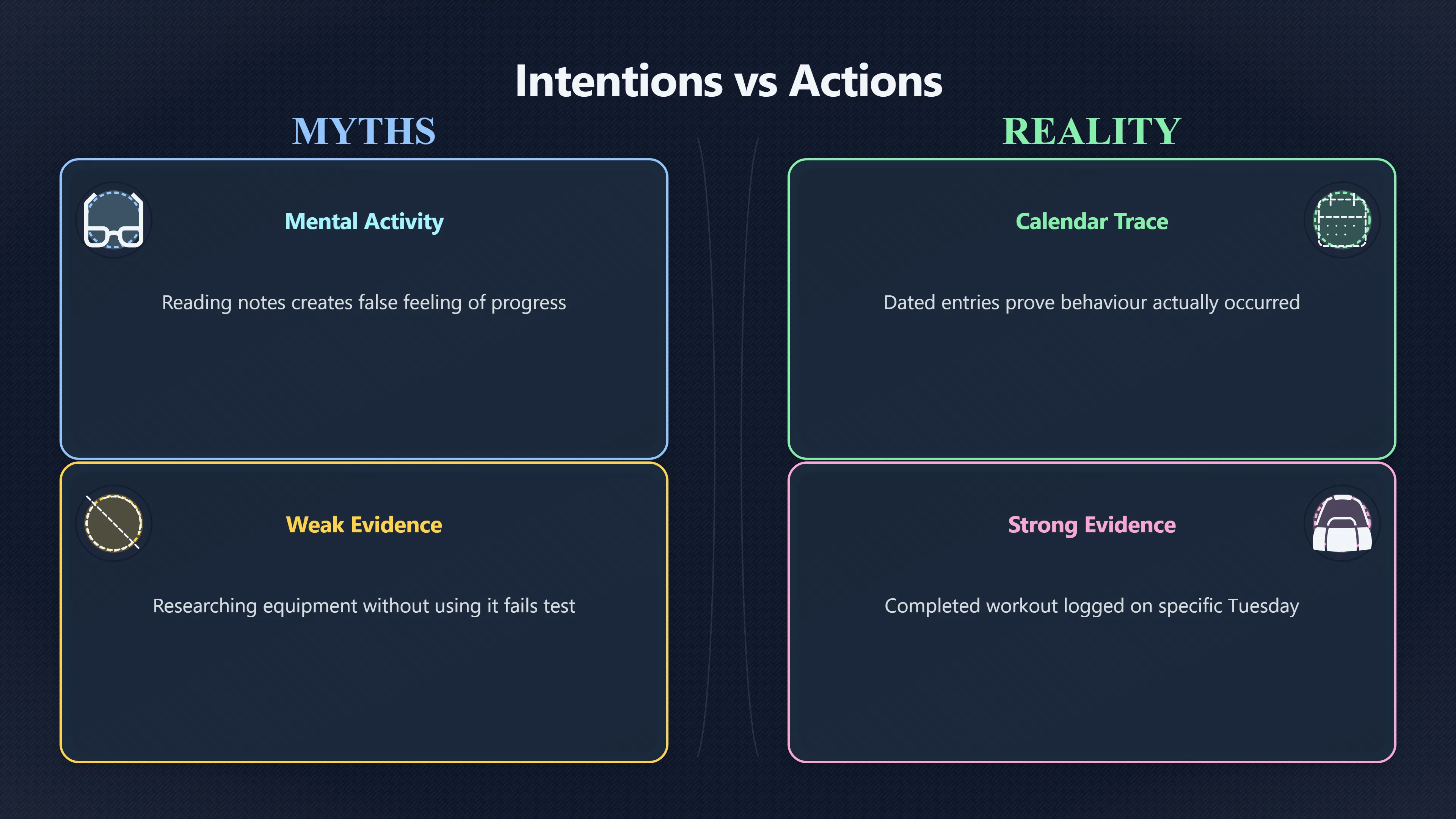
One reason self-improvement theatre is persuasive is that mental activity is easy to confuse with behavioural activity. Reading about exercise, organising a study system or redesigning a goal tracker can create a genuine feeling of progress. Yet behaviour change researchers consistently distinguish between intentions and the actions that follow from them. Implementation intentions—specific plans that connect a future situation with a concrete response—exist precisely because wanting something and doing something are not the same process.[Cancer Control]cancercontrol.cancer.govCancer ControlImplementation Intentionsby PM Gollwitzer — Implementation intentions are formed for the purpose of enhancing the translati…[PMC]pmc.ncbi.nlm.nih.govTime for Change: Using Implementation Intentions to Promote…by SA Robinson · 2018 · Cited by 71 — Implementation intentions are arg…
The calendar test makes this distinction visible. Instead of asking, “Am I serious about this goal?”, it asks:
- When did I act on it?
- How often did I act on it?
- Under what circumstances did I act on it?
- Did the action occur when life was ordinary rather than ideal?
A goal to write a book may produce calendar entries showing four writing sessions. A goal to improve fitness may produce three gym visits and two walks. A goal to strengthen relationships may produce scheduled calls, meetings or shared activities.
The point is not that every action must be formally scheduled. The point is that meaningful behavioural change tends to generate timestamps. It leaves traces in diaries, calendars, workout logs, practice records, appointments, checklists or other forms of self-monitoring. Research on self-monitoring repeatedly finds that observing and recording behaviour can support behaviour change by increasing awareness and creating feedback loops.[cambridge]cambridge.orgUniversity Press & Assessment Monitoring Interventions (Chapter 37Cambridge University Press & AssessmentMonitoring Interventions (Chapter 37) - The Handbook of…This chapter reviews the evidence that… University Press & Assessment[PMC]pmc.ncbi.nlm.nih.govThe aim of this systematic review and meta-analysis was…Read more…
A useful rule is that memories are weak evidence, while dated records are stronger evidence. People often overestimate consistency when judging themselves retrospectively. A calendar does not eliminate bias, but it reduces the room available for wishful interpretation.
What Counts as a Behavioural Trace?
The calendar test is not about filling a schedule with self-improvement activities. It is about identifying actions that would still count if nobody saw them.
A behavioural trace is evidence that a behaviour occurred at a particular time. Examples include:
- A scheduled and completed workout.
- A writing session recorded in a calendar.
- A language practice session.
- A recurring bedtime that appears consistently across the week.
- A meeting with a mentor, client or accountability partner.
- A walk taken for health rather than merely planned.
- Time blocked for deliberate practice and actually used for practice.
By contrast, these are often weak traces:
- Reading about a future habit without performing it.
- Rewriting goals repeatedly.
- Researching equipment without using it.
- Building increasingly elaborate tracking systems.
- Consuming motivational content.
Preparation is not worthless. Sometimes preparation is necessary. The calendar test simply asks whether preparation eventually produces actions that would remain visible after the preparation is removed.
For example, imagine two people who both claim to be learning a language.
The first has saved podcasts, organised flashcard apps and watched instructional videos. The second has three twenty-minute speaking sessions and four vocabulary reviews recorded across the week.
The second person’s goal has stronger behavioural evidence. The difference is not motivation. The difference is visible execution.

Why Ordinary Conditions Matter More Than Perfect Days
The strongest evidence is not what happens during a highly motivated weekend. It is what happens during an ordinary week.
Behavioural repetition in stable contexts is one of the foundations of habit formation. Habits develop through repeated performance in recurring situations, gradually reducing the need for conscious effort.[PMC]pmc.ncbi.nlm.nih.govMaking health habitual: the psychology of 'habit-formation' and…by B Gardner · 2012 · Cited by 896 — Psychological theory and evide…[PMC]pmc.ncbi.nlm.nih.govto Form a Habit: A Systematic Review and Meta-Analysis…by B Singh · 2024 · Cited by 95 — Habit formation is widely discussed across di…
For this reason, the calendar test should focus on routine conditions:
- The workday when energy is average.
- The rainy evening when enthusiasm is low.
- The week containing interruptions and obligations.
- The period after initial excitement fades.
A goal that appears only during bursts of inspiration is less robust than a goal that survives ordinary friction.
This is also why small entries matter. Fifteen minutes of writing every weekday may represent a more meaningful behavioural shift than a single five-hour writing session followed by two weeks of inactivity. Research on habit formation repeatedly emphasises repetition and consistency over dramatic effort.[PMC]pmc.ncbi.nlm.nih.govTime for Change: Using Implementation Intentions to Promote…by SA Robinson · 2018 · Cited by 71 — Implementation intentions are arg…[PMC]pmc.ncbi.nlm.nih.govThe aim of this systematic review and meta-analysis was…Read more…
The calendar test rewards recurrence rather than heroics.
How to Review a Week Without Self-Judgment
Many people turn tracking into a moral evaluation. The calendar test works better when treated as observation rather than self-criticism.
At the end of a week, review the evidence as if examining someone else’s records.
Instead of asking:
- “Was I disciplined?”
- “Was I committed enough?”
- “Why am I failing?”
Ask:
- “What behaviours actually occurred?”
- “What patterns appeared?”
- “Which plans survived contact with reality?”
- “Which intentions never became actions?”
This approach resembles the logic behind self-monitoring interventions used in behaviour-change research. Monitoring is valuable because it creates information, not because it creates guilt. Feedback helps people adjust plans, environments and expectations.[cambridge]cambridge.orgUniversity Press & Assessment Monitoring Interventions (Chapter 37Cambridge University Press & AssessmentMonitoring Interventions (Chapter 37) - The Handbook of…This chapter reviews the evidence that… University Press & Assessment[MDPI]mdpi.comImplementation of Behavior Change Theories and…by P Cotie · 2025 · Cited by 5 — Examples of these practical strategies that can be…
Suppose a person intended to exercise five times but exercised twice. The calendar test does not immediately conclude that the person lacks commitment. It asks what happened on the missed days. Were the sessions unrealistic? Were they scheduled at vulnerable times? Did competing obligations consistently interfere?
The review becomes diagnostic rather than punitive.
Turning Intentions Into Calendar Evidence
The most effective version of the test is proactive rather than retrospective.
Implementation-intention research suggests that specifying when and where an action will occur helps close the gap between intention and behaviour. Instead of “I will exercise more”, a person plans, “After work on Monday, Wednesday and Friday, I will walk for thirty minutes.”[Cancer Control]cancercontrol.cancer.govCancer ControlImplementation Intentionsby PM Gollwitzer — Implementation intentions are formed for the purpose of enhancing the translati…[Taylor & Francis Online]tandfonline.comTaylor & Francis OnlineFull article: If-then planningby M Bieleke · 2021 · Cited by 124 — They found that participants with implementatio…
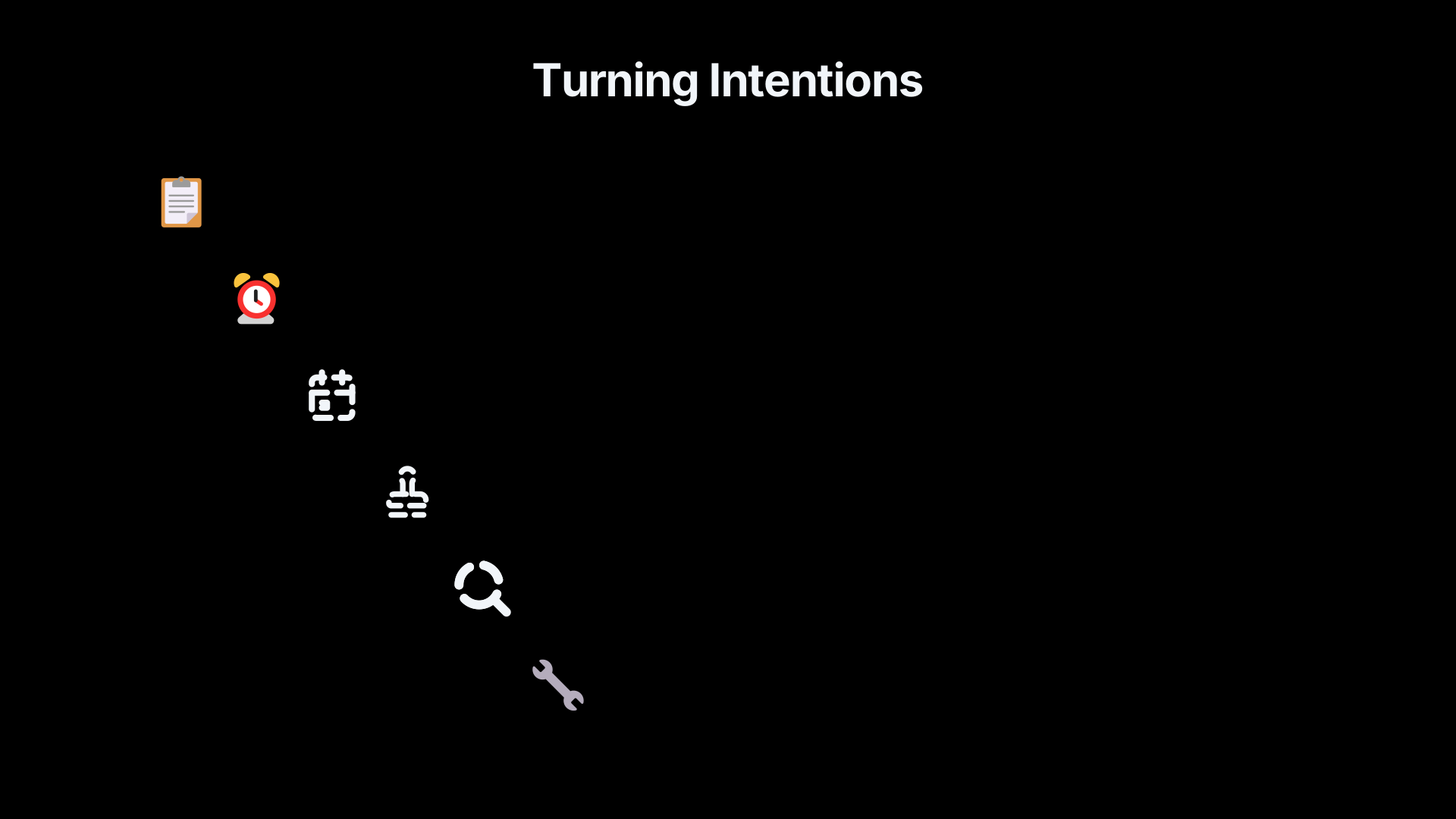
A practical sequence looks like this:
- Choose a behaviour, not an identity.
- Decide when it will happen.
- Put it on the calendar.
- Record whether it happened.
- Review the evidence after a week.
- Adjust based on reality rather than aspiration.
The key insight is that the calendar is not merely a planning tool. It is also a record of contact between intention and action.
The Question That Exposes False Progress
Many self-improvement claims collapse under a simple inspection.
Someone may say they are becoming healthier, more productive, more focused or more creative. The calendar test asks for behavioural traces rather than narratives. If a goal is changing behaviour, evidence usually exists somewhere in the week’s record.
That evidence does not need to be impressive. It only needs to be real.
A modest pattern of repeated action is often a stronger sign of progress than a dramatic story about future plans. In a culture saturated with advice, systems and optimisation, the calendar test redirects attention to the simplest indicator available: what actually happened on specific days.
When a goal consistently shows up on the calendar, it has started to move from self-improvement theatre into self-improvement that works.
Amazon book picks
Further Reading
Books and field guides related to Does Your Goal Show Up on the Calendar?. Use these as the next step if you want deeper reading beyond the article.
Atomic Habits
Rating: 3.5/5 from 7 Google Books ratings
Directly connects habits, tracking, implementation, and behavioural evidence rather than intentions.
The 7 Habits of Highly Effective People
Focuses on aligning stated priorities with calendar time and actual behaviour.
eBay marketplace picks
Marketplace Samples
Topic-anchored marketplace searches for visual, collectible, or second-hand items related to this page.



Endnotes
1.
Source: cancercontrol.cancer.gov
Link:https://cancercontrol.cancer.gov/brp/research/constructs/implementation-intentions
Source snippet
Cancer ControlImplementation Intentionsby PM Gollwitzer — Implementation intentions are formed for the purpose of enhancing the translati...
2.
Source: cambridge.org
Title: University Press & Assessment Monitoring Interventions (Chapter 37)
Link:https://www.cambridge.org/core/books/handbook-of-behavior-change/monitoring-interventions/65DD7F8EBDFC9941E42CF64A218AEA37
Source snippet
Cambridge University Press & AssessmentMonitoring Interventions (Chapter 37) - The Handbook of...This chapter reviews the evidence that...
3.
Source: mdpi.com
Link:https://www.mdpi.com/1660-4601/22/7/1133
Source snippet
Implementation of Behavior Change Theories and...by P Cotie · 2025 · Cited by 5 — Examples of these practical strategies that can be...
4.
Source: pmc.ncbi.nlm.nih.gov
Link:https://pmc.ncbi.nlm.nih.gov/articles/PMC6440859/
Source snippet
Time for Change: Using Implementation Intentions to Promote...by SA Robinson · 2018 · Cited by 71 — Implementation intentions are arg...
5.
Source: cambridge.org
Title: University Press & Assessment39
Link:https://www.cambridge.org/core/books/handbook-of-behavior-change/planning-and-implementation-intention-interventions/E1C8DA422E9BA21E7D2C4881A04898D0
Source snippet
Cambridge University Press & Assessment39 - Planning and Implementation Intention InterventionsSeveral reviews and meta-analyses have exp...
6.
Source: pmc.ncbi.nlm.nih.gov
Link:https://pmc.ncbi.nlm.nih.gov/articles/PMC6693254/
Source snippet
The aim of this systematic review and meta-analysis was...Read more...
7.
Source: pmc.ncbi.nlm.nih.gov
Link:https://pmc.ncbi.nlm.nih.gov/articles/PMC3505409/
Source snippet
Making health habitual: the psychology of 'habit-formation' and...by B Gardner · 2012 · Cited by 896 — Psychological theory and evide...
8.
Source: pmc.ncbi.nlm.nih.gov
Link:https://pmc.ncbi.nlm.nih.gov/articles/PMC11641623/
Source snippet
to Form a Habit: A Systematic Review and Meta-Analysis...by B Singh · 2024 · Cited by 95 — Habit formation is widely discussed across di...
9.
Source: mdpi.com
Link:https://www.mdpi.com/1660-4601/16/20/3806
Source snippet
The Importance of Self-Monitoring for Behavior Change in...by GM McLoughlin · 2019 · Cited by 29 — The present study tests the utility o...
10.
Source: mdpi.com
Link:https://www.mdpi.com/2071-1050/15/16/12457
Source snippet
Meta-Analysis of Implementation Intentions Interventions in...by S Peng · 2023 · Cited by 4 — This meta-analysis aims to determine the e...
11.
Source: tandfonline.com
Link:https://www.tandfonline.com/doi/full/10.1080/10463283.2020.1808936
Source snippet
Taylor & Francis OnlineFull article: If-then planningby M Bieleke · 2021 · Cited by 124 — They found that participants with implementatio...
Additional References
12.
Source: researchgate.net
Link:https://www.researchgate.net/publication/336406914_The_Importance_of_Self-Monitoring_for_Behavior_Change_in_Youth_Findings_from_the_SWITCH_R_School_Wellness_Feasibility_Study
Source snippet
The Importance of Self-Monitoring for Behavior Change in...10 Oct 2019 — Prior research has shown that self-monitoring is an effective b...
13.
Source: eprints.bournemouth.ac.uk
Link:https://eprints.bournemouth.ac.uk/37442/7/British%20J%20Health%20Psychol%20-%202022%20-%20B%20sch%20-%20What%20do%20older%20adults%20think%20about%20when%20formulating%20implementation%20intentions%20for.pdf
Source snippet
do older adults think about when formulating...by VD Bösch · 2022 · Cited by 4 — While implementation intentions were not included in th...
14.
Source: researchgate.net
Link:https://www.researchgate.net/publication/330406744_Habit_Formation_and_Behavior_Change
Source snippet
Habit Formation and Behavior Change | Request PDFSpurred by development of self-report habit measures, studies have modeled the relations...
15.
Source: researchgate.net
Link:https://www.researchgate.net/publication/272189556_Self-Monitoring_vs_Implementation_Intentions_a_Comparison_of_Behaviour_Change_Techniques_to_Improve_Sleep_Hygiene_and_Sleep_Outcomes_in_Students
Source snippet
Self-Monitoring vs. Implementation IntentionsThis study seeks to investigate and compare the efficacy of self-monitoring and implementati...
16.
Source: jamesclear.com
Link:https://jamesclear.com/implementation-intentions
Source snippet
king to our goals, whether it's writing down the exact time and date of when...Read more...
17.
Source: link.springer.com
Link:https://link.springer.com/article/10.1186/s12966-020-01001-x
Source snippet
behaviour change [techniques]({{ 'techniques/' | relative_url }}) are effective to promote...by H Schroé · 2020 · Cited by 160 — Therefore, this experimental study investigat...
18.
Source: healthline.com
Link:https://www.healthline.com/health/how-long-does-it-take-to-form-a-habit
Source snippet
Habit Formation: How Long It Takes and How to Start NowDepending on the behavior, it may become automatic for you in about [66 days]({{ '66-days/' | relative_url }})...
19.
Source: pubmed.ncbi.nlm.nih.gov
Link:https://pubmed.ncbi.nlm.nih.gov/25673110/
Source snippet
Implementation Intentionsby L Mairs · 2015 · Cited by 121 — Conclusion: Both self-monitoring and implementation intentions appear to be p...
20.
Source: thedecisionlab.com
Title: quantified self lead behaviour change
Link:https://thedecisionlab.com/insights/health/quantified-self-lead-behaviour-change
Source snippet
Does the Quantified-Self lead to behavior change?7 Nov 2017 — This article explores how these difficulties can be overcome, and highlight...
21.
Source: psychologytoday.com
Title: the science behind habit tracking
Link:https://www.psychologytoday.com/us/blog/parenting-from-a-neuroscience-perspective/202512/the-science-behind-habit-tracking
Source snippet
14 Dec 2025 — Tracking behavior increases goal success because self-monitoring itself drives change. Checkmarks trigger dopamine rewards...
Topic Tree