Within Feedback
Why Memory Is a Bad Habit Tracker
Written or visible records can reveal patterns that feelings and memory usually blur or exaggerate.
On this page
- How memory edits success and failure
- What visible records reveal about patterns
- When public or shared reporting helps
Page outline Jump by section
Introduction
A feedback loop only works if it can see reality. The problem is that memory is a poor measuring instrument. After a difficult week, people often remember only the failures. After a productive week, they may overestimate how consistent they were. Feelings, recent events and personal narratives can all distort recollection. A visible progress record—a habit tracker, training log, spending record, study diary or completed checklist—creates an external reference point that is harder to rewrite after the fact.
 This matters because self-improvement depends on adjustment. If the information feeding the adjustment process is inaccurate, the changes that follow are likely to be inaccurate too. Research on goal monitoring consistently finds that tracking progress improves goal attainment, and that the effects are stronger when progress is physically recorded rather than left in memory. Visible records help turn vague impressions into evidence that can guide the next decision.[PubMed]pubmed.ncbi.nlm.nih.govPub Med Does monitoring goal progress promote goal attainment?B Harkin · 2016 · Cited by 750 — The findings suggest that monitoring goal progress is an effective self-regulation strategy, and…
How Memory Edits Success and Failure
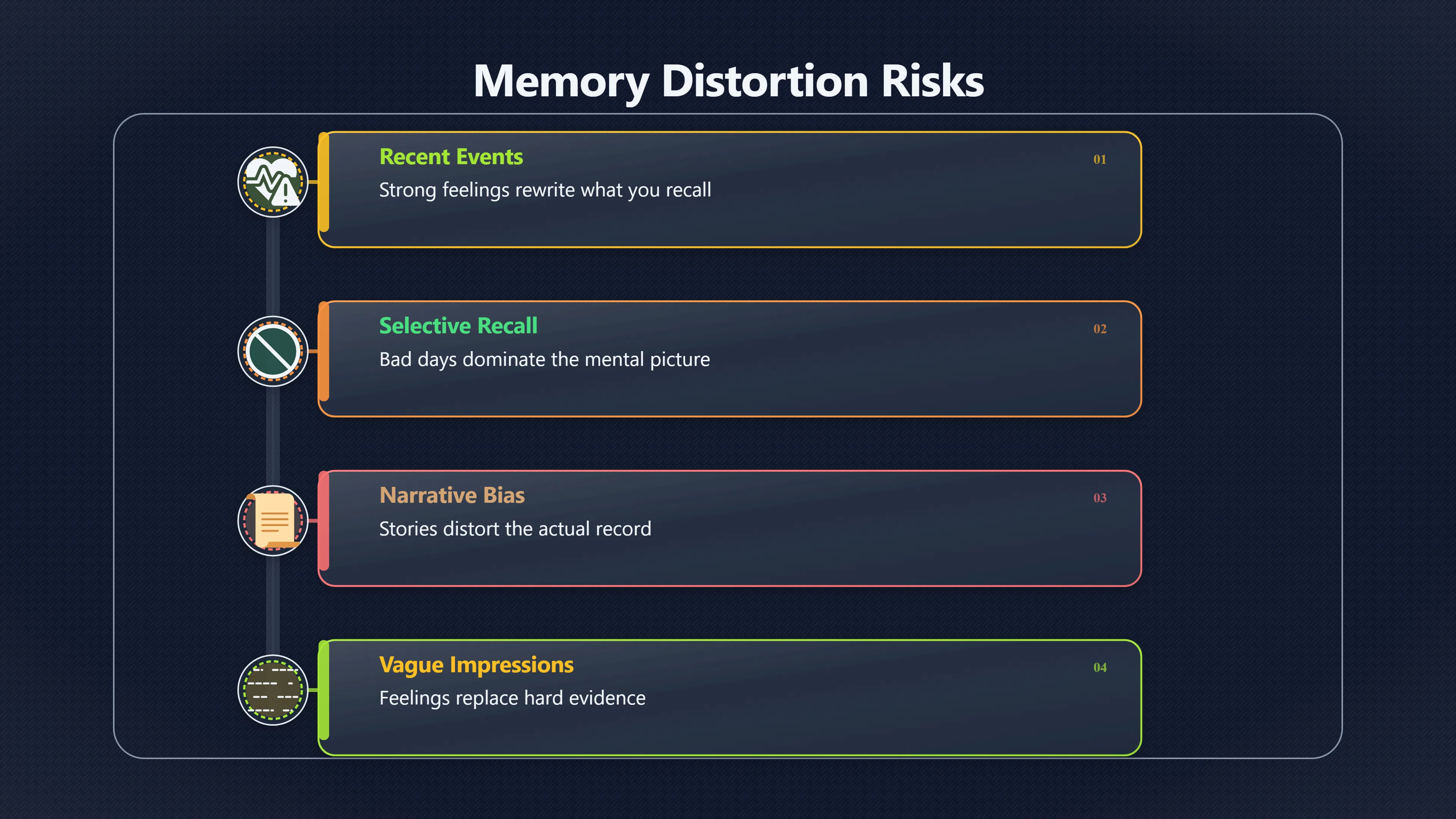
Most people assume they know how they have been doing. In practice, memory reconstructs events rather than replaying them exactly. Recent experiences, strong emotions and existing beliefs can influence what is recalled and what is forgotten.
This creates a common self-improvement problem. Someone misses three planned workouts in a row and concludes that they have “never been consistent”. A quick look at a training log may reveal that they completed sixteen workouts over the previous month and are reacting primarily to the most recent setback. The opposite error also occurs. A person may feel productive because they worked intensely for two days, while a written record shows that most of the week drifted away.
Visible records interrupt these distortions by creating a factual trace. Instead of asking, “How do I think I did?”, the question becomes, “What does the record show?” The difference is subtle but important. One relies on recollection; the other relies on evidence.
Researchers studying self-regulation have found that monitoring progress helps people compare their current state with a goal and make corrections when needed. The benefit comes from reducing uncertainty about what is actually happening.[PubMed]pubmed.ncbi.nlm.nih.govPub Med Does monitoring goal progress promote goal attainment?B Harkin · 2016 · Cited by 750 — The findings suggest that monitoring goal progress is an effective self-regulation strategy, and…
A simple record can also protect against identity-based conclusions. “I am lazy” becomes “I exercised on four of the last seven days.” The record does not eliminate disappointment, but it narrows the discussion to observable behaviour.
What Visible Records Reveal About Patterns
A single day often tells very little. Patterns emerge when behaviour is recorded repeatedly.
Consider someone trying to improve sleep. Memory may suggest that poor sleep is random. Two months of records might reveal that sleep quality drops after late caffeine, evening alcohol, or excessive screen use. The pattern was always there, but memory struggled to detect it because individual nights felt disconnected.
The same principle applies across many goals:
- A spending record may reveal that overspending happens mainly during weekends.
- A writing log may show that productivity is highest before checking email.
- A study tracker may reveal that shorter sessions occur more consistently than long ones.
- An exercise record may show that missed workouts cluster around specific work commitments.
Without records, people often explain outcomes using personality traits. With records, they can look for recurring conditions and constraints.
Research on behaviour change and habit formation increasingly relies on repeated measurement because behaviour unfolds over time and is strongly influenced by context. Tracking allows recurring cues, interruptions and environmental influences to become visible.[Taylor & Francis Online]tandfonline.comTaylor & Francis Online How does habit form?Guidelines for tracking real-world…by B Gardner · 2022 · Cited by 114 — This paper proposes methodological criteria for studies tracki…[King's College London]kclpure.kcl.ac.ukKing's College London How does habit form?Guidelines for tracking realby B Gardner · 2022 · Cited by 114 — Social psychologists are increasingly applying habit theory to study rea…
The practical value is that patterns suggest interventions. If every missed study session follows an evening commute, the problem may not be motivation. It may be timing. If workouts happen reliably when gym clothes are prepared in advance, the useful lesson is not “try harder” but “keep using the preparation routine”.
Why Written Evidence Changes Decisions
A visible record does more than improve recall. It changes how people interpret setbacks.
When no record exists, a bad day can feel representative of the entire project. When a record exists, the same bad day becomes one data point among many. This shifts attention away from emotional reactions and towards trend assessment.
For example, a runner who misses three sessions may feel as though progress has collapsed. A training log showing twenty successful sessions before those misses tells a different story. The relevant question becomes whether the recent decline is a temporary interruption or the start of a larger pattern.
This distinction is important because people often abandon goals after misinterpreting short-term fluctuations. Records help separate noise from genuine change.
The strongest evidence for progress monitoring suggests that the act of recording itself adds value. In a large meta-analysis, interventions produced larger improvements when monitored information was physically recorded rather than simply observed or remembered.[White Rose Research Online]eprints.whiterose.ac.ukModeration tests revealed that progress monitoring had larger effects on goal attainment when the outcomes were reported or made public…
A written record therefore serves two functions simultaneously:

- It preserves information that memory might lose.
- It creates a concrete object that can be reviewed and analysed later.
The second function is often overlooked. A notebook, spreadsheet or app is not merely storage. It becomes a tool for comparison across weeks and months.
What Should Be Recorded?
The most useful records usually focus on behaviour rather than identity.
A record such as “opened the writing document”, “walked 8,000 steps”, “saved £20”, or “studied for 30 minutes” is easier to interpret than a daily rating of whether someone felt disciplined or successful.
Behavioural records have several advantages:
- They are easier to define consistently.
- They are less vulnerable to mood swings.
- They point more directly towards practical adjustments.
- Different people can usually agree on whether the behaviour occurred.
The goal is not to collect endless data. Excessive tracking can become a distraction. The purpose is to record enough information to answer a useful question later.
A good test is simple: if a future review revealed an unexpected pattern, would the record help explain it? If the answer is yes, the information is probably worth keeping.
When Public or Shared Reporting Helps
Most progress records remain private, and for many people that is enough. However, evidence suggests that progress monitoring can become more effective when information is reported to others or made public in some form. Studies reviewed in the goal-monitoring literature found stronger effects when progress was reported or publicly visible compared with monitoring that remained entirely private.[White Rose Research Online]eprints.whiterose.ac.ukModeration tests revealed that progress monitoring had larger effects on goal attainment when the outcomes were reported or made public…
Several mechanisms may explain this effect.
First, reporting creates accountability. A person who knows they will review their week with a coach, colleague or friend may be more likely to maintain accurate records and follow through on planned actions.
Second, sharing reduces opportunities for selective memory. It is harder to quietly rewrite events when another person can see the same record.
Third, discussion can improve interpretation. Someone reviewing their own data may focus on failures. Another person may notice evidence of improvement that has been overlooked.
Shared reporting is not automatically beneficial. For some people it creates pressure, embarrassment or performative behaviour. Public commitment works best when the goal is learning and adjustment rather than proving worth.
The useful principle is not publicity for its own sake. It is increasing the likelihood that the record will be reviewed honestly.
The Small Record That Keeps the System Honest
Visible records are valuable because they reduce the distance between behaviour and feedback. They provide a stable reference point when emotions, assumptions and selective memory pull interpretation in different directions.
In the context of self-improvement that works, the record is not the goal. The goal is better decisions. A habit tracker, logbook, spreadsheet or checklist earns its place when it reveals something that memory alone would have missed.
The most effective feedback loops are not built on perfect recollection. They are built on evidence that remains visible after the week is over. When progress can be seen rather than merely remembered, it becomes much easier to decide what should change next.
Amazon book picks
Further Reading
Books and field guides related to Why Memory Is a Bad Habit Tracker. Use these as the next step if you want deeper reading beyond the article.
Atomic Habits
Rating: 3.5/5 from 7 Google Books ratings
Strong emphasis on visible records and habit tracking.
eBay marketplace picks
Marketplace Samples
Example marketplace items related to this page. Use the search link to explore similar finds on eBay.


Endnotes
1.
Source: pubmed.ncbi.nlm.nih.gov
Title: Pub Med Does monitoring goal progress promote goal attainment?
Link:https://pubmed.ncbi.nlm.nih.gov/26479070/
Source snippet
B Harkin · 2016 · Cited by 750 — The findings suggest that monitoring goal progress is an effective self-regulation strategy, and...
2.
Source: eprints.whiterose.ac.uk
Link:https://eprints.whiterose.ac.uk/id/eprint/87431/1/bul
Source snippet
Moderation tests revealed that progress monitoring had larger effects on goal attainment when the outcomes were reported or made public...
3.
Source: tandfonline.com
Title: Taylor & Francis Online How does habit form?
Link:https://www.tandfonline.com/doi/full/10.1080/23311908.2022.2041277
Source snippet
Guidelines for tracking real-world...by B Gardner · 2022 · Cited by 114 — This paper proposes methodological criteria for studies tracki...
4.
Source: kclpure.kcl.ac.uk
Title: King’s College London How does habit form?
Link:https://kclpure.kcl.ac.uk/portal/files/171110819/How_does_habit_form_GARNDER_Publishedonline22Feb2022GOLD_VoR_CC_BY.pdf
Source snippet
Guidelines for tracking realby B Gardner · 2022 · Cited by 114 — Social psychologists are increasingly applying habit theory to study rea...
5.
Source: researchgate.net
Title: Research Gate Does Monitoring Goal Progress Promote Goal Attainment?
Link:https://www.researchgate.net/publication/291335719_Does_Monitoring_Goal_Progress_Promote_Goal_Attainment_A_Meta-Analysis_of_the_Experimental_Evidence
Source snippet
Moderation tests revealed that progress monitoring had larger effects on goal attainment when the outcomes were reported or made public...
6.
Source: psychiatry.ucsd.edu
Title: goal progress
Link:https://psychiatry.ucsd.edu/research/programs-centers/instep/tools-resource/definitions/team-processes/action-phase/goal-progress.html
Source snippet
Progress MonitoringTracking task and progress toward mission accomplishment, interpreting system information in terms of what needs to be...
Additional References
7.
Source: eprints.whiterose.ac.uk
Title: whiterose.ac.uk Does Monitoring Goal Progress Promote Goal Attainment?
Link:https://eprints.whiterose.ac.uk/id/eprint/87431/1/bul%20harkin%20raw%20final.pdf
Source snippet
by B Harkin · 2016 · Cited by 750 — A meta-analysis of 47 experimental studies found that a medium-to-large-sized change in intentions ha...
8.
Source: annualreviews.org
Link:https://www.annualreviews.org/content/journals/10.1146/annurev-psych-020821-011744
Source snippet
Attitudes, Habits, and Behavior Changeby B Verplanken · 2022 · Cited by 552 — Beyond self-tracking and [reminders]({{ 'reminders/' | relative_url }}): designing smartphone ap...
9.
Source: habitcompanion.com
Link:https://habitcompanion.com/how-to-track-your-progress/
Source snippet
Harkin et al.'s meta-analysis of 100+ studies with 20000 participants reveals that writing...
10.
Source: semanticscholar.org
Title: Does monitoring goal progress promote goal attainment?
Link:https://www.semanticscholar.org/paper/Does-monitoring-goal-progress-promote-goal-A-of-the-Harkin-Webb/71c6265bf7a8ded9084ff21a417cd63d6f4119ea
Source snippet
findings suggest that monitoring goal progress is an effective self-regulation strategy, and that interventions that increase th...
11.
Source: facebook.com
Link:https://www.facebook.com/groups/iepeduc/posts/1224117229775130/
Source snippet
ict to report/provide data on just the goal or the goals and the objectives...
12.
Source: americanprogress.org
Title: a new vision for school accountability
Link:https://www.americanprogress.org/article/a-new-vision-for-school-accountability/
Source snippet
3 Mar 2017 — This report presents a framework for school accountability systems that achieve college and career readiness for all student...
13.
Source: sciencedirect.com
Link:https://www.sciencedirect.com/science/article/pii/S1364661324002663
Source snippet
Leveraging cognitive neuroscience for making and...by EK Buabang · 2025 · Cited by 47 — In real-life settings, habit formation typically...
14.
Source: unesdoc.unesco.org
Link:https://unesdoc.unesco.org/ark%3A/48223/pf0000259338
Source snippet
in education: meeting our commitmentsAround half of countries have produced a national education monitoring report analysing progress...
15.
Source: researchgate.net
Title: How does habit form?
Link:https://www.researchgate.net/publication/358786633_How_does_habit_form_Guidelines_for_tracking_real-world_habit_formation
Source snippet
Guidelines for tracking real-world...7 Feb 2022 — This paper proposes methodological criteria for studies tracking real-world habit form...
16.
Source: scienceforwork.com
Link:https://scienceforwork.com/blog/goal-monitoring/
Source snippet
Goal Monitoring: Why it pays to keep your eye on the prize.5 Jun 2017 — Benjamin Harkin and colleagues undertook a meta-analysis that loo...
Topic Tree