Within Goals vs Systems
Why Habits Do Not Obey a Countdown
Habit formation is not a fixed countdown, so systems should be designed for variable repetition rather than perfect streaks.
On this page
- What the habit formation study actually showed
- Why automaticity varies by behaviour
- Designing for returns after missed days
Page outline Jump by section
Introduction
The idea that a habit forms after a fixed number of days is one of the most persistent myths in self-improvement. The modern version usually claims that habits take 66 days to form. That sounds more scientific than the older “21-day rule”, but it still compresses a much messier reality into a simple countdown. The evidence behind the famous number does not show that habits automatically lock in on day 66. Instead, it shows that automaticity—the feeling that a behaviour happens with less conscious effort—develops gradually through repetition, and the speed varies enormously between people and behaviours. For anyone interested in self-improvement that works, the practical lesson is not to count down to a magic date. It is to design systems that make repetitions easier, because repetitions—not streak length—drive habit formation.[Wiley Online Library]onlinelibrary.wiley.comWiley Online LibraryHow are habits formed: Modelling habit formation in the…by P Lally · 2010 · Cited by 3454 — Three examples of incr…

What the habit formation study actually showed
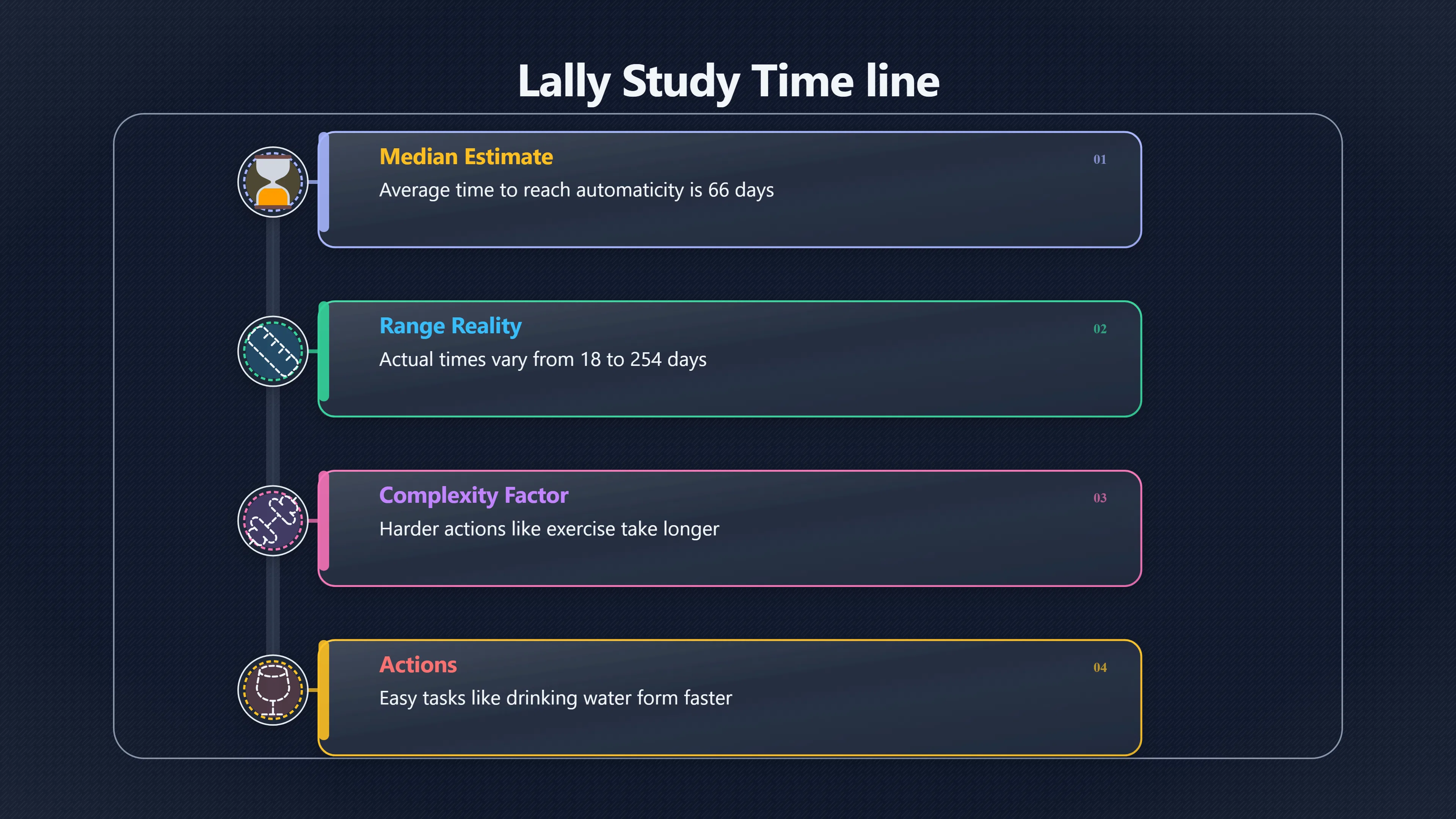
The famous 66-day figure comes from a study led by Phillippa Lally and colleagues at University College London. Participants chose a simple health-related behaviour, such as drinking water with lunch or performing an exercise routine, and repeated it in response to a consistent cue. Researchers tracked how automatic the behaviour felt over time.[Wiley Online Library]onlinelibrary.wiley.comWiley Online LibraryHow are habits formed: Modelling habit formation in the…by P Lally · 2010 · Cited by 3454 — Three examples of incr…
What became popular in self-improvement culture was the number 66. What the study actually found was more interesting.
The researchers modelled the growth of automaticity and estimated that the median time required to reach near-maximum automaticity was 66 days. However, individual results ranged from 18 days to 254 days. In other words, the average concealed enormous variation. Some behaviours became relatively automatic within a few weeks, while others took many months.[Wiley Online Library]onlinelibrary.wiley.comWiley Online LibraryHow are habits formed: Modelling habit formation in the…by P Lally · 2010 · Cited by 3454 — Three examples of incr…[University of Surrey]surrey.ac.ukdoes it really take 66 days form habit we asked expert dr pippa lallyUniversity of SurreyDoes it really take 66 days to form a habit?Jan 21, 2026 — The average time it took for the participants in my study…
This distinction matters because popular habit advice often treats 66 days as a target date. The original research treated it as a statistical summary. The study was not saying that everyone needs exactly 66 days, nor that a behaviour becomes permanently established on the sixty-sixth repetition. It showed a gradual curve of increasing automaticity that eventually levelled off.[Wiley Online Library]onlinelibrary.wiley.comWiley Online LibraryHow are habits formed: Modelling habit formation in the…by P Lally · 2010 · Cited by 3454 — Three examples of incr…
The misunderstanding resembles the earlier “21-day habit” claim. That number originated from observations by plastic surgeon Maxwell Maltz about adjustment periods after life changes, not from controlled habit-formation research. The 66-day figure is grounded in actual behavioural data, but it becomes misleading when turned into another universal countdown.[aftertone.io]aftertone.ioMissing a single day has no meaningfulHabit Formation: It Takes 66 Days, Not 21 - AftertoneThe median time for a new behaviour to become automatic is 66 days, ranging from 18…
Why automaticity varies by behaviour
The most important finding from the study was not the average. It was the variability.
Simple behaviours tied to an existing routine tend to become automatic more quickly. Drinking a glass of water after lunch requires little effort, few steps and a stable cue. More demanding behaviours, such as exercise routines, involve greater physical effort, preparation and potential disruption from everyday life. As complexity rises, automaticity generally develops more slowly.[Peter H Brown Clinical Psychologist]peterhbrownpsych.comPeter H Brown Clinical PsychologistIt Takes HOW Long to Form a Habit?: Research Shows a…Oct 8, 2009 — Although the average was 66 days…
Habit formation also follows a diminishing-returns pattern rather than a straight line. Early repetitions produce large gains in familiarity and ease. Later repetitions still help, but each additional performance contributes less than the previous one. Researchers described this as an asymptotic curve: automaticity rises rapidly at first and then gradually approaches a plateau.[Wiley Online Library]onlinelibrary.wiley.comWiley Online LibraryHow are habits formed: Modelling habit formation in the…by P Lally · 2010 · Cited by 3454 — Three examples of incr…
This explains why two people can perform the same behaviour for the same number of days yet report different experiences. Factors that influence the speed of habit formation include:
- The complexity of the behaviour.[aftertone.io]aftertone.ioMissing a single day has no meaningfulHabit Formation: It Takes 66 Days, Not 21 - AftertoneThe median time for a new behaviour to become automatic is 66 days, ranging from 18…
- How consistently it occurs in the same context.
- The amount of effort required.
- Prior experience with similar routines.
- How rewarding or enjoyable the activity feels.
- The frequency of opportunities to repeat it. PMC[Scientific American]scientificamerican.comhow long does it really take to form a habit?24 Jan 2024 — A hallmark 2009 study on habit creation found that habits developed in a range of 18 to 254 days; participants reported ta…
More recent reviews reinforce this conclusion. A 2024 systematic review found that estimates of habit-formation time vary substantially across studies, with reported medians often around 59–66 days but average values extending beyond 100 days in some contexts. The central finding is not a universal timeline but substantial variation.[PMC]pmc.ncbi.nlm.nih.govTime to Form a Habit: A Systematic Review and Meta-Analysis…by B Singh · 2024 · Cited by 88 — Four studies reported the median or m…

Why counting days can undermine progress
Countdown thinking creates a hidden problem. It encourages people to treat habit formation as a finish line rather than a process.
Someone who believes a habit should feel automatic after 66 days may become discouraged when effort is still required after two months. They conclude that the habit “didn’t stick” when, in reality, their experience may be completely normal. The original research never promised a uniform timeline.[University of Surrey]surrey.ac.ukdoes it really take 66 days form habit we asked expert dr pippa lallyUniversity of SurreyDoes it really take 66 days to form a habit?Jan 21, 2026 — The average time it took for the participants in my study…
Countdowns also encourage excessive attention to streaks. A person may focus more on protecting an unbroken chain of days than on building a repeatable system. When the streak eventually breaks—as most do—the psychological setback can be larger than the behavioural setback.
The research points in a different direction. Habit strength develops through repeated performances in a consistent context. The key variable is accumulated repetition, not the symbolic achievement of reaching a particular calendar date.[Wiley Online Library]onlinelibrary.wiley.comWiley Online LibraryHow are habits formed: Modelling habit formation in the…by P Lally · 2010 · Cited by 3454 — Three examples of incr…
Designing for returns after missed days
One of the most useful findings from the original study receives far less attention than the 66-day headline: missing a single opportunity did not significantly disrupt habit formation. Participants did not lose all progress because of one lapse.[Wiley Online Library]onlinelibrary.wiley.comWiley Online LibraryHow are habits formed: Modelling habit formation in the…by P Lally · 2010 · Cited by 3454 — Three examples of incr…
This finding supports a systems-design approach rather than a streak-preservation approach.
A goal-centred mindset often frames a missed day as failure. A systems mindset asks a different question: how quickly can the behaviour return? The objective is not perfection. The objective is reducing the friction of restarting.
Practical implications include:
- Design recovery cues. Decide in advance what happens after a missed day.
- Keep behaviours small enough to repeat. A smaller action performed consistently usually produces more repetitions than an ambitious action that is frequently abandoned.
- Measure repetitions, not calendar milestones. Tracking completed instances often reflects progress more accurately than counting days.
- Expect variability. Harder habits may require many more repetitions before they feel natural.
- Treat lapses as interruptions, not resets. One missed performance does not erase previous learning. Wiley Online Library[2melaniejwhite.com]melaniejwhite.comE#209 How Long Does It Take to Form a Habit?Melanie WhiteThe time it took to form the habit and for it to become largely automatic was 18 – 254 days, with an average of 66 days (9.5…
The broader lesson for self-improvement is that systems should be built around reliable returns. If a habit survives disruption and resumes quickly, it can continue accumulating repetitions over months and years. A fragile streak may look impressive, but a resilient return process is usually more valuable.

The real takeaway from the 66-day story
The history of habit advice shows a recurring pattern. A complex behavioural finding becomes a simple number. First it was 21 days. Then it was 66 days. Both numbers are remembered because they are easy; the underlying evidence is forgotten because it is more complicated.[aftertone.io]aftertone.ioMissing a single day has no meaningfulHabit Formation: It Takes 66 Days, Not 21 - AftertoneThe median time for a new behaviour to become automatic is 66 days, ranging from 18…
What the research actually suggests is that habits do not obey a countdown. Automaticity emerges gradually through repeated behaviour in a stable context, and the timeline can differ dramatically from one behaviour or person to another. The most effective systems therefore focus on making the next repetition likely, not on reaching a predetermined day on the calendar. When habit formation is viewed as a process of accumulating repetitions rather than surviving a countdown, missed days become less threatening and long-term consistency becomes easier to sustain.[Wiley Online Library]onlinelibrary.wiley.comWiley Online LibraryHow are habits formed: Modelling habit formation in the…by P Lally · 2010 · Cited by 3454 — Three examples of incr…[PMC]pmc.ncbi.nlm.nih.govLally P, van Jaarsveld CHM, Potts HWW, Wardle J. How are habits formedMaking health habitual: the psychology of 'habit-formation' and…by B Gardner · 2012 · Cited by 847 — More relevant research found t…
Amazon book picks
Further Reading
Books and field guides related to Why Habits Do Not Obey a Countdown. Use these as the next step if you want deeper reading beyond the article.
Atomic Habits
Rating: 3.5/5 from 7 Google Books ratings
Directly explains habit formation as systems and repetition rather than countdowns.
Tiny Habits
Focuses on small repetitions and behaviour design rather than fixed timelines.
eBay marketplace picks
Marketplace Samples
Example marketplace items related to this page. Use the search link to explore similar finds on eBay.




Endnotes
1.
Source: onlinelibrary.wiley.com
Link:https://onlinelibrary.wiley.com/doi/10.1002/ejsp.674
Source snippet
Wiley Online LibraryHow are habits formed: Modelling habit formation in the...by P Lally · 2010 · Cited by 3454 — Three examples of incr...
2.
Source: aftertone.io
Title: Missing a single day has no meaningful
Link:https://www.aftertone.io/science/habit-formation-timeline-66-days-not-21
Source snippet
Habit Formation: It Takes 66 Days, Not 21 - AftertoneThe median time for a new behaviour to become automatic is 66 days, ranging from 18...
3.
Source: pmc.ncbi.nlm.nih.gov
Link:https://pmc.ncbi.nlm.nih.gov/articles/PMC11641623/
Source snippet
Time to Form a Habit: A Systematic Review and Meta-Analysis...by B Singh · 2024 · Cited by 88 — Four studies reported the median or m...
4.
Source: pmc.ncbi.nlm.nih.gov
Title: Lally P, van Jaarsveld CHM, Potts HWW, Wardle J. How are habits formed
Link:https://pmc.ncbi.nlm.nih.gov/articles/PMC3505409/
Source snippet
Making health habitual: the psychology of 'habit-formation' and...by B Gardner · 2012 · Cited by 847 — More relevant research found t...
5.
Source: melaniejwhite.com
Title: E#209 How Long Does It Take to Form a Habit?
Link:https://melaniejwhite.com/how-long-form-habit/
Source snippet
Melanie WhiteThe time it took to form the habit and for it to become largely automatic was 18 – 254 days, with an average of 66 days (9.5...
6.
Source: onlinelibrary.wiley.com
Link:https://onlinelibrary.wiley.com/doi/abs/10.1002/ejsp.674
Source snippet
are habits formed: Modelling habit formation in the...by P Lally · 2010 · Cited by 3454 — To investigate the process of habit formation...
7.
Source: surrey.ac.uk
Title: does it really take 66 days form habit we asked expert dr pippa lally
Link:https://www.surrey.ac.uk/news/does-it-really-take-66-days-form-habit-we-asked-expert-dr-pippa-lally
Source snippet
University of SurreyDoes it really take 66 days to form a habit?Jan 21, 2026 — The average time it took for the participants in my study...
8.
Source: scientificamerican.com
Title: how long does it really take to form a habit
Link:https://www.scientificamerican.com/article/how-long-does-it-really-take-to-form-a-habit/
Source snippet
?24 Jan 2024 — A hallmark 2009 study on habit creation found that habits developed in a range of 18 to 254 days; participants reported ta...
9.
Source: peterhbrownpsych.com
Link:https://peterhbrownpsych.com/2009/10/08/it-takes-how-long-to-form-a-habit-research-shows-a-curved-relationship-between-practice-and-automaticity/
Source snippet
Peter H Brown Clinical PsychologistIt Takes HOW Long to Form a Habit?: Research Shows a...Oct 8, 2009 — Although the average was 66 days...
10.
Source: Wikipedia
Link:https://en.wikipedia.org/wiki/Automaticity
Source snippet
Automaticity - WikipediaHabit Formation: It Takes 66 Days, Not 21 - Aftertone...
11.
Source: vocabulary.com
Link:https://www.vocabulary.com/dictionary/lally
Source snippet
Definition, [Meaning]({{ 'meaning/' | relative_url }}) & Synonymssupport column consisting of a steel cylinder filled with concrete. synonyms: lally column. see moresee les...
Additional References
12.
Source: loggd.life
Link:https://loggd.life/tools/habit-formation-calculator
Source snippet
How Long to Form a Habit? 66-Day CalculatorBased on Phillippa Lally's UCL study: calculate your personal habit timeline (18-254 days). En...
13.
Source: merriam-webster.com
Link:https://www.merriam-webster.com/dictionary/Lally
Source snippet
LALLY Definition & MeaningThe meaning of LALLY is a concrete-filled cylindrical steel structural column —formerly a U.S. registered trade...
14.
Source: nypost.com
Link:https://nypost.com/2025/01/26/lifestyle/the-length-of-time-it-takes-to-make-a-new-habit-stick-study/
Source snippet
Their study, published in the journal Healthcare, analyzed data from over 2,500 participants across 20 studies. While some individuals fo...
15.
Source: mentalzon.com
Title: 66 days to build a new habit why it’s not a myth but real habit psychology
Link:https://mentalzon.com/en/post/7770/66-days-to-build-a-new-habit-why-it%E2%80%99s-not-a-myth-but-real-habit-psychology
Source snippet
66 Days to Build a New Habit: Why It's Not a Myth, But Real...Nov 1, 2025 — In 2009, a team of European psychologists led by Phillippa L...
16.
Source: jamesclear.com
Title: James Clear How Long Does it Take to Form a Habit?
Link:https://jamesclear.com/new-habit
Source snippet
Backed by Science.On average, it takes more than 2 months before a new behavior becomes automatic — 66 days to be exact. And how long it...
17.
Source: getmotivated.ai
Title: how are habits formed modelling habit formation in the real world 6eadadb6
Link:https://getmotivated.ai/sources/how-are-habits-formed-modelling-habit-formation-in-the-real-world-6eadadb6
Source snippet
A 2009 UCL study by Phillippa Lally found the real range is 18 to 254 days, depending on...Read more...
18.
Source: bulletproofmusician.com
Title: how long does it really take to form a new habit
Link:https://bulletproofmusician.com/how-long-does-it-really-take-to-form-a-new-habit/
Source snippet
?Nov 24, 2019 — On average, it took about 66 days for the participants' new behaviors to become a habit (ie for their habit strength scor...
19.
Source: studocu.vn
Link:https://www.studocu.vn/vn/document/truong-dai-hoc-ngoai-ngu-dai-hoc-da-nang/ngon-ngu-anh/modelling-habit-formation-insights-from-eur-j-soc-psychol-40-2010/157504686
Source snippet
consistent behavior repetition leads to increased automaticity over time...
20.
Source: eated.io
Link:https://eated.io/blog/how-long-does-it-take-to-build-a-healthy-eating-habit
Source snippet
w habit takes anywhere from 18 to 254 days, with an average of 66 days...
21.
Source: medium.com
Link:https://medium.com/%40claticivg/why-the-66-day-habit-installation-rule-is-a-myth-and-what-you-should-do-instead-e607bf5e6e5d
Source snippet
is sample was 66 days, but the range was from 18 to 254 days.Read more...
Topic Tree