Within Willpower
Stop Renegotiating the Same Good Choice
Defaults turn repeated decisions into pre-made answers, leaving less room for tired mood-based bargaining.
On this page
- Why repeated choices drain plans
- Default meals, money and study slots
- When a default needs a review
Page outline Jump by section
Introduction
Many self-improvement plans fail because they ask for the same decision over and over again. Each morning you decide whether to exercise. Each lunch break you decide what to eat. Each payday you decide whether to save. When energy, mood or attention are low, these decisions stop being simple choices and become negotiations with yourself.
 A more reliable approach is to create defaults: pre-made answers that take effect unless there is a good reason to change them. Defaults reduce the number of decisions that must be made under pressure. Instead of relying on willpower to win the same argument every day, you decide once and let the decision repeat automatically. Research on choice architecture and default effects shows that people strongly tend to follow pre-selected options, making defaults one of the most powerful tools for turning intentions into consistent behaviour.[BehavioralEconomics.com | The BE Hub]behavioraleconomics.comdefault optionsettingThe BE HubDefault (option/setting)4 Dec 2024 — Default options are pre-set courses of action that take effect if nothing is specified by…[Cambridge University Press & Assessment]cambridge.orgCambridge University Press & AssessmentWhen and why defaults influence decisions: a meta…by JONM JACHIMOWICZ · 2019 · Cited by 675 — O…
Why Repeated Choices Drain Plans
Within the broader idea that willpower should be a backup rather than the main engine of change, defaults solve a specific problem: repeated decision-making.
Every recurring choice creates an opportunity for delay, bargaining and exceptions. The question is rarely, “Should I abandon this goal forever?” More often it becomes, “Should I skip just today?” That conversation may happen dozens of times a week.
Research on decision fatigue suggests that the quality of decisions can deteriorate after long periods of choosing and evaluating options. Planning, self-regulation and consistent follow-through become harder when mental resources are stretched.[PMC]pmc.ncbi.nlm.nih.govPMCThe effectiveness of nudging: A meta-analysis of choiceby S Mertens · 2021 · Cited by 1053 — Our results show that choice architecture interventions overall promote behavior change with a s…[The Decision Lab]thedecisionlab.comThe Paradox of ChoiceResearchers Polman and Vohs suggest this is because decision fatigue reduces our self-regulatory resources, which ar…
The practical consequence is that a habit requiring constant fresh decisions is fragile. A habit supported by defaults is more stable because fewer decisions occur in the first place.
Consider two approaches:
- Choice-based approach: Decide every evening whether to study.
- Default-based approach: Study from 7 pm to 8 pm on weekdays unless a specific reason prevents it.
The second approach does not eliminate freedom. It simply changes the burden of proof. Instead of deciding whether to act, you act unless there is a reason not to.
This shift sounds small, but it changes the psychology of execution. The behaviour becomes normal rather than negotiable.
Default Meals, Money and Study Slots
Defaults work best when they govern recurring situations that produce repeated internal debates.
Meals
Food decisions often occur when people are hungry, busy or distracted. These are poor conditions for thoughtful planning.
A useful default might be:
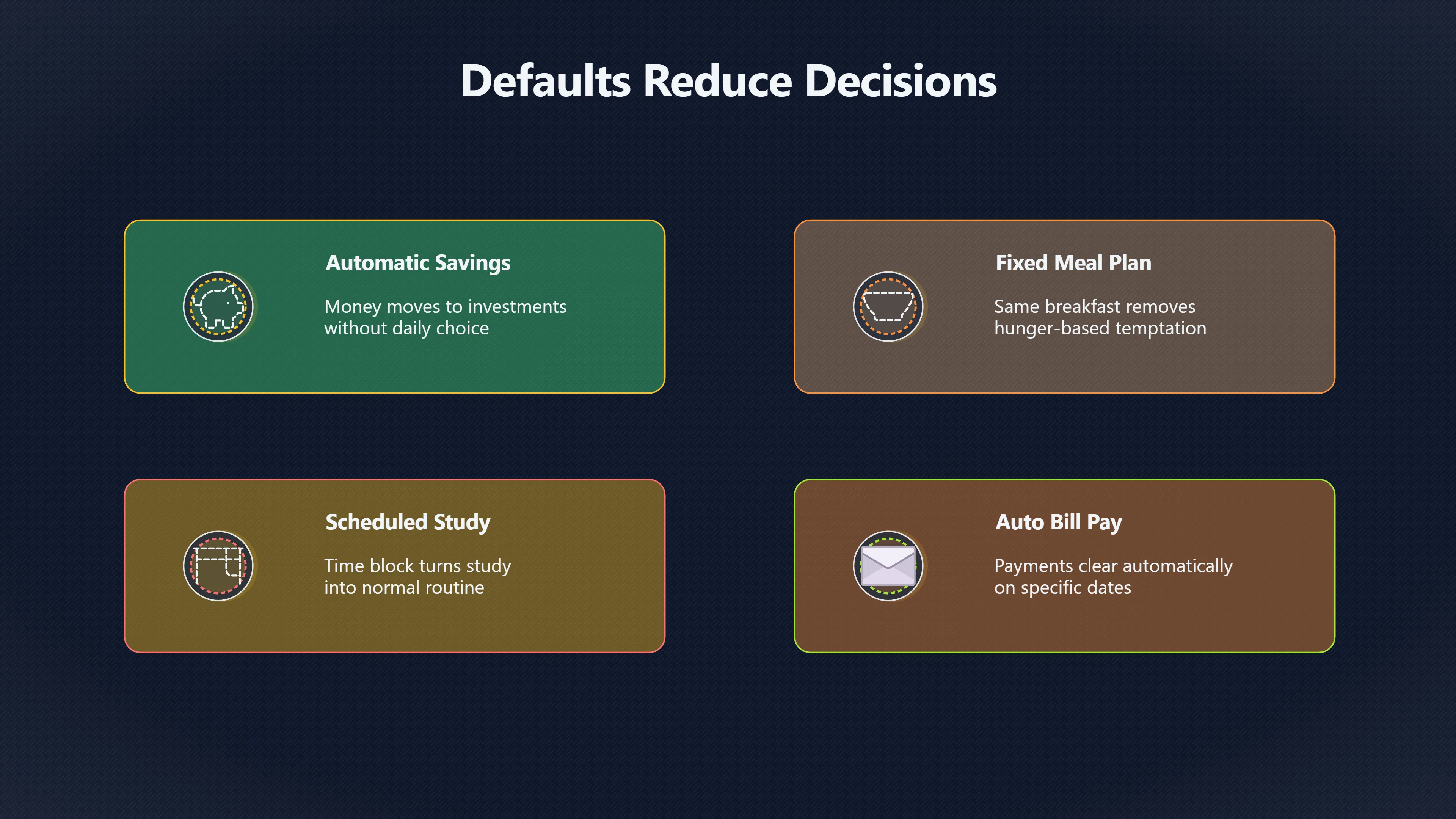
- The same breakfast on workdays.
- A standard packed lunch.
- A short list of approved evening meals rotated through the week.
The goal is not dietary perfection. The goal is to remove dozens of low-value decisions that repeatedly tempt people into convenience choices they later regret.
Many high performers and athletes use simplified meal routines for exactly this reason. The benefit is not that the chosen meal is magically superior. The benefit is that the decision no longer consumes attention.[Real Simple]realsimple.comMental health professionals describe how even simple choices, like what to wear or what to eat, can drain cognitive resources and impair…
Money
Personal finance provides some of the clearest evidence for the power of defaults.
Automatic enrolment into retirement savings plans dramatically increases participation compared with systems that require people to opt in. Studies of automatic enrolment and related programmes such as Save More Tomorrow show that changing the default can produce large and persistent increases in saving behaviour without removing individual choice.[The Decision Lab]thedecisionlab.comThe Paradox of ChoiceResearchers Polman and Vohs suggest this is because decision fatigue reduces our self-regulatory resources, which ar…[UCLA Anderson School of Management]anderson.ucla.eduUCLA Anderson School of ManagementUsing Behavioral Economics to Increase Employee Saving.by RH Thaler · 2003 · Cited by 4400 — In this pa…
The lesson for personal improvement is straightforward:
- Save automatically on payday.
- Move money into investments automatically.
- Pay important bills automatically.
Each automation removes a recurring negotiation. Instead of repeatedly deciding whether to save this month, the default answer is already in place.
Study and Deep Work
Many people believe motivation creates productive study sessions. In practice, consistency often comes from making study the default use of a specific time block.
Examples include:
- Reading from 8 am to 8:30 am every weekday.
- Language practice during a lunch break.
- Coursework from 7 pm to 8 pm on Tuesdays and Thursdays.
The important feature is not the exact schedule. It is the absence of a fresh decision.
A scheduled study block transforms the question from “Will I study today?” into “Am I following my normal routine?”

Why Defaults Are So Powerful
Defaults are a central concept in behavioural economics because people frequently accept the option that requires the least effort, uncertainty or active intervention. Large-scale research shows that default settings have substantial effects across many domains, from savings and healthcare choices to enrolment decisions.[Cambridge University Press & Assessment]cambridge.orgCambridge University Press & AssessmentWhen and why defaults influence decisions: a meta…by JONM JACHIMOWICZ · 2019 · Cited by 675 — O…[PMC]pmc.ncbi.nlm.nih.govPMCDecision Fatigue: A Conceptual Analysisby GA Pignatiello · 2018 · Cited by 335 — Theoretical evidence suggests the ego depletion experienced by those suffering from decision…
Several mechanisms make defaults effective:[thedecisionlab.com]thedecisionlab.comDefaultsIn their book, Thaler and Sunstein explore several real-world cases of where defaults have been hugely effective. One commonly ci…
They reduce friction. The desired action already has momentum behind it.
They reduce uncertainty. A pre-decided option removes the need to evaluate alternatives repeatedly.
They reduce cognitive load. Fewer decisions leave more attention available for work that actually matters.[University XP]universityxp.comwhat is choice architectureUniversity XPWhat is Choice Architecture?Jun 27, 2023 — Overall, the goal of choice architecture is to reduce the cognitive load of users…
They exploit inertia in a useful direction. Human beings often stick with existing arrangements. Defaults deliberately place good behaviours on the side of that tendency rather than fighting against it.[BehavioralEconomics.com | The BE Hub]behavioraleconomics.comdefault optionsettingThe BE HubDefault (option/setting)4 Dec 2024 — Default options are pre-set courses of action that take effect if nothing is specified by…
The key insight is that inertia exists whether you design for it or not. A default simply gives inertia a destination.
Building Personal Defaults That Actually Stick
Effective defaults share three characteristics.
First, they are specific. “Eat healthier” is not a default. “Porridge on weekdays” is.
Second, they are easy enough to repeat. An ambitious default that constantly collapses creates more negotiation, not less.
Third, they are triggered by stable circumstances. Time, location and recurring events make good anchors.
Useful examples include:
- Gym immediately after work on Monday, Wednesday and Friday.
- Reviewing finances on the first Saturday of each month.
- Reading ten pages before bed.
- Preparing tomorrow’s clothes the night before.
- Taking a daily walk after lunch.
Notice that none of these requires daily deliberation. The behaviour is attached to a repeatable pattern.
When a Default Needs a Review
Defaults are powerful, but they should not become permanent rules that survive long after circumstances change.
A useful distinction is between execution time and review time.
During execution, the default runs automatically.
During review, you deliberately evaluate whether the default still serves its purpose.
For example:
- A monthly review of automatic savings rates.
- A quarterly review of exercise schedules.
- A periodic reassessment of meal plans.
Without review, defaults can become outdated. With constant review, they stop being defaults at all.
The balance is to review intentionally but infrequently. The decision should happen at scheduled checkpoints rather than during every moment of temptation.
Stop Deciding, Start Designing
One of the most reliable forms of self-improvement is not becoming stronger at resisting bad choices. It is becoming better at preventing ordinary choices from turning into daily negotiations.
Defaults accomplish this by converting repeated decisions into pre-made answers. They reduce dependence on mood, conserve attention and move important behaviours out of the realm of constant debate.
In a system where willpower is only a backup, defaults do much of the everyday work. The less often you have to persuade yourself to do the right thing, the more likely you are to do it consistently.
Amazon book picks
Further Reading
Books and field guides related to Stop Renegotiating the Same Good Choice. Use these as the next step if you want deeper reading beyond the article.
Atomic Habits
Rating: 3.5/5 from 7 Google Books ratings
Emphasises systems, environment design, defaults and reducing reliance on daily willpower.
Tiny Habits
Focuses on making desired actions easy and automatic rather than repeatedly negotiated.
The Power of Habit
Shows how repeated choices can be replaced by automatic behavioural patterns.
Nudge
Directly explains default effects and choice architecture behind pre-made decisions.
eBay marketplace picks
Marketplace Samples
Example marketplace items related to this page. Use the search link to explore similar finds on eBay.




Endnotes
1.
Source: behavioraleconomics.com
Title: default optionsetting
Link:https://www.behavioraleconomics.com/resources/mini-encyclopedia-of-be/default-optionsetting/
Source snippet
The BE HubDefault (option/setting)4 Dec 2024 — Default options are pre-set courses of action that take effect if nothing is specified by...
2.
Source: cambridge.org
Link:https://www.cambridge.org/core/journals/behavioural-public-policy/article/when-and-why-defaults-influence-decisions-a-metaanalysis-of-default-effects/67AF6972CFB52698A60B6BD94B70C2C0
Source snippet
Cambridge University Press & AssessmentWhen and why defaults influence decisions: a meta...by JONM JACHIMOWICZ · 2019 · Cited by 675 — O...
3.
Source: pmc.ncbi.nlm.nih.gov
Title: PMCThe effectiveness of nudging: A meta-analysis of choice
Link:https://pmc.ncbi.nlm.nih.gov/articles/PMC8740589/
Source snippet
by S Mertens · 2021 · Cited by 1053 — Our results show that choice architecture interventions overall promote behavior change with a s...
4.
Source: pmc.ncbi.nlm.nih.gov
Title: PMCDecision Fatigue: A Conceptual Analysis
Link:https://pmc.ncbi.nlm.nih.gov/articles/PMC6119549/
Source snippet
by GA Pignatiello · 2018 · Cited by 335 — Theoretical evidence suggests the [ego depletion]({{ 'ego-depletion/' | relative_url }}) experienced by those suffering from decision...
5.
Source: anderson.ucla.edu
Link:https://www.anderson.ucla.edu/documents/areas/fac/accounting/smartjpe226.pdf
Source snippet
UCLA Anderson School of ManagementUsing Behavioral Economics to Increase Employee Saving.by RH Thaler · 2003 · Cited by 4400 — In this pa...
6.
Source: pmc.ncbi.nlm.nih.gov
Title: PMCThe Behavioral Foundations of Default Effects
Link:https://pmc.ncbi.nlm.nih.gov/articles/PMC10735255/
Source snippet
Behavioral Foundations of Default Effects - PMC - NIHby Z Brot-Goldberg · 2023 · Cited by 71 — We show in two natural experiments that de...
7.
Source: universityxp.com
Title: what is choice architecture
Link:https://www.universityxp.com/blog/2023/6/27/what-is-choice-architecture
Source snippet
University XPWhat is Choice Architecture?Jun 27, 2023 — Overall, the goal of choice architecture is to reduce the cognitive load of users...
8.
Source: youtube.com
Title: Behavioral Economics: The Power of Default Choices
Link:https://www.youtube.com/watch?v=-zMWJw0dK7g
Source snippet
Behavioural Economics - Choice Architecture & Nudging...
9.
Source: youtube.com
Title: Behavioural Economics
Link:https://www.youtube.com/watch?v=ZJHS_PFCJug
Source snippet
The Architecture of Autonomy: Why True Freedom Requires Both System 1 and System 2 Nudges...
10.
Source: thedecisionlab.com
Link:https://thedecisionlab.com/reference-guide/economics/the-paradox-of-choice
Source snippet
The Paradox of ChoiceResearchers Polman and Vohs suggest this is because decision fatigue reduces our self-regulatory resources, which ar...
11.
Source: realsimple.com
Link:https://www.realsimple.com/the-science-behind-decision-fatigue-11926544
Source snippet
Mental health professionals describe how even simple choices, like what to wear or what to eat, can drain cognitive resources and impair...
12.
Source: thedecisionlab.com
Link:https://thedecisionlab.com/intervention/defaults-improve-savings
Source snippet
The Decision LabDefaults improve savingsBy defaulting to an automatic 401(k) enrollment, the differences between demographic groups, whic...
13.
Source: thedecisionlab.com
Link:https://thedecisionlab.com/reference-guide/psychology/choice-architecture
14.
Source: thedecisionlab.com
Link:https://thedecisionlab.com/reference-guide/psychology/defaults
Source snippet
DefaultsIn their book, Thaler and Sunstein explore several real-world cases of where defaults have been hugely effective. One commonly ci...
15.
Source: Wikipedia
Link:https://en.wikipedia.org/wiki/Choice
Source snippet
ChoiceA choice is the range of different things from which a being can choose. The arrival at a choice may incorporate motivators and...
16.
Source: insidebe.com
Title: Choice Architecture
Link:https://insidebe.com/articles/choice-architecture/
Source snippet
This can result in decision fatigue, sticking to the default option, or even avoiding making a...Read more...
Additional References
17.
Source: journals.uchicago.edu
Link:https://www.journals.uchicago.edu/doi/10.1086/380085
Source snippet
Chicago JournalsUsing Behavioral Economics to Increase Employee SavingThe program is called Save More Tomorrow™ (or SMarT), and the basic...
18.
Source: medium.com
Link:https://medium.com/%40milijanakomad/cognitive-load-saturation-and-decision-fatigue-design-c5ef7c70e474
Source snippet
Cognitive Load Saturation and Decision Fatigue DesignThis paper examines cognitive load saturation and decision fatigue as system-level d...
19.
Source: financialplanningassociation.org
Link:https://www.financialplanningassociation.org/learning/publications/journal/MAR24-benefits-behavioral-nudges-using-choice-architecture-improve-decisions-and-shape-outcomes-OPEN
Source snippet
The Benefits of Behavioral Nudges: Using Choice...by SJ Eckert · 2024 · Cited by 2 — In 2017, Thaler built on this proposal by calling f...
20.
Source: researchgate.net
Link:https://www.researchgate.net/publication/24104390_Save_More_Tomorrow_TM_Using_Behavioral_Economics_to_Increase_Employee_Saving
Source snippet
Using Behavioral Economics to Increase Employee SavingIn this paper, we propose such a prescriptive savings program, called Save More Tom...
21.
Source: merriam-webster.com
Link:https://www.merriam-webster.com/dictionary/choice
22.
Source: yukaichou.com
Link:https://yukaichou.com/behavioral-analysis/nudge-theory-thaler-sunstein-choice-architecture/
Source snippet
Thaler's most famous applied work — the Save More Tomorrow plan with Shlomo Benartzi — is a commitment device wearing a nudge's hat...
23.
Source: zekefranco.medium.com
Title: choice architecture
Link:https://zekefranco.medium.com/choice-architecture-introduction-to-designing-for-decision-making-3c2fd32cbc32
Source snippet
Architecture: Introduction to Designing for Decision...Choice architecture is the holistic presentation and framing of information throu...
24.
Source: research.ed.ac.uk
Title: RobertsonRose TJSP 2019 UnderstandingDefaultBehaviourWorkplacePensions
Link:https://www.research.ed.ac.uk/files/115207744/RobertsonRose_TJSP_2019_UnderstandingDefaultBehaviourWorkplacePensions.pdf
Source snippet
default behaviour in workplace pensionsby L Robertson-Rose · 2021 · Cited by 21 — This article examines the retirement savings behaviour...
25.
Source: super-productivity.com
Link:https://super-productivity.com/blog/decision-fatigue-for-developers/
Source snippet
Decision Fatigue for Developers: Why Afternoon Code...Feb 2, 2026 — Decision fatigue silently degrades your code quality...
26.
Source: marketingsociety.com
Title: default settings most powerful tool behavioural scientist’s toolbox
Link:https://www.marketingsociety.com/the-gym/default-settings-most-powerful-tool-behavioural-scientist%E2%80%99s-toolbox
Source snippet
Default settings24 Apr 2019 — By defaults, we mean that when people are presented with default options already set, or are automatically...
Topic Tree