Within Identity
Change works better when it feels chosen
Identity language works better when it connects action to chosen values, competence, and relationships rather than pressure.
On this page
- Autonomy as a safeguard against pressure
- Competence and confidence in repeatable action
- Connection, belonging, and values led habits
Page outline Jump by section
Introduction
Change is easier to sustain when it feels like an expression of who you want to be rather than a response to pressure. Within the broader debate between identity change and behaviour design, one of the most important distinctions is not whether identity matters, but what kind of identity is being built. An identity rooted in chosen values tends to support persistence, learning and adjustment. An identity built mainly around approval, guilt, status or obligation often creates tension, fragility and burnout. Research on motivation consistently finds that people maintain behaviour more effectively when they experience autonomy, competence and meaningful connection rather than feeling controlled by external demands.[Self-Determination Theory]WikipediaSelf-determination theory
 This does not mean external influences are irrelevant. Social expectations, incentives and responsibilities shape behaviour every day. The key question is whether those influences become personally endorsed. Self-improvement that works usually involves translating outside goals into reasons that feel genuinely one’s own. When that happens, behaviour becomes less of a performance and more of a reflection of values.[PubMed]pubmed.ncbi.nlm.nih.govSelf-determination theory and the facilitation of intrinsic…The findings have led to the postulate of three innate psychological…
Why chosen values create stronger identities
A common self-improvement mistake is adopting an identity because it sounds admirable rather than because it reflects something personally important.
Consider two people who start exercising:
- One wants to avoid criticism about their appearance.
- The other wants to remain energetic enough to play with their children and stay healthy as they age.
The behaviour may look identical at first. Both go to the gym three times a week. Yet the underlying motivation differs. The first person is responding primarily to pressure. The second is acting in line with a chosen value.
According to Self-Determination Theory, motivation exists on a spectrum. At one end are behaviours driven by rewards, punishment, approval or pressure. At the other are behaviours that people personally value and integrate into their sense of self. The more fully a behaviour becomes aligned with personal values, the more autonomous and sustainable it tends to become.[Self-Determination Theory]WikipediaSelf-determination theory[Bridging to Learning]bridgetolearning.stanford.eduBridging to LearningRegulatory StylesIntegrated regulation reflects the fullest internalization and most autonomous and self-endorsed for…
This distinction helps explain why some habits survive difficult periods while others collapse. When motivation depends mainly on external validation, setbacks threaten the reason for continuing. When motivation is connected to values, setbacks are often interpreted as temporary obstacles rather than evidence that the effort was meaningless.
Research on identity and self-regulation suggests that identity becomes especially powerful when it increases the perceived value of goal-relevant actions. People are more willing to invest effort when behaviour feels connected to who they believe they are and what matters to them.[PMC]pmc.ncbi.nlm.nih.govFinding the “self” in self-regulation: The identity-value modelby ET Berkman · 2017 · Cited by 257 — The overarching prediction of the…
Autonomy as a safeguard against pressure
The difference between choice and compliance
Autonomy does not mean doing whatever feels pleasant in the moment. In psychological research, autonomy refers to experiencing behaviour as self-endorsed rather than coerced. A person can willingly choose a difficult training programme, demanding study schedule or strict financial plan and still feel autonomous because the decision reflects their own priorities.[PubMed]pubmed.ncbi.nlm.nih.govSelf-determination theory and the facilitation of intrinsic…The findings have led to the postulate of three innate psychological…
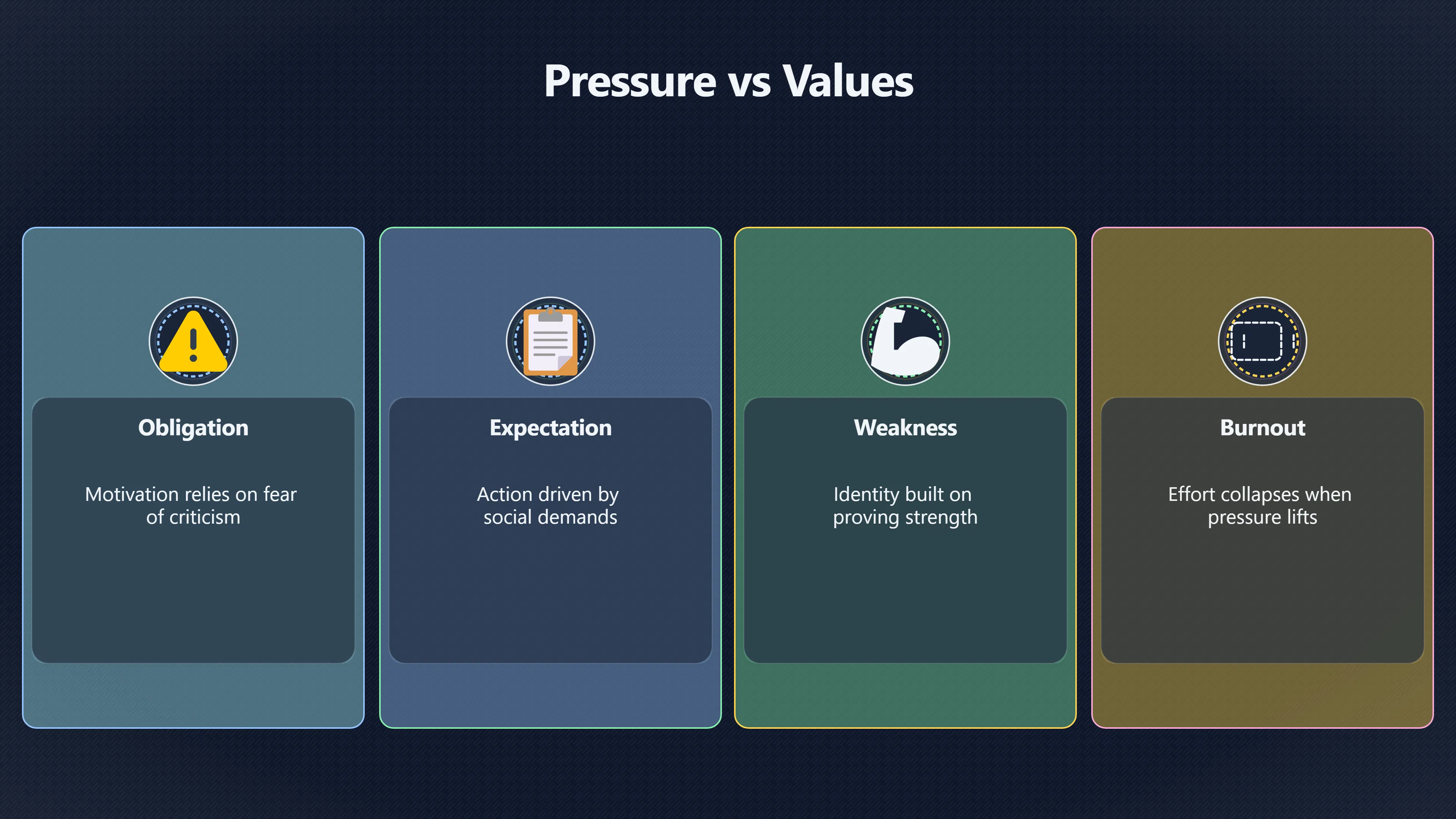
Pressure-driven identities often sound like:
- “I should be more productive.”
- “People expect me to succeed.”
- “I cannot let anyone think I am weak.”
- “I have to prove myself.”
Values-driven identities sound different:
- “I value learning.”[bridgetolearning.stanford.edu]bridgetolearning.stanford.eduBridging to LearningRegulatory StylesIntegrated regulation reflects the fullest internalization and most autonomous and self-endorsed for…
- “I want to be reliable.”
- “Health matters to me.”
- “I care about being present for my family.”
The behaviours may overlap, but the psychological experience changes. The first set is dominated by obligation and judgement. The second is anchored in personal endorsement.
Studies on internalisation show that people naturally absorb social rules and expectations, but the quality of that internalisation matters. Behaviour becomes more stable when individuals move from external compliance towards personally accepted values and integrated self-understanding.[PubMed]pubmed.ncbi.nlm.nih.govSelf-determination theory and the facilitation of intrinsic…The findings have led to the postulate of three innate psychological…[Bridging to Learning]bridgetolearning.stanford.eduBridging to LearningRegulatory StylesIntegrated regulation reflects the fullest internalization and most autonomous and self-endorsed for…
Why pressure often backfires
External pressure can produce short-term action. Deadlines, social approval and incentives can all increase effort temporarily. However, heavily controlling conditions often undermine autonomy and can reduce the sense that behaviour is truly one’s own.[Wikipedia]WikipediaSelf-determination theorySelf-determination theory
This creates a familiar self-improvement cycle:
- A person adopts a demanding goal to satisfy an external expectation.
- Initial motivation is high because of urgency or social pressure.
- Effort becomes exhausting because the goal does not feel personally meaningful.
- A setback occurs.
- Motivation collapses because the underlying reason was never fully internalised.
The problem is not discipline. The problem is that the behaviour never became integrated into the person’s values.

Competence makes identity believable
Values alone are not enough. A person may deeply value health, creativity or learning and still struggle to act consistently.
This is where competence becomes important. Self-Determination Theory identifies competence as a basic psychological need alongside autonomy and relatedness. People are more motivated when they experience themselves as capable and effective.[Self-Determination Theory]WikipediaSelf-determination theory PubMed A values-based identity becomes stronger when it is supported by repeated evidence.[youtube.com]youtube.comIntrinsic vs Extrinsic Motivation. | Motivated MondaysSelf-Determination Theory Explained…
For example:
- “I value learning” becomes more believable after months of reading and studying.
- “I value fitness” becomes more believable after dozens of completed workouts.
- “I value generosity” becomes more believable after repeated acts of support and service.
The identity is not sustained by affirmation alone. It is reinforced through competence-building actions.
This is one reason behaviour design remains important. Values provide direction, but small repeatable actions provide proof. A person who chooses actions that are achievable, measurable and repeatable accumulates evidence that supports both competence and identity. Behaviour-based identity has been associated with successful maintenance of health-related behaviours precisely because actions provide continual reinforcement of self-perception.[PMC]pmc.ncbi.nlm.nih.govBehavior-based identity is…Read more…
Confidence grows from evidence
Many people attempt to build confidence by changing their self-talk. While self-talk can help, confidence is often more durable when it emerges from demonstrated ability.
Instead of repeatedly declaring, “I am a disciplined person,” a more effective path is often:
- Complete a small action.
- Repeat it consistently.
- Observe the evidence.
- Allow confidence to grow from experience.
Competence transforms identity claims from aspirations into observations.
Connection, belonging and values-led habits
People rarely change in isolation. Identity is influenced not only by personal values but also by relationships and group membership.
A person who joins a running club, volunteer organisation or supportive professional community gains more than accountability. They gain a social environment where desired behaviours become normal. The behaviour begins to align with both personal values and group expectations.
The critical distinction is whether belonging supports autonomy or replaces it.
Healthy belonging sounds like:
- “These are people who share values I care about.”
- “This group helps me become the person I want to be.”
Unhealthy belonging sounds like:
- “I must act this way to avoid rejection.”
- “My worth depends on approval from this group.”
Research on internalisation suggests that relatedness—the experience of feeling connected and valued—helps people adopt and integrate behaviours more deeply. People are more likely to embrace values and practices when they feel respected and supported by important relationships.[PubMed]pubmed.ncbi.nlm.nih.govSelf-determination theory and the facilitation of intrinsic…The findings have led to the postulate of three innate psychological…
This explains why supportive communities often help habits endure. The social environment does not merely impose rules. It helps people make sense of those rules as part of a meaningful identity.

How to tell whether an identity is values-based
A practical test is to ask what remains when external rewards disappear.
If nobody noticed the behaviour, would it still matter?
If there were no praise, status, likes, promotions or recognition, would the action still feel worthwhile?
Values-based identities usually survive these questions because the behaviour is connected to something intrinsically important. Pressure-based identities often struggle because they depend on outside validation.
Useful questions include:
- What value does this habit express?
- Who do I want to become through this behaviour?
- Would I still choose this if nobody rewarded me?
- Does this behaviour fit my relationships and priorities?
- Am I acting from commitment or from fear?
The goal is not perfect purity of motivation. Most behaviour contains a mixture of personal and social influences. The aim is simply to move towards reasons that feel increasingly authentic and self-endorsed.
Change works better when it feels chosen
Identity can be a powerful ally in self-improvement, but only when it grows from values rather than pressure. The most durable identities are not built around proving worth, avoiding criticism or chasing approval. They are built around commitments that a person willingly endorses and repeatedly expresses through action.
When behaviour aligns with chosen values, competence develops through practice and relationships reinforce rather than control the effort, change becomes easier to sustain. The identity no longer feels like a role that must be performed. It becomes a natural summary of how a person chooses to live.[Self-Determination Theory]WikipediaSelf-determination theory[PubMed]pubmed.ncbi.nlm.nih.govSelf-determination theory and the facilitation of intrinsic…The findings have led to the postulate of three innate psychological…
Amazon book picks
Further Reading
Books and field guides related to Change works better when it feels chosen. Use these as the next step if you want deeper reading beyond the article.
Atomic Habits
Rating: 3.5/5 from 7 Google Books ratings
Links identity and behaviour through repeated action.
eBay marketplace picks
Marketplace Samples
Example marketplace items related to this page. Use the search link to explore similar finds on eBay.








Endnotes
1.
Source: pmc.ncbi.nlm.nih.gov
Link:https://pmc.ncbi.nlm.nih.gov/articles/PMC6377081/
Source snippet
Finding the “self” in self-regulation: The identity-value modelby ET Berkman · 2017 · Cited by 257 — The overarching prediction of the...
2.
Source: Wikipedia
Title: Self-determination theory
Link:https://en.wikipedia.org/wiki/Self-determination_theory
3.
Source: pmc.ncbi.nlm.nih.gov
Link:https://pmc.ncbi.nlm.nih.gov/articles/PMC6124500/
Source snippet
Behavior-based identity is...Read more...
4.
Source: youtube.com
Title: Self-Determination Theory Explained
Link:https://www.youtube.com/watch?v=_juPDoa3GBY
Source snippet
Authentic Living: Choosing Your Own Path Instead of Others' Expectations...
5.
Source: youtube.com
Title: Intrinsic vs Extrinsic Motivation. | Motivated Mondays
Link:https://www.youtube.com/watch?v=LbEzj71JVXM
Source snippet
Self-Determination Theory Explained...
6.
Source: youtube.com
Title: Self-Determination Theory Explained
Link:https://www.youtube.com/watch?v=ZpAwJKq8TOc
Source snippet
"The Happiness Trap: Stop Struggling, Start Living" by Dr. Russ Harris...
7.
Source: selfdeterminationtheory.org
Title: 2000 RyanDeci SDT
Link:https://selfdeterminationtheory.org/SDT/documents/2000_RyanDeci_SDT.pdf
Source snippet
Self-Determination TheorySelf-Determination Theory and the Facilitation of Intrinsic...by RM Ryan · 2000 · Cited by 87564 — Strong links...
8.
Source: pubmed.ncbi.nlm.nih.gov
Link:https://pubmed.ncbi.nlm.nih.gov/11392867/
Source snippet
Self-determination theory and the facilitation of intrinsic...The findings have led to the postulate of three innate psychological...
9.
Source: pubmed.ncbi.nlm.nih.gov
Link:https://pubmed.ncbi.nlm.nih.gov/8169757/
Source snippet
Facilitating internalization: the self-determination theory...by EL Deci · 1994 · Cited by 4810 — Self-determination theory (Deci...
10.
Source: bridgetolearning.stanford.edu
Link:https://bridgetolearning.stanford.edu/menu/internalization/regulatory-styles
Source snippet
Bridging to LearningRegulatory StylesIntegrated regulation reflects the fullest internalization and most autonomous and self-endorsed for...
11.
Source: selfdeterminationtheory.org
Link:https://selfdeterminationtheory.org/theory/
Source snippet
Self-Determination TheoryTheorySelf-Determination Theory (SDT) represents a broad framework for the study of human motivation and persona...
12.
Source: sciencedirect.com
Title: ScienceDirect Self-Determination Theory
Link:https://www.sciencedirect.com/topics/social-sciences/self-determination-theory
Source snippet
Self-Determination Theory - an overviewIdentified regulation reflects a more internalized form of extrinsic motivation whereby individual...
13.
Source: positivepsychology.com
Title: self determination theory
Link:https://positivepsychology.com/self-determination-theory/
Source snippet
and How It Explains Motivation21 Jun 2018 — Internalization is how well the value of an activity is felt while integration explains the p...
14.
Source: yukaichou.com
Title: Self-Determination Theory: The Complete Guide to Ryan and Deci’s
Link:https://yukaichou.com/gamification-analysis/self-determination-theory-guide-to-ryan-and-decis-motivation-framework/
Source snippet
Ryan, proposing that people are driven by three innate psychological needs (autonomy, competence, and relatedness) and that...
15.
Source: open.ncl.ac.uk
Title: self determination theory
Link:https://open.ncl.ac.uk/theories/20/self-determination-theory/
Source snippet
ncl.ac.ukSelf-Determination Theory: A review14 Mar 2026 — Identified regulation is a form of extrinsic motivation in SDT where an individ...
16.
Source: people-shift.com
Title: self determination theory autonomy competence and relatedness at work
Link:https://people-shift.com/articles/self-determination-theory-autonomy-competence-and-relatedness-at-work/
Source snippet
Self-Determination Theory: Autonomy, Competence, and...21 May 2026 — Self-Determination Theory (SDT), developed by Edward Deci and Richa...
Published: May 2026
17.
Source: motricidades.org
Title: 2594 6463 2025 v9 n2 p244 254
Link:https://motricidades.org/journal/index.php/journal/article/download/2594-6463-2025-v9-n2-p244-254/589
Source snippet
Self-Determination Theory and youth futsalby J Rota · 2025 · Cited by 1 — This internalization process occurs along a continuum, progress...
18.
Source: kyptraining.com
Title: Self-determination theory and work motivation
Link:https://kyptraining.com/self-determination-theory-and-work-motivation/
Source snippet
Within SDT, when a behavior is so motivated it is said to be externally regulated—that is, initiated and maintained by conting...
19.
Source: youtube.com
Link:https://www.youtube.com/watch?v=LHQv7FU8Atw
Source snippet
Self-determination theory. 4.3K views · 3 years ago...more...
20.
Source: sproutsschools.com
Title: self determination theory 3 basic needs that drive our behavior
Link:https://sproutsschools.com/self-determination-theory-3-basic-needs-that-drive-our-behavior/
Source snippet
Self-Determination Theory: 3 Basic Needs That Drive Our...Nov 3, 2022 — Self-determination theory argues that people are motivated to le...
21.
Source: ukcoaching.org
Link:https://www.ukcoaching.org/ukc-club/resources/self-determination-theory/
Source snippet
Self-Determination TheorySelf-Determination Theory emphasises that people are most motivated and fulfilled when their basic needs for aut...
22.
Source: urmc.rochester.edu
Title: self determination theory
Link:https://www.urmc.rochester.edu/community-health/patient-care/self-determination-theory
Source snippet
rochester.eduSelf-Determination Theory of Motivation - URMC.Rochester.eduSelf-determination theory suggests that all humans have three ba...
23.
Source: suebehaviouraldesign.com
Title: self determination theory explained
Link:https://www.suebehaviouraldesign.com/en/blog/self-determination-theory-explained/
Source snippet
Self-Determination Theory: 3 needs that drive intrinsic...1 Mar 2026 — Values that become internalised are always the result of a proces...
24.
Source: aipc.net.au
Title: self determination theory of motivation
Link:https://www.aipc.net.au/articles/self-determination-theory-of-motivation/
Source snippet
21 Oct 2010 — In this article we explore the principles of Self Determination Theory (SDT), as well as Intrinsic and Extrinsic motivation...
Additional References
25.
Source: nirandfar.com
Link:https://www.nirandfar.com/behavior-change-is-identity-change/
Source snippet
The Key to Behavior Change is Identity ChangeLearn how changing your identity can be the key to successful behavior change. Discover stra...
26.
Source: rccs.org.uk
Link:https://www.rccs.org.uk/post/autonomy-competence-and-relatedness-understanding-the-three-universal-needs-of-self-determination
Source snippet
Autonomy Competence and Relatedness – RCCS6 Feb 2026 — Self-Determination Theory (SDT), developed by psychologists Edward Deci and Richar...
27.
Source: cdn.uksca.org.uk
Link:https://cdn.uksca.org.uk/cms-uploads/assets/uksca_journal_71_summer_24_Cahill_self_determination_aca0634d96.pdf
Source snippet
to motivate university athletes using selfby C Cahill — Akin to self-determined forms of extrinsic motivation, intrinsic motives for enga...
28.
Source: researchgate.net
Link:https://www.researchgate.net/publication/322954679_Harnessing_Centered_Identity_Transformation_to_Reduce_Executive_Function_Burden_for_Maintenance_of_Health_Behavior_Change_The_Maintain_IT_Model
Source snippet
Harnessing Centered Identity Transformation to Reduce...27 Feb 2018 — Taken together, these studies underscore the value of integrating...
29.
Source: 7cups.com
Link:https://www.7cups.com/forum/projectsandevents/ArticlesandQuotes_2369/PsychologyTodayTheKeytoBehaviorChangeIsIdentityChange_279613/
Source snippet
Psychology Today: The Key to Behavior Change Is Identity...One of the most effective ways to change your behavior is to change your iden...
30.
Source: sweetinstitute.com
Title: autonomy and behavior change empowering individuals for lasting transformation
Link:https://sweetinstitute.com/autonomy-and-behavior-change-empowering-individuals-for-lasting-transformation/
Source snippet
By fostering a sense of control and ownership over their choices, individuals can enhance their...Read more...
31.
Source: stial.ie
Title: Ryan and Deci 2020 self determination theory
Link:https://stial.ie/resources/Ryan%20and%20Deci%202020%20self%20determination%20theory.pdf
Source snippet
pdfby RM Ryan · 2020 · Cited by 10079 — Studies show that students of more autonomy-supportive teachers have more intrinsic motivation, p...
32.
Source: verywellmind.com
Title: what is self determination theory 2795387
Link:https://www.verywellmind.com/what-is-self-determination-theory-2795387
Source snippet
How Self-Determination Theory Explains Motivation29 Oct 2025 — Self-determination theory suggests that fulfilling the core needs for auto...
33.
Source: researchgate.net
Title: 342380851 SELF DETERMINATION THEORY
Link:https://www.researchgate.net/publication/342380851_SELF-DETERMINATION_THEORY
Source snippet
(PDF) SELF-DETERMINATION THEORY23 Jun 2020 — Self-determination theory (SDT), developed by Deci and Ryan, emphasizes the role of intrinsi...
34.
Source: med.libretexts.org
Title: 13.06: Self Determination Theory
Link:https://med.libretexts.org/Courses/Glendale_Community_College/Public_Health_101_%28Calderone%29/13%3A_Community_Organizing_and_Health_Promotion_Programming/13.06%3A_Self-Determination_Theory
Source snippet
libretexts.org13.6: Self-Determination TheoryDec 30, 2024 — Identified regulation (the behavior is important to them); Integrated regulat...
Topic Tree