Within Ego Depletion
Why Temptation Gets Louder After Effort
After hard self-control, temptations may win because attention and motivation shift toward relief, reward and novelty.
On this page
- How the process model reframes depletion
- Why rewards become more salient after strain
- Practical cue changes for high risk transitions
Page outline Jump by section
Introduction
Why does temptation often feel stronger after a period of intense self-control? One influential answer in the ego depletion debate is that people do not necessarily “run out” of willpower. Instead, effortful control may temporarily change what the mind prioritises. After spending time resisting impulses, concentrating, suppressing emotions, or forcing attention onto difficult tasks, motivation can shift away from further control and towards relief, reward, and immediate satisfaction. At the same time, attention may become more sensitive to tempting cues and less focused on long-term goals. This perspective, known as the process model or shifting-priorities account of self-control, has become one of the most important alternatives to the classic resource-depletion explanation.[PubMed]pubmed.ncbi.nlm.nih.govPub Med What Is Ego Depletion?Toward a Mechanistic Revision of…by M Inzlicht · 2012 · Cited by 1572 — This study proposes a process model of depletion, suggesting t…[Sage Journals]journals.sagepub.comSage Journals What Is Ego Depletion?Toward a Mechanistic Revision of…by M Inzlicht · 2012 · Cited by 1571 — This study proposes a process model of depletion, suggesting t…
 For people interested in self improvement that works, the practical implication is significant. The danger period may not be a moment of empty mental fuel. It may be a moment when rewards become louder, goals become quieter, and the environment suddenly matters much more.
How the Process Model Reframes Depletion
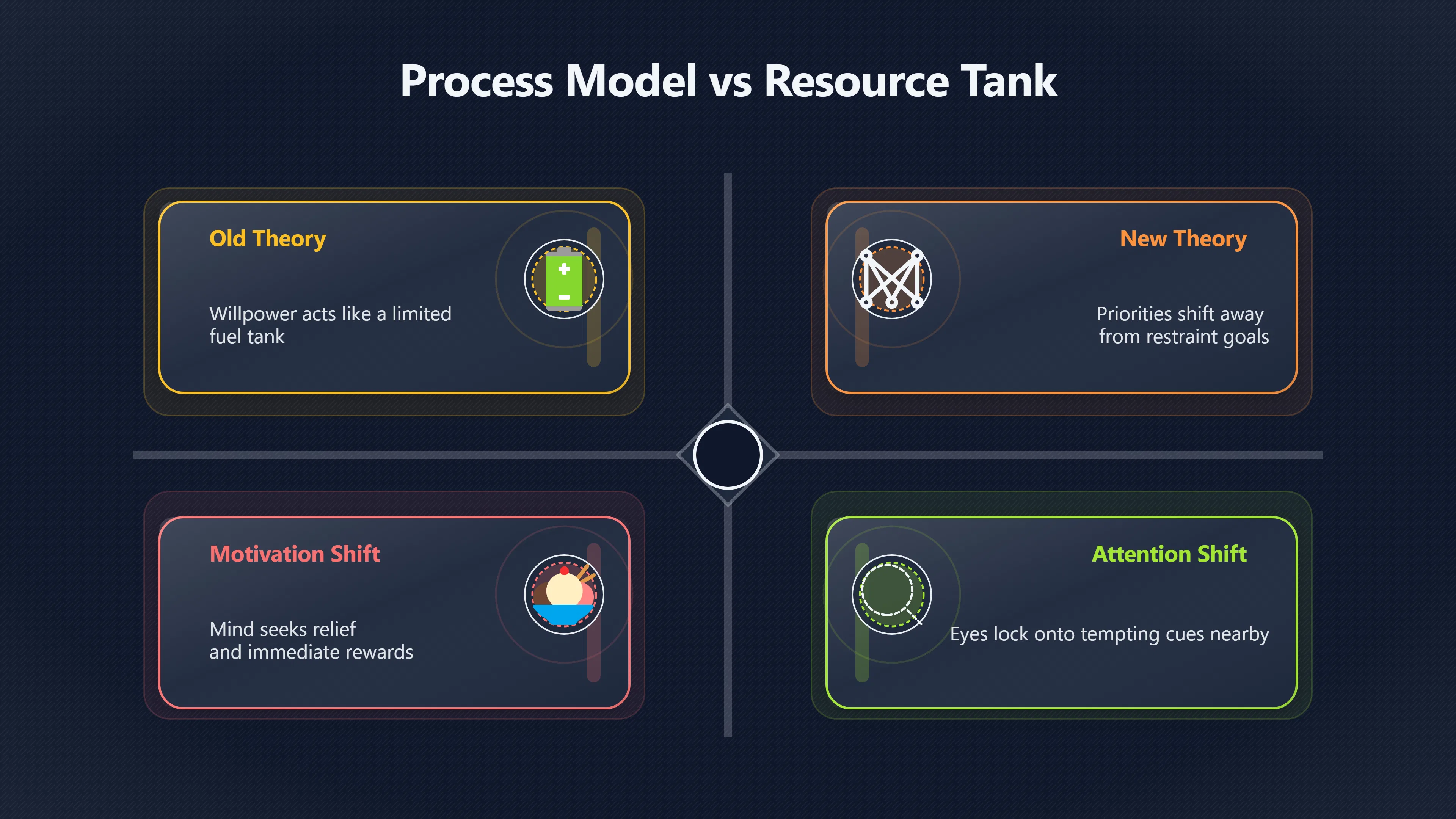
The traditional ego depletion theory proposed that self-control failures occur because a limited resource has been consumed. The process model, developed by Michael Inzlicht and Brandon Schmeichel, argues that the key mechanism is different. According to this view, exerting self-control changes motivation and attention in ways that make future self-control less likely, even if no depleted resource needs to be assumed.[PubMed]pubmed.ncbi.nlm.nih.govPub Med What Is Ego Depletion?Toward a Mechanistic Revision of…by M Inzlicht · 2012 · Cited by 1572 — This study proposes a process model of depletion, suggesting t…[Sage Journals]journals.sagepub.comSage Journals What Is Ego Depletion?Toward a Mechanistic Revision of…by M Inzlicht · 2012 · Cited by 1571 — This study proposes a process model of depletion, suggesting t…
The model proposes two linked shifts:[journals.sagepub.com]journals.sagepub.comSage JournalsAftereffects of Self-Control on Positive Emotional Reactivity7 Nov 2018 — The process model proposes that exercising self-co…
- A motivational shift away from restraint and towards gratification.
- An attentional shift away from signals that support long-term goals and towards signals associated with reward, pleasure, novelty, or relief.[PubMed]pubmed.ncbi.nlm.nih.govPub Med What Is Ego Depletion?Toward a Mechanistic Revision of…by M Inzlicht · 2012 · Cited by 1572 — This study proposes a process model of depletion, suggesting t…[Michael Inzlicht]michaelinzlicht.comwhat is ego depletionSelf-control exertion at Time 1 leads to self-control failure at. Time 2 by inducing shifts in motivation away from self-…Read more…
These shifts are thought to reinforce one another. If rewards become more appealing, attention naturally moves towards them. As attention dwells on rewarding possibilities, motivation to pursue them increases further. The result can look like depleted willpower even though the underlying mechanism is a change in priorities rather than a drained mental tank.[Michael Inzlicht]michael-inzlicht.squarespace.comMichael InzlichtAttentional and Motivational Mechanisms of Self-ControlThis explanation for the refractory period has been called the pro… ResearchGate This framework also helps explain why incentives[researchgate.net]researchgate.netResearch Gate(Inzlicht & SchmeichelThe process model of self-control…Self-control failure tends to occur after initial self-control exertions because of shifts in motiva…, mood changes, personal beliefs, and task framing can sometimes offset apparent depletion effects. If self-control performance depends partly on motivation and attention, then changing what people care about in the moment should change outcomes. Evidence that incentives and beliefs influence performance is one reason many researchers began looking beyond pure resource explanations.[Association for Psychological Science]psychologicalscience.orgself control may not be a limited resource after allInzlicht and Schmeichel propose an alternative model that describes self-control as a process involving motivation and attention. “Engagi…
Why Rewards Become More Salient After Strain
A central idea in the newer models is that self-control is often experienced as effortful and somewhat aversive. After sustained effort, the mind may begin to assign greater value to rewarding alternatives and less value to continued restraint. PMC[springer]link.springer.comAfter-effects of self-control: The reward responsivity hypothesisby NJ Kelley · 2019 · Cited by 57 — In the current paper, we rev… This does not mean that every difficult task automatically produces indulgence. Rather, the balance of motivation can shift. The person who spent the afternoon focusing on demanding work may find social media more attractive than usual. The dieter who resisted snacks all day may notice dessert more readily. The student who concentrated intensely may become unusually drawn to entertainment. The tempting option has not necessarily changed; its subjective attractiveness has.[PMC]pmc.ncbi.nlm.nih.govAftereffects of self-control: The reward responsivity hypothesisby NJ Kelley · 2019 · Cited by 57 — Self-control exertion is aversive…[PMC]pmc.ncbi.nlm.nih.govInzlicht and Schmeichel (2012) proposed a process model of ego…Read more…
Researchers have referred to this idea as the reward responsivity hypothesis. It suggests that exercising self-control can temporarily increase responsiveness to rewarding stimuli, including food, money, positive images, risk-taking opportunities, or other sources of immediate gratification. Evidence across behavioural and neuroscience studies has provided support for the possibility that reward processing becomes more prominent following effortful control.[Springer]link.springer.comAfter-effects of self-control: The reward responsivity hypothesisby NJ Kelley · 2019 · Cited by 57 — In the current paper, we rev…[PMC]pmc.ncbi.nlm.nih.govincrease local knowledge—Exploring the hidden…by CD Wiesner · 2021 · Cited by 6 — The reward responsivity hypothesis proposes that peo…
Importantly, this mechanism predicts outcomes that a simple resource model struggles to explain. If the issue were only reduced control capacity, people should mainly perform worse on later control tasks. But some studies suggest that prior self-control can also increase approach-oriented reactions, positive emotional responses to rewarding stimuli, and willingness to pursue attractive opportunities. These outcomes are easier to understand if motivation itself has shifted. PMC[Frontiers]frontiersin.orgTrait approach motivation moderates the aftereffects of self-…by A Crowell · 2014 · Cited by 30 — Based on a process model proposing t…
Attention Follows What the Mind Values
Motivation and attention are closely linked. When rewards become more valuable, the brain allocates more attention to reward-related information.
In practical terms, this means that after a demanding period of self-control:
- Temptations may stand out more.
- Reward cues may be noticed more quickly.
- Long-term goals may require more deliberate effort to keep in mind.
- Novel or pleasurable options may capture attention more easily.[PubMed]pubmed.ncbi.nlm.nih.govPub Med What Is Ego Depletion?Toward a Mechanistic Revision of…by M Inzlicht · 2012 · Cited by 1572 — This study proposes a process model of depletion, suggesting t…[Michael Inzlicht]michaelinzlicht.comwhat is ego depletionSelf-control exertion at Time 1 leads to self-control failure at. Time 2 by inducing shifts in motivation away from self-…Read more…
This helps explain a common experience: people often feel disciplined while actively engaged in a demanding task, yet become vulnerable immediately afterwards. The challenge is not only fatigue. It is that attention is no longer anchored to the goal that previously guided behaviour.
Why This Matters for Everyday Change
The shifting-priorities account changes how self-improvement failures are interpreted.
Consider someone trying to reduce late-night snacking. A resource model encourages the explanation: “I used up my willpower during the day.” The process model suggests a different story: after many hours of effort, the person became more motivated by comfort and reward and more attentive to food cues. The evening environment then did the rest.[PubMed]pubmed.ncbi.nlm.nih.govPub Med What Is Ego Depletion?Toward a Mechanistic Revision of…by M Inzlicht · 2012 · Cited by 1572 — This study proposes a process model of depletion, suggesting t…[Association for Psychological Science]psychologicalscience.orgself control may not be a limited resource after allInzlicht and Schmeichel propose an alternative model that describes self-control as a process involving motivation and attention. “Engagi…
The distinction matters because it points towards different solutions. If the problem is an empty resource, the main answer is to conserve willpower. If the problem is shifting priorities, then managing attention, incentives, and environments becomes crucial.
The newer perspective also explains why people often experience a sense of earned indulgence. After difficult work, reward-seeking can feel justified. The mind may not merely crave a treat; it may reinterpret the treat as deserved. Researchers have argued that these motivational changes can make self-control failures appear voluntary rather than impossible.[Association for Psychological Science]psychologicalscience.orgself control may not be a limited resource after allInzlicht and Schmeichel propose an alternative model that describes self-control as a process involving motivation and attention. “Engagi…[RCGD]rcgd.isr.umich.eduInzlicht Berkman in pressSchmeichel, et al., 2014), self-control wanes over time not because people have no energy but because people experience a shift in…Rea…

Practical Cue Changes for High-Risk Transitions
The process model suggests that self-control failures frequently occur during transitions between effortful activity and unstructured time. These moments deserve special attention.
Protect the First Minutes After Effort
Many lapses occur immediately after demanding work rather than during it. When a task ends, reward-seeking motivation can become dominant before long-term goals have been re-established. Creating a planned transition reduces reliance on moment-to-moment restraint.
Examples include:
- Taking a short walk before entering a kitchen.
- Having a predefined post-work routine.
- Leaving a workspace before opening entertainment apps.
- Scheduling a healthy reward rather than searching for one impulsively.
These strategies reduce exposure to tempting cues during a period when attention may be unusually vulnerable.
Reduce Reward Signals Rather Than Fighting Them
If reward cues become more salient after effort, removing or hiding those cues may be more effective than attempting to overpower them.
For example:
- Keeping tempting foods out of sight.
- Blocking distracting websites during recovery periods.
- Avoiding shopping apps immediately after stressful work.
- Preparing healthy defaults before demanding days begin.
This approach aligns with a broader lesson from behavioural science: changing what captures attention is often easier than repeatedly resisting it.
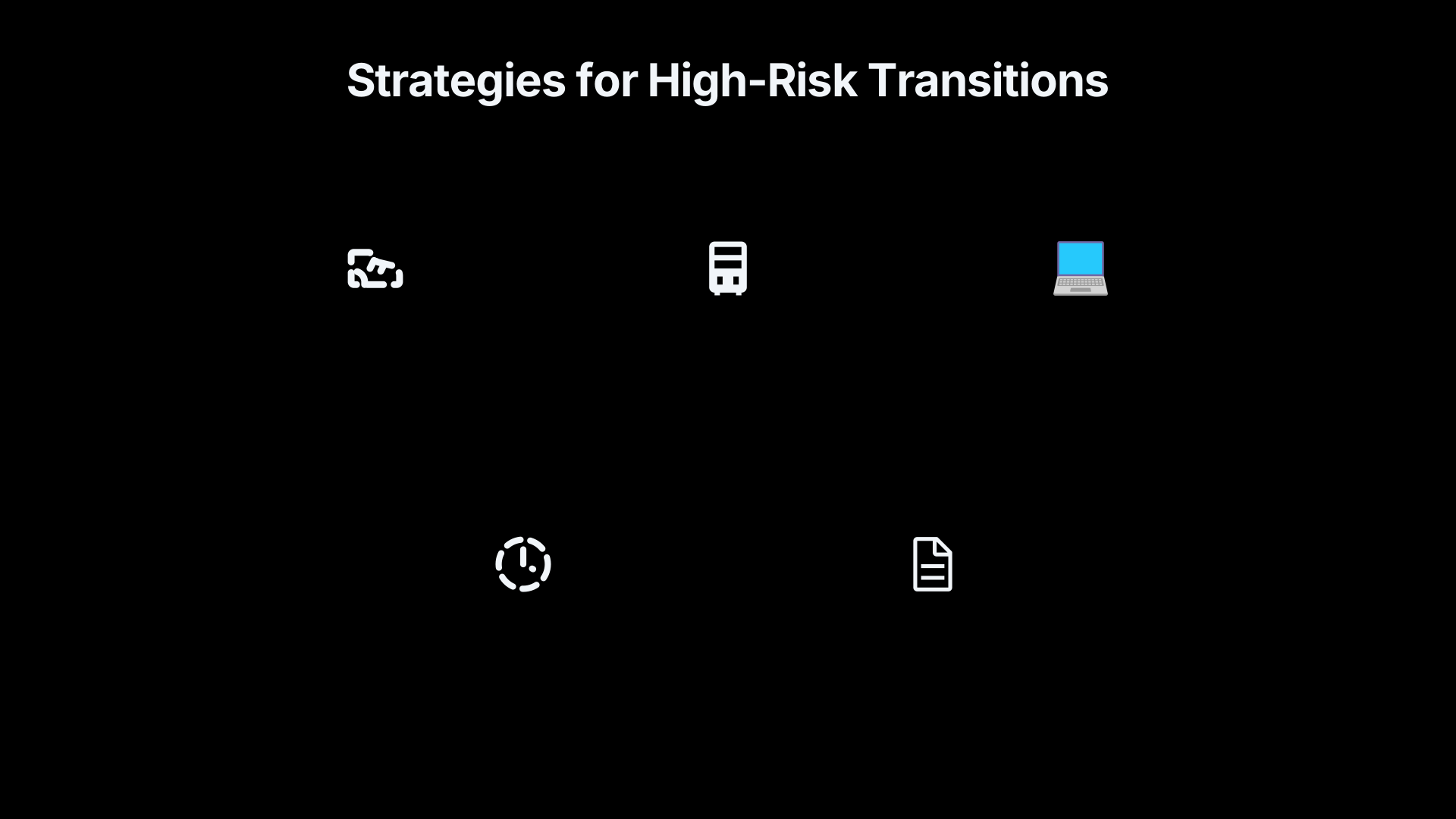
Reintroduce Long-Term Goals
The process model implies that goals temporarily lose priority rather than disappearing entirely. Bringing them back into focus can counteract the shift.
Useful methods include:
- Reviewing a written goal before leaving work.
- Using reminders linked to high-risk times of day.
- Tracking behaviours immediately after difficult tasks.
- Making future benefits concrete rather than abstract.
The objective is not to generate more effort but to make the desired goal visible again when reward cues are competing for attention.
What the Mechanism Explains—and What It Does Not
The motivation-and-attention account has become influential because it offers a more detailed explanation than a simple resource metaphor. It explains why incentives matter, why rewards can feel unusually attractive after strain, and why environmental cues become so important during vulnerable moments.[PubMed]pubmed.ncbi.nlm.nih.govPub Med What Is Ego Depletion?Toward a Mechanistic Revision of…by M Inzlicht · 2012 · Cited by 1572 — This study proposes a process model of depletion, suggesting t…[PubMed At the same time]pubmed.ncbi.nlm.nih.govPub Med What Is Ego Depletion?Toward a Mechanistic Revision of…by M Inzlicht · 2012 · Cited by 1572 — This study proposes a process model of depletion, suggesting t…, it does not solve every question in the ego depletion debate. Researchers continue to discuss how large these effects are, when they occur, and how they interact with fatigue, habits, emotions, and beliefs. Some findings support shifting-priority explanations, while other results remain mixed or difficult to replicate consistently.[University of California Press]online.ucpress.eduUniversity of California PressSelf-Control Following Prior Exertion: An Empirical Test of the…Jan 30, 2025 — Instead, it has been argu…[PMC]pmc.ncbi.nlm.nih.govAftereffects of self-control: The reward responsivity hypothesisby NJ Kelley · 2019 · Cited by 57 — Self-control exertion is aversive…
For everyday self-improvement, however, the core insight remains valuable: after effortful control, the biggest threat may not be a depleted reservoir of willpower. It may be a temporary change in what the mind notices and what it wants. When rewards become more salient and goals become less prominent, temptation feels louder—not necessarily because control has vanished, but because attention and motivation have moved elsewhere.[PubMed]pubmed.ncbi.nlm.nih.govPub Med What Is Ego Depletion?Toward a Mechanistic Revision of…by M Inzlicht · 2012 · Cited by 1572 — This study proposes a process model of depletion, suggesting t…[Sage Journals]journals.sagepub.comSage Journals What Is Ego Depletion?Toward a Mechanistic Revision of…by M Inzlicht · 2012 · Cited by 1571 — This study proposes a process model of depletion, suggesting t…
Amazon book picks
Further Reading
Books and field guides related to Why Temptation Gets Louder After Effort. Use these as the next step if you want deeper reading beyond the article.
The Willpower Instinct
Explores why temptations become more compelling in certain states.
Atomic Habits
Rating: 3.5/5 from 7 Google Books ratings
Shows how cues and environments shape attention and action.
eBay marketplace picks
Marketplace Samples
Example marketplace items related to this page. Use the search link to explore similar finds on eBay.





Endnotes
1.
Source: researchgate.net
Title: Research Gate(Inzlicht & Schmeichel)
Link:https://www.researchgate.net/figure/Inzlicht-Schmeichel-The-process-model-of-self-control-fatigue-Self-control-failure_fig2_259438432
Source snippet
The process model of self-control...Self-control failure tends to occur after initial self-control exertions because of shifts in motiva...
2.
Source: rcgd.isr.umich.edu
Title: Inzlicht Berkman in press
Link:https://rcgd.isr.umich.edu/wp-content/uploads/2018/08/Inzlicht__Berkman_in_press.pdf
Source snippet
Schmeichel, et al., 2014), self-control wanes over time not because people have no energy but because people experience a shift in...Rea...
3.
Source: pmc.ncbi.nlm.nih.gov
Link:https://pmc.ncbi.nlm.nih.gov/articles/PMC8182659/
Source snippet
Aftereffects of self-control: The reward responsivity hypothesisby NJ Kelley · 2019 · Cited by 57 — Self-control exertion is aversive...
4.
Source: link.springer.com
Link:https://link.springer.com/article/10.3758/s13415-019-00694-3
Source snippet
After-effects of self-control: The reward responsivity hypothesisby NJ Kelley · 2019 · Cited by 57 — In the current paper, we rev...
5.
Source: pmc.ncbi.nlm.nih.gov
Link:https://pmc.ncbi.nlm.nih.gov/articles/PMC4179327/
Source snippet
Inzlicht and Schmeichel (2012) proposed a process model of ego...Read more...
6.
Source: pmc.ncbi.nlm.nih.gov
Link:https://pmc.ncbi.nlm.nih.gov/articles/PMC8486128/
Source snippet
increase local knowledge—Exploring the hidden...by CD Wiesner · 2021 · Cited by 6 — The reward responsivity hypothesis proposes that peo...
7.
Source: researchgate.net
Title: (Inzlicht & Schmeichel)
Link:https://www.researchgate.net/figure/Inzlicht-Schmeichel-The-process-model-of-self-control-fatigue-Self-control-failure_fig1_259200658
Source snippet
The process model of self-control...Instead of self-control failure stemming from depletion of finite energetic resources, the process m...
8.
Source: researchgate.net
Title: 386084974 Harnessing Opportunity Cost Salience for Effortless Self Control
Link:https://www.researchgate.net/publication/386084974_Harnessing_Opportunity_Cost_Salience_for_Effortless_Self-Control
Source snippet
Harnessing Opportunity Cost Salience for Effortless Self-...23 Nov 2024 — Drawing on behavioral economics literature, we investigate opp...
9.
Source: pubmed.ncbi.nlm.nih.gov
Title: Pub Med What Is Ego Depletion?
Link:https://pubmed.ncbi.nlm.nih.gov/26168503/
Source snippet
Toward a Mechanistic Revision of...by M Inzlicht · 2012 · Cited by 1572 — This study proposes a process model of depletion, suggesting t...
10.
Source: journals.sagepub.com
Title: Sage Journals What Is Ego Depletion?
Link:https://journals.sagepub.com/doi/abs/10.1177/1745691612454134
Source snippet
Toward a Mechanistic Revision of...by M Inzlicht · 2012 · Cited by 1571 — This study proposes a process model of depletion, suggesting t...
11.
Source: pubmed.ncbi.nlm.nih.gov
Link:https://pubmed.ncbi.nlm.nih.gov/24439530/
Source snippet
Why self-control seems (but may not be) limitedby M Inzlicht · 2014 · Cited by 1272 — Self-control refers to the mental processes t...
12.
Source: michael-inzlicht.squarespace.com
Link:https://michael-inzlicht.squarespace.com/s/attentional-and-motivational-mechanisms-of-self-control.pdf
Source snippet
Michael InzlichtAttentional and Motivational Mechanisms of Self-ControlThis explanation for the refractory period has been called the pro...
13.
Source: michaelinzlicht.com
Title: what is ego depletion
Link:https://michaelinzlicht.com/s/what-is-ego-depletion.pdf
Source snippet
Self-control exertion at Time 1 leads to self-control failure at. Time 2 by inducing shifts in motivation away from self-...Read more...
14.
Source: psychologicalscience.org
Title: self control may not be a limited resource after all
Link:https://www.psychologicalscience.org/news/releases/self-control-may-not-be-a-limited-resource-after-all.html
Source snippet
Inzlicht and Schmeichel propose an alternative model that describes self-control as a process involving motivation and attention. “Engagi...
15.
Source: frontiersin.org
Link:https://www.frontiersin.org/journals/psychology/articles/10.3389/fpsyg.2014.01112/full
Source snippet
Trait approach motivation moderates the aftereffects of self-...by A Crowell · 2014 · Cited by 30 — Based on a process model proposing t...
16.
Source: journals.sagepub.com
Link:https://journals.sagepub.com/doi/10.1177/0146167218802836
Source snippet
Sage JournalsAftereffects of Self-Control on Positive Emotional Reactivity7 Nov 2018 — The process model proposes that exercising self-co...
17.
Source: online.ucpress.edu
Link:https://online.ucpress.edu/collabra/article/11/1/128616/205875/Self-Control-Following-Prior-Exertion-An-Empirical
Source snippet
University of California PressSelf-Control Following Prior Exertion: An Empirical Test of the...Jan 30, 2025 — Instead, it has been argu...
18.
Source: frontiersin.org
Link:https://www.frontiersin.org/journals/systems-neuroscience/articles/10.3389/fnsys.2019.00079/full
Source snippet
An Integrative Model of Effortful Controlby N André · 2019 · Cited by 107 — This article presents an integrative model of effortful contr...
19.
Source: worldsupporter.org
Link:https://www.worldsupporter.org/en/summary/what-ego-depletion-toward-mechanistic-revision-resource-model-self-control-inzlicht
Source snippet
self-control - Inzlicht & Schmeichel - 2012 - Article.Read more...
Additional References
20.
Source: d-nb.info
Link:https://d-nb.info/1256674230/34
Source snippet
Exploring the hidden benefits of self-control failureby CD Wiesner · Cited by 5 — In both cases, we expect that exerting effortful self-c...
21.
Source: madoc.bib.uni-mannheim.de
Link:https://madoc.bib.uni-mannheim.de/62513/1/J%20Organ%20Behavior%20-%202022%20-%20Wehrt%20-%20More%20than%20a%20muscle%20How%20self%E2%80%90control%20motivation%20depletion%20and%20self%E2%80%90regulation.pdf
Source snippet
than a muscle: How self‐control motivation, depletion...by W Wehrt · 2022 · Cited by 44 — Perceiving oneself as depleted has been interp...
22.
Source: selfdeterminationtheory.org
Link:https://selfdeterminationtheory.org/wp-content/uploads/2021/01/2020_LudwigBrownBrewer_SelfRegulation.pdf
Source snippet
Self-Regulation Without Force: Can Awareness Leverage...by VU Ludwig · 2020 · Cited by 127 — Attempting to overcome unwanted habit loops...
23.
Source: journals.sagepub.com
Title: In this article, we provide a framework to better
Link:https://journals.sagepub.com/doi/abs/10.1177/0963721414534256
Source snippet
the Mechanisms of Self-Control Improvementby M Inzlicht · 2014 · Cited by 240 — Good self-control is central to success across life domai...
24.
Source: macau.uni-kiel.de
Link:https://macau.uni-kiel.de/receive/macau_mods_00002669
Source snippet
by C Wiesner · 2021 · Cited by 6 — The results showed that participants who exerted a high amount of effortful self-control during t...
25.
Source: publications.rwth-aachen.de
Link:https://publications.rwth-aachen.de/record/63200/files/3368.pdf?version=1
Source snippet
Interestingly, seemingly easy or well-practiced tasks that still require a...
26.
Source: bpb-us-e1.wpmucdn.com
Title: Inzlicht, Berkman, & Elkins-Brown, in press2
Link:https://bpb-us-e1.wpmucdn.com/blogs.uoregon.edu/dist/1/172/files/2015/06/Inzlicht-Berkman-Elkins-Brown-in-press2-1mc0a6u.pdf
Source snippet
CDNThis is then followed by a discussion of a more mechanistically-informed alternative to the resource account, called the process model...
27.
Source: tandfonline.com
Link:https://www.tandfonline.com/doi/full/10.1080/02699931.2023.2209711
Source snippet
Roles of recalled parenting experiences and effortful...by J Tammilehto · 2023 · Cited by 19 — Research suggests that both childhood exp...
28.
Source: youtube.com
Title: The Science of Ego Depletion: Is Your Willpower Running Out?
Link:https://www.youtube.com/watch?v=LIERO2mHho0
Source snippet
Self Control: The Top 10 Ways to Resist Impulses, Control Your Choices and be More Mindful...
29.
Source: youtube.com
Title: Ego Depletion: Defined
Link:https://www.youtube.com/watch?v=NJeZkh87QNE
Source snippet
The video #298 Michael Inzlicht: Self-Control, Gratification Delay, Ego-Depletion, And The Replication Crisis features the primary archit...
Topic Tree