Within Goals vs Systems
When Goals Start Rewarding the Wrong Thing
A narrow target can improve effort while quietly encouraging shortcuts, blind spots or neglected priorities.
On this page
- Why narrow targets distort attention
- Personal examples beyond workplaces
- Safety rails and review points
Page outline Jump by section
Introduction
Goals can be powerful motivators, but they have a weakness that is often overlooked: they do not just direct behaviour, they define what gets rewarded. When a target becomes the main measure of success, people naturally focus on whatever improves that measure, even if it undermines the deeper purpose behind it. This is one of the most important reasons why self-improvement efforts sometimes produce disappointing results. A weight-loss target can encourage crash dieting. A reading target can encourage skimming. A savings target can encourage excessive frugality that damages quality of life.
 The problem is not that goals are useless. Research on goal-setting consistently shows that specific, challenging goals can improve performance. The problem arises when the goal becomes so dominant that it crowds out other values, signals and feedback. Researchers have described this as a recurring side effect of narrowly defined goals, while economists and social scientists often discuss the same mechanism through Goodhart’s Law: when a measure becomes a target, it stops being a reliable measure of what you actually care about.[Wikipedia]WikipediaGoal settingGoal setting[Wikipedia]WikipediaGoodhart's lawGoodhart's law
Why Narrow Targets Distort Attention
Achievement goals work by focusing attention. That is usually their strength. The same mechanism, however, can become a weakness.
When a target is highly visible, people devote more mental resources to actions that improve that target and fewer resources to everything else. Goal-setting researchers have repeatedly noted that goals channel attention towards goal-relevant activities. The risk is that important non-goal activities become less visible simply because they are not being measured.[Academy of Management Journals]journals.aom.orgAcademy of Management JournalsThe Systematic Side Effects of Overprescribing Goal Settingby LD Ordóñez · 2009 · Cited by 1157 — There are…
Consider a simple personal example. Suppose someone sets a goal of reading fifty books this year. The target may increase reading time, which is good. But it can also subtly change behaviour:
- Short books become more attractive than difficult ones.
- Finishing books becomes more important than understanding them.
- Quantity becomes easier to notice than learning.
The original objective might have been intellectual growth. The measurement became book count. Once book count dominates attention, behaviour shifts towards improving the number rather than improving understanding.
This pattern appears so frequently that it has its own principle. Goodhart’s Law states that when a measure becomes a target, it ceases to be a good measure. The metric begins to shape behaviour rather than merely describe it.[PMC]pmc.ncbi.nlm.nih.govMissed, Self Hit: Goal-Setting, Goal-Failure, and Their…by J Höpfner · 2021 · Cited by 94 — For example, goals can narrow the attentio…
The key insight for self-improvement is that the problem is often invisible. People believe they are pursuing the goal they originally chose, while their daily decisions are increasingly optimised for the metric attached to it.
How Reward Structures Create Unwanted Behaviour
The distortion becomes stronger when rewards, status or self-worth become attached to the target.
Research examining the darker side of goal setting has identified several recurring effects. Narrow goals can increase risk-taking, encourage unethical shortcuts, reduce learning and cause people to neglect important outcomes that are not explicitly measured. Academy of Management Journals[Harvard Business School]hbs.eduHarvard Business SchoolGoals Gone Wild: The Systematic Side Effects of Over-…by LD Ordóñez · 2009 · Cited by 1157 — We identify specif…
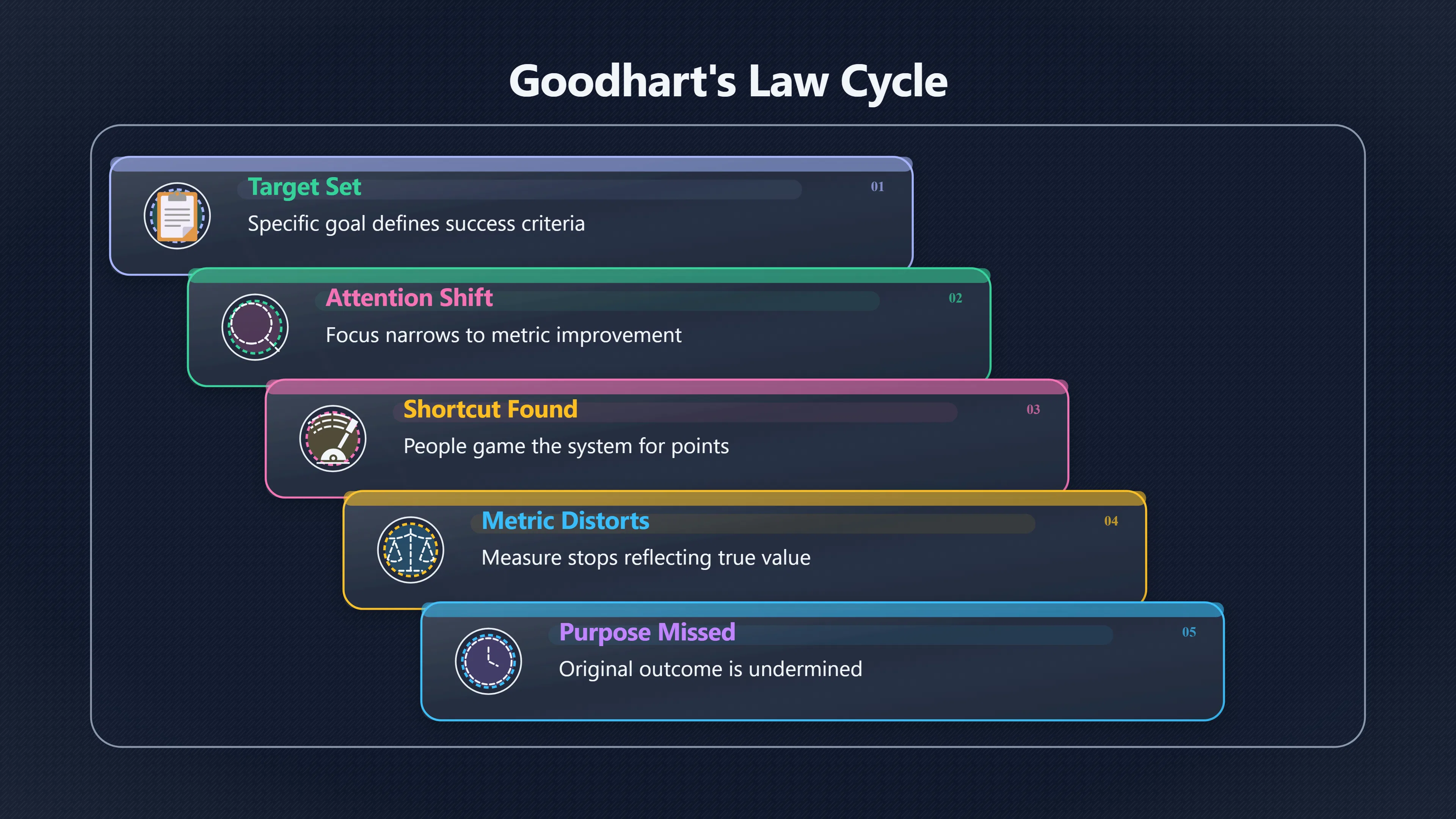
The mechanism is straightforward:
- A target is established.
- Success becomes defined by that target.
- The target receives disproportionate attention.
- People discover shortcuts that improve the metric.
- The shortcut is rewarded.
- The original purpose is weakened.
The shortcut may not even feel dishonest. It often appears rational because the system is rewarding it.
A person whose only fitness goal is a lower number on the scales may skip strength training, under-eat protein or use unsustainable dieting methods. The scale improves, but health, strength and long-term adherence may suffer. The goal rewarded weight reduction, not overall fitness.
Similarly, someone aiming to write every day might begin producing low-quality work simply to maintain a streak. The streak remains intact while the actual purpose—improving as a writer—receives less attention.
Personal Examples Beyond Workplaces
Discussions of goal side effects often focus on organisations, but the same mechanism appears in everyday self-improvement.
The Study Goal That Rewards Memorisation
A student may set a target of achieving a particular exam score. As the exam approaches, activities that raise the score become increasingly attractive.
That can be useful when the score genuinely reflects mastery. However, if practice tests and memorisation tricks produce faster gains than deep understanding, the student may optimise for performance rather than knowledge. Educational researchers have long observed similar effects when schools are judged heavily by test results, encouraging teaching aimed at the test rather than broader learning.[Daisy Christodoulou]daisychristodoulou.comExactly the same has happened with the 5 A*-C includingDaisy ChristodoulouExams and Goodhart's Law - Daisy…November 16, 2013 — 16 Nov 2013 — Goodhart's Law: when a measure becomes a target…
The Productivity Goal That Rewards Busyness
Many people track completed tasks, emails answered or hours worked.
These indicators are easy to measure, but they are not always good proxies for meaningful progress. Someone may spend a day clearing small tasks because completion feels rewarding, while avoiding the difficult project that actually matters. The metric improves. The important outcome does not.
The Savings Goal That Rewards Deprivation
Saving money is valuable, but an aggressively framed savings target can encourage behaviours that reduce wellbeing.
A person focused exclusively on maximising monthly savings may avoid beneficial experiences, delay necessary purchases or create unnecessary stress. Financial progress occurs, but the broader goal of building a sustainable life becomes secondary.
The Weight-Loss Goal That Rewards Extremes
Weight is one of the clearest examples because it is measurable and emotionally significant.
A target based solely on kilograms lost may encourage dehydration, excessive restriction or unsustainable exercise patterns. The measurement improves while health markers, energy levels and long-term habits deteriorate. The goal is technically achieved while the larger objective is missed.

Why Systems Often Outperform Pure Achievement Targets
This is one reason systems-based approaches often prove more durable than achievement-only approaches.
A system focuses attention on behaviours rather than solely on outcomes. Instead of rewarding a particular number on a scale, a system might reward consistent exercise, sufficient sleep and nutritious meals. Instead of rewarding books completed, it might emphasise focused reading sessions and reflection.
The distinction matters because behaviours are usually closer to the true objective than the final metric.
A goal says, “Lose ten kilograms.”
A system asks:
- Are you sleeping enough?
- Are you exercising consistently?
- Are you eating in a way you can sustain?
- Are you recovering when you miss a day?
Systems are not immune to distortion, but they reduce the temptation to chase a single outcome at any cost.
Safety Rails and Review Points
The solution is not to abandon goals. It is to design goals that are difficult to game and to review them regularly.
Several practical safeguards can reduce the risk that a goal starts rewarding the wrong behaviour.
Ask What the Metric Cannot See
Every measure leaves something out.
When reviewing a goal, ask:
- What behaviours would improve this number without improving the underlying outcome?
- What important factors are currently invisible?
- What would someone do if they cared only about hitting the target?
These questions often reveal loopholes before they become habits.

Track More Than One Indicator
Single metrics are easier to distort than balanced scorecards.
For example, a fitness plan might monitor:
- Body weight
- Strength
- Energy levels
- Exercise consistency
A writing project might track:
- Time spent writing
- Quality feedback received
- Drafts completed
Multiple indicators make it harder for one number to dominate decision-making.
Review the Behaviour, Not Just the Outcome
Many people evaluate goals by asking, “Did I hit the target?”
A better question is, “What behaviour did the target encourage?”
If progress came from shortcuts, obsession or neglect of other priorities, the goal may require redesign even when it was achieved.
Use Outcome Goals Sparingly
Outcome goals provide direction, but they work best when paired with process goals.
An outcome goal might be running a half marathon.
The supporting process goals might include:
- Completing scheduled training runs.
- Maintaining sleep routines.
- Following recovery practices.
The process goals protect the broader purpose from being sacrificed to the outcome.
The Real Test of a Good Goal
A well-designed goal improves behaviour without narrowing vision so much that everything else disappears. The danger is not ambition. The danger is allowing one number, one milestone or one visible achievement to become the entire definition of success.
When goals start rewarding the wrong thing, people often achieve exactly what they measured and miss what they actually wanted. The most effective self-improvement systems recognise that targets are tools, not truths. They use goals to provide direction while regularly checking whether the behaviour being rewarded still serves the outcome that matters.[Harvard Business School]hbs.eduHarvard Business SchoolGoals Gone Wild: The Systematic Side Effects of Over-…by LD Ordóñez · 2009 · Cited by 1157 — We identify specif…[Academy of Management Journals]journals.aom.orgAcademy of Management JournalsThe Systematic Side Effects of Overprescribing Goal Settingby LD Ordóñez · 2009 · Cited by 1157 — There are…
Amazon book picks
Further Reading
Books and field guides related to When Goals Start Rewarding the Wrong Thing. Use these as the next step if you want deeper reading beyond the article.
Atomic Habits
Rating: 3.5/5 from 7 Google Books ratings
Encourages focusing on systems rather than obsessive target chasing.
eBay marketplace picks
Marketplace Samples
Example marketplace items related to this page. Use the search link to explore similar finds on eBay.








Endnotes
1.
Source: Wikipedia
Title: Goal setting
Link:https://en.wikipedia.org/wiki/Goal_setting
2.
Source: Wikipedia
Title: Goodhart’s law
Link:https://en.wikipedia.org/wiki/Goodhart%27s_law
3.
Source: pmc.ncbi.nlm.nih.gov
Link:https://pmc.ncbi.nlm.nih.gov/articles/PMC8490751/
Source snippet
Missed, Self Hit: Goal-Setting, Goal-Failure, and Their...by J Höpfner · 2021 · Cited by 94 — For example, goals can narrow the attentio...
4.
Source: hbs.edu
Link:https://www.hbs.edu/ris/Publication%20Files/09-083.pdf
Source snippet
Harvard Business SchoolGoals Gone Wild: The Systematic Side Effects of Over-...by LD Ordóñez · 2009 · Cited by 1157 — We identify specif...
5.
Source: journals.aom.org
Link:https://journals.aom.org/doi/10.5465/AMP.2009.37007999
Source snippet
Academy of Management JournalsThe Systematic Side Effects of Overprescribing Goal Settingby LD Ordóñez · 2009 · Cited by 1157 — There are...
6.
Source: daisychristodoulou.com
Title: Exactly the same has happened with the 5 A*-C including
Link:https://daisychristodoulou.com/2013/11/exams-and-goodharts-law/
Source snippet
Daisy ChristodoulouExams and Goodhart's Law - Daisy...November 16, 2013 — 16 Nov 2013 — Goodhart's Law: when a measure becomes a target...
Published: November 16, 2013
Additional References
7.
Source: linkedin.com
Link:https://www.linkedin.com/top-content/leadership/team-performance-leadership-strategies/applying-goodhart-s-law-to-leadership-strategies/
Source snippet
Applying Goodhart's Law to Leadership StrategiesQuestion incentive structure: Take time to review what behaviors your rewards and targets...
8.
Source: reddit.com
Link:https://www.reddit.com/r/explainlikeimfive/comments/1bp7apj/eli5_what_does_godharts_law_mean/
Source snippet
ELI5: What does Godhart's law mean?: r/explainlikeimfiveIt goes "When a measure becomes a target, it ceases to be a good measure." How d...
9.
Source: thedecisionlab.com
Link:https://thedecisionlab.com/reference-guide/philosophy/goal-setting-theory
Source snippet
Goal-Setting TheoryLocke and Latham argue that these problems are not an indictment of Goal-Setting Theory, but rather are a result of po...
10.
Source: medium.com
Link:https://medium.com/%40claus.nisslmueller/goodharts-law-and-the-death-of-honest-metrics-e08cc756f93a
Source snippet
Goodhart's Law and the Death of Honest MetricsExample: public test scores become the target, teaching becomes test-prep, and the scores s...
11.
Source: changeassociates.com
Link:https://changeassociates.com/goodharts-law-and-the-illusion-of-progress-in-change-programmes/
Source snippet
Goodhart's Law in change programmesHow Goodhart's Law undermines change programmes when metrics become the goal. Plus practical ways to k...
12.
Source: modelthinkers.com
Link:https://modelthinkers.com/mental-model/goodharts-law
Source snippet
Goodhart's LawGoodhart's Law is a reminder that measures that become targets will distort behaviours in generally undesirable ways as peo...
13.
Source: researchgate.net
Link:https://www.researchgate.net/publication/274694075_The_dark_side_of_goal_setting_The_role_of_goals_in_motivating_unethical_behavior
Source snippet
The role of goals in motivating unethical behaviorIn this article we explore the proposition that challenging goals motivate not only con...
14.
Source: educationlibrary.org
Title: Effective goal systems balance ambition with learning, flexibility,
Link:https://educationlibrary.org/goal-setting-theory-how-clear-goals-drive-[motivation
Source snippet
Goal Setting Theory: How Clear Goals Drive Motivation and...Aggressive goals can encourage unethical behavior if incentives are poorly d...
15.
Source: psychsafety.com
Title: goodharts law campbells law and the cobra effect
Link:https://psychsafety.com/goodharts-law-campbells-law-and-the-cobra-effect/
Source snippet
Goodhart's Law, Campbell's Law, and the Cobra Effect.19 Jul 2024 — Goodhart's Law is “When a measure becomes a target, it ceases to be a...
16.
Source: facebook.com
Link:https://www.facebook.com/readingnumeracyinterventions/posts/goodharts-lawwhen-a-measure-becomes-a-target-it-ceases-to-be-a-good-measure-this/1204072788402988/
Source snippet
it ceases to be a good measure.” The moment schools focus on...Read more...
Topic Tree