Within Digital Tools
When does tracking actually change a habit?
Tracking works best when it makes patterns visible and points to a realistic next action, not when it becomes another data chore.
On this page
- What self monitoring can reveal
- When tracking becomes noise
- Turning data into the next action
Page outline Jump by section
Introduction
Many behaviour-change apps ask people to track something: steps, sleep, spending, study time, mood, calories, screen use, or medication. Yet most tracking does not automatically produce change. The evidence from digital behaviour-change research points to a more specific conclusion: self-monitoring changes habits when it helps people notice a meaningful pattern, connects that pattern to a goal, and suggests a realistic next action. When tracking becomes a passive record of past behaviour, its impact is much weaker. Studies of digital habit-formation interventions consistently find self-monitoring among the most common and useful behaviour-change techniques, but usually in combination with feedback, goal setting, prompts, and reinforcement rather than as a standalone feature. JMIR[PubMed]pubmed.ncbi.nlm.nih.govBehavior Change Intervention Designs for Habit…by Y Zhu · 2024 · Cited by 83 — The results show that the most applied behavior change…
 For self-improvement, this distinction matters. The question is not whether tracking works. The question is which kinds of tracking help people do something differently tomorrow.
When does tracking actually change a habit?
Self-monitoring works through awareness. People are often poor judges of their own behaviour patterns. Someone may believe they study regularly, exercise enough, or spend only occasionally on impulse purchases until a record reveals what is actually happening. Tracking makes invisible behaviour visible.[MDPI]mdpi.comA Comprehensive Review of Behavior Change Techniques…by C Del-Valle-Soto · 2024 · Cited by 38 — Users can track their own behavior…
However, awareness alone is only the first step. Habit formation depends on repeated behaviour in consistent contexts over time. Tracking becomes useful when it helps people identify where repetition is succeeding or failing and why. Research on digital habit-formation interventions shows that self-monitoring is commonly paired with goal setting, prompts, cues, and feedback because these components help convert awareness into action. JMIR[PMC]pmc.ncbi.nlm.nih.govPMCDigital Behavior Change Intervention Designs for Habitby Y Zhu · 2024 · Cited by 58 — The results show that the most applied behavior change techniques were the self-monitoring of behavior…
Consider three versions of the same walking app:
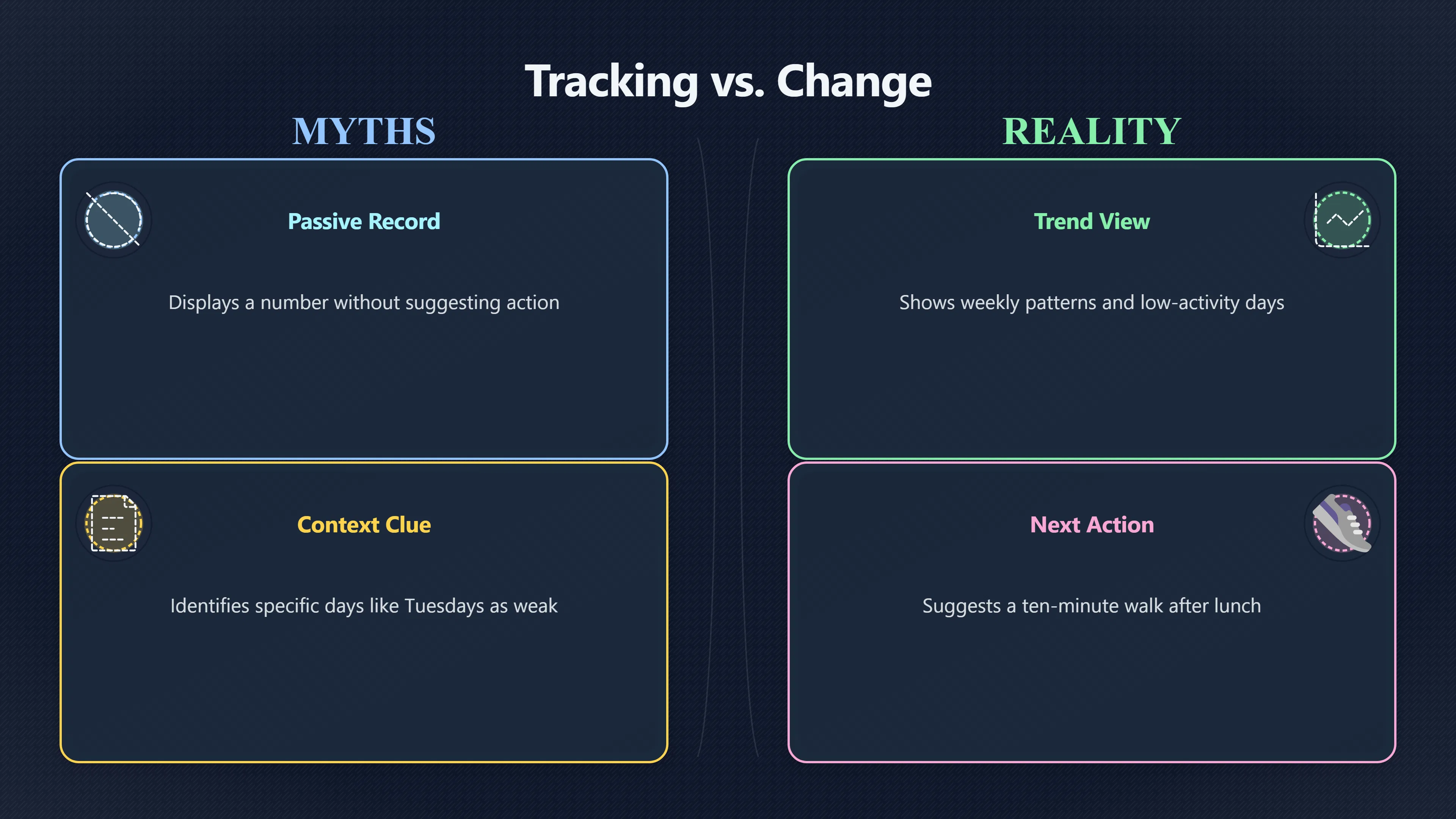
- Version one records steps and displays a number.
- Version two shows weekly trends and identifies low-activity days.
- Version three highlights that Tuesdays and Thursdays are consistently below target and suggests a ten-minute walk after lunch on those days.
Only the third version clearly links observation to behaviour change. The data points toward a specific adjustment rather than merely documenting performance.
This pattern appears repeatedly across reviews of digital interventions. Self-monitoring is most useful when combined with feedback that helps users interpret their data and decide what to do next.[Springer]link.springer.comImpact of feedback generation and presentation on self…by RA Krukowski · 2024 · Cited by 43 — This review underlines the impor…[PMC]pmc.ncbi.nlm.nih.govPMCDigital Behavior Change Intervention Designs for Habitby Y Zhu · 2024 · Cited by 58 — The results show that the most applied behavior change techniques were the self-monitoring of behavior…
What self-monitoring can reveal
The most effective tracking features expose patterns that are difficult to notice in everyday life.
Context matters more than totals
A daily total often tells less than the circumstances surrounding it. For example:
- A spending tracker may reveal that overspending clusters around Friday evenings.
- A study tracker may show that sessions started before breakfast last twice as long.
- A sleep tracker may reveal that late-night screen use consistently precedes poor sleep quality.
- A physical-activity tracker may show that office days produce lower movement than work-from-home days.
These observations create opportunities for targeted changes. Rather than trying to improve everything at once, the user can focus on a recurring trigger, barrier, or opportunity.
Digital interventions increasingly use automatic monitoring through sensors, wearables, timers, and passive data collection because reducing the effort required to track behaviour increases the likelihood that monitoring continues long enough to reveal useful patterns. Reviews of habit-focused digital interventions identify automatic monitoring as one of the most commonly used implementation methods. JMIR[PMC]pmc.ncbi.nlm.nih.govPMCDigital Behavior Change Intervention Designs for Habitby Y Zhu · 2024 · Cited by 58 — The results show that the most applied behavior change techniques were the self-monitoring of behavior…
Progress before results
Many habits produce delayed rewards. Exercise may not change appearance quickly. Saving money may not feel immediately rewarding. Learning a language may show little visible progress for weeks.
Tracking can provide evidence that the process is working even when the ultimate outcome has not yet arrived. Recording completed workouts, study sessions, savings deposits, or sleep consistency creates a visible record of repetition. This matters because habit formation typically develops gradually over months rather than days. Recent reviews suggest that automaticity often takes substantially longer than popular “21-day habit” claims imply.[PMC]pmc.ncbi.nlm.nih.govPMCDigital Behavior Change Intervention Designs for Habitby Y Zhu · 2024 · Cited by 58 — The results show that the most applied behavior change techniques were the self-monitoring of behavior…
In this role, tracking acts less like a scorecard and more like a reminder that the behaviour is occurring consistently enough for habit formation to develop.
When tracking becomes noise
The same mechanism that creates awareness can also create overload.
Many apps collect more information than users can realistically act upon. Dozens of charts, scores, and metrics may appear impressive while offering little guidance. When every fluctuation becomes visible, users can struggle to distinguish meaningful trends from normal variation.
Several common failure modes appear repeatedly:
Tracking without interpretation. Data accumulates, but the user receives no explanation of what it means.
Tracking too many behaviours at once. Monitoring ten habits simultaneously can dilute attention and make none of them feel manageable.
Manual logging fatigue. If recording behaviour becomes burdensome, engagement often declines over time.
Outcome obsession. Users focus on results they cannot directly control, such as weight fluctuations or productivity scores, instead of tracking repeatable actions.[ResearchGate]researchgate.netPDF) Time to Form a Habit: A Systematic Review and…4 Dec 2024 — Habit formation typically takes 2 to 6 months, and up to a year for s…
Research on engagement with digital health tools repeatedly identifies dropout and disengagement as major challenges. The problem is not usually that users lack data. It is that tracking demands effort while delivering insufficient value.[Frontiers]frontiersin.orgFrontiersPotential associations between behavior change…by M Milne-Ives · 2023 · Cited by 70 — The aim of this systematic review was t…
A useful rule is that every tracked metric should answer a practical question. If a number does not influence a decision, it may not need to be tracked.
Turning data into the next action
The strongest self-monitoring features do not stop at measurement. They shorten the distance between observation and action.
Research reviews examining feedback systems consistently highlight the importance of how feedback is generated and presented. Feedback is not merely additional information. It is the mechanism that helps users interpret self-monitoring data and choose a response.[Springer]link.springer.comImpact of feedback generation and presentation on self…by RA Krukowski · 2024 · Cited by 43 — This review underlines the impor…
The most useful designs typically answer one of three questions:
What happened?
A trend view, weekly summary, or comparison against a personal baseline helps users understand behaviour over time.
Example:
“Your average bedtime moved 45 minutes later this week.”
Why might it have happened?
The system identifies correlations, recurring contexts, or likely barriers.
Example:
“Most missed study sessions occurred on days with evening commitments.”
What should happen next?
The system suggests a small, specific adjustment.
Example:
“Schedule a 15-minute review session immediately after lunch on weekdays.”
This final step is where tracking becomes behaviour change rather than record keeping. The user is not left alone with the data. The data points toward a concrete experiment.
Reviews of digital habit-formation interventions show that descriptive feedback, self-set goals, prompts, and cues frequently accompany self-monitoring because they help create this transition from observation to action. JMIR[PubMed]pubmed.ncbi.nlm.nih.govBehavior Change Intervention Designs for Habit…by Y Zhu · 2024 · Cited by 83 — The results show that the most applied behavior change…

The features most likely to help
Across digital behaviour-change research, several self-monitoring features appear particularly useful:
- Automatic tracking that reduces logging effort.
- Trend visualisation that highlights patterns across days or weeks rather than isolated events.
- Behaviour-focused metrics that track actions under the user’s control.
- Personalised feedback that interprets data instead of simply displaying it.
- Goal-linked monitoring that shows progress toward a meaningful target.
- Context-sensitive summaries that identify when and where behaviours occur.
- Action suggestions that translate insights into the next repeatable step.[PMC]pmc.ncbi.nlm.nih.govPMCDigital Behavior Change Intervention Designs for Habitby Y Zhu · 2024 · Cited by 58 — The results show that the most applied behavior change techniques were the self-monitoring of behavior… [3MDPI 3JMIR]
Notably, none of these features depend on collecting the maximum possible amount of information. Their value comes from reducing uncertainty about what to do next.
The practical lesson
Tracking changes habits when it supports self-regulation rather than surveillance. The goal is not to build the most complete record of behaviour. The goal is to make important patterns visible early enough to influence the next decision.
A step count becomes useful when it reveals inactive days that need a walking cue. A spending log becomes useful when it exposes a recurring trigger for impulse purchases. A study tracker becomes useful when it identifies the conditions under which learning actually happens.
The strongest self-monitoring systems therefore act less like archives and more like mirrors. They reflect behaviour clearly enough that a person can recognise a pattern, understand its significance, and take the next small action that keeps a habit moving forward.[PMC]pmc.ncbi.nlm.nih.govPMCDigital Behavior Change Intervention Designs for Habitby Y Zhu · 2024 · Cited by 58 — The results show that the most applied behavior change techniques were the self-monitoring of behavior…[MDPI]mdpi.comImplementation of Behavior Change Theories and…by P Cotie · 2025 · Cited by 4 — Examples of these practical strategies that can be…[Springer]link.springer.comImpact of feedback generation and presentation on self…by RA Krukowski · 2024 · Cited by 43 — This review underlines the impor…
Amazon book picks
Further Reading
Books and field guides related to When does tracking actually change a habit?. Use these as the next step if you want deeper reading beyond the article.
Atomic Habits
Rating: 3.5/5 from 7 Google Books ratings
Connects tracking, feedback, and habit formation into practical action.
Measure What Matters
Demonstrates how measurement becomes useful when linked to meaningful goals.
eBay marketplace picks
Marketplace Samples
Example marketplace items related to this page. Use the search link to explore similar finds on eBay.


Endnotes
1.
Source: jmir.org
Link:https://www.jmir.org/2024/1/e54375/
Source snippet
Digital Behavior Change Intervention Designs for Habit...by Y Zhu · 2024 · Cited by 58 — The results show that the most applied beha...
2.
Source: pmc.ncbi.nlm.nih.gov
Title: PMCDigital Behavior Change Intervention Designs for Habit
Link:https://pmc.ncbi.nlm.nih.gov/articles/PMC11161714/
Source snippet
by Y Zhu · 2024 · Cited by 58 — The results show that the most applied behavior change techniques were the self-monitoring of behavior...
3.
Source: mdpi.com
Link:https://www.mdpi.com/1424-8220/24/8/2429
Source snippet
A Comprehensive Review of Behavior Change Techniques...by C Del-Valle-Soto · 2024 · Cited by 38 — Users can track their own behavior...
4.
Source: mdpi.com
Link:https://www.mdpi.com/1660-4601/22/7/1133
Source snippet
Implementation of Behavior Change Theories and...by P Cotie · 2025 · Cited by 4 — Examples of these practical strategies that can be...
5.
Source: link.springer.com
Link:https://link.springer.com/article/10.1186/s12966-023-01555-6
Source snippet
Impact of feedback generation and presentation on self...by RA Krukowski · 2024 · Cited by 43 — This review underlines the impor...
6.
Source: pmc.ncbi.nlm.nih.gov
Link:https://pmc.ncbi.nlm.nih.gov/articles/PMC12259960/
Source snippet
review and meta analysis of standalone digital...by SA Lee · 2025 · Cited by 5 — The most common behavior change techniques were 2.2 fee...
7.
Source: pmc.ncbi.nlm.nih.gov
Link:https://pmc.ncbi.nlm.nih.gov/articles/PMC11641623/
Source snippet
Time to Form a Habit: A Systematic Review and Meta-Analysis...by B Singh · 2024 · Cited by 67 — The meta-analysis showed significant...
8.
Source: researchgate.net
Link:https://www.researchgate.net/publication/386593213_Time_to_Form_a_Habit_A_Systematic_Review_and_Meta-Analysis_of_Health_Behaviour_Habit_Formation_and_Its_Determinants
Source snippet
(PDF) Time to Form a Habit: A Systematic Review and...4 Dec 2024 — Habit formation typically takes 2 to 6 months, and up to a year for s...
9.
Source: researchgate.net
Link:https://www.researchgate.net/publication/391205475_Small_changes_big_impact_A_mini_review_of_habit_formation_and_behavioral_change_principles
Source snippet
Small changes, big impact: A mini review of habit formation...27 Apr 2025 — This mini-review explores the science of habit f...
10.
Source: mdpi.com
Link:https://www.mdpi.com/2227-9032/12/23/2488
Source snippet
Time to Form a Habit: A Systematic Review and Meta...by B Singh · 2024 · Cited by 68 — Practitioners should counsel patients on the exte...
11.
Source: researchgate.net
Title: Digital Behavior Change Intervention Designs for Habit
Link:https://www.researchgate.net/publication/380854529_Digital_Behavior_Change_Intervention_Designs_for_Habit_Formation_Systematic_Review
Source snippet
May 24, 2024 — The results show that the most applied behavior change techniques were the self-monitoring of behavior, goal setting, and...
Published: May 24, 2024
12.
Source: researchgate.net
Link:https://www.researchgate.net/publication/330406744_Habit_Formation_and_Behavior_Change
Source snippet
nge interventions, drawing on the most methodologically and...Read more...
13.
Source: researchgate.net
Link:https://www.researchgate.net/publication/391233961_The_Impact_of_Dedicated_Mobile_Apps_on_Habit_Formation_A_Systematic_Review
Source snippet
The Impact of Dedicated Mobile Apps on Habit Formation28 Apr 2025 — The results show that the most applied behavior change techniques wer...
14.
Source: jmir.org
Link:https://www.jmir.org/2024/1/e54375/citations
Source snippet
Digital Behavior Change Intervention Designs for Habit...24 May 2024 — Digital Behavior Change Intervention Designs for Habit Formation...
Published: May 2024
15.
Source: pubmed.ncbi.nlm.nih.gov
Link:https://pubmed.ncbi.nlm.nih.gov/38787601/
Source snippet
Behavior Change Intervention Designs for Habit...by Y Zhu · 2024 · Cited by 83 — The results show that the most applied behavior change...
16.
Source: frontiersin.org
Link:https://www.frontiersin.org/journals/psychology/articles/10.3389/fpsyg.2023.1227443/full
Source snippet
FrontiersPotential associations between behavior change...by M Milne-Ives · 2023 · Cited by 70 — The aim of this systematic review was t...
17.
Source: pubmed.ncbi.nlm.nih.gov
Link:https://pubmed.ncbi.nlm.nih.gov/39088817/
Source snippet
Change Techniques Within Digital Interventions...by PC Thomas · 2024 · Cited by 14 — This study aims to define the BCTs within digital s...
Additional References
18.
Source: nature.com
Link:https://www.nature.com/nature-index/topics/l4/behavior-change-and-habit-formation-in-health-contexts
Source snippet
Behavior Change and Habit Formation in Health ContextsBehaviour change and habit formation lie at the heart of promoting and sustaining h...
19.
Source: merriam-webster.com
Link:https://www.merriam-webster.com/dictionary/digital
Source snippet
DIGITAL Definition & Meaning6 days ago — The [meaning]({{ 'meaning/' | relative_url }}) of DIGITAL is of, relating to, or utilizing devices constructed or working by the me...
20.
Source: healthline.com
Link:https://www.healthline.com/health/how-long-does-it-take-to-form-a-habit
Source snippet
Habit Formation: How Long It Takes and How to Start NowIt can take anywhere from 18 to 254 days for a person to form a new habit and an a...
21.
Source: ijsmsjournal.org
Link:https://ijsmsjournal.org/2024/volume-7%20issue-1/ijsms-v7i1p115.pdf
22.
Source: research.polyu.edu.hk
Title: digital behavior change intervention designs for habit formation
Link:https://research.polyu.edu.hk/en/publications/digital-behavior-change-intervention-designs-for-habit-formation-/
Source snippet
PolyU Scholars HubDigital Behavior Change Intervention Designs for Habit...by Y Zhu · 2024 · Cited by 57 — The results show that the mos...
23.
Source: success.com
Link:https://www.success.com/success-edge/the-identity-trap
Source snippet
The Identity Trap: Why Your Brain Won't Let You Build...1 day ago — Implementation intentions must bridge the gap between identity and a...
24.
Source: sciencedirect.com
Link:https://www.sciencedirect.com/science/article/pii/S027795362500930X
Source snippet
Navigating behavioural change: insights from prompts self...by ES Collier · 2025 — Do automated digital health behaviour change interven...
25.
Source: pmc.ncbi.nlm.nih.gov
Link:https://pmc.ncbi.nlm.nih.gov/articles/13153395
Source snippet
Change Techniques in Digital Health Interventions...A systematic review of internet-based self-help therapeutic interventions to improve...
26.
Source: semanticscholar.org
Link:https://www.semanticscholar.org/paper/Digital-Behavior-Change-Intervention-Designs-for-Zhu-Long/31fd298628af87ecfa1cfe1b9e952ff62cf38450
Source snippet
r change techniques, types of habit formation techniques...
27.
Source: tandfonline.com
Link:https://www.tandfonline.com/doi/full/10.1080/08870446.2026.2626493
Source snippet
Determinants and strategies of self-reported habit...by R Edgren · 2026 · Cited by 1 — Theorised person related determinants of habit fo...
Topic Tree