Within Feedback
When the Tracker Becomes the Problem
Tracking can stop helping when the dashboard becomes more important than the behaviour it was meant to support.
On this page
- Signs the feedback system is too noisy
- How streaks and dashboards can shift the goal
- Ways to simplify tracking without losing the loop
Page outline Jump by section
Introduction
Feedback loops are valuable because they make behaviour visible. The problem begins when the feedback system stops serving the behaviour and starts competing with it. A tracker that was meant to support exercise, writing, saving money or better sleep can gradually become a separate project: updating dashboards, reviewing graphs, fixing categories, maintaining streaks and analysing metrics. At that point, the person may spend more energy observing improvement than creating it.
 Research consistently shows that monitoring progress can improve goal attainment, especially when progress is recorded. Yet the same body of work on self-tracking and personal informatics also documents friction, burden, demotivation and abandonment when tracking becomes too demanding or emotionally costly. The useful question is not whether tracking works. It is whether the tracker is still helping the underlying behaviour.[White Rose Research Online]eprints.whiterose.ac.ukby B Harkin · 2016 · Cited by 750 — Taken together, the findings suggest that monitoring goal progress is an effective self-regulation st…[PMC]pmc.ncbi.nlm.nih.govSelf-monitoring often involves self-evaluation…Read more…
When Tracking Stops Being Feedback
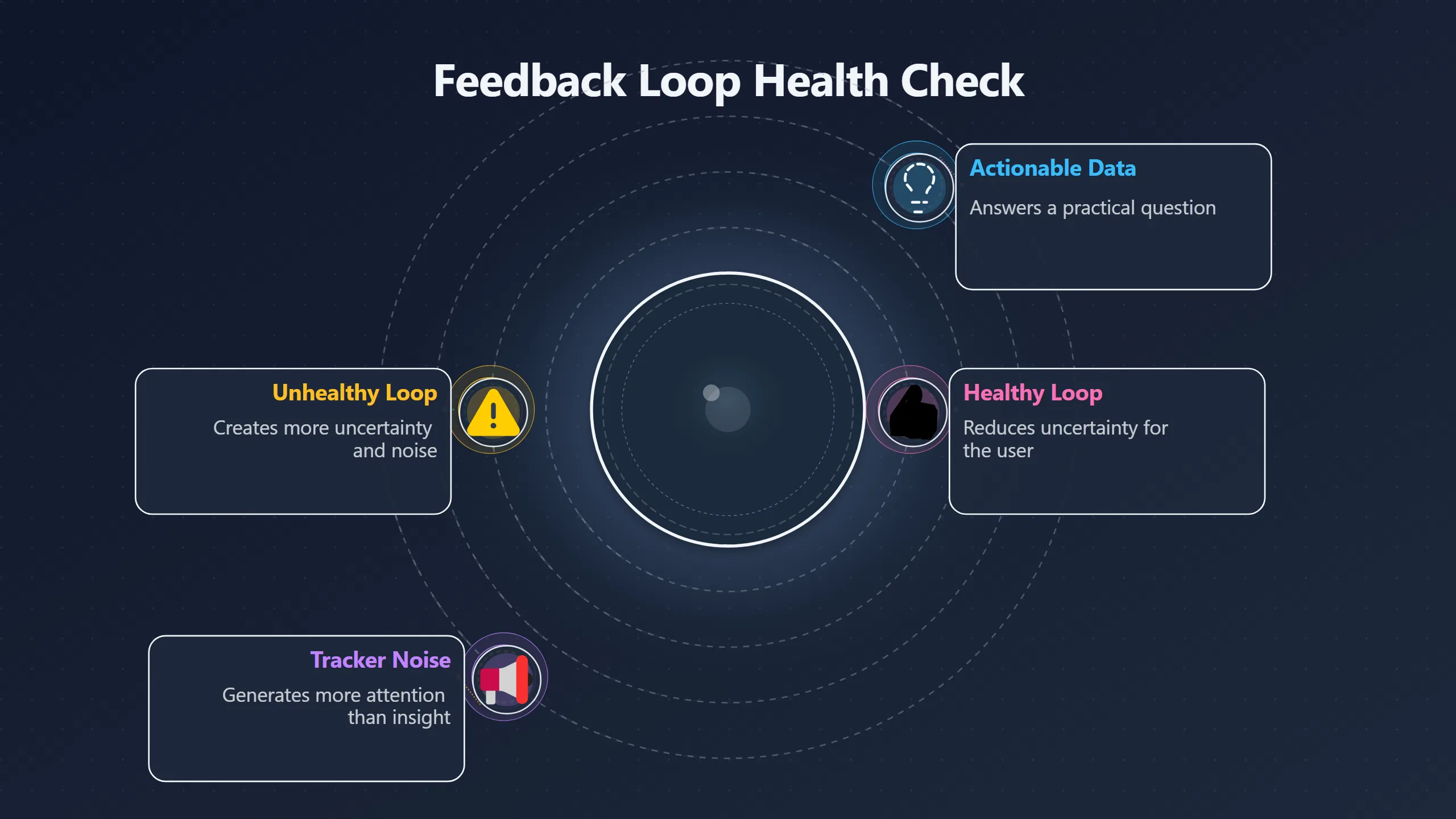
A healthy feedback loop reduces uncertainty. An unhealthy one creates more of it.
Many self-improvement systems begin with a simple measure: workouts completed, pages written, money saved, hours slept. Over time, people often add layers. One metric becomes five. A weekly review becomes a daily dashboard. Notes become tags, categories, colour codes and correlations. The system becomes increasingly sophisticated, but not necessarily more useful.
Researchers studying self-tracking technologies repeatedly note a tension between the value of information and the effort required to collect and manage it. Tracking creates awareness, but it also creates maintenance work. When the maintenance cost rises faster than the value of the insight, users experience tracking fatigue and disengagement.[pac.cs.cornell.edu]pac.cs.cornell.edureater awareness of behaviors and can create a reactive effect yielding positive, therapeutic behavior…[PMC]pmc.ncbi.nlm.nih.govSelf-tracking and the Quantified Self Promote Health and…by S Feng · 2021 · Cited by 249 — We have undertaken a systematic literature…
The danger is subtle because dashboard work feels productive. Looking at a chart can feel similar to improving the thing the chart measures. A person may spend twenty minutes refining a habit tracker instead of spending twenty minutes doing the habit.
This creates a form of avoidance that is disguised as self-improvement.
Signs the Feedback System Is Too Noisy
A tracker has become noise when it generates more attention than actionable information.
Common warning signs include:
- You spend more time recording behaviour than performing it.
- Missing data feels more upsetting than missing the behaviour itself.
- You frequently redesign the system instead of using it.
- You check dashboards repeatedly without making changes.
- Tracking sessions create guilt, anxiety or procrastination.
- You avoid opening the app because the information feels unpleasant.
- New metrics are added regularly, but few are removed.
One of the recurring findings in self-tracking research is that people often stop using systems that demand excessive manual input or create emotional discomfort. The problem is not a lack of data. It is that the cost of engaging with the data becomes too high. PMC[2pac.cs.cornell.edu]pac.cs.cornell.edureater awareness of behaviors and can create a reactive effect yielding positive, therapeutic behavior…
A useful rule is that every metric should answer a practical question. If a chart exists only because it can exist, it is probably noise.
How Streaks and Dashboards Can Shift the Goal
The most common tracking failure is goal substitution.
The original goal might be exercising three times per week. The tracker introduces a visible streak counter. Over time, preserving the streak becomes emotionally more important than exercising for health. The measure has become the target.
This pattern resembles a broader management problem often summarised by Goodhart’s Law: when a measure becomes a target, it can stop functioning as a good measure. In personal improvement, the distortion is usually psychological rather than deliberate. People begin optimising what is easy to count instead of what they originally cared about.
A writer who tracks daily word counts may produce words simply to protect a streak. A reader may choose shorter books because they increase completion statistics. Someone focused on fitness may chase wearable metrics while ignoring recovery, enjoyment or injury risk.
The dashboard starts defining success.
The irony is that the person can appear increasingly successful according to the metrics while drifting away from the real objective.
Research on self-tracking design has highlighted the importance of presenting data in ways that support motivation rather than turning metrics into sources of discouragement or misplaced focus. Poorly designed feedback can produce the opposite of the intended behavioural effect.[JMIR]jmir.orgHow Self-tracking and the Quantified Self Promote Health…by S Feng · 2021 · Cited by 249 — We have undertaken a systematic literat…
Why More Data Is Not Always Better
The quantified-self movement demonstrated that personal data can reveal useful patterns. People can discover relationships between sleep and mood, exercise and energy, or spending and financial stress. However, self-tracking research has also shown that accumulating data does not automatically create insight.[JMIR]jmir.orgHow Self-tracking and the Quantified Self Promote Health…by S Feng · 2021 · Cited by 249 — We have undertaken a systematic literat…
Three mechanisms commonly turn useful tracking into avoidance:
Information overload. Too many variables make it harder to identify the few factors that matter. Instead of clarifying decisions, the dashboard creates ambiguity.
Analysis without action. Reviewing data provides a sense of engagement that can replace behavioural change. Insight becomes an endpoint rather than a trigger.
Emotional buffering. Looking at numbers can feel safer than confronting behaviour directly. Someone may spend hours analysing productivity statistics because it is less uncomfortable than starting an important task.
The result is a paradox: more measurement can produce less behavioural adaptation.

The Hidden Cost of Tracker Maintenance
Every feedback system has an administrative burden.
This burden is often ignored because it accumulates gradually. Recording entries, correcting mistakes, synchronising apps, reviewing reports and managing categories each consume a small amount of attention. Individually they seem trivial. Together they can become a meaningful share of the effort.
Research in personal informatics has repeatedly identified tracking burden as a central design challenge. Semi-automated approaches are often recommended because they preserve awareness while reducing the labour required from the user. The less energy spent maintaining the system, the more energy remains available for the behaviour itself.[pac.cs.cornell.edu]pac.cs.cornell.edureater awareness of behaviors and can create a reactive effect yielding positive, therapeutic behavior…
A useful feedback loop should feel lighter over time. If it becomes progressively heavier, it is probably growing beyond its purpose.
Ways to Simplify Tracking Without Losing the Loop
The solution is rarely abandoning feedback altogether. The solution is reducing the amount of tracking to the minimum needed for learning.
Track Decisions, Not Everything
Many people track every outcome but few track the behaviours that produce those outcomes.
Instead of monitoring dozens of fitness indicators, track workouts completed. Instead of tracking every productivity statistic, track focused work sessions started.
The closer the measure is to a controllable action, the more useful it usually becomes.
Remove Metrics That Never Change Decisions
A metric earns its place only if it influences behaviour.
Ask a simple question: “What would I do differently if this number increased or decreased?”
If there is no answer, the metric is probably decorative.
Review Less Frequently
Some dashboards are checked far more often than the underlying behaviour changes.
Daily reviews of long-term goals often generate noise. Weekly or monthly reviews may provide clearer signals because meaningful trends have had time to emerge.
Use One Primary Measure
A single clear measure is often more effective than a sophisticated dashboard.
For example:
- Workouts completed this week.
- Days studied.
- Savings transferred.
- Hours of sleep above a chosen threshold.
Supporting metrics can exist, but one measure should dominate attention.
Allow Imperfection
Many tracking systems fail because they demand complete data.
Missing an entry should not require rebuilding the system. A useful tracker survives imperfect use. If the system collapses after a few missed days, the system is too fragile.
The Test of a Good Dashboard
The simplest test is behavioural.
After interacting with a dashboard, do you know what action to take next?
If the answer is yes, the feedback loop is working. If the answer is no, the dashboard may be functioning as entertainment, reassurance, anxiety management or procrastination rather than feedback.
In effective self-improvement systems, tracking is not the goal. It is a temporary aid for noticing reality. The best dashboards eventually become almost invisible. They provide just enough information to guide the next adjustment, then get out of the way so the real work can happen.
Amazon book picks
Further Reading
Books and field guides related to When the Tracker Becomes the Problem. Use these as the next step if you want deeper reading beyond the article.
Atomic Habits
Rating: 3.5/5 from 7 Google Books ratings
Advocates simple tracking that serves behavior rather than complexity.
eBay marketplace picks
Marketplace Samples
Example marketplace items related to this page. Use the search link to explore similar finds on eBay.




Endnotes
1.
Source: pmc.ncbi.nlm.nih.gov
Link:https://pmc.ncbi.nlm.nih.gov/articles/PMC6122239/
Source snippet
Self-monitoring often involves self-evaluation...Read more...
2.
Source: pac.cs.cornell.edu
Link:https://pac.cs.cornell.edu/pubs/ekchoe_pervasive17.pdf
Source snippet
reater awareness of behaviors and can create a reactive effect yielding positive, therapeutic behavior...
3.
Source: pmc.ncbi.nlm.nih.gov
Link:https://pmc.ncbi.nlm.nih.gov/articles/PMC8493454/
Source snippet
Self-tracking and the Quantified Self Promote Health and...by S Feng · 2021 · Cited by 249 — We have undertaken a systematic literature...
4.
Source: jmir.org
Link:https://www.jmir.org/2021/9/e25171/
Source snippet
How Self-tracking and the Quantified Self Promote Health...by S Feng · 2021 · Cited by 249 — We have undertaken a systematic literat...
5.
Source: pmc.ncbi.nlm.nih.gov
Link:https://pmc.ncbi.nlm.nih.gov/articles/PMC10589825/
Source snippet
Mental Health Self-Tracking Preferences of Young Adults With...by ML Beltzer · 2023 · Cited by 10 — This study seeks to assess the ty...
6.
Source: eprints.whiterose.ac.uk
Link:https://eprints.whiterose.ac.uk/id/eprint/87431/1/bul%20harkin%20raw%20final.pdf
Source snippet
by B Harkin · 2016 · Cited by 750 — Taken together, the findings suggest that monitoring goal progress is an effective self-regulation st...
7.
Source: kinfolk.com
Title: The Quantified Self
Link:https://www.kinfolk.com/stories/the-quantified-self/
Source snippet
But for the 95,000-strong QS community, self-tracking is more than just a casual habit. “It becomes a way of life,” explains Btiha...
Additional References
8.
Source: researchgate.net
Link:https://www.researchgate.net/publication/353303143_How_Self-tracking_and_the_Quantified_Self_Promote_Health_and_Well-being_A_Systematic_Literature_Review
Source snippet
(PDF) How Self-tracking and the Quantified Self Promote...21 Sept 2021 — We have undertaken a systematic literature review on self-track...
9.
Source: publica.fraunhofer.de
Link:https://publica.fraunhofer.de/bitstreams/74cbccfe-97d9-4f82-b06a-1084c7e0d687/download
Source snippet
much do self-trackers care about their data's privacy?by A Floris · Cited by 1 — As self-tracking has grown more common, it is crucial th...
10.
Source: researchgate.net
Title: Does Monitoring Goal Progress Promote Goal Attainment?
Link:https://www.researchgate.net/publication/291335719_Does_Monitoring_Goal_Progress_Promote_Goal_Attainment_A_Meta-Analysis_of_the_Experimental_Evidence
Source snippet
The findings suggest that monitoring goal progress is an effective self-regulation strategy, and that interventions that increase the fre...
11.
Source: cdtm.com
Title: reflecting on technologies ii our quantified self
Link:https://cdtm.com/blog/reflecting-on-technologies-ii-our-quantified-self
Source snippet
Reflecting on Technologies II: Our quantified self17 Oct 2023 — From monitoring every step taken to counting every calorie consumed, self...
12.
Source: semanticscholar.org
Link:https://www.semanticscholar.org/paper/Self-tracking-for-Mental-Wellness%3A-Understanding-Kelley-Lee/5d32d91acbee7a11b9545ae79486cb67f9a1a3ed
Source snippet
and mental wellness in student populations reveal expert perspectives on the...
13.
Source: reddit.com
Link:https://www.reddit.com/r/selfimprovement/comments/1tiettl/habit_tracking_apps_reviewed_for_people_who_are/
Source snippet
Habit tracking apps reviewed for people who are done with...Quantified-self tracker that combines habits with mood, sleep, and activity...
14.
Source: quantifiedself.com
Link:https://quantifiedself.com/blog/quantified-self-101-make-it-smart/
Source snippet
Quantified Self 101: Make it SMART26 Jan 2012 — Quantified Self is all about using the power of data to help you learn about yourself...
15.
Source: cambridge.org
Link:https://www.cambridge.org/core/journals/public-health-nutrition/article/websitebased-eatracker-my-goals-feature-a-qualitative-evaluation/E42D73050D3C90093C86C4733B83D9B1
Source snippet
The website-based eaTracker® 'My Goals' featureby JRL Lieffers · 2017 · Cited by 11 — The purpose of the present study was to document ex...
16.
Source: ris.utwente.nl
Link:https://ris.utwente.nl/ws/files/213653232/Asbjornsen2019persuasive.pdf
Source snippet
System Design Principles and Behavior Changeby RA Asbjørnsen · 2019 · Cited by 192 — Behavior change [techniques]({{ 'techniques/' | relative_url }}) (BCTs) are observable and...
17.
Source: todoist.com
Link:https://www.todoist.com/inspiration/quantified-self-apps
Source snippet
14 Quantified Self Apps: How to Build a Simple Tracking...The quantified self is a movement in which you track aspects of your daily lif...
Topic Tree