Within Feedback
Why Better Feedback Sounds Less Personal
Feedback works better when it names the task problem instead of turning data into a verdict on character.
On this page
- Why self judgement gives no usable instruction
- How task focused wording changes the next attempt
- Examples that turn blame into system diagnosis
Page outline Jump by section
Introduction
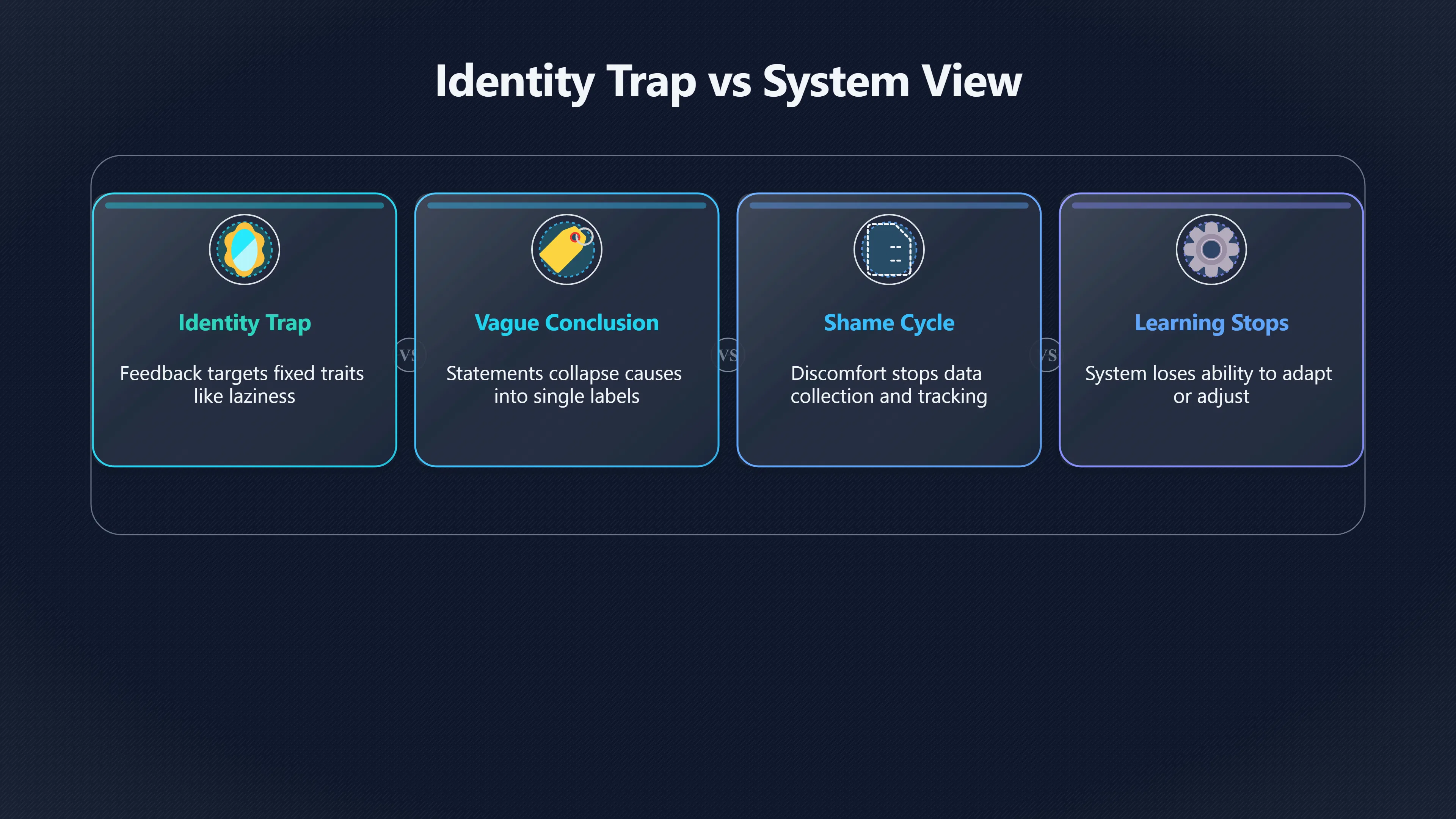
Many self-improvement systems fail at the feedback stage, not because the information is wrong, but because the interpretation becomes personal. A missed workout turns into “I am lazy”. A poor presentation becomes “I am not good enough”. Once feedback is treated as a verdict on character, it often triggers shame, avoidance, and defensive thinking rather than useful adjustment.
 Task-focused feedback works differently. It keeps attention on what happened, what influenced the result, and what can change next time. Instead of asking, “What does this say about me?”, it asks, “What does this say about the process?” Research on feedback, self-regulation, self-compassion, and learning consistently suggests that people cope better with setbacks and persist longer when feedback targets strategies, effort allocation, or task execution rather than personal worth.[PubMed]pubmed.ncbi.nlm.nih.govPerson versus process praise and criticism: implications for…by ML Kamins · 1999 · Cited by 1621 — Two studies tested the hypoth…[PMC]pmc.ncbi.nlm.nih.govSelf-regulatory behavior change techniques in interventions to…by B Spring · 2020 · Cited by 115 — Inclusion of 14 self-regulatory…
Why Self-Judgement Gives No Usable Instruction
Self-judgement feels informative because it is emotionally intense. In practice, however, it is often vague.
Consider the difference:
- “I am undisciplined.”
- “I started work with my phone beside me and checked messages three times in the first fifteen minutes.”
The first statement describes an identity. The second describes a behaviour. Only one of them suggests a possible intervention.
This distinction matters because behaviour can be changed, redesigned, supported, automated, simplified, or replaced. Character labels rarely provide any clear next action. They tend to collapse many possible causes into a single negative conclusion about the self.
Research on self-compassion and self-criticism helps explain why. Self-compassion is not simply being kind to oneself. In the psychological literature, it is associated with a style of responding to mistakes that combines acknowledgement of the problem with constructive correction. Rather than denying failure, it allows people to examine it without becoming consumed by self-condemnation. Studies consistently find links between self-compassion, reduced maladaptive self-criticism, and more adaptive responses to setbacks.[Self-Compassion]self-compassion.orgPsych Review article in press21 self-criticism, self-compassion uses warmth, encouragement, and constructive feedback to work toward personal goals. Self-compassion is… Frontiers The practical consequence is simple: when feedback attacks identity[frontiersin.org]frontiersin.orgThe impact of Emotion-focused training for…by J Halamová · 2023 · Cited by 8 — Empirical research is increasingly focused on self-comp…, attention shifts from solving the problem to protecting the self.
How Shame Disrupts the Feedback Loop
A useful feedback loop requires accurate observation. Shame often interrupts that process.
When people anticipate feeling judged by their own data, they frequently stop collecting it. They avoid stepping on the scale, checking spending, reviewing study results, or opening the habit tracker. The problem is no longer the behaviour itself; it becomes the discomfort associated with seeing evidence.
This creates a damaging cycle:
- A setback occurs.
- The setback is interpreted as evidence of personal failure.
- Shame increases.
- Measurement becomes unpleasant.
- Feedback is avoided.
- Learning stops.
The original goal may still matter, but the system loses its ability to adapt.
Behaviour-change research repeatedly identifies monitoring and feedback as important self-regulation mechanisms because they provide information for adjustment. Those mechanisms only work when people remain willing to look at the information. PMC[EEF]educationendowmentfoundation.org.ukSelf-regulation strategies | EEFSelf-regulation strategies have a positive impact (+ three months), on average, and may be a cost-effecti…
Task-focused feedback preserves that willingness by treating data as operational information rather than moral judgement.
How Task-Focused Wording Changes the Next Attempt
The most effective feedback often sounds surprisingly impersonal.
Instead of explaining outcomes through fixed traits, it identifies controllable elements of performance:
- Timing
- Preparation
- Environment
- Strategy
- Attention
- Sequence
- Resources
- Difficulty level
This shift transforms feedback from diagnosis of the person into diagnosis of the system.
For example:
Personal interpretation
“I have no self-control.”
Task-focused interpretation[researchgate.net]researchgate.net361410794 Learning from Failure with Self vs Task Focused FeedbackLearning from Failure with Self vs Task Focused Feedback19 Jun 2022 — Decades of feedback research have suggested that feedback is more e…
“My plan relied on resisting distractions rather than removing them.”
The second statement immediately suggests experiments: block websites, change location, work offline, or create a pre-start routine.
Task-focused feedback also reduces the tendency to overgeneralise. A failed study session becomes a failed study session rather than proof of permanent incompetence. A missed run becomes a scheduling problem rather than evidence that fitness goals are impossible.
The key mechanism is specificity. The narrower and more observable the feedback, the easier it becomes to adjust behaviour on the next attempt.
What Research Says About Person-Focused and Process-Focused Feedback
One of the most influential lines of research on feedback comes from studies comparing person-focused and process-focused responses.
Person-focused feedback targets traits or identity:
- “You are smart.”
- “You are talented.”
- “You are careless.”
- “You are bad at this.”
Process-focused feedback targets actions, strategies, or methods:
- “That strategy worked well.”
- “You concentrated for longer this time.”
- “You skipped an important step.”
- “This approach did not solve the problem.”
Research by Melissa Kamins and Carol Dweck found that feedback framed around the person can create a sense that worth depends on performance. After setbacks, children exposed to person-focused praise or criticism showed more helpless responses and self-blame than those receiving process-focused feedback.[PubMed]pubmed.ncbi.nlm.nih.govPerson versus process praise and criticism: implications for…by ML Kamins · 1999 · Cited by 1621 — Two studies tested the hypoth…[Student Experience Research Network]studentexperiencenetwork.orgStudent Experience Research Network Person vsprocess praise and criticismDweck, Carol S. Children displayed more "helpless" responses (including self blame) after receiving person cr…
The important lesson for self-improvement is that people can deliver person-focused feedback to themselves just as easily as others can.
Many internal monologues sound like this:
- “I am not disciplined.”
- “I am the type of person who always quits.”
- “I am terrible at consistency.”
These statements mirror the same identity-focused pattern that research associates with poorer coping after setbacks.[PubMed]pubmed.ncbi.nlm.nih.govPerson versus process praise and criticism: implications for…by ML Kamins · 1999 · Cited by 1621 — Two studies tested the hypoth… ScienceDirect Replacing them with process-focused observations keeps attention on changeable variables.[sciencedirect.com]sciencedirect.comA network approach to shame: The central roles of self…by B ShamsAlam · 2025 · Cited by 4 — This network analysis provides a precise u…

Examples That Turn Blame Into System Diagnosis
The easiest way to apply task-focused feedback is to rewrite self-blaming conclusions as operational observations.
Exercise
Blame
“I am too lazy to exercise.”
System diagnosis
“I scheduled workouts after my energy was already depleted.”
Possible adjustment
Move exercise earlier or reduce session length.
Writing
Blame
“I lack discipline.”
System diagnosis
“I start with a vague task and spend the first ten minutes deciding what to do.”
Possible adjustment
Define the first action before ending the previous session.
Spending
Blame
“I am bad with money.”
System diagnosis
“Most unplanned purchases happen when I browse late at night.”
Possible adjustment
Remove shopping apps or set a waiting period.
Studying
Blame
“I am not smart enough.”
System diagnosis
“I reviewed material passively instead of testing recall.”
Possible adjustment
Switch from rereading to retrieval practice.
Notice that none of the revised versions excuse the problem. They simply describe it in a form that can influence the next attempt.
The Test: Can the Feedback Produce an Experiment?
A practical way to evaluate feedback is to ask a single question:
Does this statement suggest a specific experiment?
If the answer is no, the feedback is probably too personal or too vague.
Compare these examples:
- “I am unreliable.”
- “My reminders are arriving after the task should have started.”
Only the second statement naturally leads to a test.
Likewise:
- “I am terrible at habits.”
- “Missing one day often becomes three because I have no recovery plan.”
The second statement suggests an intervention immediately: create a rule for restarting after interruptions.
Useful feedback narrows the gap between observation and action. Unhelpful feedback widens it by turning performance data into identity judgements.
Why Better Feedback Sounds Less Personal
People often assume that harsh self-criticism creates accountability. The evidence suggests a more complicated reality. Constructive self-correction does not require attacking the self. It requires accurate information, emotional tolerance, and attention to variables that can actually be changed.[Self-Compassion]self-compassion.orgPsych Review article in press21 self-criticism, self-compassion uses warmth, encouragement, and constructive feedback to work toward personal goals. Self-compassion is… Frontiers The most productive feedback therefore sounds less like a verdict and more like an investigation.[frontiersin.org]frontiersin.orgThe impact of Emotion-focused training for…by J Halamová · 2023 · Cited by 8 — Empirical research is increasingly focused on self-comp…
Instead of asking whether a result proves something about who you are, task-focused feedback asks what the result reveals about the system you are using. That small shift prevents shame from consuming the signal. The mistake remains visible, but it becomes information for redesign rather than evidence for self-condemnation.
Amazon book picks
Further Reading
Books and field guides related to Why Better Feedback Sounds Less Personal. Use these as the next step if you want deeper reading beyond the article.
eBay marketplace picks
Marketplace Samples
Example marketplace items related to this page. Use the search link to explore similar finds on eBay.



Endnotes
1.
Source: pmc.ncbi.nlm.nih.gov
Link:https://pmc.ncbi.nlm.nih.gov/articles/PMC7429262/
Source snippet
Self-regulatory behavior change [techniques]({{ 'techniques/' | relative_url }}) in interventions to...by B Spring · 2020 · Cited by 115 — Inclusion of 14 self-regulatory...
2.
Source: self-compassion.org
Title: Psych Review article in press
Link:https://self-compassion.org/wp-content/uploads/2022/06/Psych-Review-article-in-press.pdf
Source snippet
21 self-criticism, self-compassion uses warmth, encouragement, and constructive feedback to work toward personal goals. Self-compassion is...
3.
Source: sciencedirect.com
Link:https://www.sciencedirect.com/science/article/pii/S2666915325000204
Source snippet
A network approach to shame: The central roles of self...by B ShamsAlam · 2025 · Cited by 4 — This network analysis provides a precise u...
4.
Source: educationendowmentfoundation.org.uk
Link:https://educationendowmentfoundation.org.uk/early-years/toolkit/self-regulation-strategies
Source snippet
Self-regulation strategies | EEFSelf-regulation strategies have a positive impact (+ three months), on average, and may be a cost-effecti...
5.
Source: sciencedirect.com
Link:https://www.sciencedirect.com/science/article/pii/S0148296322009006
Source snippet
Self-regulation and goal-directed behavior: A systematic...by S Billore · 2023 · Cited by 112 — This article is one of the first to pres...
6.
Source: sciencedirect.com
Link:https://www.sciencedirect.com/science/article/abs/pii/S0959475226000046
Source snippet
The roles of growth mindset and feedback type in shaping...by X Liu · 2026 — Person-oriented criticism targets the child's global self (...
7.
Source: youtube.com
Title: Carol Dweck
Link:https://www.youtube.com/watch?v=NWv1VdDeoRY
Source snippet
Defensiveness Ends Here | The What, So What, Now What Framework...
8.
Source: pubmed.ncbi.nlm.nih.gov
Link:https://pubmed.ncbi.nlm.nih.gov/10380873/
Source snippet
Person versus process praise and criticism: implications for...by ML Kamins · 1999 · Cited by 1621 — Two studies tested the hypoth...
9.
Source: frontiersin.org
Link:https://www.frontiersin.org/journals/psychology/articles/10.3389/fpsyg.2022.1047022/full
Source snippet
The impact of Emotion-focused training for...by J Halamová · 2023 · Cited by 8 — Empirical research is increasingly focused on self-comp...
10.
Source: studentexperiencenetwork.org
Title: Student Experience Research Network Person vs
Link:https://studentexperiencenetwork.org/research_library/person-vs-process-praise-and-criticism-implications-for-contingent-self-worth-and-coping/
Source snippet
process praise and criticismDweck, Carol S. Children displayed more "helpless" responses (including self blame) after receiving person cr...
11.
Source: researchgate.net
Title: 361410794 Learning from Failure with Self vs Task Focused Feedback
Link:https://www.researchgate.net/publication/361410794_Learning_from_Failure_with_Self_vs_Task_Focused_Feedback
Source snippet
Learning from Failure with Self vs Task Focused Feedback19 Jun 2022 — Decades of feedback research have suggested that feedback is more e...
12.
Source: dictionary.cambridge.org
Link:https://dictionary.cambridge.org/ja/dictionary/english/person
Source snippet
意味, Cambridge 英語辞書での定義person noun [C] (HUMAN)... a man, woman, or child: Who was the first person to swim the English Channel? A meal...
13.
Source: frontiersin.org
Link:https://www.frontiersin.org/journals/psychology/articles/10.3389/fpsyg.2025.1625771/full
Source snippet
A comparative study of state self-esteem responses to...by YH Chen · 2025 · Cited by 10 — Adolescents demonstrated significantly greater...
14.
Source: linkedin.com
Title: how can you use self compassion deal feedback
Link:https://www.linkedin.com/advice/0/how-can-you-use-self-compassion-deal-feedback
Source snippet
Self-Compassion at Work: How to Deal with Feedback...10 Apr 2023 — Learn how to use self-compassion to cope with stress, improve your p...
15.
Source: njlifehacks.com
Title: self compassion versus self criticism
Link:https://www.njlifehacks.com/self-compassion-versus-self-criticism/
Source snippet
because their [motivation]({{ 'motivation/' | relative_url }}) stems...
Additional References
16.
Source: phwwhocc.co.uk
Link:https://phwwhocc.co.uk/wp-content/uploads/2024/02/Identifying-and-Applying-Behaviour-Change-Techniques-1.pdf
Source snippet
Identifying and Applying Behaviour Change TechniquesThis interactive tool unpacks step 5 'build the intervention' where we explore how to...
17.
Source: oxfordlearning.com
Link:https://oxfordlearning.com/praising-children-for-effort-rather-than-ability/
Source snippet
Praising Children for Effort Rather Than AbilityPraising effort rather than skills or natural ability helps students of all ages learn th...
18.
Source: researchgate.net
Link:https://www.researchgate.net/publication/12918063_Person_Versus_Process_Praise_and_Criticism_Implications_for_Contingent_Self-Worth_and_Coping
Source snippet
Person Versus Process Praise and Criticism: Implications...Kamins and Dweck (1999) demonstrated that process praise (e.g., "You found a...
19.
Source: learningloop.io
Link:https://learningloop.io/plays/psychology/feedback-loops
Source snippet
Feedback Loops: Provide instant insight into user actionsUse feedback loops to give users immediate clarity on their actions - practical...
20.
Source: bingschool.stanford.edu
Title: carol dweck praising intelligence costs childrens self esteem and motivation
Link:https://bingschool.stanford.edu/news/carol-dweck-praising-intelligence-costs-childrens-self-esteem-and-motivation
Source snippet
Dweck: Praising Intelligence: Costs to Children's Self...Nov 1, 2007 — Dweck and her team are now working on developing a computer-based...
21.
Source: studentexperiencenetwork.org
Link:https://studentexperiencenetwork.org/wp-content/uploads/2015/09/Praise-That-Makes-Learners-More-Reslient.pdf
Source snippet
But another important idea for parents and teachers to remember is that both praise and criticism should.Read more...
22.
Source: reed.edu
Title: College Effects of person versus process praise on student motivation
Link:https://www.reed.edu/psychology/motivation/assets/downloads/Haimovitz_Corpus_2011.pdf
Source snippet
Reed CollegeEffects of person versus process praise on student motivationMay 26, 2011 — Con- versely, those who received person praise su...
Published: May 26, 2011
23.
Source: assets.publishing.service.gov.uk
Link:https://assets.publishing.service.gov.uk/media/5a7f0d5940f0b6230268d23a/Behaviour_change_reference_report_tcm6-9697.pdf
Source snippet
overview of behaviour change models and their usesThis is a central line of narrative in Tim Jackson's review of behavioural theory in wh...
24.
Source: semanticscholar.org
Link:https://www.semanticscholar.org/paper/Person-versus-process-praise-and-criticism%3A-for-and-Kamins-Dweck/5f28c7e059f999d8f10510128198154e9930f025
Source snippet
veyed person or trait judgments could send a message of contingent worth and...
25.
Source: escholarship.org
Title: qt68j7q1t4 noSplash 2d42212fd2f4c2c6bdea92cc30585219
Link:https://escholarship.org/content/qt68j7q1t4/qt68j7q1t4_noSplash_2d42212fd2f4c2c6bdea92cc30585219.pdf
Source snippet
Decades of feedback research have suggested that feedback is more effective in correcting errors than confirming the right responses...
Topic Tree