Within Feedback
Track the Steering Wheel, Not Just the Score
Behaviour measures usually give better next actions than outcome numbers that only judge the final result.
On this page
- Why outcomes matter but steer poorly day to day
- How to choose behaviour measures you can change
- Examples for fitness, writing, money, and focus
Page outline Jump by section
Introduction
Most people track outcomes because outcomes are what they ultimately care about. They want to lose weight, publish more writing, save money, improve concentration, or achieve a better result at work. The problem is that outcomes are often delayed, noisy and only partly under direct control. By the time an outcome changes, the behaviour that caused it may have happened weeks or months earlier.
 A more effective feedback loop usually tracks behaviours that drive the outcome. In management language, these are often called leading indicators rather than lagging indicators. In self-improvement, they function as steering wheels rather than scoreboards. The scoreboard tells you whether you won; the steering wheel helps you influence what happens next. Research on progress monitoring and behaviour change consistently finds that monitoring actions and progress can improve goal attainment, particularly when progress is recorded and made visible.[PubMed]pubmed.ncbi.nlm.nih.govPub Med Does monitoring goal progress promote goal attainment?B Harkin · 2016 · Cited by 750 — Moderation tests revealed that progress monitoring had larger effects on goal attainment when th…
Why Outcomes Matter but Steer Poorly Day to Day
Outcomes are not useless. They define the destination. If nobody cared about body fat, race times, savings balances, published articles or exam results, there would be no reason to track behaviour in the first place.
The difficulty is that outcomes often arrive too late to guide today’s decisions. A person can eat well and exercise for two weeks and see little movement on the scale. A writer can produce excellent work for months before readership grows. An investor can make sound decisions and still experience short-term losses because markets fluctuate.
This creates a common self-improvement trap: people wait for outcome changes before deciding whether a process is working. Because the signal arrives slowly, motivation becomes tied to events that are partly outside their control.
Business and performance-management literature has long distinguished between lagging and leading indicators. Lagging indicators measure results after they occur. Leading indicators measure activities that predict future results and provide time to adjust course.[Intrafocus]intrafocus.comLead and Lag IndicatorsLead and Lag Indicators - IntrafocusLeading and lagging indicators are two types of measurements used when assessing performanc…
A useful way to think about the difference is:
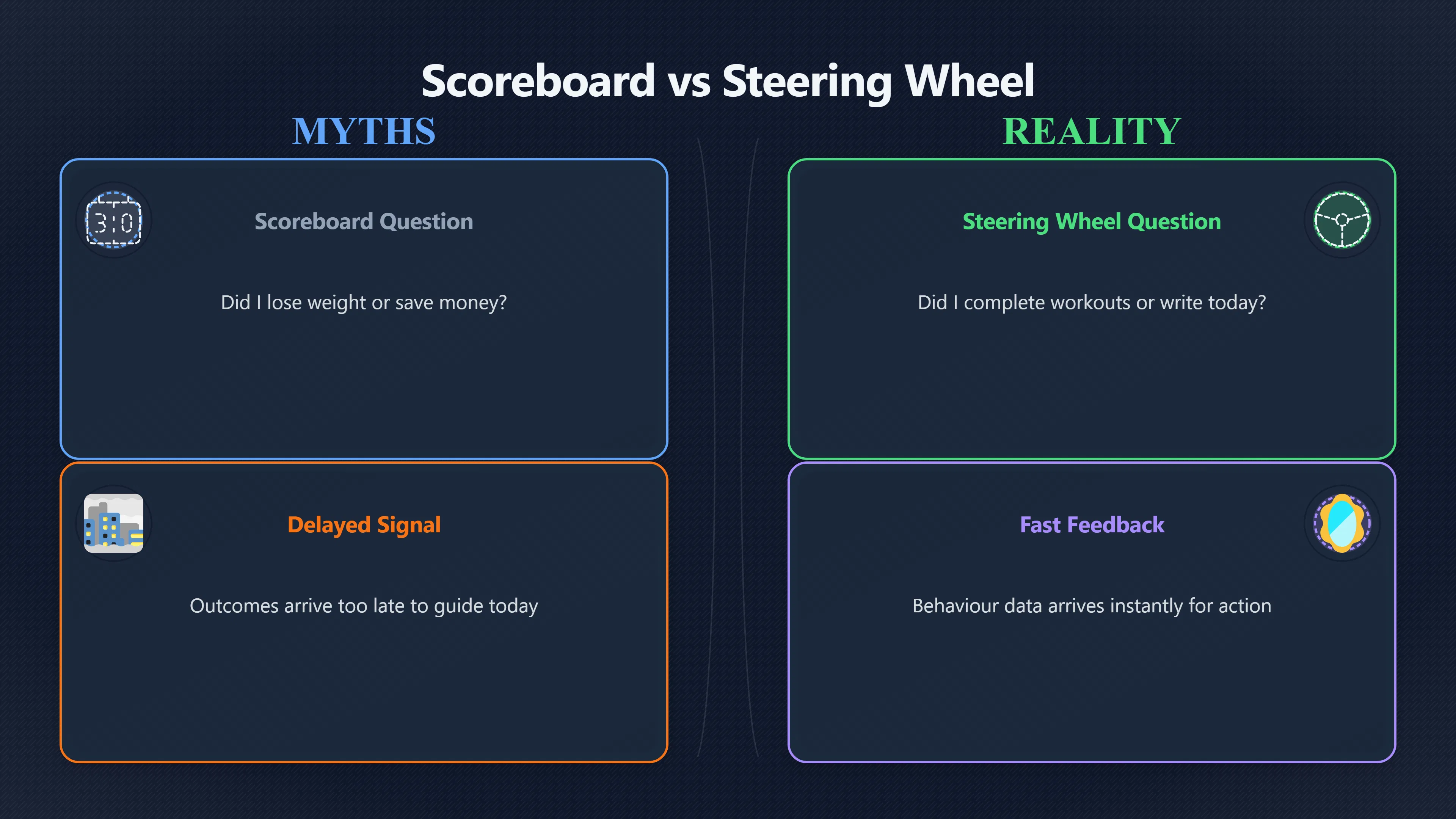
Scoreboard QuestionSteering-Wheel QuestionDid I lose weight?Did I complete my planned workouts?Did I publish a book?Did I write today?Did I save £5,000?Did I transfer money into savings this week?Did I achieve a promotion?Did I complete the development work that improves promotion odds?
The scoreboard evaluates. The steering wheel guides.
Why Behaviour Measures Create Better Feedback
Behaviour measures are closer to the moment of action. They shrink the gap between effort and information.
The Behaviour Change Technique Taxonomy, a widely used framework in behaviour-change research, explicitly distinguishes between monitoring behaviour and monitoring outcomes of behaviour. The distinction matters because behaviour is usually the component a person can directly modify.[NCBI]ncbi.nlm.nih.govNCBIResults of the behaviour change technique synthesisby J Baker · 2022 — Establish a method for the person to monitor and record the outcome(s) of their behavior as part of a behavior ch…[PubMed When feedback focuses on behaviour]pubmed.ncbi.nlm.nih.govPub Med Does monitoring goal progress promote goal attainment?B Harkin · 2016 · Cited by 750 — Moderation tests revealed that progress monitoring had larger effects on goal attainment when th…, three advantages appear.
The feedback arrives faster.
You know today whether you exercised, wrote, studied or followed your spending plan. You do not need to wait for a distant result.
The feedback is more actionable.
“Three workouts completed” naturally leads to questions about scheduling, recovery and consistency. “Weight unchanged” often leads only to frustration.
The feedback stays closer to personal control.
Many outcomes depend on luck, timing, competition, biology or market conditions. Behaviour measures are not perfectly controllable, but they are far more controllable than final results.
Research on goal monitoring supports this logic. Progress monitoring is associated with improved goal attainment, especially when information is recorded rather than left to memory. Visible records make it easier to detect patterns and adjust behaviour before outcomes deteriorate.[PubMed]pubmed.ncbi.nlm.nih.govPub Med Does monitoring goal progress promote goal attainment?B Harkin · 2016 · Cited by 750 — Moderation tests revealed that progress monitoring had larger effects on goal attainment when th…[White Rose Research Online]eprints.whiterose.ac.ukby B Harkin · 2016 · Cited by 750 — Moderation tests revealed that progress monitoring had larger effects on goal attainment when the out…
The Historical Shift from Results Alone to Leading Indicators
For much of modern management, organisations relied heavily on outcome reporting: revenue, profit, production totals and other final results. These measures remained important, but managers increasingly realised that waiting for final results often meant discovering problems too late.
One influential perspective came from Intel leader Andrew Grove, who argued that managers should identify indicators that provide an early view into future performance. He described indicators as windows into an otherwise opaque process, allowing corrective action before final results appear.[Medium]medium.comTop Takeaways from Andy Grove's High Output ManagementJanuary 8, 2020 — Indicators let you “cut holes” in the black box to get a vi…[Thrive Street Advisors]thrivestreetadvisors.com“Indicators tend to direct your attention toward what they are monitoring. It is like riding a bicycle: you…Read more…
The same logic applies to personal improvement.
A fitness goal is a miniature production system. A writing career is a miniature production system. Personal finances are a miniature production system. In each case, the final result is important, but the practical question is which daily actions predict that result.
The historical lesson is not that outcomes should be ignored. It is that outcomes alone make poor steering instruments.
How to Choose Behaviour Measures You Can Change
Not every behavioural metric is useful. Some are merely busywork dressed up as measurement.
A good steering metric usually meets four tests.
Is it directly controllable?
Track something you can decide to do.
Good examples:
- Minutes spent writing.
- Planned workouts completed.
- Number of sales calls made.
- Percentage of income transferred into savings.
Weak examples:
- Social-media engagement.
- Body weight on a single day.
- Investment returns this month.
- Number of job offers received.
The weaker examples are outcomes or heavily influenced by external factors.
Does it happen frequently?
The best feedback loops operate on short cycles.
If a measure changes only every few months, it provides little guidance. Daily or weekly behaviours generate many opportunities for adjustment.
Is there a believable connection to the outcome?
A steering metric should plausibly influence the destination.
Counting how many productivity apps you install is unlikely to predict meaningful achievement. Counting uninterrupted hours of focused work probably will.
Can it trigger a next action?
Useful metrics suggest a response.
If workout completion drops from four sessions to one session, the next question is obvious: what prevented the sessions? If savings transfers stop, the next question is equally clear.
A metric that produces no practical adjustment is usually not a steering metric.
Examples for Fitness, Writing, Money and Focus
Fitness
Many people monitor weight almost exclusively.
Weight matters if fat loss is the goal, but it fluctuates because of hydration, glycogen storage, digestion and other short-term factors. Daily weight readings can therefore create emotional reactions unrelated to actual progress.
Better steering measures include:
- Workouts completed.
- Steps per day.
- Protein targets met.
- Sleep duration.
- Exercise minutes.
The scale remains the scoreboard. The behaviours become the steering wheel.
Writing
Writers often focus on outcomes such as publication, readership or sales.
Those outcomes are meaningful but delayed.
More useful behavioural measures include:
- Writing sessions completed.
- Words drafted.
- Minutes spent in focused writing.
- Number of days the document was opened and worked on.
A writer cannot force publication success today. They can decide whether they write today.

Money
People often watch account balances obsessively.
Balances matter, but market returns, interest rates and unexpected expenses create noise.
More actionable measures include:
- Percentage of income saved.
- Automatic transfers completed.
- Spending reviews completed.
- Days without unplanned purchases.
These behaviours are easier to influence than future net worth.
Focus
Many people judge concentration through vague impressions such as “I was productive” or “I wasted the day”.
Behaviour measures create clearer feedback:
- Number of distraction-free work blocks.
- Time spent with notifications disabled.
- Planned tasks completed before checking email.
- Deep-work hours logged.
The behaviour data identifies where attention was won or lost.
Common Mistakes When Using Steering Metrics
One mistake is replacing outcomes entirely. Outcomes still matter because they verify that the behaviours are actually producing the desired effect.
If a person completes every planned workout but strength never improves, the training plan may need revision. The scoreboard provides validation.
A second mistake is measuring too many behaviours at once. Excessive tracking creates administrative work rather than useful feedback. A handful of meaningful indicators is usually enough.
A third mistake is selecting behaviours that are merely convenient to count. Easy measurement does not guarantee relevance. The question is not “What can I track?” but “What behaviour most strongly influences the result I want?”
A Practical Rule for Self-Improvement
When a goal feels stuck, look first at the steering wheel before staring harder at the scoreboard.
Ask:
- What outcome do I ultimately care about?
- Which behaviours most strongly influence that outcome?
- Which of those behaviours can I measure weekly or daily?
- What adjustment will I make if the behaviour declines?
This approach keeps attention on the part of the system that can still change. Outcomes remain important because they reveal where you are. Behaviour measures matter because they help determine where you go next.
In effective self-improvement systems, scoreboards tell the truth about results. Steering metrics help create those results. The scoreboard reports the game after it happens; the steering wheel influences the next move. Research on progress monitoring, behaviour change and leading indicators suggests that improvement accelerates when people spend more attention on the second function than the first.[Intrafocus]intrafocus.comLead and Lag IndicatorsLead and Lag Indicators - IntrafocusLeading and lagging indicators are two types of measurements used when assessing performanc…[PubMed]pubmed.ncbi.nlm.nih.govPub Med Does monitoring goal progress promote goal attainment?B Harkin · 2016 · Cited by 750 — Moderation tests revealed that progress monitoring had larger effects on goal attainment when th…[White Rose Research Online]eprints.whiterose.ac.ukby B Harkin · 2016 · Cited by 750 — Moderation tests revealed that progress monitoring had larger effects on goal attainment when the out…
Amazon book picks
Further Reading
Books and field guides related to Track the Steering Wheel, Not Just the Score. Use these as the next step if you want deeper reading beyond the article.
Atomic Habits
Rating: 3.5/5 from 7 Google Books ratings
Encourages tracking behaviors rather than waiting for outcomes.
eBay marketplace picks
Marketplace Samples
Example marketplace items related to this page. Use the search link to explore similar finds on eBay.




Endnotes
1.
Source: intrafocus.com
Title: Lead and Lag Indicators
Link:https://www.intrafocus.com/resources/lead-and-lag-indicators/
Source snippet
Lead and Lag Indicators - IntrafocusLeading and lagging indicators are two types of measurements used when assessing performanc...
2.
Source: ncbi.nlm.nih.gov
Title: NCBIResults of the behaviour change technique synthesis
Link:https://www.ncbi.nlm.nih.gov/books/NBK580337/
Source snippet
by J Baker · 2022 — Establish a method for the person to monitor and record the outcome(s) of their behavior as part of a behavior ch...
3.
Source: medium.com
Link:https://medium.com/%40iantien/top-takeaways-from-andy-grove-s-high-output-management-2e0ecfb1ea63
Source snippet
Top Takeaways from Andy Grove's High Output ManagementJanuary 8, 2020 — Indicators let you “cut holes” in the black box to get a vi...
Published: January 8, 2020
4.
Source: managers.app
Link:https://managers.app/high-output-management-by-andrew-grove/
Source snippet
Managers can do their job, their individual...Read more...
5.
Source: pubmed.ncbi.nlm.nih.gov
Title: Pub Med Does monitoring goal progress promote goal attainment?
Link:https://pubmed.ncbi.nlm.nih.gov/26479070/
Source snippet
B Harkin · 2016 · Cited by 750 — Moderation tests revealed that progress monitoring had larger effects on goal attainment when th...
6.
Source: eprints.whiterose.ac.uk
Link:https://eprints.whiterose.ac.uk/id/eprint/91437/
Source snippet
by B Harkin · 2016 · Cited by 750 — Moderation tests revealed that progress monitoring had larger effects on goal attainment when the out...
7.
Source: pubmed.ncbi.nlm.nih.gov
Link:https://pubmed.ncbi.nlm.nih.gov/23512568/
Source snippet
behavior change technique taxonomy (v1) of 93...by S Michie · 2013 · Cited by 8848 — "BCT taxonomy v1," an extensive taxonomy of 93 cons...
8.
Source: thrivestreetadvisors.com
Title: Thrive Street Advisors
Link:https://www.thrivestreetadvisors.com/leadership-library/high-output-management
Source snippet
“Indicators tend to direct your attention toward what they are monitoring. It is like riding a bicycle: you...Read more...
Additional References
9.
Source: acf.gov
Link:https://acf.gov/sites/default/files/documents/opre/50020_goals_measurebrief_final_508.pdf
Source snippet
t skills, behaviors, and mindsets that the programs seek to change to help participants achieve those longer-...Read mo...
10.
Source: phwwhocc.co.uk
Link:https://phwwhocc.co.uk/wp-content/uploads/2024/02/Identifying-and-Applying-Behaviour-Change-[Techniques
Source snippet
Identifying and Applying Behaviour Change TechniquesWhilst the BCTs identified within the Taxonomy aren't new, some of them such as “goal...
11.
Source: tyastunggal.com
Link:https://tyastunggal.com/p/high-output-management-by-andy-grove
Source snippet
High Output Management by Andy GroveLeading indicators show what the future may look like, providing time to take corrective action to av...
12.
Source: digitalwellbeing.org
Link:https://digitalwellbeing.org/wp-content/uploads/2016/11/BCTTv1_PDF_version.pdf
Source snippet
i BCT Taxonomy (v1): 93 hierarchically-clustered techniquesReview behavior goal(s) Review behavior goal(s) jointly with the person and co...
13.
Source: rene.kizilcec.com
Link:https://rene.kizilcec.com/wp-content/uploads/2021/05/cho2021bct.pdf
Source snippet
the Behavior Change Technique Taxonomy from...by JY Cho · 2021 · Cited by 11 — In this syn- thesis paper, we describe the characteristic...
14.
Source: semanticscholar.org
Title: Semantic Scholar Does monitoring goal progress promote goal attainment?
Link:https://www.semanticscholar.org/paper/Does-monitoring-goal-progress-promote-goal-A-of-the-Harkin-Webb/71c6265bf7a8ded9084ff21a417cd63d6f4119ea
Source snippet
findings suggest that monitoring goal progress is an effective self-regulation strategy, and that interventions that increase th...
15.
Source: discovery.ucl.ac.uk
Title: ‘active ingredient’ (e.g., feedback, self-monitoring, reinforcement)
Link:https://discovery.ucl.ac.uk/1400691/1/Michie_et%20al.%20%28in%20press%29%20-%20BCT%20Taxonomy%20v1%20development%20paper.pdf
Source snippet
ucl.ac.uk1 The Behavior Change Technique Taxonomy (v1) of 93...by S Michie · 2013 · Cited by 8812 — redirect causal processes that regul...
16.
Source: researchgate.net
Title: Does Monitoring Goal Progress Promote Goal Attainment?
Link:https://www.researchgate.net/publication/291335719_Does_Monitoring_Goal_Progress_Promote_Goal_Attainment_A_Meta-Analysis_of_the_Experimental_Evidence
Source snippet
The findings suggest that monitoring goal progress is an effective self-regulation strategy, and that interventions that increase the fre...
17.
Source: maxmednik.com
Title: Max Mednik Notes on High Output Management by Andrew S
Link:https://www.maxmednik.com/blog/notes-on-high-output-management-by-andrew-s-grove
Source snippet
Grove31 Jul 2021 — Monitor credible leading indicators. Linearity indicator of output over time. Can flash early warning. Trend indicator...
18.
Source: GOV.UK
Title: behaviour change techniques review descriptive studies
Link:https://www.gov.uk/guidance/behaviour-change-techniques-review-descriptive-studies
Source snippet
change techniques review: descriptive studies6 Jul 2020 — A behaviour change techniques (BCTs) review uses established classifications of...
Topic Tree