Within Digital Tools
Why some reminders help and others nag
Prompts are useful when they arrive near a feasible action, but they fail when the real barrier is energy, time, pain, stress, or money.
On this page
- What a good cue can do
- When reminders miss the real barrier
- Designing prompts around feasible actions
Page outline Jump by section
Introduction
Most reminders fail for a simple reason: they assume forgetting is the problem. In many real-world situations, people already remember what they intend to do. The obstacle is lack of time, low energy, stress, pain, competing priorities, or the fact that the suggested action is inconvenient at that moment. A reminder that arrives when action is feasible can help bridge the gap between intention and behaviour. A reminder that arrives when action is impossible often feels like nagging.
 Research on digital behaviour-change interventions consistently finds that prompts and cues can support action, but their effectiveness depends heavily on timing, context and the user’s ability to act. The most useful reminders do not merely repeat instructions. They increase the chances that a person can do something useful right now. PMC[Fogg Behavior Model]youtube.comForget big change, start with a tiny habit: BJ Fogg at TEDx FremontTINY HABITS by BJ Fogg | Core Message…
What a good cue can do
A reminder is best understood as a cue rather than a motivational speech. Its job is not to create determination from nothing. Its job is to bring an intended behaviour to mind at the right moment.
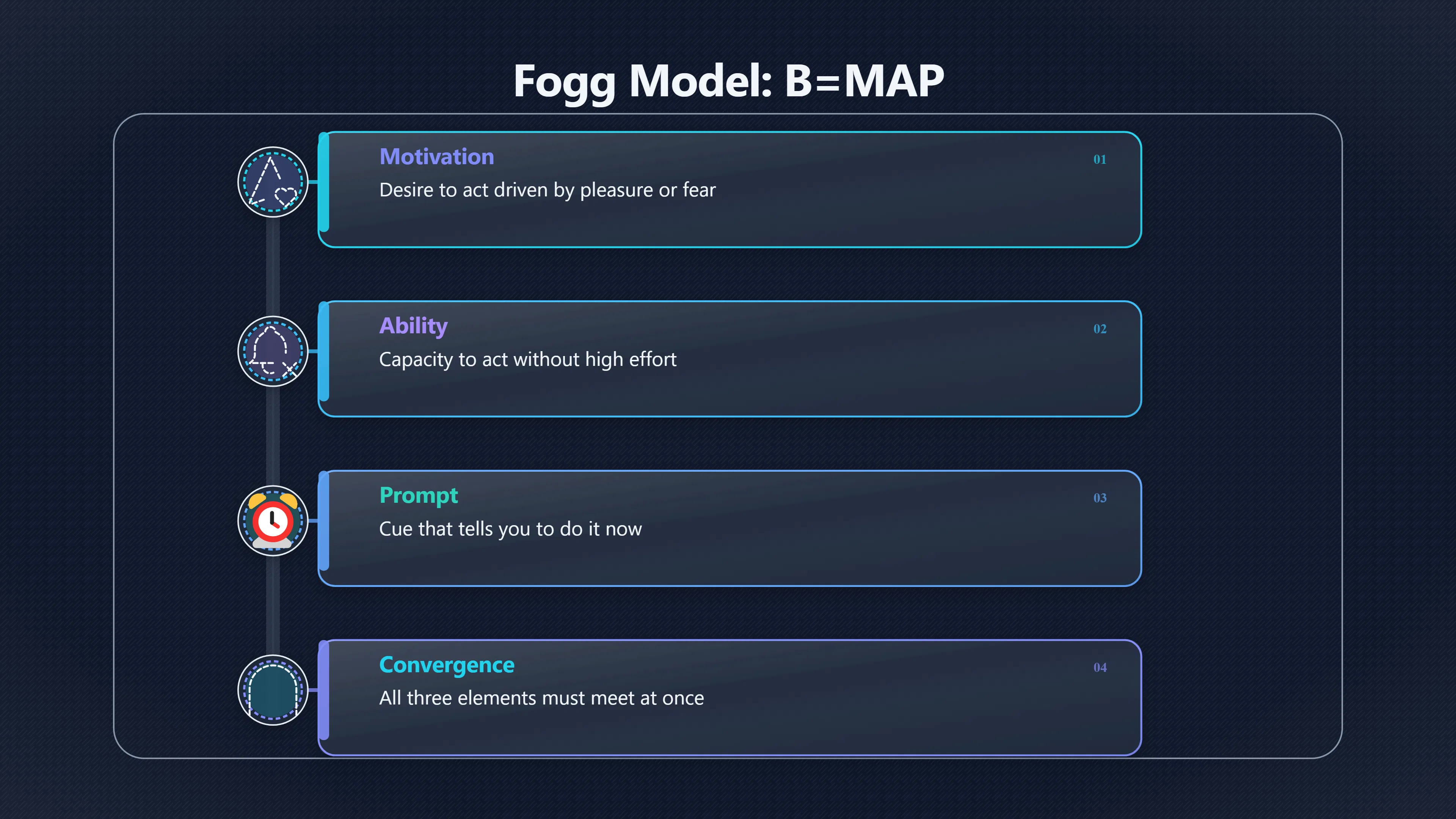
Behaviour scientist BJ Fogg’s Behaviour Model argues that behaviour occurs when motivation, ability and a prompt converge at the same time. If the prompt arrives but the person lacks the ability to act, the behaviour is unlikely to happen.[Fogg Behavior Model]youtube.comForget big change, start with a tiny habit: BJ Fogg at TEDx FremontTINY HABITS by BJ Fogg | Core Message…[Behavior Design Lab]behaviordesign.stanford.eduBehavior Design LabFogg Behavior ModelThe Fogg Behavior Model shows that three elements must converge at the same moment for a behavior t…
This helps explain why some app reminders feel surprisingly useful:
- A medication reminder appears when someone is preparing breakfast and the tablets are nearby.
- A study reminder arrives when a calendar shows a free half-hour rather than during a meeting.
- A walking prompt appears after prolonged sitting and before the next scheduled commitment.
- A sleep reminder appears before the usual bedtime routine has already started.
In each case, the notification is not adding information. The user already knows the task exists. The reminder works because it arrives close to an opportunity for action. This is why prompts and cues remain a common behaviour-change technique in health, fitness and productivity apps.[ResearchGate]researchgate.netFive studies reported a theoryResearchGate(PDF) Reinforcement Learning to Send Reminders at Right…June 4, 2021 — Common behaviour change techniques were goal settin…
Another overlooked benefit is reducing mental load. When a trusted system remembers something on a person’s behalf, they do not need to keep actively rehearsing the intention throughout the day. The reminder effectively stores the intention until action becomes possible.
When reminders miss the real barrier
The weakness of many reminder systems is that they treat every missed behaviour as a memory problem.
Imagine an exercise app that sends the same notification every day at 6 pm. If the user is exhausted after work, caring for children, travelling home or dealing with illness, the obstacle is not forgetfulness. The reminder highlights a failure without removing the barrier.
This distinction matters because repeated prompts can create several unintended effects:
Prompt fatigue. Notifications become background noise and are ignored automatically. The user stops distinguishing between important and unimportant alerts.[PMC]pmc.ncbi.nlm.nih.govJust-in-Time Adaptive Interventions (JITAIs) in Mobile Healthby I Nahum-Shani · 2017 · Cited by 2532 — JITAI is an intervention design…
Learned dismissal. If reminders repeatedly arrive when action is impossible, users learn that opening or responding is not worth the effort.
Guilt without progress. A reminder can increase awareness of a goal while doing nothing to increase the ability to pursue it. The result is frustration rather than behaviour change.
Notification blindness. Modern smartphones compete for attention. A reminder must compete with messages, emails, news alerts and social media notifications. Generic prompts are easily lost.
The practical lesson is that reminders are poor solutions for barriers involving energy, pain, money, workload or major life constraints. When those factors dominate, changing the task itself is often more effective than increasing reminder frequency. A ten-minute walk may be feasible where a one-hour workout is not. A reminder to read one page may succeed where a reminder to study for an hour fails.
This insight is reflected in behaviour-design frameworks that emphasise ability and simplicity alongside prompting. When behaviour does not occur, the missing ingredient is often feasibility rather than motivation.[Fogg Behavior Model]youtube.comForget big change, start with a tiny habit: BJ Fogg at TEDx FremontTINY HABITS by BJ Fogg | Core Message…[The Decision Lab]thedecisionlab.comFogg Behavior ModelMotivation: The desire to perform the behavior, driven by factors such as pleasure/pain, hope/fear, and social accepta…
Designing prompts around feasible actions
The most effective reminder systems increasingly focus on helping users do something achievable rather than insisting on a pre-planned ideal behaviour.
Several design principles emerge from behaviour-change research.
Make the next action small
A reminder should point to an action that can realistically be completed immediately.
A notification saying “Improve your fitness” is vague. A notification saying “Take a five-minute walk before your next meeting” identifies a concrete action with a clear starting point.
The smaller the required action, the less the reminder depends on high motivation. This aligns with behaviour-design research showing that making an action easier often produces more reliable results than attempting to increase motivation.[YouTube]youtube.comThe Fogg Behavior Model: How to Turn Learning into ActionFog argues that making a behavior easier is often more efficient than try…

Match the reminder to context
A reminder is more useful when it reflects current circumstances.
Researchers describe this approach as a Just-In-Time Adaptive Intervention (JITAI): support delivered at the right moment, based on changing conditions rather than a fixed schedule. Instead of sending the same notification every day, a system adapts according to location, activity patterns, time availability or behavioural risk.[PMC]pmc.ncbi.nlm.nih.govHow Notifications Affect Engagement With a Behavior Change…by L Bell · 2023 · Cited by 38 — Push notifications (reminders or pop-up…
Examples include:
- Prompting movement after a long sedentary period.
- Suggesting a study session when a calendar gap appears.
- Delivering stress-management exercises during periods of elevated stress.
- Timing medication reminders around established routines.
The key idea is responsiveness. The reminder is triggered by opportunity rather than merely by the clock.
Respect receptiveness
Even a well-designed suggestion can fail if delivered at the wrong moment.
A growing area of digital-health research examines “receptiveness”—whether a user is currently able and willing to engage with support. Some systems attempt to infer this from behavioural data, while others allow users to customise reminder windows.[JMIR Research Protocols]researchprotocols.orgJMIR Research ProtocolsNotifications to Improve Engagement With an Alcohol…by L Bell · 2020 · Cited by 35 — The primary objective is t…[PMC]pmc.ncbi.nlm.nih.govJust-in-Time Adaptive Interventions (JITAIs) in Mobile Healthby I Nahum-Shani · 2017 · Cited by 2532 — JITAI is an intervention design…
This reflects a simple truth: the best reminder is often the one that arrives when the user has spare attention.
Adapt after non-response
Many apps repeatedly send the same notification after it is ignored. A more helpful approach treats non-response as information.
If reminders are consistently dismissed, the system can:
- Change timing.
- Reduce frequency.
- Suggest a smaller action.
- Ask whether the goal remains relevant.
- Temporarily pause prompts.
Adaptive reminder systems using machine learning and reinforcement learning have been explored specifically to identify moments when users are more likely to respond. Early studies suggest that timing can be improved by learning from behavioural patterns rather than relying on fixed schedules.[eDepot]edepot.wur.nle Depot Reinforcement Learning to Send Reminders at Right MomentsReinforcement Learning to Send Reminders at Right Moments…June 4, 2021 — by S Wang · 2021 · Cited by 36 — In our study, a smartp…
Why the best reminders often disappear
One sign that a reminder is working is that it eventually becomes less necessary.
Habit-formation research suggests that behaviours become more automatic when they are repeatedly linked to stable cues in daily life. The long-term goal is often not permanent dependence on notifications but transferring control to natural routines and environmental triggers.[usabilitypanda.com]usabilitypanda.com4-weeN study exploring the impact of different types of cues and positive reinforcement on the development…
For example:
- Taking medication after brushing teeth.
- Reviewing notes after lunch.
- Walking immediately after a regular work task.
- Starting a bedtime routine after a recurring evening activity.
In these cases, the app reminder acts as temporary scaffolding. Once the behaviour becomes reliably attached to an existing routine, the notification can often be reduced or removed.
The practical takeaway
A helpful reminder answers the question, “Can I realistically do something useful right now?” A nagging reminder repeatedly asks, “Why haven’t you done this yet?”
The difference is not mainly frequency. It is alignment with real-world constraints. Effective prompts arrive near an opportunity for action, point to a feasible next step and adapt when circumstances change. When the true barrier is low energy, lack of time, stress, pain or cost, additional reminders rarely solve the problem. In those situations, simplifying the behaviour or removing obstacles is usually more powerful than sending another notification. PMC[Fogg Behavior Model]youtube.comForget big change, start with a tiny habit: BJ Fogg at TEDx FremontTINY HABITS by BJ Fogg | Core Message…
Amazon book picks
Further Reading
Books and field guides related to Why some reminders help and others nag. Use these as the next step if you want deeper reading beyond the article.
Atomic Habits
Rating: 3.5/5 from 7 Google Books ratings
Discusses cues, environment design, and triggers for action.
Tiny Habits
Fogg's work centers on prompts, ability, and timing, directly matching reminder effectiveness.
The Power of Habit
Provides a practical framework for understanding cue-driven behavior.
eBay marketplace picks
Marketplace Samples
Example marketplace items related to this page. Use the search link to explore similar finds on eBay.






Endnotes
1.
Source: pmc.ncbi.nlm.nih.gov
Link:https://pmc.ncbi.nlm.nih.gov/articles/PMC5364076/
Source snippet
Just-in-Time Adaptive Interventions (JITAIs) in Mobile Healthby I Nahum-Shani · 2017 · Cited by 2532 — JITAI is an intervention design...
2.
Source: researchgate.net
Title: Five studies reported a theory
Link:https://www.researchgate.net/publication/352143472_Reinforcement_Learning_to_Send_Reminders_at_Right_Moments_in_Smartphone_Exercise_Application_A_Feasibility_Study
Source snippet
ResearchGate(PDF) Reinforcement Learning to Send Reminders at Right...June 4, 2021 — Common behaviour change [techniques]({{ 'techniques/' | relative_url }}) were goal settin...
Published: June 4, 2021
3.
Source: pmc.ncbi.nlm.nih.gov
Link:https://pmc.ncbi.nlm.nih.gov/articles/PMC10337295/
Source snippet
How Notifications Affect Engagement With a Behavior Change...by L Bell · 2023 · Cited by 38 — Push notifications (reminders or pop-up...
4.
Source: youtube.com
Link:https://www.youtube.com/watch?v=k-TCLz37IPE
Source snippet
The Fogg Behavior Model: How to Turn Learning into ActionFog argues that making a behavior easier is often more efficient than try...
5.
Source: researchgate.net
Link:https://www.researchgate.net/publication/332205632_A_systematic_review_of_just-in-time_adaptive_interventions_JITAIs_to_promote_physical_activity
Source snippet
A systematic review of just-in-time adaptive interventions...We define JITAIs as having three features: behavioural support that directl...
6.
Source: usabilitypanda.com
Link:https://usabilitypanda.com/publications/StawarzCoxBlandford2015-habit-apps.pdf
Source snippet
4-weeN study exploring the impact of different types of cues and positive reinforcement on the development...
7.
Source: formative.jmir.org
Link:https://formative.jmir.org/2021/1/e15369/
Source snippet
Smartphone App to Support Sedentary Behavior Change by...by Y Wang · 2021 · Cited by 26 — The app provides personal mobility pattern vis...
8.
Source: jmir.org
Link:https://www.jmir.org/2021/9/e29412/
Source snippet
Just-in-Time Adaptive Mechanisms of Popular Mobile Apps...by GW Teepe · 2021 · Cited by 69 — The aim of this study is to systematically...
9.
Source: youtube.com
Link:https://www.youtube.com/watch?v=iQLhihcfBSY
Source snippet
Just-In-Time Adaptive Interventions (JITAI) in mHealthIn this session, Drs. Mike Dorsch and Jessie Golbus present on just-in-time adaptiv...
10.
Source: youtube.com
Title: Forget big change, start with a tiny habit: BJ Fogg at TEDx Fremont
Link:https://www.youtube.com/watch?v=AdKUJxjn-R8
Source snippet
TINY HABITS by BJ Fogg | Core Message...
11.
Source: youtube.com
Title: TINY HABITS by BJ Fogg | Core Message
Link:https://www.youtube.com/watch?v=S_8e-6ZHKLs
Source snippet
Fogg behavior model in 2 minutes and 30 seconds...
12.
Source: youtube.com
Title: Fogg behavior model in 2 minutes and 30 seconds
Link:https://www.youtube.com/watch?v=jsbF9z6adAo
Source snippet
A Survey of Notification Designs in Commercial mHealth Apps...
13.
Source: youtube.com
Title: A Survey of Notification Designs in Commercial m Health Apps
Link:https://www.youtube.com/watch?v=pRB5gxmf2yQ
Source snippet
How Simplicity Changes Behavior -- BJ Fogg's Behavior Model...
14.
Source: youtube.com
Title: How Simplicity Changes Behavior – BJ Fogg’s Behavior Model
Link:https://www.youtube.com/watch?v=oRkKWPqEkYU
Source snippet
BJ Fogg prompts tiny habits TINY HABITS by BJ Fogg | Core Message Productivity Game...
15.
Source: behaviormodel.org
Link:https://www.behaviormodel.org/
Source snippet
Fogg Behavior ModelFogg Behavior Model - BJ FoggThe Fogg Behavior Model shows that three elements must converge at the same moment for a...
16.
Source: behaviordesign.stanford.edu
Link:https://behaviordesign.stanford.edu/resources/fogg-behavior-model
Source snippet
Behavior Design LabFogg Behavior ModelThe Fogg Behavior Model shows that three elements must converge at the same moment for a behavior t...
17.
Source: behaviormodel.org
Link:https://www.behaviormodel.org/prompts
Source snippet
Fogg Behavior ModelPrompts in the Fogg Behavior ModelLearn how prompts activate behavior in the Fogg Behavior Model and how to design eff...
18.
Source: researchprotocols.org
Link:https://www.researchprotocols.org/2020/8/e18690/
Source snippet
JMIR Research ProtocolsNotifications to Improve Engagement With an Alcohol...by L Bell · 2020 · Cited by 35 — The primary objective is t...
19.
Source: thedecisionlab.com
Link:https://thedecisionlab.com/reference-guide/psychology/fogg-behavior-model
Source snippet
Fogg Behavior ModelMotivation: The desire to perform the behavior, driven by factors such as pleasure/pain, hope/fear, and social accepta...
20.
Source: researchprotocols.org
Link:https://www.researchprotocols.org/2026/1/e79022
Source snippet
JMIR Research ProtocolsJust-in-Time Adaptive Intervention to Promote Walking...by CJ Firkin · 2026 · Cited by 1 — Our JITAI approach wil...
21.
Source: edepot.wur.nl
Title: e Depot Reinforcement Learning to Send Reminders at Right Moments
Link:https://edepot.wur.nl/549193
Source snippet
Reinforcement Learning to Send Reminders at Right Moments...June 4, 2021 — by S Wang · 2021 · Cited by 36 — In our study, a smartp...
Published: June 4, 2021
22.
Source: northbeam.io
Title: fogg behavior model motivation ability and prompts
Link:https://www.northbeam.io/blog/fogg-behavior-model-motivation-ability-and-prompts
Source snippet
Fogg Behavior Model: Motivation, Ability, and Prompts29 Oct 2025 — The Fogg Behavior Model explains that behavior occurs when Motivation...
Additional References
23.
Source: medium.com
Link:https://medium.com/design-bootcamp/designing-with-intention-applying-bj-foggs-behavioral-model-in-ai-experiences-05ea6dca3069
Source snippet
Applying BJ Fogg's Behavioral Model in AI ExperiencesHow Understanding Motivation, Ability, and Prompts Can Enhance User Engagement and D...
24.
Source: digitalcharitylab.org
Link:https://digitalcharitylab.org/2019/06/behavior-motivation-ability-prompt-the-fogg-behaviorial-model-and-digital-charities/
Source snippet
Behavior = Motivation + Ability + Prompt: The Fogg...27 Jun 2019 — Three elements must converge at the same moment for a behavior to occ...
25.
Source: thebettercompany.io
Link:https://thebettercompany.io/en/tiny-habits-method/
Source snippet
tivation (motivation), Ability (capability/simplicity) and a Prompt (cue/trigger)...
26.
Source: gsb.stanford.edu
Title: building habits key lasting behavior change
Link:https://www.gsb.stanford.edu/insights/building-habits-key-lasting-behavior-change
Source snippet
Stanford Graduate School of BusinessBuilding Habits: The Key to Lasting Behavior Change18 Apr 2023 — In this episode, BJ Fogg reveals the...
27.
Source: pubmed.ncbi.nlm.nih.gov
Link:https://pubmed.ncbi.nlm.nih.gov/30943983/
Source snippet
systematic review of just-in-time adaptive interventions...by W Hardeman · 2019 · Cited by 438 — We conducted a systematic review of JIT...
28.
Source: ui-patterns.com
Title: making the fogg behavior model actionable
Link:https://ui-patterns.com/blog/making-the-fogg-behavior-model-actionable
Source snippet
8 Apr 2019 — BJ Fogg outlines three types of prompts, facilitators, sparks, and signals. A spark motivates behavior, a facilitator makes...
29.
Source: facebook.com
Title: For a behavior to happen, you need some
Link:https://www.facebook.com/NPR/posts/for-a-habit-to-stick-you-need-to-do-more-than-just-repeat-it-says-behavioral-sci/1357831806213815/
Source snippet
For a habit to stick, you need to do more than just repeat it...Fogg's model for behavior change relies on three components: Motivation...
30.
Source: habitweekly.com
Link:https://www.habitweekly.com/models-frameworks/the-fogg-model
Source snippet
on the person's level of motivation and ability.Read more...
31.
Source: triplewhale.com
Title: What Is the Fogg Behavior Model?
Link:https://www.triplewhale.com/blog/fogg-behavior-model
Source snippet
A Complete Guide to...12 Mar 2026 — The Fogg Behavior Model explains why behavior happens when motivation, ability, and a prompt align...
32.
Source: yukaichou.com
Title: bj fogg extended part 1 of 2
Link:https://yukaichou.com/behavioral-analysis/bj-fogg-extended-part-1-of-2/
Source snippet
BJ Fogg Behavior Model: B=MAP Explained (2026)12 Nov 2019 — P stands for Prompt (the cue that tells them to do it now). The formula is mu...
Topic Tree