Within Missed Days
Is One Missed Day Really a Relapse?
A missed habit day becomes less damaging when it is treated as a limited lapse rather than proof that the whole change has failed.
On this page
- How a lapse differs from a relapse
- Why labels change the recovery response
- Examples from workouts, food, sleep and writing
Page outline Jump by section
Introduction
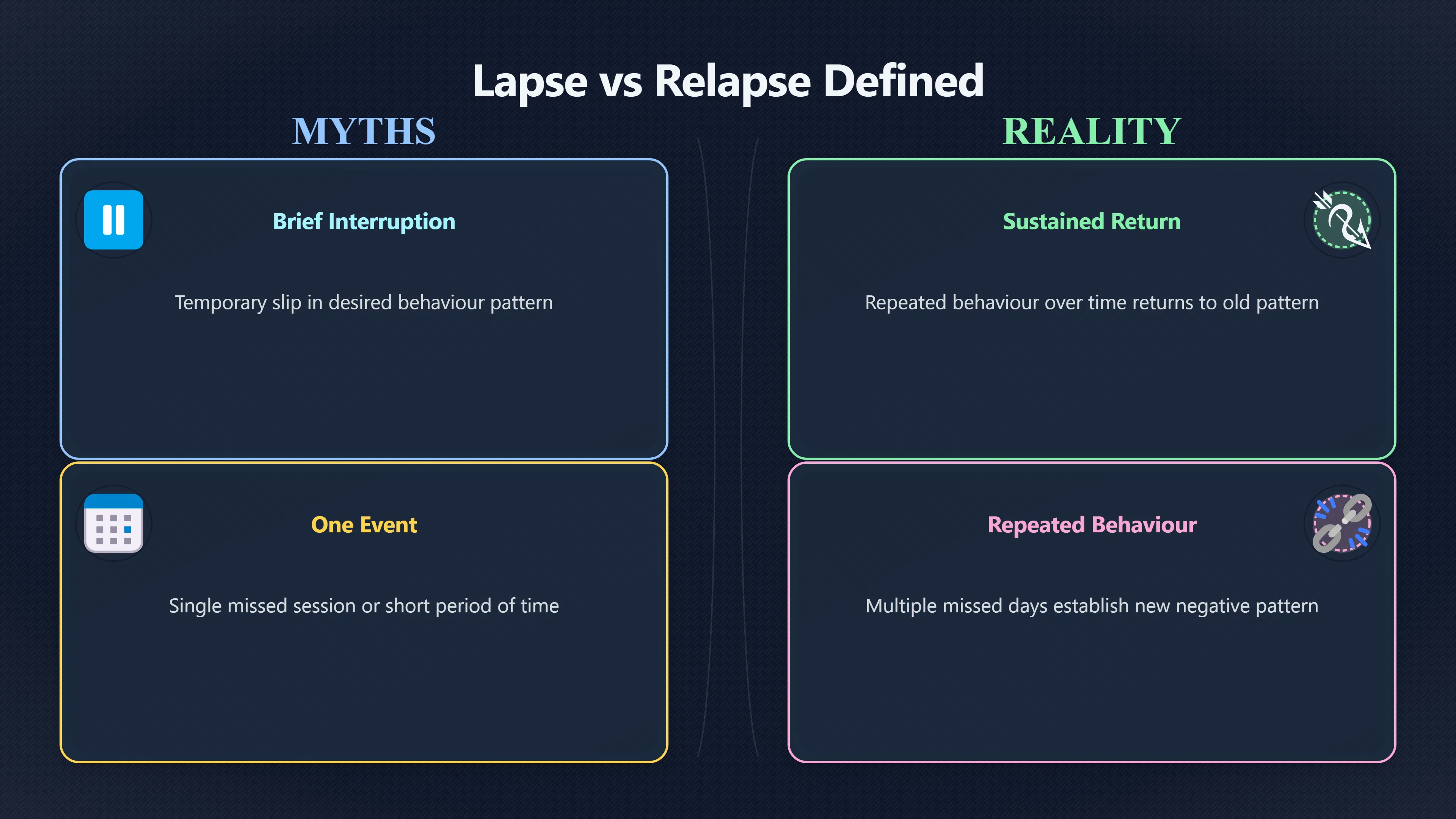
A missed habit day is usually a lapse, not a relapse. The distinction matters because people often respond very differently depending on the label they apply to the same event. A lapse is a temporary interruption in a desired behaviour. A relapse is a broader return to the previous pattern of behaviour. In relapse-prevention research, the difference is not merely semantic: it changes how people interpret setbacks, how much control they believe they have, and whether they restart quickly or abandon the effort altogether.[PubMed Central]pmc.ncbi.nlm.nih.govPub Med Central Relapse Prevention: An Overview of Marlatt's Cognitiveby ME Larimer · 1999 · Cited by 1168 — Lapse-management strategies focus on halting the lapse and combating the abstinence violation e…[PubMed Central]pmc.ncbi.nlm.nih.govPub Med Central Relapse Prevention: An Overview of Marlatt's Cognitiveby ME Larimer · 1999 · Cited by 1168 — Lapse-management strategies focus on halting the lapse and combating the abstinence violation e…
 For self-improvement that works, the key question after a missed day is not “Have I failed?” but “Did this interruption become the new pattern?” One skipped workout, one late night, one missed writing session or one off-plan meal is generally best understood as a lapse. The danger comes when that lapse is interpreted as proof that change has collapsed, creating the conditions for an actual relapse.[PubMed Central]pmc.ncbi.nlm.nih.govPub Med Central Relapse Prevention: An Overview of Marlatt's Cognitiveby ME Larimer · 1999 · Cited by 1168 — Lapse-management strategies focus on halting the lapse and combating the abstinence violation e…[Psychology Today]psychologytoday.comthe abstinence violation effect and overcoming it2 Jan 2024 — AVE occurs when someone who is striving for abstinence from a particular behavior or substance experiences a setback, such a…
How a Lapse Differs from a Relapse
The lapse-versus-relapse distinction became prominent through relapse-prevention work developed by psychologist G. Alan Marlatt and colleagues. In this framework, a lapse is a brief deviation from a goal, whereas a relapse is a sustained return to the old behavioural pattern. The difference is not the existence of a mistake but its duration, scope and consequences.[PubMed Central]pmc.ncbi.nlm.nih.govPub Med Central Relapse Prevention: An Overview of Marlatt's Cognitiveby ME Larimer · 1999 · Cited by 1168 — Lapse-management strategies focus on halting the lapse and combating the abstinence violation e…[PubMed Central]pmc.ncbi.nlm.nih.govPub Med Central Relapse Prevention: An Overview of Marlatt's Cognitiveby ME Larimer · 1999 · Cited by 1168 — Lapse-management strategies focus on halting the lapse and combating the abstinence violation e…
A useful comparison is:
SituationLapseRelapseBehaviour changeBrief interruptionSustained return to previous patternDurationOne event or short periodRepeated behaviour over timeIdentity interpretation“I slipped.”“I am back where I started.”Recovery responseRestart quicklyContinue old behaviourLong-term effectOften smallOften substantial
Historically, relapse-prevention researchers became interested in why some people recovered immediately from a slip while others turned the same slip into a prolonged setback. Their conclusion was that the interpretation of the event often mattered as much as the event itself.[PubMed Central]pmc.ncbi.nlm.nih.govPub Med Central Relapse Prevention: An Overview of Marlatt's Cognitiveby ME Larimer · 1999 · Cited by 1168 — Lapse-management strategies focus on halting the lapse and combating the abstinence violation e…[PubMed Central]pmc.ncbi.nlm.nih.govPub Med Central Relapse Prevention: An Overview of Marlatt's Cognitiveby ME Larimer · 1999 · Cited by 1168 — Lapse-management strategies focus on halting the lapse and combating the abstinence violation e…
In everyday habit change, this distinction remains useful. Missing one scheduled run is a lapse. Not exercising for the next month because the missed run “broke the streak” is closer to relapse. The first is an event; the second is a pattern.
Why Labels Change the Recovery Response
The most important mechanism is what relapse researchers call the abstinence violation effect. This describes the tendency to interpret a slip as evidence of personal failure, lost control or lack of willpower. Instead of viewing the lapse as temporary, the person treats it as proof that the goal is already lost.[PubMed Central]pmc.ncbi.nlm.nih.govPub Med Central Relapse Prevention: An Overview of Marlatt's Cognitiveby ME Larimer · 1999 · Cited by 1168 — Lapse-management strategies focus on halting the lapse and combating the abstinence violation e… ScienceDirect The sequence often unfolds like this:[sciencedirect.com]sciencedirect.comScienceDirect Abstinence ViolationAbstinence Violation - an overviewThe abstinence violation effect can be defined as a tendency to continue to engage in a pr…
- A habit day is missed.
- The person feels disappointment or guilt.
- The missed day is interpreted as failure rather than interruption.
- Motivation drops.
- Additional missed days become more likely.
- A genuine relapse develops.
Research on relapse prevention repeatedly identifies this cognitive shift as a major risk factor. The lapse itself is often manageable. The self-judgement that follows can be more damaging than the original mistake.[PubMed Central]pmc.ncbi.nlm.nih.govPub Med Central Relapse Prevention: An Overview of Marlatt's Cognitiveby ME Larimer · 1999 · Cited by 1168 — Lapse-management strategies focus on halting the lapse and combating the abstinence violation e…[PubMed Central]pmc.ncbi.nlm.nih.govPub Med Central Relapse Prevention: An Overview of Marlatt's Cognitiveby ME Larimer · 1999 · Cited by 1168 — Lapse-management strategies focus on halting the lapse and combating the abstinence violation e…
This helps explain a common paradox: two people can miss exactly the same habit day and experience completely different outcomes. One says, “I missed yesterday; I’ll continue today.” The other says, “I knew I couldn’t stick with this.” The behaviour was identical. The interpretation was not. Find Rehab Centers Based On Your Needs[Psychology Today]psychologytoday.comthe abstinence violation effect and overcoming it2 Jan 2024 — AVE occurs when someone who is striving for abstinence from a particular behavior or substance experiences a setback, such a…
Why One Missed Day Usually Does Less Damage Than People Think
The fear behind treating a lapse as a relapse is often the belief that habit formation has been reset to zero. Evidence from habit-formation research suggests this fear is overstated.
Research led by Phillippa Lally and colleagues on habit formation found that habits develop gradually through repeated performance in stable contexts. Importantly, analyses from that work indicated that missing a single opportunity to perform a behaviour did not significantly disrupt the long-term habit-formation process. Automaticity continued to develop when the behaviour resumed.[cykelvaeksthuset.dk]cykelvaeksthuset.dkPromoting habit formationMay 5, 2017 — by P Lally · 2013 · Cited by 1269 — Habits are automatic behavioural responses to environmental cues, thought to develop th…[academia]academia.eduHow Habits are FormedAcademia(PDF) How Habits are Formed16 Jul 2009 — Missing a single opportunity to perform a behavior does not significantly impact habit f… This finding is historically important because it challenged the popular belief that habits are fragile streaks that shatter instantly aftera missed day. Habit strength appears to be built from accumulated repetitions, not from perfect attendance. One omission is different from abandoning repetition altogether.[PubMed Central]pmc.ncbi.nlm.nih.govPub Med Central Relapse Prevention: An Overview of Marlatt's Cognitiveby ME Larimer · 1999 · Cited by 1168 — Lapse-management strategies focus on halting the lapse and combating the abstinence violation e…[2cykelvaeksthuset.dk]cykelvaeksthuset.dkPromoting habit formationMay 5, 2017 — by P Lally · 2013 · Cited by 1269 — Habits are automatic behavioural responses to environmental cues, thought to develop th…
That does not mean missed days are irrelevant. Frequent interruptions can slow habit development and may reveal weaknesses in the behavioural system. But the evidence suggests that a single lapse is not equivalent to starting over.[Academia]academia.eduHow Habits are FormedAcademia(PDF) How Habits are Formed16 Jul 2009 — Missing a single opportunity to perform a behavior does not significantly impact habit f…[Open Research Surrey]openresearch.surrey.ac.ukOpen Research Surrey What Makes a Habit?Investigating Potential Determinants of…by S Bürgler — Habitual behaviors are automatic responses to specific cues, acquired through r…
Examples from Workouts, Food, Sleep and Writing
Workouts
A person plans to exercise every Monday, Wednesday and Friday. They miss Wednesday because of a late work commitment.
If they treat this as a lapse, Friday’s workout proceeds as normal. The interruption remains a single missed session.
If they treat it as a relapse, they may think the week’s plan is ruined and skip Friday as well. The original missed workout becomes the trigger for multiple missed workouts. The relapse emerges from the response, not from the Wednesday absence itself.

Food
Someone aiming to improve their diet eats an unplanned takeaway meal after a stressful day.
The lapse interpretation is: “That meal wasn’t what I intended. I’ll return to my normal eating pattern tomorrow.”
The relapse interpretation is: “I’ve blown the diet, so I may as well keep eating badly this week.”
Researchers studying self-regulation have long observed versions of this pattern, where breaking a rule encourages further rule-breaking because the person believes the goal has already been lost.[ScienceDirect]sciencedirect.comScienceDirect Abstinence ViolationAbstinence Violation - an overviewThe abstinence violation effect can be defined as a tendency to continue to engage in a pr…
Sleep
A person committed to a consistent bedtime stays up far too late one night because of travel or a family emergency.
A lapse response focuses on restoring the schedule the next evening.
A relapse response treats the disrupted night as proof that the routine is impossible, leading to several more days of irregular sleep.
The practical difference is whether the person sees the event as an exception or a new normal.
Writing
A writer intends to write daily but misses a day due to illness.
The lapse mindset asks, “When is my next writing session?”
The relapse mindset asks, “Am I really the sort of person who can maintain a writing practice?”
The first question concerns behaviour. The second concerns identity. Relapse-prevention research suggests that identity-level condemnation often magnifies setbacks unnecessarily.[PubMed Central]pmc.ncbi.nlm.nih.govPub Med Central Relapse Prevention: An Overview of Marlatt's Cognitiveby ME Larimer · 1999 · Cited by 1168 — Lapse-management strategies focus on halting the lapse and combating the abstinence violation e… Find Rehab Centers Based On Your Needs[rehabcenter.net]rehabcenter.netabstinence violation effectFind Rehab Centers Based On Your NeedsWhat Is The Abstinence Violation Effect?4 Feb 2019 — The abstinence violation effect (AVE) describe…
The Historical Shift from Failure Thinking to Recovery Thinking
Older views of self-discipline often implied that success depended on uninterrupted compliance. A broken streak was treated as evidence of insufficient commitment.
Relapse-prevention approaches introduced a different perspective. Instead of asking whether a person had slipped, researchers asked how they responded after slipping. The focus moved from perfection to recovery. A temporary lapse was not ignored or excused, but neither was it treated as a complete defeat.[PubMed Central]pmc.ncbi.nlm.nih.govPub Med Central Relapse Prevention: An Overview of Marlatt's Cognitiveby ME Larimer · 1999 · Cited by 1168 — Lapse-management strategies focus on halting the lapse and combating the abstinence violation e…[PubMed Central]pmc.ncbi.nlm.nih.govPub Med Central Relapse Prevention: An Overview of Marlatt's Cognitiveby ME Larimer · 1999 · Cited by 1168 — Lapse-management strategies focus on halting the lapse and combating the abstinence violation e…
This shift remains one of the most useful ideas for modern habit change. The decisive moment is frequently not the missed day itself but the day immediately afterwards. Fast recovery prevents a lapse from becoming a relapse. Slow recovery allows a small interruption to grow into a new pattern.[PubMed Central]pmc.ncbi.nlm.nih.govPub Med Central Relapse Prevention: An Overview of Marlatt's Cognitiveby ME Larimer · 1999 · Cited by 1168 — Lapse-management strategies focus on halting the lapse and combating the abstinence violation e…[Center for Addiction Studies]centerforaddictionstudies.comRelapse PreventionLapse-management strategies focus on halting the lapse and combating the abstinence violation effect to prevent an unco…

A Practical Test: Is It a Lapse or a Relapse?
When a habit day is missed, three questions provide a useful diagnostic:
- Was this a single interruption or the start of a sustained pattern?
- Am I evaluating my behaviour or condemning my character?
- What is my next opportunity to perform the habit?
If the answer still centres on restarting the behaviour, the event is probably a lapse. If the answer centres on abandoning the goal, justifying continued avoidance or returning fully to the old pattern, relapse may be underway.
The practical lesson is simple: a missed day is an observation, not a verdict. The difference between a lapse and a relapse is often determined less by the missed behaviour itself than by what happens next.[PubMed Central]pmc.ncbi.nlm.nih.govPub Med Central Relapse Prevention: An Overview of Marlatt's Cognitiveby ME Larimer · 1999 · Cited by 1168 — Lapse-management strategies focus on halting the lapse and combating the abstinence violation e…[2turningpoint.org.au]turningpoint.org.auLapse and relapseA lapse refers to a short return to alcohol or other drug use, or gambling. It is a one-time (or temporary) step back on…
Amazon book picks
Further Reading
Books and field guides related to Is One Missed Day Really a Relapse?. Use these as the next step if you want deeper reading beyond the article.
eBay marketplace picks
Marketplace Samples
Example marketplace items related to this page. Use the search link to explore similar finds on eBay.




The evidence at a glance
The lapse-versus-relapse comparison above, condensed into its verified structure. Every attribute and evidence row below is grounded in the primary sources this page already cites in its endnotes; each row carries its own resolvable sources. This comparison carries no commercial channel — it is editorial throughout.
Lapse-framed recovery — † marks an attribute verified against a corpus-held primary source
| Attribute | What the sources establish | Sources |
|---|---|---|
| a lapse is a brief deviation, distinct in duration, scope and consequence | in the Marlatt relapse-prevention framework a lapse is a brief deviation from the goal, whereas a relapse is a sustained return to the old behavioural pattern | pmc.ncbi.nlm.nih.gov · www.guilford.com · tdpsychology.co.za · www.recoveryanswers.org |
| identity interpretation stays intact | the event reads as ‘I slipped’, not ‘I am back where I started’ | pmc.ncbi.nlm.nih.gov · www.psychologytoday.com · www.rehabcenter.net |
| the recovery response is a fast restart | restart quickly is the tabled recovery response under the lapse reading of the same event | pmc.ncbi.nlm.nih.gov · www.recoveryanswers.org · www.turningpoint.org.au |
| single omissions do not reset habit formation † | missing a single opportunity to perform a behaviour did not significantly disrupt the long-term habit-formation process; automaticity continued when the behaviour resumed | www.cykelvaeksthuset.dk · www.academia.edu · www.ucl.ac.uk · www.researchgate.net |
| long-term effect of a single lapse is often small | habit strength is built from accumulated repetitions, not from perfect attendance; one omission is different from abandoning repetition altogether | pmc.ncbi.nlm.nih.gov · www.cykelvaeksthuset.dk · openresearch.surrey.ac.uk |
Relapse-framed recovery — † marks an attribute verified against a corpus-held primary source
| Attribute | What the sources establish | Sources |
|---|---|---|
| the event is read as a sustained return to the previous pattern | the same missed day is interpreted as the old behaviour pattern resumed, repeated over time | pmc.ncbi.nlm.nih.gov · www.guilford.com · www.turningpoint.org.au |
| the abstinence violation effect converts the slip into evidence of personal failure | the tendency to interpret a slip as proof of lost control or lack of willpower, treating the goal as already lost | www.psychologytoday.com · www.sciencedirect.com · www.rehabcenter.net · www.betterhelp.com · www.researchgate.net |
| the cognitive shift is identified as a major relapse risk factor † | the self-judgement that follows the lapse can be more damaging than the original mistake | pmc.ncbi.nlm.nih.gov · www.sciencedirect.com · www.researchgate.net |
| identity interpretation collapses | ‘I knew I couldn’t stick with this’ replaces ‘I missed yesterday; I’ll continue today’ for the identical behaviour | pmc.ncbi.nlm.nih.gov · www.psychologytoday.com · keelhabits.com |
| long-term effect is often substantial | continued old behaviour over time, not a single event, is what the relapse reading enacts | pmc.ncbi.nlm.nih.gov · www.researchgate.net · link.springer.com |
Evidence rows
| # | Claim | Sources |
|---|---|---|
| 1 | the lapse/relapse distinction is a defined construct of relapse-prevention research (the Marlatt lineage), not a colloquial equivalence | pmc.ncbi.nlm.nih.gov · www.guilford.com · tdpsychology.co.za · www.recoveryanswers.org · centerforaddictionstudies.com |
| 2 | the abstinence violation effect interprets a slip as personal failure or lost control and raises the risk of a full relapse | www.psychologytoday.com · www.sciencedirect.com · www.rehabcenter.net · www.betterhelp.com · www.researchgate.net |
| 3 | in prospective habit-formation research, missing a single performance opportunity did not significantly disrupt the habit-formation process; automaticity continued when the behaviour resumed | www.cykelvaeksthuset.dk · www.academia.edu · www.ucl.ac.uk · www.researchgate.net · openresearch.surrey.ac.uk |
| 4 | the interpretation applied to the event changes the recovery response: two people can miss the same day and reach different outcomes because the label, not the behaviour, differs | pmc.ncbi.nlm.nih.gov · www.psychologytoday.com · www.sciencedirect.com · keelhabits.com · www.betterhelp.com |
| 5 | relapse is a process that unfolds over time (recurrent lapses, escalating), which is why early lapse-management differs from relapse management | www.researchgate.net · link.springer.com · lagunatreatment.com · www.turningpoint.org.au · pmc.ncbi.nlm.nih.gov |
Dated verdict
A missed habit day is usually a lapse, not a relapse: the evidence-backed question after a miss is not ‘Have I failed?’ but ‘Did this interruption become the new pattern?’.
— Better Change corpus synthesis of the cited primary sources, 2026-10-02 (basis: this page’s “How a Lapse Differs from a Relapse”, “Why Labels Change the Recovery Response” and “Why One Missed Day Usually Does Less Damage Than People Think”).
† Attribute verified against a primary source the corpus itself holds — not a claim reproducible from marketing pages.
Endnotes
1.
Source: turningpoint.org.au
Link:https://www.turningpoint.org.au/treatment/about-addiction/treating-addiction/lapse-and-relapse
Source snippet
Lapse and relapseA lapse refers to a short return to alcohol or other drug use, or gambling. It is a one-time (or temporary) step back on...
2.
Source: sciencedirect.com
Title: ScienceDirect Abstinence Violation
Link:https://www.sciencedirect.com/topics/psychology/abstinence-violation
Source snippet
Abstinence Violation - an overviewThe abstinence violation effect can be defined as a tendency to continue to engage in a pr...
3.
Source: cykelvaeksthuset.dk
Title: Promoting habit formation
Link:https://www.cykelvaeksthuset.dk/media/az3linp0/promoting-habit-formation.pdf
Source snippet
May 5, 2017 — by P Lally · 2013 · Cited by 1269 — Habits are automatic behavioural responses to environmental cues, thought to develop th...
Published: May 5, 2017
4.
Source: academia.edu
Title: How Habits are Formed
Link:https://www.academia.edu/39279827/How_Habits_are_Formed
Source snippet
Academia(PDF) How Habits are Formed16 Jul 2009 — Missing a single opportunity to perform a behavior does not significantly impact habit f...
5.
Source: pmc.ncbi.nlm.nih.gov
Title: Pub Med Central Relapse Prevention: An Overview of Marlatt’s Cognitive
Link:https://pmc.ncbi.nlm.nih.gov/articles/PMC6760427/
Source snippet
by ME Larimer · 1999 · Cited by 1168 — Lapse-management strategies focus on halting the lapse and combating the abstinence violation e...
6.
Source: pmc.ncbi.nlm.nih.gov
Title: Pub Med Central Relapse prevention
Link:https://pmc.ncbi.nlm.nih.gov/articles/PMC5844157/
Source snippet
PubMed CentralRelapse prevention - PMC - NIHby J Menon · 2018 · Cited by 151 — Relapse prevention (RP) is a strategy for reducing the lik...
7.
Source: psychologytoday.com
Title: the abstinence violation effect and overcoming it
Link:https://www.psychologytoday.com/nz/blog/stigma-addiction-and-mental-health/202309/the-abstinence-violation-effect-and-overcoming-it
Source snippet
2 Jan 2024 — AVE occurs when someone who is striving for abstinence from a particular behavior or substance experiences a setback, such a...
8.
Source: pmc.ncbi.nlm.nih.gov
Title: Pub Med Central Relapse prevention for addictive behaviors
Link:https://pmc.ncbi.nlm.nih.gov/articles/PMC3163190/
Source snippet
PubMed CentralRelapse prevention for addictive behaviors - PMC - NIHby CS Hendershot · 2011 · Cited by 647 — This paper provides an overv...
9.
Source: researchgate.net
Title: Abstinence Violation Effect
Link:https://www.researchgate.net/profile/Susan-Collins-6/publication/281298055_Abstinence_Violation_Effect/links/5600d24e08aeafc8ac8c7a55/Abstinence-Violation-Effect.pdf
Source snippet
As originally described by Marlatt and Gordon. (1985), the relapse process typically begins when a person who has achieved abstinence enc...
10.
Source: rehabcenter.net
Title: abstinence violation effect
Link:https://www.rehabcenter.net/abstinence-violation-effect/
Source snippet
Find Rehab Centers Based On Your NeedsWhat Is The Abstinence Violation Effect?4 Feb 2019 — The abstinence violation effect (AVE) describe...
11.
Source: pmc.ncbi.nlm.nih.gov
Link:https://pmc.ncbi.nlm.nih.gov/articles/PMC3505409/
Source snippet
PubMed CentralMaking health habitual: the psychology of 'habit-formation' and...by B Gardner · 2012 · Cited by 899 — Psychological theor...
12.
Source: openresearch.surrey.ac.uk
Title: Open Research Surrey What Makes a Habit?
Link:https://openresearch.surrey.ac.uk/esploro/outputs/journalArticle/What-Makes-a-Habit-Investigating-Potential/991112195502346
Source snippet
Investigating Potential Determinants of...by S Bürgler — Habitual behaviors are automatic responses to specific cues, acquired through r...
13.
Source: centerforaddictionstudies.com
Link:https://centerforaddictionstudies.com/wp-content/uploads/Relapse-Prevention_Readings.pdf
Source snippet
Relapse PreventionLapse-management strategies focus on halting the lapse and combating the abstinence violation effect to prevent an unco...
14.
Source: lagunatreatment.com
Link:https://lagunatreatment.com/relapse/
Source snippet
Abstinence Violation Effect & Relapse Rates By DrugApr 9, 2025 — Marlatt considered the abstinence violation affect a serious risk factor...
Additional References
15.
Source: researchgate.net
Link:https://www.researchgate.net/publication/381044449_What_is_habit_and_how_can_it_be_used_to_change_real-world_behaviour_Narrowing_the_theory-reality_gap
Source snippet
What is habit and how can it be used to change real‐world...1 Jun 2024 — Our review seeks to offer interpretations of habit theory and e...
16.
Source: researchgate.net
Link:https://www.researchgate.net/publication/51519176_Relapse_Dynamics_During_Smoking_Cessation_Recurrent_Abstinence_Violation_Effects_and_Lapse-Relapse_Progression
Source snippet
(PDF) Relapse Dynamics During Smoking Cessation9 Oct 2025 — Relapse Dynamics During Smoking Cessation: Recurrent Abstinence Violation Eff...
17.
Source: guilford.com
Link:https://www.guilford.com/excerpts/marlatt.pdf?srsltid=AfmBOopvYjkmZzzdtdaBdtPKq5XVzsBVc4K5OJpX9epRLIl8xmev2SG4
18.
Source: tdpsychology.co.za
Link:https://tdpsychology.co.za/relapse-prevention-pmc/
Source snippet
Relapse prevention PMC – TDPsychologyAn important part of RP is the notion of Abstinence violation effect (AVE), which refers to an indiv...
19.
Source: recoveryanswers.org
Link:https://www.recoveryanswers.org/resource/relapse-prevention-rp/
20.
Source: betterhelp.com
Title: countering the abstinence violation effect supporting recovery through relapse
Link:https://www.betterhelp.com/advice/happiness/countering-the-abstinence-violation-effect-supporting-recovery-through-relapse/
Source snippet
Abstinence Violation Effect: Supporting Recovery15 Apr 2026 — Abstinence violation effect is when a person relapses, then decides since t...
21.
Source: link.springer.com
Title: Nature Link Relapse prevention for addictive behaviors
Link:https://link.springer.com/article/10.1186/1747-597X
Source snippet
Springer Nature LinkRelapse prevention for addictive behaviors - Springer Natureby CS Hendershot · 2011 · Cited by 658 — The RP model dev...
22.
Source: keelhabits.com
Title: Why Bounce-Back Rate Matters More Than Streaks
Link:https://keelhabits.com/blog/why-bounce-back-matters
Source snippet
Keel27 Feb 2026 — In a landmark study by Phillippa Lally at University College London [1], researchers found that missing a single day di...
23.
Source: instagram.com
Link:https://www.instagram.com/p/DYU8D-ClLoC/
Source snippet
a single day did not measurably reset the curve. Behavior...
24.
Source: ucl.ac.uk
Title: how long does it take form habit
Link:https://www.ucl.ac.uk/news/2009/aug/how-long-does-it-take-form-habit
Source snippet
University College LondonHow long does it take to form a habit?4 Aug 2009 — It takes an average [66 days]({{ '66-days/' | relative_url }}) to form a new habit, according to...
Topic Tree