Within Better Change
Build the Plan for Your Worst Day
Plans that assume low energy are more likely to survive stress, fatigue and imperfect weeks.
On this page
- Minimum actions
- Environmental shortcuts
- Recovery without guilt
Page outline Jump by section
Introduction
Self-improvement plans are most likely to last when they are designed for the day when energy is low, not the day when motivation is high. A good low-energy plan does not lower your standards permanently; it defines the smallest useful version of the behaviour, removes avoidable friction, and gives you a guilt-free route back after a missed day. This matters because many people abandon improvement plans at the first tired week, assuming the lapse proves a lack of discipline. Behaviour-change evidence points in a different direction: plans survive better when they specify what to do, where and when to do it, what cue will trigger it, and how to respond when predictable barriers appear.[Cancer Control]cancercontrol.cancer.govCancer ControlImplementation Intentionsby PM Gollwitzer — Implementation intentions are formed for the purpose of enhancing the translati…
The practical aim is to build a “worst day” version of the plan before the worst day arrives. That means deciding in advance what counts as enough: one paragraph instead of an hour of writing, five minutes outside instead of a full workout, opening the budgeting app instead of rebuilding your whole financial system. The low-energy version keeps the identity of the habit alive while protecting recovery, sleep and self-respect.
Why the worst-day plan matters
Most self-improvement plans are written in a state that does not match ordinary life. They are planned on a Sunday evening, during a burst of optimism, after watching a motivating video, or at the start of January. The problem is not that optimism is bad. The problem is that it is a poor forecast of what you will do after bad sleep, work pressure, family stress, pain, low mood or decision fatigue.
Behaviour-change models such as COM-B are useful here because they do not treat behaviour as a simple test of character. The COM-B model, developed as part of the Behaviour Change Wheel, argues that behaviour depends on capability, opportunity and motivation. On low-energy days, all three can shrink: you may have less mental bandwidth, fewer practical opportunities, and less emotional drive. A workable plan therefore has to reduce the demand on all three rather than simply telling you to “try harder”.[PMC]pmc.ncbi.nlm.nih.govby S Michie · 2011 · Cited by 17114 — At the centre of a proposed new framework is a 'behaviour system' involving three essential cond…
Sleep and stress make this especially important. Reviews of sleep loss and cognition report effects on emotional regulation, impulse control and stress vulnerability, while research on sleep, stress and executive function links poor sleep regulation and psychological stress with poorer self-regulatory capacity. The exact “willpower as a limited resource” theory remains debated, but the practical lesson is still sound: tired people need simpler systems, fewer choices and kinder recovery rules.[PMC]pmc.ncbi.nlm.nih.govby S Michie · 2011 · Cited by 17114 — At the centre of a proposed new framework is a 'behaviour system' involving three essential cond…[Frontiers]frontiersin.orgSource details in endnotes.
A worst-day plan also prevents the “all-or-nothing” trap. Without a minimum version, a missed workout becomes “I have failed at fitness”; an unfinished study session becomes “I am not a disciplined person”. With a minimum version, the same day becomes “I did the maintenance dose”. That shift is not cosmetic. It keeps the behaviour connected to a cue, keeps the plan visible, and makes returning tomorrow less emotionally expensive.
Minimum actions
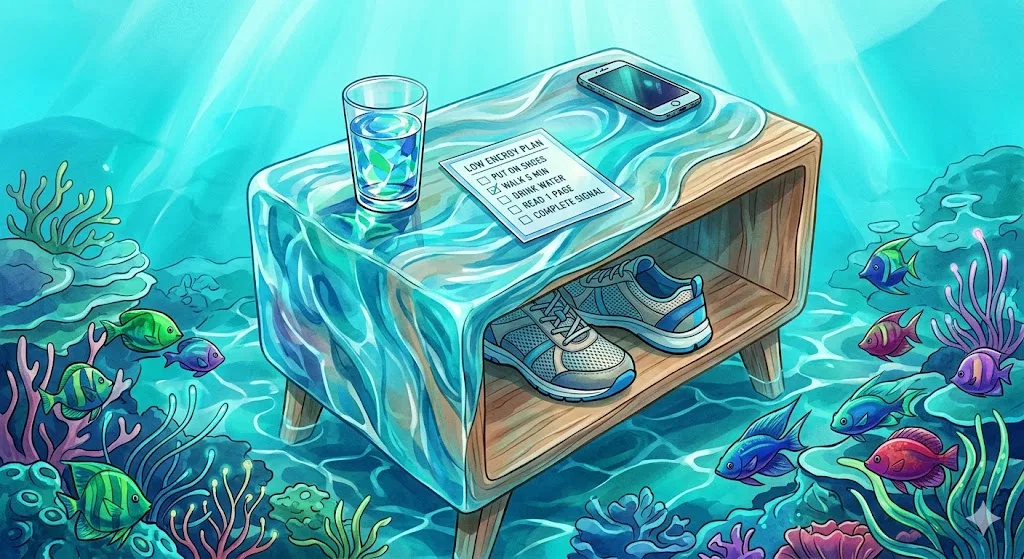
The minimum action is the smallest version of the behaviour that still points in the right direction. It should be so small that it can be done when you are tired, busy or mildly discouraged, but not so vague that it becomes meaningless. “Do something productive” is too broad. “Open the document and write one sentence” is a minimum action. “Exercise” is too broad. “Put on shoes and walk for five minutes” is a minimum action.
This approach fits the evidence better than heroic consistency. Habit research emphasises repeated cue-behaviour links: doing a behaviour in a stable context helps it become more automatic over time. A 2024 systematic review and meta-analysis found that reported times to habit formation vary widely, with median or mean estimates ranging from about two months to several months and substantial individual variation. That variation is a reason to design for continuity rather than perfection.[cambridge]cambridge.orgUniversity Press & Assessment Habit Interventions (Chapter 41University Press & Assessment Habit Interventions (Chapter 41 University Press & Assessment
A useful minimum action has three qualities:
- It preserves the cue. If the full plan is “read after making tea”, the low-energy version is still attached to tea: read one page, not “read sometime”.
- It produces a visible completion signal. Tick a box, close the book after one page, save the sentence, log the five-minute walk.
- It avoids turning recovery into failure. The point is not to squeeze maximum output from a depleted day; it is to keep the routine alive without making exhaustion worse.
For example, someone trying to improve their health might set three levels: full day, five-kilometre run; normal day, twenty-minute walk; low-energy day, walk round the block. Someone trying to study might use: full day, two focused hours; normal day, twenty-five minutes; low-energy day, open the notes and make three flashcards. The low-energy action is not the main goal. It is the floor that stops the plan collapsing.
Implementation intentions make this floor more concrete. They are “if-then” plans that link a situation to a response, such as “If I get home exhausted, then I will do the five-minute version before sitting down.” The US National Cancer Institute’s behavioural research summary describes implementation intentions as a way to translate goals into action by preparing responses to self-regulatory problems.[Cancer Control]cancercontrol.cancer.govCancer ControlImplementation Intentionsby PM Gollwitzer — Implementation intentions are formed for the purpose of enhancing the translati…
The strongest minimum actions are decided before the low-energy day. Deciding while tired creates another task. Deciding in advance turns the plan into a script.

Environmental shortcuts
Low-energy planning works best when the environment does some of the work. This is not a motivational slogan; it is a behaviour-design principle. NICE guidance on individual behaviour change identifies goals and planning, feedback and monitoring, and social support as important techniques, while behaviour-change taxonomies include prompts, cues, adding objects to the environment and restructuring the physical environment as recognised techniques.[NICE]nice.org.ukBehaviour change: individual approaches | Guidance2 Jan 2014 — This guideline covers changing health-damaging behaviours among people…
The shortcut should make the desired action easier at the exact moment it is likely to fail. A yoga mat in the cupboard is a possession. A yoga mat unrolled beside the bed is a prompt. A book on a shelf is an intention. A book on the pillow is an environmental cue. A budgeting app buried on the third screen of a phone is an aspiration. A direct shortcut on the home screen after payday is a practical nudge.
Good shortcuts reduce one of three kinds of friction:
- Starting friction: lay out clothes, open the document, place the notebook on the desk, pre-load the playlist, chop vegetables earlier.
- Decision friction: use a default routine, a fixed time, a pre-written low-energy menu, or a short list of approved minimum actions.
- Competing friction: put the phone in another room, block the distracting app during the vulnerable hour, keep snacks out of sight, charge devices away from the bed.
This is where low-energy plans differ from ordinary productivity advice. The aim is not to create an immaculate lifestyle system. The aim is to arrange the next action so it asks less of you when you have less to give. In COM-B terms, the environment increases opportunity; in habit terms, it strengthens the cue; in ordinary language, it makes the right thing easier to do half-asleep.[Springer]link.springer.coman across contexts empirical examination of the COM-B modelby TJ Willmott · 2021 · Cited by 346 — In the COM-B model, capability…
The shortcut should also be modest enough to maintain. If the environmental setup takes longer than the habit itself, it may become another barrier. A person trying to cook more on tired evenings may not need an elaborate meal-prep system. They may need three reliable low-effort meals, visible ingredients, and permission for “good enough” dinners that prevent takeaway becoming the only tired-day option.
Recovery without guilt
Low-energy planning can become unhealthy if it is used to deny real rest. The minimum action is not a loophole for ignoring illness, burnout, grief or chronic exhaustion. It is a way to separate two different situations: “I am avoiding a valued behaviour because starting feels hard” and “I genuinely need recovery.” A plan that works must include both action and rest.
This is where guilt becomes a practical problem, not just an unpleasant emotion. When a lapse is interpreted as proof of personal failure, people are more likely to hide from the plan, overcorrect, or give up. Research on self-compassion and health behaviour setbacks suggests that self-compassion can support more adaptive responses to lapses by reframing failure and encouraging renewed effort rather than self-attack.[PMC]pmc.ncbi.nlm.nih.govby S Michie · 2011 · Cited by 17114 — At the centre of a proposed new framework is a 'behaviour system' involving three essential cond…
Recovery without guilt does not mean pretending every missed day is ideal. It means using accurate language. “I missed today because I slept four hours and had a migraine” is different from “I am lazy.” “I did the five-minute version” is different from “I failed to do the full version.” “I need a recovery day and will resume with the minimum action tomorrow” is different from “The whole plan is ruined.”
Relapse-prevention thinking, especially in health behaviour and addiction contexts, also offers a useful general principle: setbacks are part of the change process, and planning for triggers helps people re-enter change more quickly. That does not mean every ordinary habit lapse should be treated like a clinical relapse. It means the same planning logic applies: identify the predictable trigger, decide the next safe action, and avoid turning one lapse into a story of permanent failure.[PMC]pmc.ncbi.nlm.nih.govby S Michie · 2011 · Cited by 17114 — At the centre of a proposed new framework is a 'behaviour system' involving three essential cond…
A simple recovery rule is: never miss the return step. The return step should be smaller than the full routine and scheduled clearly. For example: “Tomorrow after breakfast, I will do the two-minute version.” Not “I will restart properly on Monday.” The longer and grander the restart, the more likely it is to become another fantasy plan.

A practical worst-day template
A low-energy self-improvement plan should be written while you are calm enough to think clearly. It can be short. The purpose is not to design a second life; it is to remove negotiation from predictable moments of fatigue.
Use this structure:
- Name the real behaviour. Choose the behaviour you want to preserve: walking, reading, studying, tidying, stretching, cooking, budgeting, writing, contacting a friend.
- Define the full version. This is what you do on a good day: “Write for forty-five minutes after lunch.”
- Define the normal version. This is the ordinary sustainable version: “Write for twenty minutes after lunch.”
- Define the low-energy version. This is the non-negotiable floor: “Open the document and write one sentence.”
- Attach it to a cue. Use a time, place or existing routine: “After I make tea,” “after brushing my teeth,” “when I shut my laptop.”
- Add an environmental shortcut. Put the object, app, clothing or reminder where the behaviour happens.
- Write the recovery rule. Decide what happens after a missed day: “No catching up. Resume with the low-energy version at the next cue.”
This structure draws on action planning and coping planning. Action planning specifies when, where and how a behaviour will happen; coping planning prepares responses to barriers. Health-behaviour research describes planning as a bridge between intention and behaviour, and NICE guidance defines action plans as specifying what will happen, in what situation or at what time, how often, for how long and where.[DNB]d-nb.infoDNBAction planning and coping planning for long-term lifestyleDNBAction planning and coping planning for long-term lifestyle
A finished example might look like this:
Goal: Improve fitness without quitting during busy weeks.
Full version: Gym for forty-five minutes after work.
Normal version: Twenty-minute walk after dinner.
Low-energy version: Put on shoes and walk for five minutes.
Cue: After placing dinner plate in the sink.
Shortcut: Shoes and coat by the door.
Recovery rule: If I miss a day, I do the five-minute version the next evening; I do not “make up” the missed session.
The same pattern works for non-fitness goals:
Goal: Read more consistently.[cancercontrol.cancer.gov]cancercontrol.cancer.govCancer ControlImplementation Intentionsby PM Gollwitzer — Implementation intentions are formed for the purpose of enhancing the translati…
Full version: Thirty pages before bed.
Normal version: Ten pages after brushing teeth.
Low-energy version: One page with phone outside the bedroom.
Cue: Toothbrush back in the cup.
Shortcut: Book on pillow.
Recovery rule: If I miss a night, I read one page the next night and continue from there.
The point is not that one page or five minutes will transform your life by itself. The point is that the behaviour remains available even when your energy is not.

Common mistakes on low-energy days
The most common mistake is making the minimum action too large. A “low-energy” workout that still requires changing clothes, travelling to the gym, completing a full programme and showering afterwards is not a minimum action. It is a normal action wearing a kinder label. The minimum version should be small enough that it feels almost too easy on an ordinary day.
A second mistake is confusing low-energy planning with low standards. The minimum action is a floor, not the ceiling. On better days, the fuller version still exists. The plan works because it has range. A rigid plan breaks when life changes; a tiered plan bends.
A third mistake is tracking in a way that creates shame. Self-monitoring is a recognised behaviour-change technique, but the form matters. A streak tracker can motivate some people and demoralise others. On low-energy plans, it is often better to track “returned after lapse” as a success, not just uninterrupted streaks. NICE guidance includes reviewing behavioural goals in light of experience and making further plans according to progress, which is different from using a tracker as a daily verdict on your worth.[NICE]nice.org.ukOpen source on nice.org.uk.
A fourth mistake is treating every tired day as a discipline problem. Sometimes the correct self-improvement action is sleep, food, medical care, a boundary, or a smaller workload. Sleep loss and stress can affect the very systems used for planning, inhibition and emotional regulation, so a plan that never asks why energy is low may become self-punishment disguised as consistency.[PMC]pmc.ncbi.nlm.nih.govby S Michie · 2011 · Cited by 17114 — At the centre of a proposed new framework is a 'behaviour system' involving three essential cond…
The final mistake is making the restart too dramatic. “From tomorrow I will do everything properly” sounds motivating, but it often recreates the original fragile plan. A better restart is deliberately boring: return to the cue, do the minimum action, record it, stop.
What changes when the plan assumes fatigue
A self-improvement plan built for low-energy days changes the central question. Instead of asking, “How do I become the kind of person who never slips?” it asks, “What system helps me continue after a normal human slip?” That is a more useful question because stress, fatigue and imperfect weeks are not exceptions to life. They are part of the conditions under which any real plan must operate.
The best low-energy plan is therefore not the easiest possible plan. It is the most resilient useful plan: specific enough to guide action, small enough to survive bad days, supported enough by the environment, and forgiving enough to make return easy. It protects momentum without pretending that momentum is the only thing that matters.
For self improvement that works, this is the practical test: the plan should still make sense on your worst ordinary day. If it only works when you are rested, confident and uninterrupted, it is not yet a real plan.
Amazon book picks
Further Reading
Books and field guides related to Build the Plan for Your Worst Day. Use these as the next step if you want deeper reading beyond the article.
Atomic Habits
Rating: 3.5/5 from 7 Google Books ratings
Promotes sustainable habits through small actions on difficult days.
eBay marketplace picks
Marketplace Samples
Example marketplace items related to this page. Use the search link to explore similar finds on eBay.

Endnotes
1.
Source: cancercontrol.cancer.gov
Link:https://cancercontrol.cancer.gov/brp/research/constructs/implementation-intentions
Source snippet
Cancer ControlImplementation Intentionsby PM Gollwitzer — Implementation intentions are formed for the purpose of enhancing the translati...
2.
Source: nice.org.uk
Link:https://www.nice.org.uk/guidance/ph49/chapter/recommendations
Source snippet
Behaviour change: individual approaches | Guidance2 Jan 2014 — This guideline covers changing health-damaging behaviours among people...
3.
Source: pmc.ncbi.nlm.nih.gov
Link:https://pmc.ncbi.nlm.nih.gov/articles/PMC3096582/
Source snippet
by S Michie · 2011 · Cited by 17114 — At the centre of a proposed new framework is a 'behaviour system' involving three essential cond...
4.
Source: link.springer.com
Link:https://link.springer.com/article/10.1186/s12889-021-11019-w
Source snippet
an across contexts empirical examination of the COM-B modelby TJ Willmott · 2021 · Cited by 346 — In the COM-B model, capability...
5.
Source: pmc.ncbi.nlm.nih.gov
Link:https://pmc.ncbi.nlm.nih.gov/articles/PMC12168795/
Source snippet
The Role of Sleep and the Effects of Sleep Loss on Cognitive...by A Hyndych · 2025 · Cited by 59 — Sleep deprivation profoundly affec...
6.
Source: cambridge.org
Title: University Press & Assessment Habit Interventions (Chapter 41)
Link:https://www.cambridge.org/core/books/handbook-of-behavior-change/habit-interventions/420CFDC7EE75036CC4D08EE137108E45
7.
Source: nice.org.uk
Link:https://www.nice.org.uk/guidance/ph49
8.
Source: pmc.ncbi.nlm.nih.gov
Link:https://pmc.ncbi.nlm.nih.gov/articles/PMC10543633/
9.
Source: pmc.ncbi.nlm.nih.gov
Link:https://pmc.ncbi.nlm.nih.gov/articles/PMC9014843/
10.
Source: d-nb.info
Title: DNBAction planning and coping planning for long-term lifestyle
Link:https://d-nb.info/1103027735/34
11.
Source: self-compassion.org
Link:https://self-compassion.org/wp-content/uploads/publications/SCtheoryarticle.pdf
12.
Source: frontiersin.org
Link:https://www.frontiersin.org/journals/sleep/articles/10.3389/frsle.2024.1359723/full
13.
Source: hal.science
Link:https://hal.science/hal-03561895v1/document
14.
Source: frontiersin.org
Link:https://www.frontiersin.org/journals/digital-health/articles/10.3389/fdgth.2021.620383/full
Additional References
15.
Source: youtube.com
Title: Minimum Viable Habit: the best-kept secret to being consistent with your habits
Link:https://www.youtube.com/watch?v=3NpMGZh-ThI
Source snippet
How to be productive (even when you're tired) | tips to stay motivated during a 9-5 work day...
16.
Source: youtube.com
Link:https://www.youtube.com/watch?v=VfGRTOIT9Z4
Source snippet
The “Can't Fail” Morning Routine ☀️ (ADHD, Low Energy Days)...
17.
Source: youtube.com
Title: How to Have a Productive Day When You Have No Energy (Gentle, Realistic Tips)
Link:https://www.youtube.com/watch?v=11Vl35uvILs
Source snippet
Why Most Plans Fail (And What Actually Works)...
18.
Source: ncbi.nlm.nih.gov
Link:https://www.ncbi.nlm.nih.gov/books/NBK571075/
19.
Source: youtube.com
Title: Why Most Plans Fail (And What Actually Works)
Link:https://www.youtube.com/watch?v=rlHg8SFekwg
Source snippet
Minimum Viable Habit: the best-kept secret to being consistent with your habits...
20.
Source: researchgate.net
Link:https://www.researchgate.net/publication/358734161_From_Ego_Depletion_to_Self-Control_Fatigue_A_Review_of_Criticisms_Along_With_New_Perspectives_for_the_Investigation_and_Replication_of_a_Multicomponent_Phenomenon
21.
Source: researchgate.net
Link:https://www.researchgate.net/publication/228079793_Sleep_Self-Regulation_Self-Control_and_Health
22.
Source: researchgate.net
Link:https://www.researchgate.net/publication/391205475_Small_changes_big_impact_A_mini_review_of_habit_formation_and_behavioral_change_principles
23.
Source: drugsandalcohol.ie
Link:https://www.drugsandalcohol.ie/21170/1/Behaviour_change_individual_approaches.pdf
24.
Source: yukaichou.com
Link:https://yukaichou.com/gamification-analysis/com-b-behavior-change-wheel-michie-capability-opportunity-motivation/
Topic Tree