Within Small Starts
The Habit Growth Rule Most Plans Miss
Habits need modest increases in duration, difficulty, quality or independence once the current step becomes ordinary.
On this page
- Why repetition alone eventually stops building skill
- Five ways to raise the demand safely
- How to increase one variable at a time
Page outline Jump by section
Introduction
Starting small is an effective way to begin a habit, but it is not enough to keep improving. Once a behaviour becomes routine, repeating the exact same version often produces diminishing returns. The person may maintain the habit, but growth in skill, capacity, quality or independence slows. This is where a form of progressive overload becomes useful outside the gym.
 In habit building, progressive overload means deliberately increasing the demands of a routine after the current level feels normal. The increase does not have to involve more time. It can involve greater complexity, higher standards, more responsibility, reduced support, or more challenging conditions. The goal is to stay just beyond autopilot without creating so much difficulty that the habit breaks down. Research on habit formation, behaviour change techniques, skill acquisition and deliberate practice all point to the same underlying mechanism: learning continues when repetition is paired with appropriately increasing challenge.[PMC]pmc.ncbi.nlm.nih.govTime to Form a Habit: A Systematic Review and Meta-Analysis…by B Singh · 2024 · Cited by 95 — The premise of habit formation involv…[PubMed]pubmed.ncbi.nlm.nih.govThe authors describe the effects of practice conditions in motor learning (e.g., contextual interference, knowledge of results) within th…
The Habit Growth Rule Most Plans Miss
A common mistake in self-improvement is treating consistency as the final objective rather than the foundation for development.
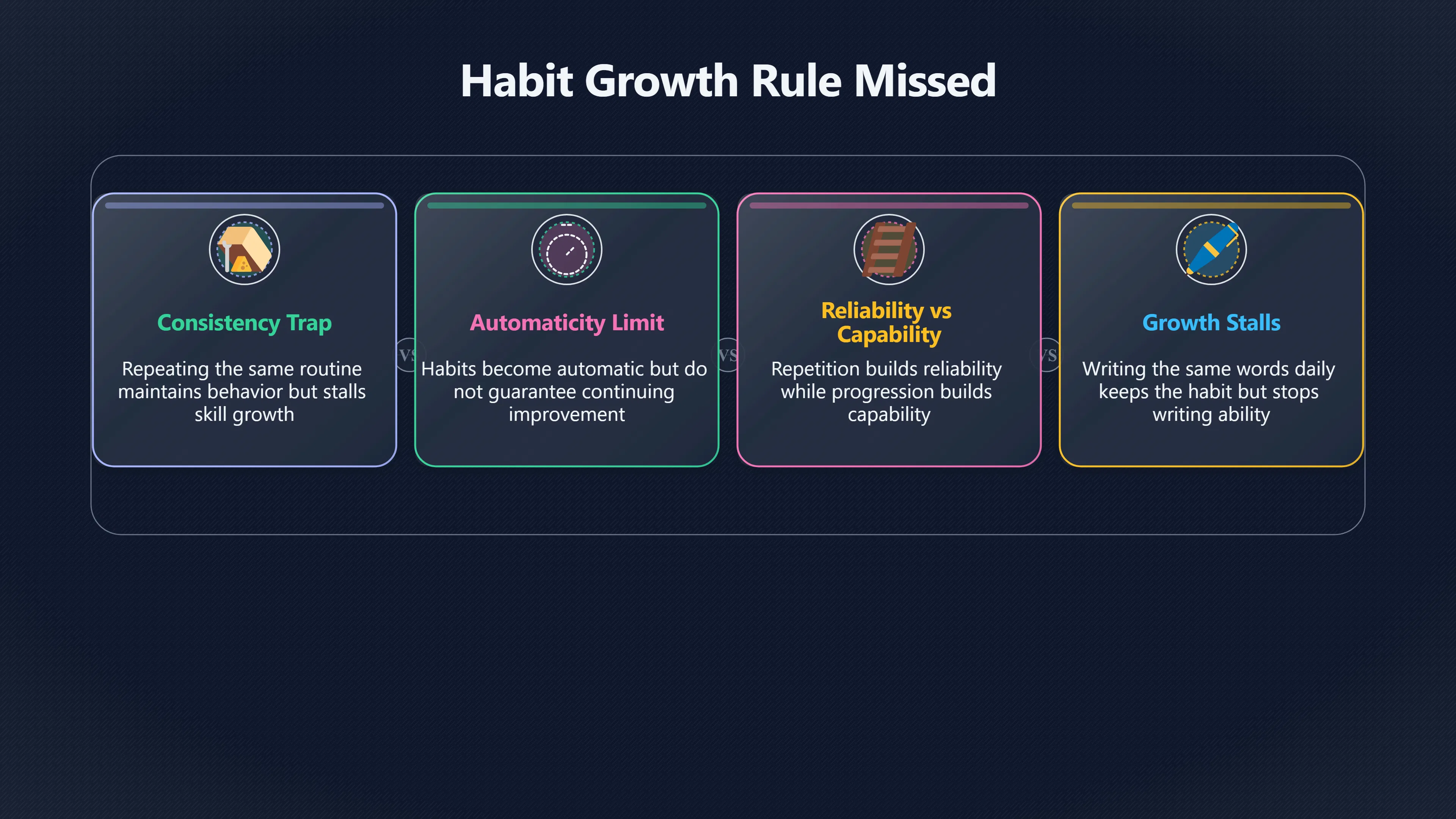
Imagine someone who writes 100 words every morning. That habit may successfully become automatic. Yet after several months, writing the same 100 words under the same conditions may maintain the behaviour without significantly improving writing ability. The habit survives, but growth stalls.
Researchers studying habit formation describe habits as behaviours that become increasingly automatic through repetition in a stable context. Automaticity is valuable because it reduces reliance on motivation. However, automaticity itself does not guarantee continuing improvement in performance or skill.[PMC]pmc.ncbi.nlm.nih.govTime to Form a Habit: A Systematic Review and Meta-Analysis…by B Singh · 2024 · Cited by 95 — The premise of habit formation involv…
This distinction explains why many people become excellent at maintaining routines but not necessarily at advancing them. Repetition builds reliability. Progression builds capability.
Why Repetition Alone Eventually Stops Building Skill
Learning depends on information, feedback and adaptation. When a task becomes too predictable, it provides less new information about what works, what fails and what could be improved.
The challenge point framework, a well-established model of skill acquisition, proposes that learning is greatest when task difficulty is matched to current ability. If a task is too easy, there is little information available for improvement. If it is too difficult, performance deteriorates and learning suffers. Between those extremes lies an optimal challenge level. As ability rises, the challenge must rise too.[PubMed]pubmed.ncbi.nlm.nih.govThe authors describe the effects of practice conditions in motor learning (e.g., contextual interference, knowledge of results) within th…
This principle applies far beyond physical training:
- A reader who always chooses books at the same level eventually stops stretching comprehension.
- A language learner who only reviews familiar vocabulary maintains knowledge but gains little new fluency.
- A manager who never delegates harder responsibilities limits leadership growth.
- A writer who never attempts more complex projects preserves consistency while slowing development.
Deliberate-practice research reaches a similar conclusion. Improvement comes not from repeating what is already comfortable, but from systematically working on the edge of current competence and receiving feedback about performance.[interpreterslab.org]interpreterslab.orgA Deliberate Practice Approach to Skill DevelopmentApril 16, 2020 — by RE Herring · 2015 · Cited by 8 — Research into skill acquisition and expertise suggests that asking learners to perfo…[Taylor & Francis Online]tandfonline.comTaylor & Francis OnlineEffective practice and instruction: A skill acquisition…by AM Williams · 2023 · Cited by 118 — There are some c…
Five Ways to Raise the Demand Safely
Progressive overload outside the gym works because challenge can increase in multiple dimensions. Time is only one option.
Increase Duration
The simplest progression is extending the activity.
Examples include:
- Expanding a ten-minute daily walk to fifteen minutes.
- Increasing focused study from twenty minutes to thirty.
- Growing a five-minute journalling habit into a fifteen-minute reflection session.
Duration is useful when endurance or volume is the desired outcome. However, it is often the least interesting form of progression because longer does not automatically mean better.
Increase Difficulty
Difficulty rises when the task requires greater effort, concentration or skill.
Examples include:
- Moving from beginner to intermediate language material.
- Solving more demanding mathematics problems.
- Choosing books that require deeper analysis.
- Writing essays instead of short notes.
The challenge-point literature suggests that difficulty should rise gradually enough that success remains achievable while failure remains informative.[PubMed]pubmed.ncbi.nlm.nih.govThe authors describe the effects of practice conditions in motor learning (e.g., contextual interference, knowledge of results) within th…
Increase Quality Standards
A habit can remain the same size while demanding better execution.
Examples include:
- Editing writing more carefully.
- Improving pronunciation in language practice.
- Focusing on accuracy rather than simply completion.
- Replacing superficial reading with active note-taking.
This approach often produces substantial gains without requiring additional time.
Increase Complexity
Complexity involves combining skills or handling more variables at once.
Examples include:
- Progressing from cooking simple meals to planning an entire week’s menu.
- Moving from individual coding exercises to complete software projects.
- Shifting from practising presentations alone to handling audience questions.
Complexity introduces new learning demands while preserving the original habit structure.

Increase Independence
Many habits begin with support systems: reminders, templates, coaches, checklists or accountability partners.
A useful progression is gradually removing these supports.
Examples include:
- Planning your week without a template.
- Managing finances without constant prompts.
- Completing work without external deadlines.
- Maintaining a reading routine without a tracking app.
Independence is often overlooked, yet it reflects genuine capability growth.
How to Increase One Variable at a Time
One reason habits collapse is that people attempt multiple upgrades simultaneously.
A person might decide to read longer, choose harder material, take detailed notes and wake up earlier all in the same week. Each change appears reasonable on its own, but their combined effect can overwhelm the system.
Behaviour-change frameworks frequently use graded tasks: a technique in which demands are increased gradually through achievable steps rather than abrupt leaps. Reviews of graded-task interventions suggest that structured progression works best when combined with clear goals and action plans.[PubMed]pubmed.ncbi.nlm.nih.govThe authors describe the effects of practice conditions in motor learning (e.g., contextual interference, knowledge of results) within th…[Taylor & Francis Online]tandfonline.comTaylor & Francis OnlineEffective practice and instruction: A skill acquisition…by AM Williams · 2023 · Cited by 118 — There are some c…
A practical rule is simple:
- Keep the habit cue unchanged.
- Change only one demand variable.
- Maintain the new level until it feels ordinary.
- Increase again only after stability returns.
For example:
WeekReading Habit1–3Read 10 pages daily4–6Read 15 pages daily7–9Read 15 pages and write one note10–12Read more demanding material while keeping volume constant
Each stage adds challenge without changing everything at once.
Signs You Are Progressing Too Slowly
Some habits become maintenance routines disguised as growth routines.
Warning signs include:
- The habit feels effortless every day.
- Performance has plateaued for months.
- There is no measurable increase in output or skill.
- The activity feels more like checking a box than practising.
Interestingly, research on behaviour-change systems shows that people often drift towards easier versions of interventions over time while still believing they will return to harder versions later. In practice, that return frequently does not happen automatically. Progress usually requires a deliberate decision to raise the challenge again.[arXiv]arxiv.orgNot Now, Ask Later: Users Weaken Their Behavior Change Regimen Over Time, But Expect To Re-Strengthen It ImminentlyJanuary 27, 2021…
Comfort is not necessarily failure, but prolonged comfort is often a signal that growth has slowed.
Signs You Are Progressing Too Quickly
The opposite problem is excessive overload.
Indicators include:
- Frequent missed sessions.
- Rising frustration.
- Sharp drops in performance quality.
- Persistent avoidance of the habit.
- Needing unusually high motivation to continue.
The challenge-point framework predicts this outcome as well. When task demands exceed a person’s ability to process information effectively, performance suffers and learning becomes less efficient.[PubMed]pubmed.ncbi.nlm.nih.govThe authors describe the effects of practice conditions in motor learning (e.g., contextual interference, knowledge of results) within th…
The best progression usually feels slightly uncomfortable rather than overwhelming. Success remains common, but not guaranteed.
Growth Without Losing the Habit
The central lesson is that habits and growth are not the same thing. Habits create consistency. Progressive overload creates development.
A small habit should eventually become too easy. That is not a flaw in the habit; it is evidence that the habit worked. The next step is not to abandon the routine but to raise the demand carefully. Whether the increase comes through duration, difficulty, quality, complexity or independence, the principle remains the same: once a level becomes ordinary, make it slightly more challenging and allow adaptation to catch up.
This is how a habit remains sustainable while still moving somewhere. The behaviour stays stable, but the person does not.
Amazon book picks
Further Reading
Books and field guides related to The Habit Growth Rule Most Plans Miss. Use these as the next step if you want deeper reading beyond the article.
Atomic Habits
Rating: 3.5/5 from 7 Google Books ratings
Explains how habits compound and evolve over time.
eBay marketplace picks
Marketplace Samples
Example marketplace items related to this page. Use the search link to explore similar finds on eBay.


Endnotes
1.
Source: pmc.ncbi.nlm.nih.gov
Link:https://pmc.ncbi.nlm.nih.gov/articles/PMC11641623/
Source snippet
Time to Form a Habit: A Systematic Review and Meta-Analysis...by B Singh · 2024 · Cited by 95 — The premise of habit formation involv...
2.
Source: interpreterslab.org
Title: A Deliberate Practice Approach to Skill Development
Link:https://www.interpreterslab.org/wp-content/uploads/2020/04/A-Deliberate-Practice-Approach-to-Skill-Development_RHerring.pdf
Source snippet
April 16, 2020 — by RE Herring · 2015 · Cited by 8 — Research into skill acquisition and expertise suggests that asking learners to perfo...
Published: April 16, 2020
3.
Source: arxiv.org
Link:https://arxiv.org/abs/2101.11743
Source snippet
Not Now, Ask Later: Users Weaken Their Behavior Change Regimen Over Time, But Expect To Re-Strengthen It ImminentlyJanuary 27, 2021...
Published: January 27, 2021
4.
Source: arxiv.org
Link:https://arxiv.org/html/2501.01779v2
Source snippet
vior repetition, turning habit formation into a time-to-event problem.Read more...
5.
Source: pubmed.ncbi.nlm.nih.gov
Link:https://pubmed.ncbi.nlm.nih.gov/15130871/
Source snippet
The authors describe the effects of practice conditions in motor learning (e.g., contextual interference, knowledge of results) within th...
6.
Source: tandfonline.com
Link:https://www.tandfonline.com/doi/full/10.1080/02640414.2023.2240630
Source snippet
Taylor & Francis OnlineEffective practice and instruction: A skill acquisition...by AM Williams · 2023 · Cited by 118 — There are some c...
7.
Source: pubmed.ncbi.nlm.nih.gov
Link:https://pubmed.ncbi.nlm.nih.gov/41644516/
Source snippet
The effects of graded tasks on physical activityby S Gibson · Cited by 1 — This review establishes the extent to which the behaviou...
8.
Source: tandfonline.com
Link:https://www.tandfonline.com/doi/full/10.1080/17437199.2026.2618195
Source snippet
This review establishes the extent to which the behaviour change technique (BCT) Graded Tasks is effective in increasing physical activit...
9.
Source: Wikipedia
Title: Challenge point framework
Link:https://en.wikipedia.org/wiki/Challenge_point_framework
Source snippet
Challenge point frameworkThis framework relates practice variables to the skill level of the individual, task difficulty, and informat...
10.
Source: Wikipedia
Title: Progressive overload
Link:https://en.wikipedia.org/wiki/Progressive_overload
Source snippet
Progressive overloadProgressive overload is a principle of strength training and hypertrophy training that allows for continuous gains...
11.
Source: healthline.com
Title: progressive overload
Link:https://www.healthline.com/health/progressive-overload
Source snippet
What It Is, Examples, and Tips30 Jul 2020 — Progressive overload is when you gradually increase the weight, [frequency]({{ 'frequency/' | relative_url }}), or number of repet...
12.
Source: health.clevelandclinic.org
Title: progressive overload
Link:https://health.clevelandclinic.org/progressive-overload
Source snippet
more...
Additional References
13.
Source: researchgate.net
Link:https://www.researchgate.net/publication/377893673_Use_of_behavior_change_techniques_in_physical_activity_programs_and_services_for_older_adults_findings_from_a_rapid_review
Source snippet
Use of behavior change techniques in physical activity...1 Feb 2024 — Interventions that used any of the most common BCTs showed overwhe...
14.
Source: phwwhocc.co.uk
Link:https://phwwhocc.co.uk/wp-content/uploads/2024/02/Identifying-and-Applying-Behaviour-Change-Techniques-1.pdf
Source snippet
Identifying and Applying Behaviour Change TechniquesThis interactive tool unpacks step 5 'build the intervention' where we explore how to...
15.
Source: gymaware.com
Link:https://gymaware.com/progressive-overload-the-ultimate-guide/
Source snippet
Progressive overload: the ultimate guideProgressive overload is a strength training strategy in which you gradually increase the intensit...
16.
Source: uhra.herts.ac.uk
Link:https://uhra.herts.ac.uk/id/eprint/15509/1/Gibson_et_al.2024-Graded_tasks_Review_Poster_1.pdf
Source snippet
Change Taxonomy Version 1: 8.7Graded Tasks have been associated with effective physical activity interventions3. • This research contribu...
17.
Source: researchgate.net
Link:https://www.researchgate.net/publication/357785323_An_extended_challenge-based_framework_for_practice_design_in_sports_coaching
Source snippet
(PDF) An extended challenge-based framework for...9 Feb 2022 — Our aims in this paper were to explain and elaborate on the challenge poi...
18.
Source: digitalwellbeing.org
Title: i BCT Taxonomy (v1): 93 hierarchically-clustered techniques Graded tasks
Link:https://digitalwellbeing.org/wp-content/uploads/2016/11/BCTTv1_PDF_version.pdf
Source snippet
9. Comparison of outcomes. 9.1. Credible source. 9.2. Pros... the same goal, a small change in that goal or setting a new goal instead o...
19.
Source: research.manchester.ac.uk
Title: the effects of graded tasks on physical activity a systematic rev
Link:https://research.manchester.ac.uk/en/publications/the-effects-of-graded-tasks-on-physical-activity-a-systematic-rev/
Source snippet
Research ExplorerThe Effects of Graded Tasks on Physical Activity: A Systematic...by S Gibson · 2026 · Cited by 1 — This review establis...
20.
Source: researchgate.net
Title: (PDF) Progressive Overload in Long-Term Exercise
Link:https://www.researchgate.net/publication/395352177_Progressive_Overload_in_Long-Term_Exercise_Interventions_Targeting_Executive_Function_A_Scoping_Review
Source snippet
progressive overload and explore occupational and resistance-training contexts.... This study targets the development of motor and cogni...
21.
Source: sciencedirect.com
Title: ScienceDirect Behavior Change Technique
Link:https://www.sciencedirect.com/topics/psychology/behavior-change-technique
Source snippet
Behavior Change Technique - an overviewBehavior change techniques (BCTs) are defined as the active ingredients of interventions designed...
22.
Source: blog.nasm.org
Title: progressive overload explained
Link:https://blog.nasm.org/progressive-overload-explained
Source snippet
Overload Explained: Grow Muscle & Strength...This blog explains the importance of progressive overload and how clients can progressively...
Topic Tree