Within Coffee Cue
Which Coffee Moment Should Start Work?
A good coffee cue is precise, automatic, and early enough to protect the first task from digital drift.
On this page
- Why stable cues beat vague morning intentions
- Best anchor points in a coffee routine
- Matching the cue to home, office, or commuting mornings
Page outline Jump by section
Introduction
If morning coffee is going to become the cue that starts meaningful work, the most important decision is not the coffee itself. It is choosing exactly which moment in the coffee routine will trigger action. Many productivity habits fail because the cue is too vague (“after breakfast”) or arrives after email, news, messaging apps, and other distractions have already captured attention. Research on habit formation consistently finds that behaviours become more automatic when they are repeated in response to stable, specific contextual cues rather than broad intentions.[PubMed Central]pmc.ncbi.nlm.nih.govPubMed CentralMaking health habitual: the psychology of 'habit-formation' and…by B Gardner · 2012 · Cited by 851 — Psychological theor…[Cambridge University Press & Assessment]cambridge.orgCambridge University Press & AssessmentChanging Behavior Using Habit Theory (Chapter 13)Evidence shows that established habits are cue-co…
 A coffee cue that survives real mornings is precise, predictable, and difficult to skip. The goal is to identify a moment that happens almost every workday and immediately connect it to the first work action. The better the cue, the less motivation and memory are required.
Why Stable Cues Beat Vague Morning Intentions
People often assume the challenge is discipline. In practice, the challenge is remembering and initiating the behaviour at the right moment.
Research on implementation intentions—specific “if-then” plans—shows that linking a particular situation to a particular response helps translate intentions into action. Instead of relying on a general goal such as “be productive this morning”, the person creates a cue-response pair: “When the coffee machine starts, I open today’s task list.”[Cancer Control]cancercontrol.cancer.govCancer ControlImplementation Intentionsby PM Gollwitzer — Implementation intentions are formed for the purpose of enhancing the translati…[PubMed Central]pmc.ncbi.nlm.nih.govPubMed CentralMaking health habitual: the psychology of 'habit-formation' and…by B Gardner · 2012 · Cited by 851 — Psychological theor…
Habit researchers describe habits as responses that become associated with recurring contexts. Repetition in a stable context gradually strengthens the connection between cue and behaviour. The cue begins to trigger the action with less conscious effort.[PubMed Central]pmc.ncbi.nlm.nih.govPubMed CentralMaking health habitual: the psychology of 'habit-formation' and…by B Gardner · 2012 · Cited by 851 — Psychological theor… ResearchGate This explains why many seemingly reasonable cues fail:[researchgate.net]researchgate.netPDF) Habit Formation and ChangeAs people repeat behavior in a stable context, their intentions and goals to perform the behavior. gradua…
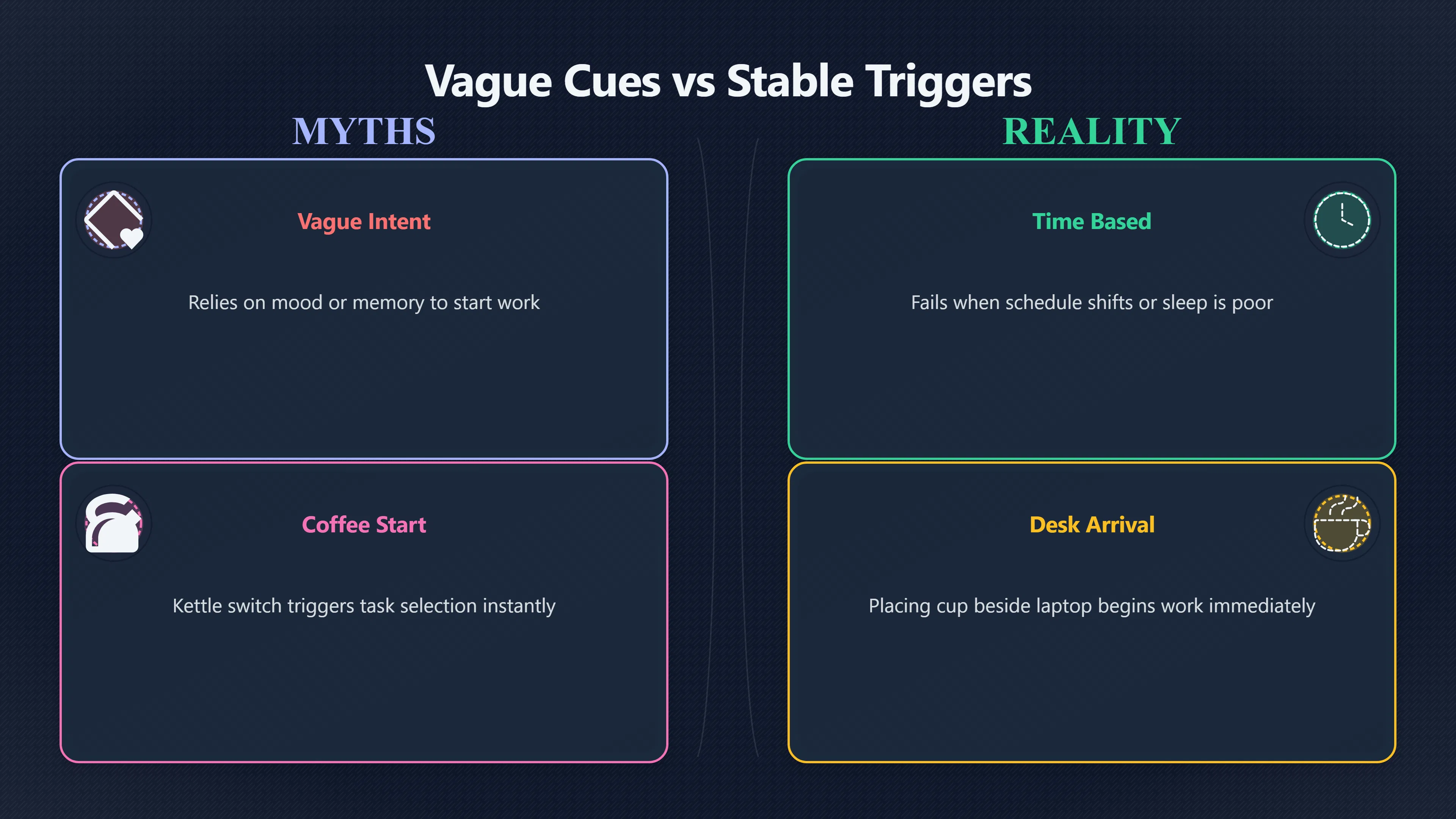
- “When I feel ready” depends on mood.
- “After my morning routine” is too broad.
- “At 8:00 am” breaks when schedules shift.
- “When I remember” is not a cue at all.
By contrast, a specific coffee-related event is concrete and observable. It either happened or it did not happen.
Research on cue selection suggests that people frequently choose ineffective cues when starting new behaviours, often because the cues are not stable enough in daily life. A good cue is less about inspiration and more about reliability.[PubMed Central]pmc.ncbi.nlm.nih.govPubMed CentralMaking health habitual: the psychology of 'habit-formation' and…by B Gardner · 2012 · Cited by 851 — Psychological theor…
Best Anchor Points in a Coffee Routine
Not every coffee moment is equally useful. The strongest cues share three characteristics:
- They occur almost every workday.
- They happen before digital distractions.
- They lead naturally into the work environment.
The Brewing Start
Examples:
- Switching on the kettle
- Pressing the espresso machine button
- Starting a coffee maker
This is often the strongest review cue because it creates a short waiting period. During those seconds or minutes, there is little else to do. That pause can become the dedicated moment for selecting the day’s first important task.
A useful implementation plan might be:
When the coffee starts brewing, I choose the first task and write the first action step.
The cue is visible, repeatable, and early.
The Cup Reaches the Desk
For many knowledge workers, this is the strongest start cue.
The behaviour becomes:
When I place the coffee beside my laptop, I begin the first work action.
This approach reduces the gap between cue and behaviour. The work environment is already present, which lowers friction.
The First Sip
The first sip works well when the location varies from day to day.
Someone who works in multiple offices, co-working spaces, or client locations may not have a consistent desk setup. The first sip remains available almost everywhere.
The drawback is that many people take that first sip while simultaneously checking messages. If the phone is already involved, the cue may arrive too late.
The End of Preparation
For people who make elaborate coffee drinks, the final preparation step can serve as a clean trigger:
When I finish adding milk, I open the project document.
The advantage is clarity. The preparation phase is complete and the work phase begins.
The Hidden Test: Would the Cue Still Work on a Bad Morning?
A useful way to evaluate a cue is to imagine an imperfect day.
Ask:
- Would this cue still happen if I overslept?
- Would it still happen if I felt stressed?
- Would it still happen on a Monday?
- Would it still happen after poor sleep?
- Would it still happen during a busy week?
If the answer is no, the cue is probably attached to an idealised morning rather than a real one.
Habit formation depends on repeated encounters with the cue. Every missed cue is a missed opportunity for repetition. Researchers emphasise the importance of stable contexts because consistency of cue exposure helps behaviours become automatic over time.[Taylor & Francis Online]tandfonline.comTaylor & Francis OnlineDeveloping habit-based health behaviour change…by B Gardner · 2023 · Cited by 155 — Theory suggests that making…[Refubium This is why]tandfonline.comTaylor & Francis Online How does habit form?Guidelines for tracking real-world…by B Gardner · 2022 · Cited by 100 — This paper proposes methodological criteria for studies tracki…“after meditation” is often weaker than “when the kettle starts” for many people. Coffee may happen every day; meditation may not.
Matching the Cue to Home, Office, or Commuting Mornings
The best cue depends on where the morning actually happens.
Home-Based Work
Home workers usually benefit from the earliest coffee-related cue available.
Effective examples include:
- When the kettle switches on
- When the coffee starts brewing
- When the mug touches the desk
Because the home environment contains many competing activities, an earlier cue provides protection against drifting into household tasks, social media, or news.
Office-Based Work
The strongest cue is often the transition from coffee acquisition to sitting down.
Examples:
- When returning from the office kitchen
- When placing the cup beside the keyboard
- When arriving at the desk with coffee
The commute has already consumed part of the morning, so the cue should trigger work immediately upon arrival.
Commuting With Coffee
People who buy coffee on the way to work need a cue tied to location rather than preparation.
Examples:
- First sip after sitting at the desk
- Entering the office with coffee in hand
- Opening the laptop while holding the drink
The key is connecting the cue to the first meaningful task rather than to inbox processing.

Protecting the Cue From Digital Drift
A cue loses power when another habit consistently arrives first.
Many people unintentionally create this sequence:
- Make coffee.
- Check phone.
- Check messages.
- Check news.
- Eventually start work.
In behavioural terms, the phone becomes the stronger cue.
Research on habits suggests that repeated cue-behaviour pairings strengthen over time. If coffee is repeatedly paired with scrolling, that is the habit that becomes automatic.[Cambridge University Press & Assessment]cambridge.orgCambridge University Press & AssessmentChanging Behavior Using Habit Theory (Chapter 13)Evidence shows that established habits are cue-co…[ScienceDirect]sciencedirect.comHabit formation and changeby L Carden · 2018 · Cited by 359 — This review highlights emerging findings and new directions in research on…
A more effective sequence is:
- Coffee cue appears.
- First task begins.
- Email and messages come later.
The practical lesson is simple: choose a coffee cue that occurs before digital drift starts. Once another routine has captured attention, the coffee cue is no longer the trigger—it is just background.
A Simple Rule for Choosing the Right Coffee Cue
When several coffee moments are available, choose the earliest one that satisfies all three conditions:
- It happens almost every workday.
- It occurs before common distractions.
- It sits close to the place where work begins.
For many people, that will be the moment the coffee starts brewing. For others, it will be the moment the cup reaches the desk. The exact choice matters less than the precision. A cue such as “during my coffee routine” leaves room for negotiation. A cue such as “when I place the mug beside the laptop, I start the first task” leaves very little.
That reduction in decision-making is the mechanism that allows a simple coffee ritual to survive real mornings rather than ideal ones.[PubMed Central]pmc.ncbi.nlm.nih.govPubMed CentralMaking health habitual: the psychology of 'habit-formation' and…by B Gardner · 2012 · Cited by 851 — Psychological theor…[Cancer Control]cancercontrol.cancer.govCancer ControlImplementation Intentionsby PM Gollwitzer — Implementation intentions are formed for the purpose of enhancing the translati…
Amazon book picks
Further Reading
Books and field guides related to Which Coffee Moment Should Start Work?. Use these as the next step if you want deeper reading beyond the article.
Atomic Habits
Rating: 3.5/5 from 7 Google Books ratings
Covers environment design and cue selection.
eBay marketplace picks
Marketplace Samples
Example marketplace items related to this page. Use the search link to explore similar finds on eBay.




Endnotes
1.
Source: cambridge.org
Link:https://www.cambridge.org/core/books/handbook-of-behavior-change/changing-behavior-using-habit-theory/5F222BC3AF6ADD9A8307BBB726D43F5C
Source snippet
Cambridge University Press & AssessmentChanging Behavior Using Habit Theory (Chapter 13)Evidence shows that established habits are cue-co...
2.
Source: cancercontrol.cancer.gov
Link:https://cancercontrol.cancer.gov/brp/research/constructs/implementation-intentions
Source snippet
Cancer ControlImplementation Intentionsby PM Gollwitzer — Implementation intentions are formed for the purpose of enhancing the translati...
3.
Source: researchgate.net
Link:https://www.researchgate.net/publication/322222649_Habit_Formation_and_Change
Source snippet
(PDF) Habit Formation and ChangeAs people repeat behavior in a stable context, their intentions and goals to perform the behavior. gradua...
4.
Source: sciencedirect.com
Link:https://www.sciencedirect.com/science/article/abs/pii/S2352154617301602
Source snippet
Habit formation and changeby L Carden · 2018 · Cited by 359 — This review highlights emerging findings and new directions in research on...
5.
Source: good.you
Title: Habit Stacking and Implementation Intentions
Link:https://good.you/growth/habits/habit-stacking-implementation-intentions
Source snippet
13 Feb 2026 — Habit stacking (B.J. Fogg's "anchor habits") involves attaching a new behaviour to an existing, well-established ha...
6.
Source: sciencedirect.com
Link:https://www.sciencedirect.com/science/article/pii/S1364661324002663
Source snippet
Leveraging cognitive neuroscience for making and...by EK Buabang · 2025 · Cited by 47 — Similarly, [stable cues]({{ 'stable-cues/' | relative_url }}) and reduced action monito...
7.
Source: researchgate.net
Title: How does habit form?
Link:https://www.researchgate.net/publication/358786633_How_does_habit_form_Guidelines_for_tracking_real-world_habit_formation
Source snippet
Guidelines for tracking real-world...7 Feb 2022 — This paper proposes methodological criteria for studies tracking real-world habit form...
8.
Source: researchgate.net
Link:https://www.researchgate.net/publication/348328187_Habit_formation_following_routine-based_versus_time-based_cue_planning_A_randomized_controlled_trial
Source snippet
(PDF) Habit formation following routine‐based versus time...Habitual behaviors are automatic responses to specific cues, acquired throug...
9.
Source: researchgate.net
Link:https://www.researchgate.net/publication/391205475_Small_changes_big_impact_A_mini_review_of_habit_formation_and_behavioral_change_principles
Source snippet
Small changes, big impact: A mini review of habit formation...27 Apr 2025 — This mini-review explores the science of habit formation, em...
10.
Source: cambridge.org
Title: Habit Interventions (Chapter 41)
Link:https://www.cambridge.org/core/books/handbook-of-behavior-change/habit-interventions/420CFDC7EE75036CC4D08EE137108E45
Source snippet
The Handbook of...This chapter outlines how developing new cue-behavior associations so that a habit can form may disrupt unwanted habit...
11.
Source: mindlabneuroscience.com
Link:https://mindlabneuroscience.com/habit-formation-7-powerful-strategies/
Source snippet
Habit Formation Neuroscience: 7 Brain-Based StrategiesHabit stacking involves anchoring a new desired behavior to an existing automatic r...
12.
Source: pmc.ncbi.nlm.nih.gov
Link:https://pmc.ncbi.nlm.nih.gov/articles/PMC3505409/
Source snippet
PubMed CentralMaking health habitual: the psychology of 'habit-formation' and...by B Gardner · 2012 · Cited by 851 — Psychological theor...
13.
Source: tandfonline.com
Link:https://www.tandfonline.com/doi/full/10.1080/08870446.2021.2003362
Source snippet
Taylor & Francis OnlineDeveloping habit-based health [behaviour change]({{ 'behaviour-change/' | relative_url }})...by B Gardner · 2023 · Cited by 155 — Theory suggests that making...
14.
Source: pmc.ncbi.nlm.nih.gov
Link:https://pmc.ncbi.nlm.nih.gov/articles/PMC10585941/
Source snippet
PubMed CentralInstant habits versus flexible tenacity: Do implementation...by T van Timmeren · 2022 · Cited by 11 — Implementation inten...
15.
Source: pmc.ncbi.nlm.nih.gov
Link:https://pmc.ncbi.nlm.nih.gov/articles/PMC7106637/
Source snippet
They not only [support]({{ 'support/' | relative_url }}) memory but may also help to make the new...
16.
Source: tandfonline.com
Title: Taylor & Francis Online How does habit form?
Link:https://www.tandfonline.com/doi/full/10.1080/23311908.2022.2041277
Source snippet
Guidelines for tracking real-world...by B Gardner · 2022 · Cited by 100 — This paper proposes methodological criteria for studies tracki...
17.
Source: pmc.ncbi.nlm.nih.gov
Link:https://pmc.ncbi.nlm.nih.gov/articles/PMC4566897/
Source snippet
NIHby B Gardner · 2014 · Cited by 1305 — This paper examines use of the term in the context of health-related behaviour, and explor...
18.
Source: Wikipedia
Link:https://en.wikipedia.org/wiki/Habit
Source snippet
HabitA habit is a routine of behavior that is repeated regularly and tends to occur subconsciously. Good Habits Poster. The concept of...
Additional References
19.
Source: nature.com
Link:https://www.nature.com/nature-index/topics/l4/behavior-change-and-habit-formation-in-health-contexts
Source snippet
Behavior Change and Habit Formation in Health ContextsBehaviour change and habit formation lie at the heart of promoting and sustaining h...
20.
Source: weber.edu
Link:https://www.weber.edu/academicpeercoaching/blog/forming-habits.html
Source snippet
Forming Habits Without Much AdoA cue is a trigger. The 5 most common cues are location, time of day, emotional status, thought, belief, a...
21.
Source: merriam-webster.com
Link:https://www.merriam-webster.com/dictionary/habit
Source snippet
HABIT Definition & Meaning8 days ago — The word habit most often refers to a usual way of behaving or a tendency that someone has settled...
22.
Source: therapyroute.com
Link:https://www.therapyroute.com/article/habit-formation-by-therapyroute
Source snippet
Habit FormationHabit formation is the process by which behaviours become automatic through repetition and practice. It's how your brain c...
23.
Source: jamesclear.com
Link:https://jamesclear.com/habit-triggers
Source snippet
The 5 Triggers That Make New Habits StickTriggers are the cues in the habit loop that prompt new habits. Learn the 5 fundamental triggers...
24.
Source: triagemethod.com
Link:https://triagemethod.com/understanding-the-basics-of-behaviour-change-and-habit-formation/
Source snippet
The routine is the behaviour itself. The reward is what your brain gets from doing it, which reinforces the...Read more...
25.
Source: ie.edu
Title: Cue: The trigger that starts the habit, like hearing an alarm that
Link:https://www.ie.edu/center-for-health-and-well-being/blog/the-science-behind-building-habits-how-to-make-healthy-choices-that-stick/
Source snippet
The science behind building habits: how to make healthy...30 Jan 2025 — The habit loop consists of four stages: cue, craving, response...
26.
Source: goalsandprogress.com
Title: Habit stacking is anchoring a new behavior to an existing automatic habit
Link:https://goalsandprogress.com/habit-formation-complete-guide/
Source snippet
Habit Formation: 6-Step System That Survives Past Week 4Implementation intentions – the research term for specific if-then plans...
27.
Source: companyaddress.co.uk
Link:https://companyaddress.co.uk/sites/detail/index.php?p=Research-Shows-3-Critical-Factors-for-Successful-Habit-Formation-msgJv8C9cYpWR
Source snippet
eliable contextual cue in your daily routine (e.g., "after I brush my teeth" or...Read more...
28.
Source: effectiveselfhelp.org
Title: Behaviour change: a guide to forming habits you’ll keep1
Link:https://effectiveselfhelp.org/research/a-guide-to-forming-habits-you-ll-keep/
Source snippet
Form a clear goal intention - what specifically are you hoping to achieve? · 2. Plan how you intend to implement the behaviour - what you...
Topic Tree