Within The Idea That A Habit Forms In 21 Days
Signs Your Habit Is Working Before It Feels Easy
Progress can show up as fewer reminders, faster recovery and less debate long before a behavior feels fully automatic.
On this page
- Early signs of growing automaticity
- Why missed days do not erase progress
- How to judge the trend instead of the deadline
Page outline Jump by section
Introduction
One of the biggest mistakes in self-improvement is assuming that a habit is only working when it feels effortless. In reality, habit strength usually improves long before a behaviour becomes easy. Research on habit formation shows that automaticity develops gradually, often over weeks or months, and people commonly experience meaningful progress while still relying on reminders, discipline and conscious effort.[Wiley Online Library]onlinelibrary.wiley.comWiley Online LibraryHow are habits formed: Modelling habit formation in the…16 Jul 2009 — To test the hypothesis that missing an oppor…
 This matters because many people abandon useful habits at the exact point when they are actually gaining strength. They interpret ongoing effort as evidence of failure, when the more relevant question is whether the behaviour is becoming easier to start, easier to recover and more likely to happen than it was a few weeks earlier. The signs of progress are often subtle, but they appear well before a habit feels fully automatic.[King's College London]kclpure.kcl.ac.ukexperiences of habit formation a qualitative studyKing's College LondonExperiences of habit formation: A qualitative studyby P Lally · 2011 · Cited by 365 — Results showed that behaviour…
Early Signs of Growing Automaticity
The clearest sign that a habit is strengthening is not that it feels effortless. It is that the behaviour requires slightly less mental negotiation than before.
In the early stages, a person may spend several minutes debating whether to go for a run, practise a skill or prepare a healthy meal. As the habit develops, that internal discussion often becomes shorter. The behaviour still requires effort, but less effort is spent deciding whether to do it. Habit researchers describe this shift as the gradual movement from conscious decision-making towards cue-driven action.[Open Research Surrey]openresearch.surrey.ac.ukOpen Research Surrey Habit Formation and Behavior ChangeOpen Research SurreyHabit Formation and Behavior Change - University of Surreyby AL Rebar · 2019 · Cited by 407 — Within psychology, the…
Common signs include:
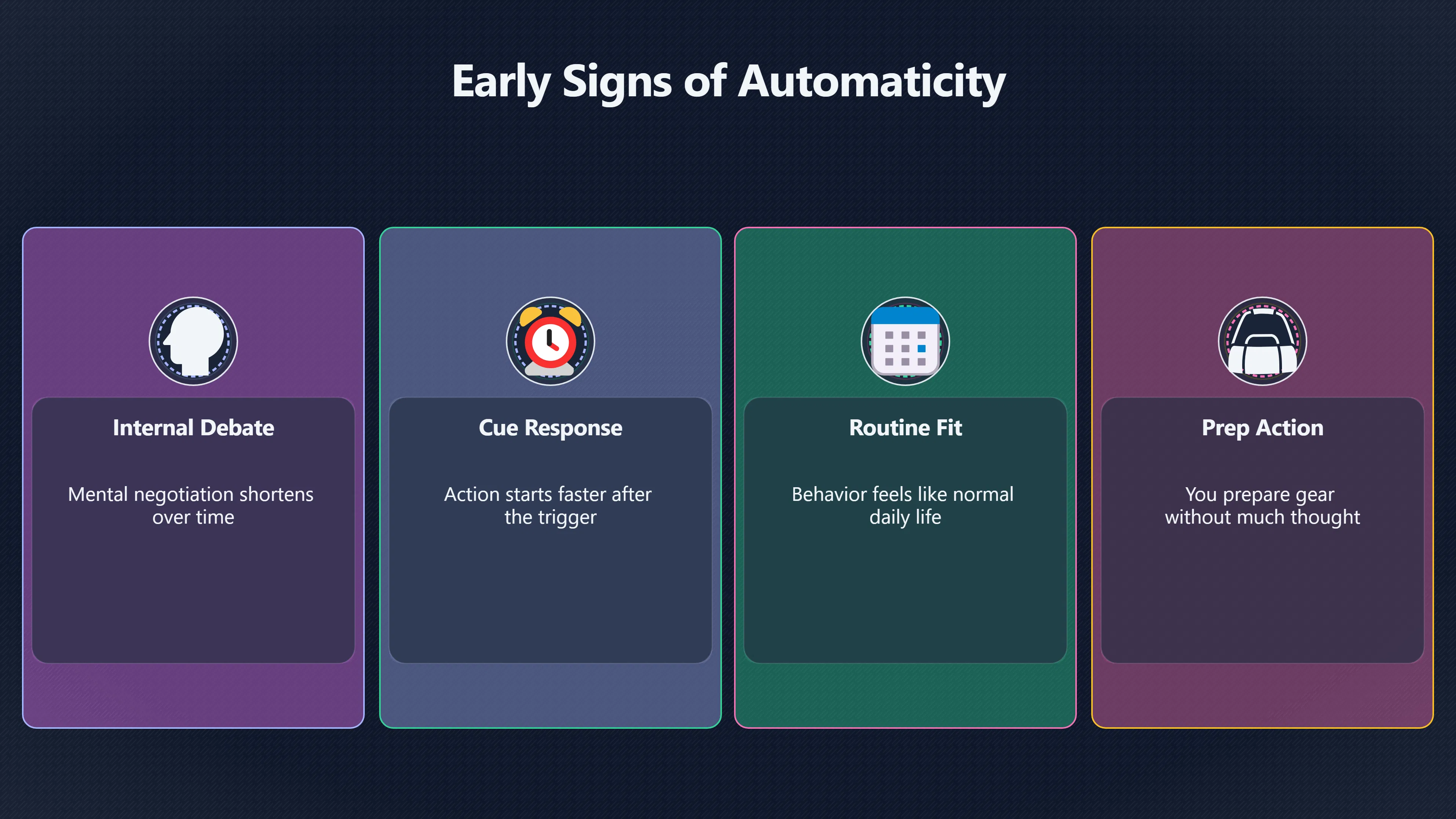
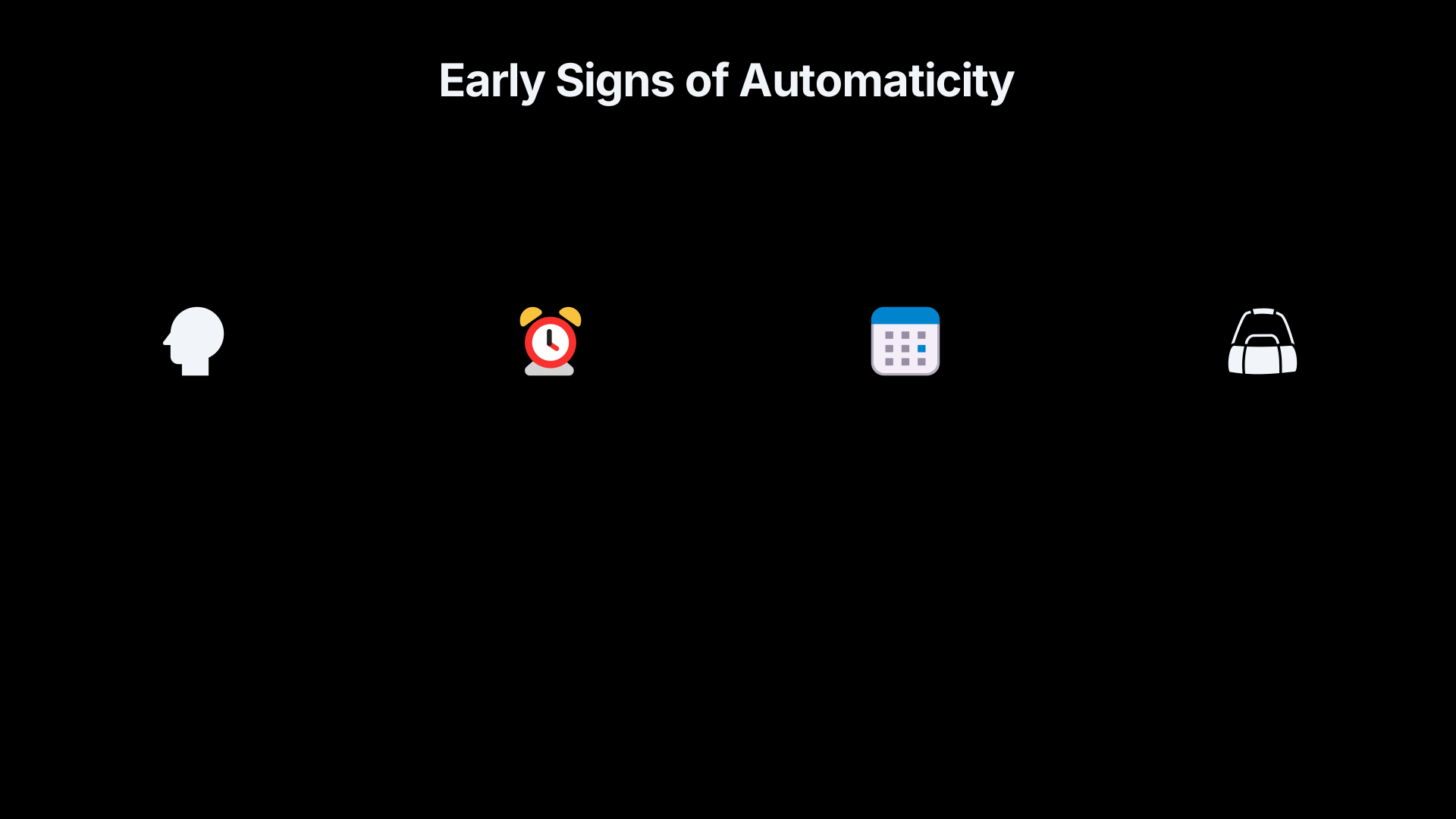
- You begin the behaviour more quickly after encountering the usual cue.
- You need fewer reminders, alarms or notes than before.
- The behaviour feels like part of your normal routine rather than a special project.
- You notice yourself preparing for the habit automatically, such as laying out gym clothes or opening a study document without much thought.
- Skipping the behaviour starts to feel unusual or slightly uncomfortable.
Another encouraging sign is increased consistency in familiar situations. Habits are built through repeated responses to stable cues, such as a particular time of day, location or preceding activity. When the same context reliably triggers the behaviour, even imperfectly, the underlying habit is generally strengthening.[Frontiers]frontiersin.orgFrontiersContext Stability in Habit Building Increases Automaticity…by M Stojanovic · 2022 · Cited by 25 — In this paper, we investiga…[BPS Psych Hub]bpspsychub.onlinelibrary.wiley.comRoutine cues are linked to higher behavioural…Read more…
When the Start Gets Easier but the Activity Still Feels Hard
Many people expect the activity itself to become pleasant immediately. That is not always how habit formation works.
A new exercise routine may still feel physically demanding after two months. Daily writing may still require concentration. Healthy eating may still involve temptation. What often changes first is the ease of getting started.
Research and qualitative studies of habit development suggest that people frequently experience the behaviour as cognitively effortful at first, while the process of initiation gradually becomes more automatic over time.[King's College London]kclpure.kcl.ac.ukexperiences of habit formation a qualitative studyKing's College LondonExperiences of habit formation: A qualitative studyby P Lally · 2011 · Cited by 365 — Results showed that behaviour…
This distinction is important. A habit can be growing stronger even when the activity remains challenging.
Why Missed Days Do Not Erase Progress
A common fear is that one missed day means starting over. The evidence does not support that belief.
The well-known habit formation research conducted by Phillippa Lally and colleagues found that missing a single opportunity to perform a behaviour did not materially affect habit development. Subsequent summaries of the research have emphasised the same finding: habit strength continued to increase after occasional lapses.[Wiley Online Library]onlinelibrary.wiley.comWiley Online LibraryHow are habits formed: Modelling habit formation in the…16 Jul 2009 — To test the hypothesis that missing an oppor…[University College London]ucl.ac.ukhow long does it take form habitUniversity College LondonHow long does it take to form a habit?4 Aug 2009 — In our study we showed that missing one opportunity did not s…
The more meaningful measure is recovery speed.
A weakening habit often produces a chain reaction: one missed day becomes several. A strengthening habit behaves differently. After a lapse, the person returns to the behaviour relatively quickly. The interruption becomes a brief deviation rather than a collapse of the routine.
For example:
- A beginner who misses one workout may abandon exercise for three weeks.
- Someone with a strengthening exercise habit may miss one workout but return at the next planned session.
The difference is not perfection. The difference is recovery.
Research on habit formation suggests that automaticity grows through repeated performances over time, not through flawless streaks. Occasional interruptions are normal within the broader upward trend. PMC[Taylor & Francis Online]tandfonline.comTaylor & Francis Online How does habit form?Guidelines for tracking real-world…by B Gardner · 2022 · Cited by 105 — This paper proposes methodological criteria for studies tracki…

The Risk of Misreading Normal Variability
Many habit-building efforts fail because people expect a smooth upward trajectory.
Actual habit formation tends to follow a pattern in which improvements are noticeable at first and then become more gradual. Progress can seem to stall even while automaticity continues to strengthen beneath the surface.[Wiley Online Library]onlinelibrary.wiley.comWiley Online LibraryHow are habits formed: Modelling habit formation in the…16 Jul 2009 — To test the hypothesis that missing an oppor…
This creates a psychological trap. During the first weeks, visible gains are encouraging. Later, the habit may still be improving, but the changes become harder to notice. People may incorrectly conclude that they have reached a plateau or that the habit is not working.
How to Judge the Trend Instead of the Deadline
The most useful question is not whether a habit feels automatic on day 21, day 30 or even day 66. The more useful question is whether the overall trend is moving in the right direction.
Instead of evaluating a single day, look for changes across several weeks:
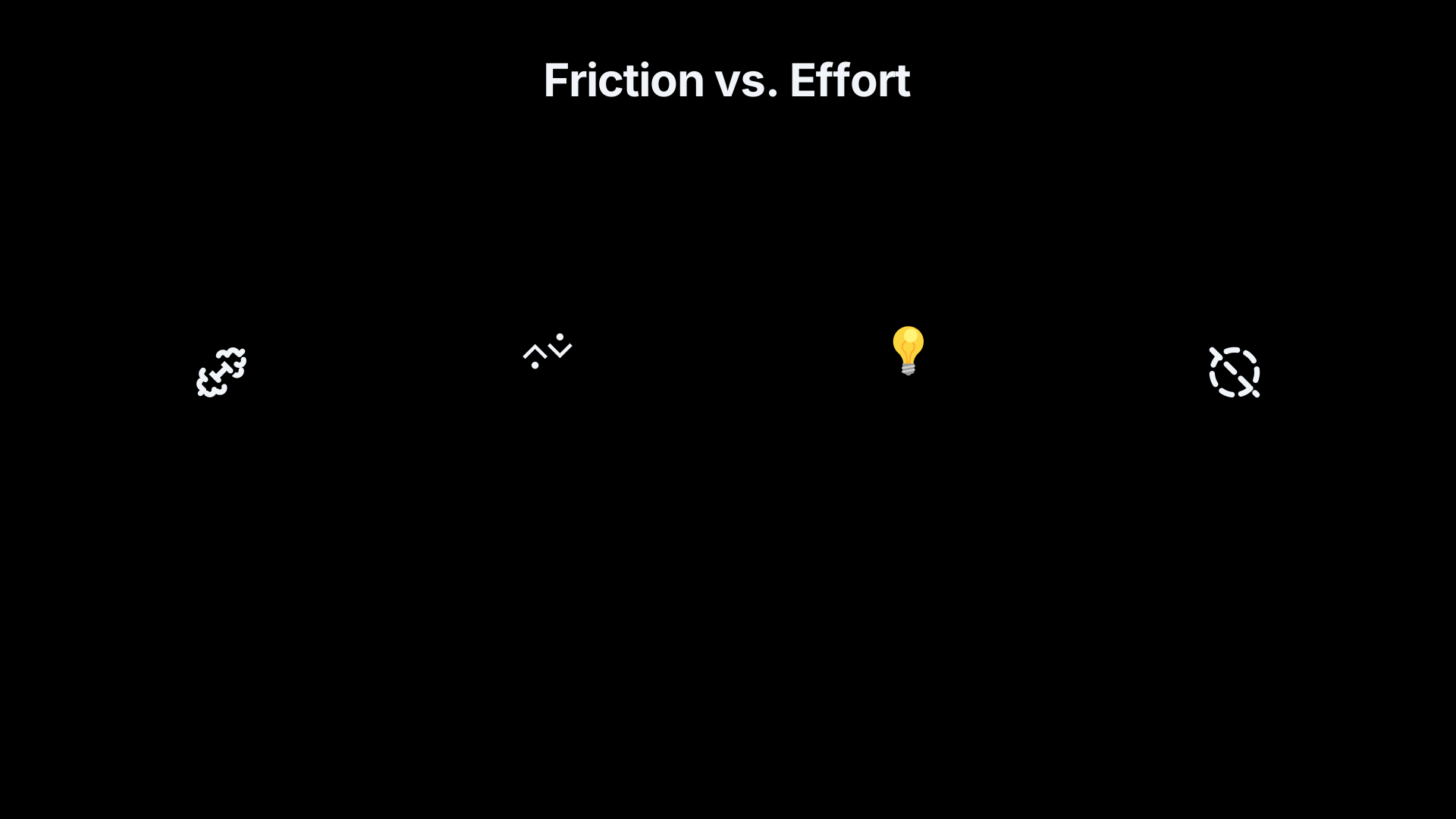
Frequency. Are you performing the behaviour more often than before?
Initiation speed. Do you start with less delay once the cue appears?
Reliance on motivation. Do you sometimes act even when motivation is low?
Recovery time. Are you returning more quickly after missed days?
Environmental fit. Have your routines and surroundings begun supporting the behaviour naturally?
These indicators often reveal genuine progress before the habit feels easy. They also align more closely with how psychologists define habit strength: as increasing automaticity in response to recurring cues, rather than simple repetition or streak length.[Nature]nature.comBehavior Change and Habit Formation in Health ContextsAutomaticity: The extent to which a behaviour is performed with little consci…[European Health Psychology Society]ehps.netEuropean Health Psychology SocietyHabit as automaticity, not frequencyby B Gardner · 2012 · Cited by 260 — Habit development will best su…
A Practical Example
Imagine someone trying to establish a ten-minute evening reading habit.
In week one, they remember only half the time and frequently debate whether to begin.
By week four, they still need effort to read, but they usually pick up the book after sitting in their usual chair.
By week eight, they occasionally miss a night, yet restarting no longer feels like beginning from scratch.
The reading habit may not feel effortless. However, the cue-to-action connection is becoming more reliable. That strengthening connection is the real sign of progress. Research consistently suggests that habit formation is a gradual increase in automatic responding to familiar contexts, not a sudden transformation from difficult to easy.[Open Research Surrey]openresearch.surrey.ac.ukOpen Research Surrey Habit Formation and Behavior ChangeOpen Research SurreyHabit Formation and Behavior Change - University of Surreyby AL Rebar · 2019 · Cited by 407 — Within psychology, the…[Cambridge University Press & Assessment]cambridge.orgChanging Behavior Using Habit Theory (Chapter 13)Habits involve a direct cue-behavior association in memory. When encountered, cues activ…
The Most Reliable Signal: Less Friction, Not No Friction
The strongest habits eventually feel natural, but the path towards that point is usually marked by decreasing friction rather than disappearing friction.
You still need effort. You still need attention. You may still miss days. Yet the behaviour starts occurring with greater regularity, less debate and faster recovery. Those changes are often the earliest and most meaningful indicators that a habit is strengthening.
For people focused on self improvement that works, recognising these signs prevents a costly mistake: abandoning a habit that is already taking root simply because it has not become easy yet. The evidence suggests that habit formation is not measured by the absence of effort but by the gradual growth of automaticity over time.[Wiley Online Library]onlinelibrary.wiley.comWiley Online LibraryHow are habits formed: Modelling habit formation in the…16 Jul 2009 — To test the hypothesis that missing an oppor…[PMC]pmc.ncbi.nlm.nih.govhabit formation process: automaticity gains soon resumed after one missed performance.Read more…
Amazon book picks
Further Reading
Books and field guides related to Signs Your Habit Is Working Before It Feels Easy. Use these as the next step if you want deeper reading beyond the article.
Atomic Habits
Rating: 3.5/5 from 7 Google Books ratings
Explains gradual gains and measuring progress through consistency.
The Power of Habit
Helps readers understand how habits strengthen before feeling automatic.
eBay marketplace picks
Marketplace Samples
Example marketplace items related to this page. Use the search link to explore similar finds on eBay.


Endnotes
1.
Source: onlinelibrary.wiley.com
Link:https://onlinelibrary.wiley.com/doi/10.1002/ejsp.674
Source snippet
Wiley Online LibraryHow are habits formed: Modelling habit formation in the...16 Jul 2009 — To test the hypothesis that missing an oppor...
2.
Source: pmc.ncbi.nlm.nih.gov
Link:https://pmc.ncbi.nlm.nih.gov/articles/PMC3505409/
Source snippet
habit formation process: automaticity gains soon resumed after one missed performance.Read more...
3.
Source: cambridge.org
Link:https://www.cambridge.org/core/books/handbook-of-behavior-change/changing-behavior-using-habit-theory/5F222BC3AF6ADD9A8307BBB726D43F5C
Source snippet
Changing Behavior Using Habit Theory (Chapter 13)Habits involve a direct cue-behavior association in memory. When encountered, cues activ...
4.
Source: bpspsychub.onlinelibrary.wiley.com
Link:https://bpspsychub.onlinelibrary.wiley.com/doi/10.1111/bjhp.12504
Source snippet
Routine cues are linked to higher behavioural...Read more...
5.
Source: onlinelibrary.wiley.com
Link:https://onlinelibrary.wiley.com/doi/abs/10.1002/ejsp.674
Source snippet
Wiley Online LibraryHow are habits formed: Modelling habit formation in the...by P Lally · 2010 · Cited by 3507 — Missing one opportunit...
6.
Source: nature.com
Link:https://www.nature.com/nature-index/topics/l4/behavior-change-and-habit-formation-in-health-contexts
Source snippet
Behavior Change and Habit Formation in Health ContextsAutomaticity: The extent to which a behaviour is performed with little consci...
7.
Source: dictionary.cambridge.org
Link:https://dictionary.cambridge.org/dictionary/english/habit
Source snippet
English [meaning]({{ 'meaning/' | relative_url }}) - Cambridge Dictionary7 days ago — something that you do often and regularly, sometimes without knowing that you are do...
8.
Source: kclpure.kcl.ac.uk
Title: experiences of habit formation a qualitative study
Link:https://kclpure.kcl.ac.uk/portal/en/publications/experiences-of-habit-formation-a-qualitative-study
Source snippet
King's College LondonExperiences of habit formation: A qualitative studyby P Lally · 2011 · Cited by 365 — Results showed that behaviour...
9.
Source: openresearch.surrey.ac.uk
Title: Open Research Surrey Habit Formation and Behavior Change
Link:https://openresearch.surrey.ac.uk/esploro/outputs/bookChapter/Habit-Formation-and-Behavior-Change/99648862902346
Source snippet
Open Research SurreyHabit Formation and Behavior Change - University of Surreyby AL Rebar · 2019 · Cited by 407 — Within psychology, the...
10.
Source: frontiersin.org
Link:https://www.frontiersin.org/journals/psychology/articles/10.3389/fpsyg.2022.883795/full
Source snippet
FrontiersContext Stability in Habit Building Increases Automaticity...by M Stojanovic · 2022 · Cited by 25 — In this paper, we investiga...
11.
Source: ucl.ac.uk
Title: how long does it take form habit
Link:https://www.ucl.ac.uk/news/2009/aug/how-long-does-it-take-form-habit
Source snippet
University College LondonHow long does it take to form a habit?4 Aug 2009 — In our study we showed that missing one opportunity did not s...
12.
Source: tandfonline.com
Title: Taylor & Francis Online How does habit form?
Link:https://www.tandfonline.com/doi/full/10.1080/23311908.2022.2041277
Source snippet
Guidelines for tracking real-world...by B Gardner · 2022 · Cited by 105 — This paper proposes methodological criteria for studies tracki...
13.
Source: ehps.net
Link:https://www.ehps.net/ehp/index.php/contents/article/download/ehp.v14.i2.p32/1012
Source snippet
European Health Psychology SocietyHabit as automaticity, not frequencyby B Gardner · 2012 · Cited by 260 — Habit development will best su...
14.
Source: Wikipedia
Link:https://en.wikipedia.org/wiki/Habit
Source snippet
HabitThere are four main components to habit formation: the context cue, craving, behavioral repetition, and the reward. The context c...
15.
Source: oxford-review.com
Title: Habit Formation
Link:https://oxford-review.com/habit-formation-what-the-neuroscience-is-saying/
Source snippet
What the Neuroscience is SayingAutomaticity – actions performed with minimal conscious awareness; Context sensitivity – they are triggere...
16.
Source: medium.com
Title: The Psychology Behind Habits
Link:https://medium.com/%40eduklz2222/the-psychology-behind-habits-d07e694909c5
Source snippet
Introduction | by EduklzThe habit loop, as proposed by psychologist Charles Duhigg, consists of three key components: cue, routine, and r...
17.
Source: frontiersin.org
Link:https://www.frontiersin.org/journals/psychology/articles/10.3389/fpsyg.2019.01556/full
Source snippet
Habits, Quick and Easy: Perceived Complexity Moderates...by K McCloskey · 2019 · Cited by 69 — The results of this study confirm that be...
18.
Source: psychologytoday.com
Title: habit formation
Link:https://www.psychologytoday.com/gb/basics/habit-formation
Source snippet
12 Nov 2025 — Habit formation is the process by which behaviors become automatic. Habits can form without a person intending to acquire t...
19.
Source: gymglish.com
Link:https://www.gymglish.com/en/gymglish/english-translation/habit
Source snippet
Definition & MeaningExamples. "Philip: Force of habit, I guess." "To help you achieve your goals, I need you to adopt some new habits."...
Additional References
20.
Source: rti.org
Link:https://www.rti.org/publication/experiences-habit-formation-qualitative-study
Source snippet
Experiences of habit formationThis study documented experiences of habit development in 10 participants enrolled on a weight loss interve...
21.
Source: merriam-webster.com
Link:https://www.merriam-webster.com/dictionary/habit
Source snippet
HABIT Definition & MeaningThe word habit most often refers to a usual way of behaving or a tendency that someone has settled into, as in...
22.
Source: healthline.com
Link:https://www.healthline.com/health/how-long-does-it-take-to-form-a-habit
23.
Source: youtube.com
Link:https://www.youtube.com/watch?v=iJ5niLZx6xo
Source snippet
This is Why New Habits FailResolutions often fall into two distinct categories: achievement goals and habit goals. While achievement goal...
24.
Source: globalrph.com
Link:https://globalrph.com/2026/04/the-science-of-habit-formation-how-to-rewire-your-brain-for-change/
Source snippet
lying habit formation and explores evidence-based strategies for behavioral change.Read more...
25.
Source: coachpedropinto.com
Link:https://coachpedropinto.com/habit-formation/
Source snippet
Habit Formation: Essential Strategies For Success4 Jun 2024 — Habits are behaviors that become automatic routines through repetitive action...
26.
Source: facebook.com
Title: “It takes 21 days to build a habit” or does it?
Link:https://www.facebook.com/groups/511108004341042/posts/527153156069860/
Source snippet
Let's see what...Interestingly, the researchers also found that “missing one opportunity to perform the behavior did not materially affe...
27.
Source: studocu.vn
Title: Modelling Habit Formation: Insights from Eur
Link:https://www.studocu.vn/vn/document/hoc-vien-ngoai-giao-viet-nam/van-hoa-viet-nam-va-hoi-nhap-quoc-te/modelling-habit-formation-insights-from-eur-j-soc-psychol-40-2010/147722239
Source snippet
J. Soc....Missing one opportunity to perform the behaviour did not materially affect the habit formation process. With repetition of a b...
28.
Source: studocu.vn
Title: Modelling Habit Formation: Insights from Eur
Link:https://www.studocu.vn/vn/document/truong-dai-hoc-ngoai-ngu-dai-hoc-da-nang/ngon-ngu-anh/modelling-habit-formation-insights-from-eur-j-soc-psychol-40-2010/157504686
Source snippet
J. Soc....16 Jul 2009 — Missing one opportunity to perform the behaviour did not materially affect the habit formation process. With rep...
29.
Source: sciencedirect.com
Title: ScienceDirect How do habits guide behavior?
Link:https://www.sciencedirect.com/science/article/abs/pii/S002210311100254X?utm=
Source snippet
Perceived and actual...by DT Neal · 2012 · Cited by 669 — In contrast, context cues for habits reflect features of the performance envir...
Topic Tree