Within Automaticity
Which Daily Cues Make Habits Stick?
Existing routines such as coffee, breakfast and brushing teeth can make new habits easier to remember and repeat.
On this page
- Why existing routines make stronger anchors
- How to choose the cue before the action
- Examples for reading, movement, food and sleep
Page outline Jump by section
Introduction
New habits often fail for a simple reason: there is no dependable moment that tells you when to begin. Motivation varies from day to day, but certain daily routines happen with remarkable consistency. When a new behaviour is attached to one of these existing routines, the routine acts as an anchor that reminds you to perform the new action. Habit researchers describe this as context-dependent repetition: the same cue repeatedly triggers the same behaviour until the connection becomes increasingly automatic. Taylor & Francis Online[Cambridge University Press & Assessment]cambridge.orgWhen encountered, cues activate a single, specific well-learned behavioral response.Read more…
 For most people, the best anchors are not alarms, inspirational quotes, or vague intentions such as “sometime this morning”. They are ordinary actions that already happen every day: brushing teeth, making coffee, sitting at a desk, finishing lunch, getting into bed, or turning off a light. These routines are stable, frequent, and easy to notice, making them powerful starting points for new habits.[Tiny Habits]youtube.com3 Build the Perfect Routine, Change Habits Effectively, and Improve at Anything…[Thrive Street Advisors]thrivestreetadvisors.comTiny HabitsThe Anatomy of Tiny Habits. 1. ANCHOR MOMENT: “An existing routine (like brushing your teeth) or an event that happens (like a…
Why Existing Routines Make Stronger Anchors
A good anchor solves the remembering problem before it solves the motivation problem. Instead of asking yourself whether you feel like reading, stretching, or preparing tomorrow’s lunch, the anchor creates a predictable moment for action.
Research on habit formation consistently emphasises the importance of repeating behaviour in the same context. Stable cues help create a direct association between a situation and a response, reducing the need for conscious decision-making over time. PMC[Taylor & Francis Online]tandfonline.comTaylor & Francis OnlinePromoting habit formation: Health Psychology Reviewby P Lally · 2013 · Cited by 1248 — To promote habit formation…
Existing routines work especially well because they already have three qualities that new habits lack:
- Reliability: they happen most days without effort.
- Visibility: you notice them naturally.
- Consistency: they occur in roughly the same sequence.
Brushing your teeth every evening is a stronger anchor than “when I have time tonight” because it happens regardless of mood, workload, or motivation. The old routine effectively carries the new one along with it.[Tiny Habits]youtube.com3 Build the Perfect Routine, Change Habits Effectively, and Improve at Anything…[Dr Paul McCarthy]drpaulmccarthy.comYour habit becomes more reliable when your anchor is solidDr Paul McCarthyTiny Habits: The Breakthrough Method for Building Life-…10 Feb 2026 — Habit recipes work like this: "After I [existing…
How to Choose the Cue Before the Action
Not every routine makes an equally useful anchor. The best cue is usually the one that already occurs immediately before the behaviour you want.
A simple way to evaluate an anchor is to ask three questions:
- Does it happen daily or nearly daily?
- Will I reliably notice it?
- Does it occur in a setting where the new habit is practical?
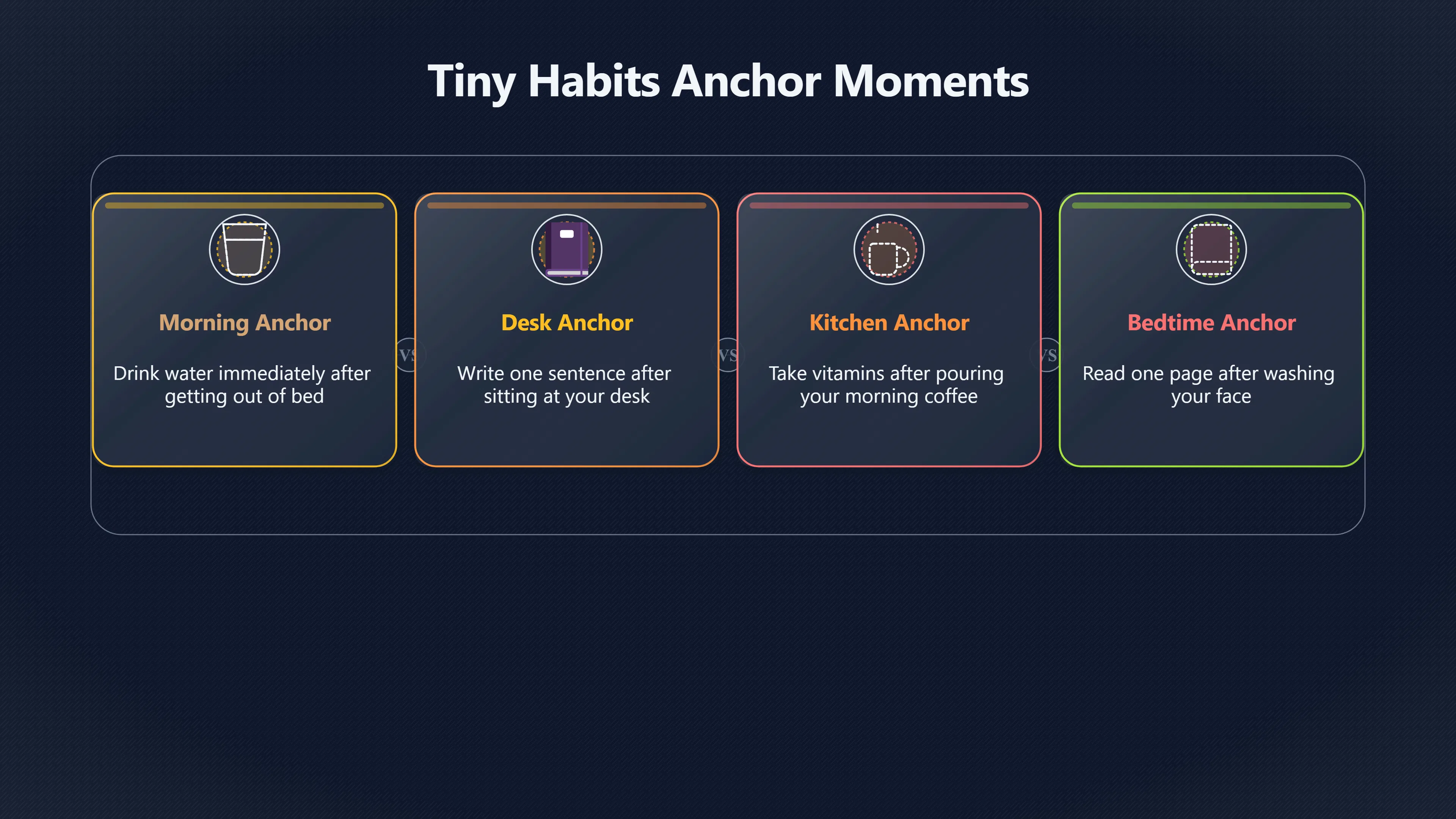
For example, “after I pour my morning coffee” may be an excellent anchor for taking vitamins because both actions occur in the kitchen. It is less useful for a twenty-minute workout if you are usually rushing out of the house.[Tiny Habits]youtube.com3 Build the Perfect Routine, Change Habits Effectively, and Improve at Anything…[Cancer Control]cancercontrol.cancer.govAn association is…Read more…
Behaviour-Based Cues Often Beat Time-Based Cues
Many people try to build habits around the clock: “I will read at 7:00 pm.” This can work, but time-based cues often fail when schedules change.
Behaviour-based cues are frequently more robust because they travel with your routine. “After I finish dinner, I will read for ten minutes” still works whether dinner happens at 6:00 pm or 8:00 pm. This idea closely resembles implementation intentions, which strengthen behaviour by linking a specific cue to a specific response.[Cancer Control]cancercontrol.cancer.govAn association is…Read more…[PMC]pmc.ncbi.nlm.nih.govMaking health habitual: the psychology of 'habit-formation' and…by B Gardner · 2012 · Cited by 892 — Psychological theory and evide…
A useful formula is:
After I existing routine, I will new behaviour.[thebehavioralscientist.com]thebehavioralscientist.comexisting routine or event that reliably occurs.Read more…
This structure has become widely known through habit-stacking and Tiny Habits approaches because it makes the cue explicit and difficult to forget.[Tiny Habits]youtube.com3 Build the Perfect Routine, Change Habits Effectively, and Improve at Anything…[James Clear]jamesclear.comHow to Build New Habits by Taking Advantage of Old OnesThe quickest way to build a new habit into your life is to stack it on top of a cu…
Which Daily Cues Work Best?
The strongest anchors tend to come from routines that are already deeply embedded in daily life.
Morning Anchors
Morning routines are often highly stable because they occur before the day’s unpredictability begins.
Effective examples include:
- After getting out of bed, drink a glass of water.
- After brushing your teeth, meditate for two minutes.
- After making coffee, review today’s priorities.
- After sitting at your desk, write one sentence of a project.
These anchors benefit from consistency and from occurring before competing demands accumulate.[Tiny Habits]youtube.com3 Build the Perfect Routine, Change Habits Effectively, and Improve at Anything…[The Washington Post]washingtonpost.comPopularized by authors BJ Fogg and James Clear, and widely used by behavioral therapists, habit-stacking involves "stacking" small, speci…
Transition Anchors
Transitions between activities are often overlooked but powerful.
Examples include:
- After arriving home, change into walking shoes.
- After closing your laptop, spend five minutes stretching.
- After parking the car, practise a minute of deep breathing.
- After finishing work, prepare tomorrow’s lunch.
Transitions already signal that one activity has ended and another is about to begin, making them natural points for behavioural change.[USC Dornsife]dornsife.usc.eduDornsife How do habits guide behavior?Perceived and actual triggers…by DT Neal · 2011 · Cited by 675 — What are the psychological mechanisms that trigger habits in daily li…
Evening Anchors
Evening routines are useful for habits related to recovery, reflection, and sleep.
Examples include:
- After washing your face, read one page of a book.
- After putting your phone on charge, write three lines in a journal.
- After setting your alarm, prepare clothes for tomorrow.
- After getting into bed, practise a brief relaxation exercise.
Because these routines often occur in the same order every night, they provide strong contextual stability.[Frontiers]frontiersin.orgFrontiersContext Stability in Habit Building Increases Automaticity…by M Stojanovic · 2022 · Cited by 25 — In this paper, we investiga…
Examples for Reading, Movement, Food and Sleep
Different habits benefit from different anchors. Matching the habit to the surrounding routine increases the chance of repetition.
Reading
Reading often succeeds when attached to a quiet existing activity rather than a vague aspiration to “read more”.
Good anchors include:
- After brushing your teeth at night, read one page.
- After lunch, read for five minutes.
- After making morning tea, read a short article.
The key is reducing the activation energy. Once the reading habit begins, people often continue beyond the minimum.[Tiny Habits]youtube.com3 Build the Perfect Routine, Change Habits Effectively, and Improve at Anything…
Movement
Exercise habits benefit from anchors that naturally precede physical activity.
Examples:
- After arriving home from work, take a ten-minute walk.
- After finishing a meeting, stand and stretch.
- After putting on trainers, walk around the block.
The cue should make movement the obvious next step.[Taylor & Francis Online]tandfonline.comTaylor & Francis OnlinePromoting habit formation: Health Psychology Reviewby P Lally · 2013 · Cited by 1248 — To promote habit formation…

Food Habits
Healthy eating habits often work best when anchored to meal preparation rather than hunger alone.
Examples:
- Before breakfast, prepare fruit for later.
- After making lunch, fill a water bottle.
- After unpacking groceries, wash vegetables immediately.
These cues occur at the point where food decisions are actually made.[PMC]pmc.ncbi.nlm.nih.govInstant habits versus flexible tenacity: Do implementation…by T van Timmeren · 2022 · Cited by 11 — Implementation intentions (stra…
Sleep Habits
Sleep routines become more consistent when attached to repeatable evening signals.
Examples:
- After turning off the television, dim household lights.
- After plugging in your phone, stop checking messages.
- After changing into sleepwear, begin a wind-down routine.
These anchors help create a predictable sequence leading into sleep rather than relying on willpower late at night.[PMC]pmc.ncbi.nlm.nih.govApplying the Science of Habit Formation to Evidence-Based…by AG Harvey · 2021 · Cited by 56 — Also, implementation intentions to pe…
Common Mistakes When Choosing Anchors
Many habit attempts fail not because the behaviour is difficult but because the anchor is weak.
Common problems include:
- Anchoring to an inconsistent event. “After my workout” is unreliable if workouts happen irregularly.
- Choosing a cue that is easy to miss. A calendar reminder can be ignored; brushing your teeth usually cannot.
- Adding too much to one anchor. Stacking five new behaviours onto a single cue often creates friction and confusion.[Health]health.comIntroduced by S.J. Scott in his 2014 book, the method builds on established behavioral psychology principles dating back to B.F. Skinner…
- Using a cue that occurs too far from the action. “After breakfast” is a poor anchor for a behaviour that requires equipment located elsewhere hours later.
The best anchor is usually boring. It is not exciting, inspirational, or ambitious. It is simply dependable.
The Practical Rule: Anchor First, Habit Second
People often begin by asking which habit they want to build. A more effective question is: Which stable event already happens every day?
Habit theory suggests that automaticity develops through repeated cue-behaviour pairings. When the cue is strong and consistent, the new behaviour becomes easier to remember, easier to start, and eventually less dependent on motivation.[cambridge]cambridge.orgWhen encountered, cues activate a single, specific well-learned behavioral response.Read more… University Press & Assessment[Taylor & Francis Online]tandfonline.comTaylor & Francis OnlinePromoting habit formation: Health Psychology Reviewby P Lally · 2013 · Cited by 1248 — To promote habit formation…
For that reason, the best daily anchors are usually the routines that are already impossible to forget: getting out of bed, making coffee, eating meals, arriving at work, brushing teeth, and preparing for sleep. Rather than creating a completely new structure, they allow a new habit to ride on the stability that already exists.[Tiny Habits]youtube.com3 Build the Perfect Routine, Change Habits Effectively, and Improve at Anything…[Thrive Street Advisors]thrivestreetadvisors.comTiny HabitsThe Anatomy of Tiny Habits. 1. ANCHOR MOMENT: “An existing routine (like brushing your teeth) or an event that happens (like a…
Amazon book picks
Further Reading
Books and field guides related to Which Daily Cues Make Habits Stick?. Use these as the next step if you want deeper reading beyond the article.
Tiny Habits
Built around anchors and prompts, making it highly aligned with cue-based habit formation.
Atomic Habits
Rating: 3.5/5 from 7 Google Books ratings
Popularizes habit stacking and using existing routines as reliable cues.
The Power of Habit
Provides foundational understanding of how cues trigger recurring behaviors.
eBay marketplace picks
Marketplace Samples
Example marketplace items related to this page. Use the search link to explore similar finds on eBay.



Endnotes
1.
Source: cambridge.org
Link:https://www.cambridge.org/core/books/handbook-of-behavior-change/changing-behavior-using-habit-theory/5F222BC3AF6ADD9A8307BBB726D43F5C
Source snippet
When encountered, cues activate a single, specific well-learned behavioral response.Read more...
2.
Source: dornsife.usc.edu
Title: Dornsife How do habits guide behavior?
Link:https://dornsife.usc.edu/wendy-wood/wp-content/uploads/sites/183/2024/01/neal.wood_.labrecque.lally_.2012.pdf
Source snippet
Perceived and actual triggers...by DT Neal · 2011 · Cited by 675 — What are the psychological mechanisms that trigger habits in daily li...
3.
Source: pmc.ncbi.nlm.nih.gov
Link:https://pmc.ncbi.nlm.nih.gov/articles/PMC3505409/
Source snippet
Making health habitual: the psychology of 'habit-formation' and...by B Gardner · 2012 · Cited by 892 — Psychological theory and evide...
4.
Source: health.com
Link:https://www.health.com/habit-stacking-resolutions-8759073
Source snippet
Introduced by S.J. Scott in his 2014 book, the method builds on established behavioral psychology principles dating back to B.F. Skinner...
5.
Source: cancercontrol.cancer.gov
Link:https://cancercontrol.cancer.gov/brp/research/constructs/implementation-intentions
Source snippet
An association is...Read more...
6.
Source: pmc.ncbi.nlm.nih.gov
Link:https://pmc.ncbi.nlm.nih.gov/articles/PMC10585941/
Source snippet
Instant habits versus flexible tenacity: Do implementation...by T van Timmeren · 2022 · Cited by 11 — Implementation intentions (stra...
7.
Source: pmc.ncbi.nlm.nih.gov
Link:https://pmc.ncbi.nlm.nih.gov/articles/PMC12318445/
Source snippet
Applying the Science of Habit Formation to Evidence-Based...by AG Harvey · 2021 · Cited by 56 — Also, implementation intentions to pe...
8.
Source: good.you
Title: Habit Stacking and Implementation Intentions
Link:https://good.you/growth/habits/habit-stacking-implementation-intentions
Source snippet
13, 2026 — Research on habit formation consistently finds that intention alone is a poor predictor of behaviour. The "intention-behaviour...
9.
Source: youtube.com
Title: TINY HABITS Audiobook | Book
Link:https://www.youtube.com/watch?v=37cbpZFhFU8
Source snippet
2 Tiny Habits - BJ Fogg PhD [Mind Map Book Summary]...
10.
Source: youtube.com
Title: Tiny Habits
Link:https://www.youtube.com/watch?v=3pje2TsLrsQ
Source snippet
3 Build the Perfect Routine, Change Habits Effectively, and Improve at Anything...
11.
Source: tandfonline.com
Link:https://www.tandfonline.com/doi/abs/10.1080/17437199.2011.603640
Source snippet
Taylor & Francis OnlinePromoting habit formation: Health Psychology Reviewby P Lally · 2013 · Cited by 1248 — To promote habit formation...
12.
Source: tinyhabits.com
Link:https://tinyhabits.com/good-spot/
Source snippet
Tiny HabitsFind a Good Spot in Your LifeIn the Tiny Habits method, you pick an existing routine to remind you to do the new tiny behavior...
13.
Source: thrivestreetadvisors.com
Link:https://www.thrivestreetadvisors.com/leadership-library/tiny-habits
Source snippet
Tiny HabitsThe Anatomy of Tiny Habits. 1. ANCHOR MOMENT: “An existing routine (like brushing your teeth) or an event that happens (like a...
14.
Source: washingtonpost.com
Link:https://www.washingtonpost.com/wellness/2026/04/26/habit-stacking/
Source snippet
Popularized by authors BJ Fogg and James Clear, and widely used by behavioral therapists, habit-stacking involves "stacking" small, speci...
15.
Source: frontiersin.org
Link:https://www.frontiersin.org/journals/psychology/articles/10.3389/fpsyg.2022.883795/full
Source snippet
FrontiersContext Stability in Habit Building Increases Automaticity...by M Stojanovic · 2022 · Cited by 25 — In this paper, we investiga...
16.
Source: drpaulmccarthy.com
Title: Your habit becomes more reliable when your anchor is solid
Link:https://www.drpaulmccarthy.com/post/tiny-habits-the-breakthrough-method-for-building-life-changing-behaviors
Source snippet
Dr Paul McCarthyTiny Habits: The Breakthrough Method for Building Life-...10 Feb 2026 — Habit recipes work like this: "After I [existing...
17.
Source: jamesclear.com
Link:https://jamesclear.com/habit-stacking
Source snippet
How to Build New Habits by Taking Advantage of Old OnesThe quickest way to build a new habit into your life is to stack it on top of a cu...
18.
Source: Wikipedia
Link:https://en.wikipedia.org/wiki/Habit
Source snippet
HabitA habit is a routine of behavior that is repeated regularly and tends to occur subconsciously. Good Habits Poster. The concept of...
19.
Source: brain.health
Link:https://brain.health/tiny-habits/
Source snippet
Tiny Habits® by BJ FoggAnchor Moment. An existing routine (like brushing your teeth); New Tiny Behaviour. A simple version of the new ha...
20.
Source: themindmapguy.com
Title: Tiny Habits
Link:https://themindmapguy.com/blogs/book-summaries/tiny-habits-bj-fogg-phd
Source snippet
BJ Fogg PhD6 Oct 2021 — ANCHOR MOMENT An existing routine (like brushing your teeth) or an... Anchor to describe something in your life...
21.
Source: tinyhabits.com
Link:https://tinyhabits.com/
Source snippet
Tiny Habits: BJ FoggCreate any habit you want in your life using Tiny Habits: A breakthrough method created by Stanford behavior scientis...
22.
Source: parkerklein.com
Title: tiny habits
Link:https://www.parkerklein.com/notes/tiny-habits
Source snippet
by BJ Fogg24 Jan 2022 — 1. Anchor moment. - An existing routine or event that happens which reminds you to do the new tiny behavior · 2...
23.
Source: thebehavioralscientist.com
Link:https://www.thebehavioralscientist.com/articles/fogg-behavior-model
Source snippet
existing routine or event that reliably occurs.Read more...
Additional References
24.
Source: researchgate.net
Link:https://www.researchgate.net/publication/322222649_Habit_Formation_and_Change
25.
Source: dialecticalbehaviortherapy.com
Link:https://dialecticalbehaviortherapy.com/act/move-toward/habit-stacking/
Source snippet
Habit StackingHabit Stacking (popularized by BJ Fogg and James Clear) captures that principle in one line: “After [current habit], I will...
26.
Source: cohorty.app
Link:https://www.cohorty.app/blog/habit-stacking-how-to-build-new-habits-on-top-of-old-ones
Source snippet
Habit Stacking: How to Build New Habits on Top of Old OnesUse existing habits as triggers for new ones. Habit stacking leverages your bra...
27.
Source: realsimple.com
Link:https://www.realsimple.com/work-life/life-strategies/inspiration-motivation/habit-stacking
Source snippet
This technique capitalizes on the brain's established neural pathways, making new habits easier to adopt by tying them to familiar routin...
28.
Source: joanwestenberg.medium.com
Link:https://joanwestenberg.medium.com/how-to-build-a-habit-lab-a-guide-to-scientifically-re-engineering-your-own-behaviour-913356a0b37f
Source snippet
to Build a Habit Lab: A Guide to Scientifically Re...BJ Fogg's Tiny Habits method advises tying a desired pattern, like 15 minutes of me...
29.
Source: merriam-webster.com
Link:https://www.merriam-webster.com/dictionary/habit
Source snippet
HABIT Definition & MeaningThe word habit most often refers to a usual way of behaving or a tendency that someone has settled into, as in...
30.
Source: sciencedirect.com
Link:https://www.sciencedirect.com/science/article/pii/S1364661324002663
Source snippet
Leveraging cognitive neuroscience for making and...by EK Buabang · 2025 · Cited by 44 — Similarly, stable cues and reduced action monito...
31.
Source: researchgate.net
Title: 32898894 How are habits formed Modeling habit formation in the real world
Link:https://www.researchgate.net/publication/32898894_How_are_habits_formed_Modeling_habit_formation_in_the_real_world
Source snippet
Modeling habit formation in the real world | Request PDFThird, contemporary habit-formation models (Lally et al., 2010) highlight the gra...
32.
Source: surrey.ac.uk
Title: does it really take [66 days]({{ ‘66-days/’ | relative_url }}) form habit we asked expert dr pippa lally
Link:https://www.surrey.ac.uk/news/does-it-really-take-66-days-form-habit-we-asked-expert-dr-pippa-lally
Source snippet
Does it really take 66 days to form a habit?21 Jan 2026 — In 2010, Dr Pippa Lally, with colleagues at UCL, published a study that found t...
33.
Source: workmate.com
Title: implementation intentions vs habit stacking for professionals
Link:https://www.workmate.com/blog/implementation-intentions-vs-habit-stacking-for-professionals
Source snippet
Nov 3, 2025 — Implementation intentions provide precise if-then plans that reliably improve follow-through for high-impulsivity professio...
Topic Tree