Within Defaults
Set the blocker before the scroll begins
Device defaults are strongest when they block the tempting path before tired attention has to resist it.
On this page
- Why defaults need to act before temptation
- Work hour blockers, charging locations and notification settings
- Exit routes that avoid turning structure into a trap
Page outline Jump by section
Introduction
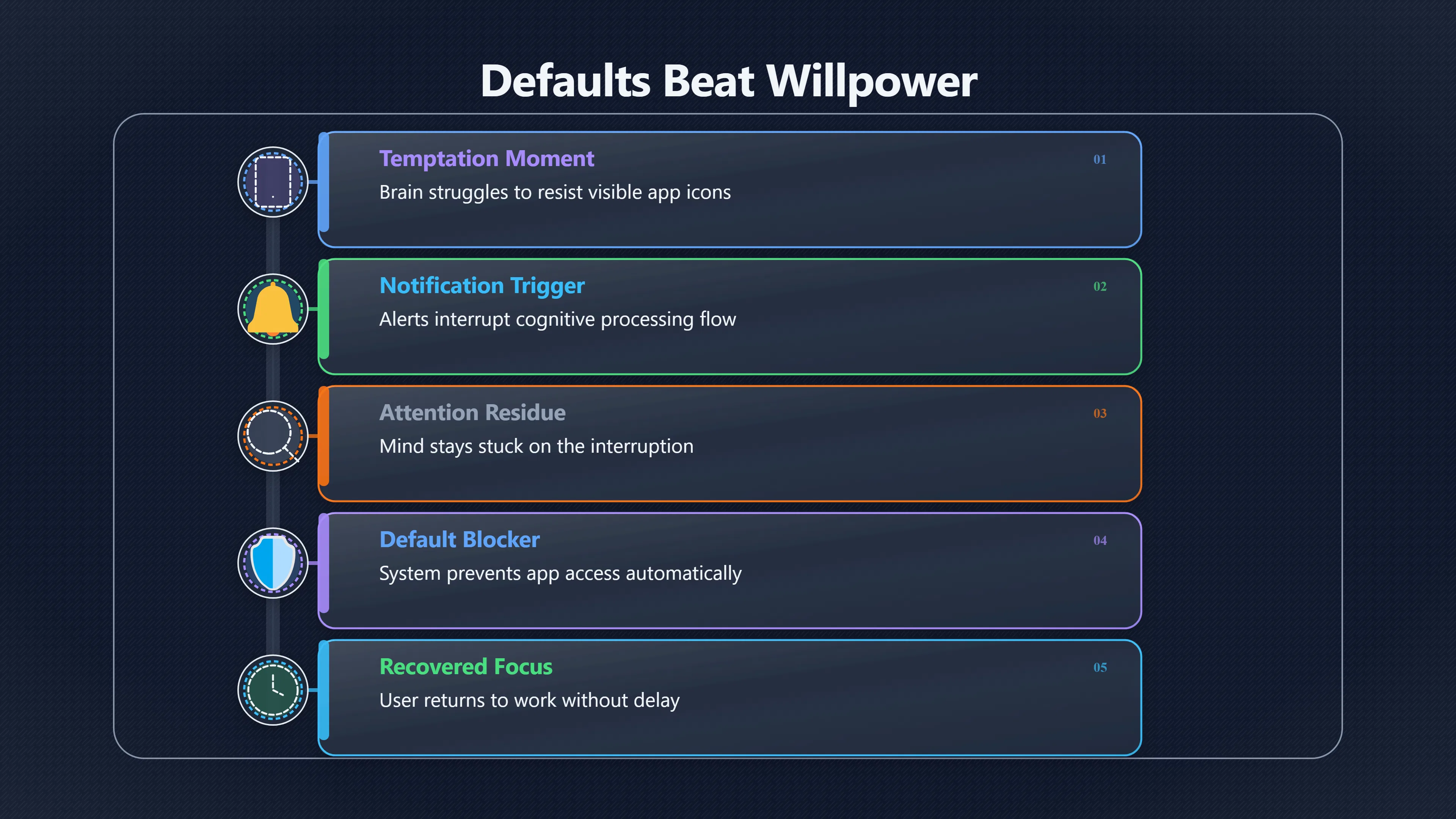
Phone distraction is often treated as a self-control problem: resist the urge, ignore the notification, close the app. In practice, the more reliable solution is usually architectural rather than motivational. By the time a tempting app is visible, a notification has arrived, or a bored moment appears, attention is already under pressure. The strongest phone defaults therefore act before distraction begins.
 This is the logic behind scheduled focus modes, notification filtering, charging locations, app timers and blocked work-hour access. These settings shift decisions from the moment of temptation to a calmer moment of planning. Research consistently finds that notifications and smartphone interruptions impair attention and increase task-switching costs, while tools that suppress or batch interruptions can improve sustained focus for many users. ERIC[PLOS]journals.plos.orgeffects of smartphone notifications on cognitive control…by JD Upshaw · 2022 · Cited by 40 — The current study examined the effects of…
Within choice architecture, the goal is not to make distraction impossible. It is to make the preferred behaviour the default path and the distracting behaviour the exception.
Why defaults need to act before temptation
Many digital self-improvement strategies fail because they depend on making a good decision at exactly the moment when attention is weakest.
A common example is social media. Someone intends to check a message, sees a notification, opens an app, encounters a recommendation feed and loses twenty minutes. The critical choice was not whether to scroll endlessly. The critical choice happened earlier, when the phone was configured to deliver interruptions instantly and place the app one tap away.
Research on smartphone notifications repeatedly finds measurable attention costs. Notifications can disrupt ongoing cognitive processing, increase the time required to complete tasks and impair performance on attention-demanding activities. ERIC[PLOS]journals.plos.orgeffects of smartphone notifications on cognitive control…by JD Upshaw · 2022 · Cited by 40 — The current study examined the effects of… The mechanism is broader than the few seconds spent looking at a screen. Researchers studying interruptions often describe a phenomenon called attention residue: after attention shifts, part of the mind remains attached to the interruption, making it harder to fully re-engage with the original task.[ScienceDirect]sciencedirect.comConsistent with the research on attention residue.Read more…
This is why phone defaults matter. They remove many interruptions before the brain has to recover from them.
Consider two approaches:
- Willpower approach: Receive notifications normally and resist opening them.
- Default approach: Prevent non-essential notifications from appearing during focused work.
The second approach eliminates hundreds of small decisions. Instead of repeatedly choosing not to be distracted, the user rarely encounters the distraction in the first place.
Work-hour blockers that change the easiest action
The most useful blockers are often the least dramatic. They do not permanently remove apps. They simply make distraction unavailable during periods when attention is valuable.
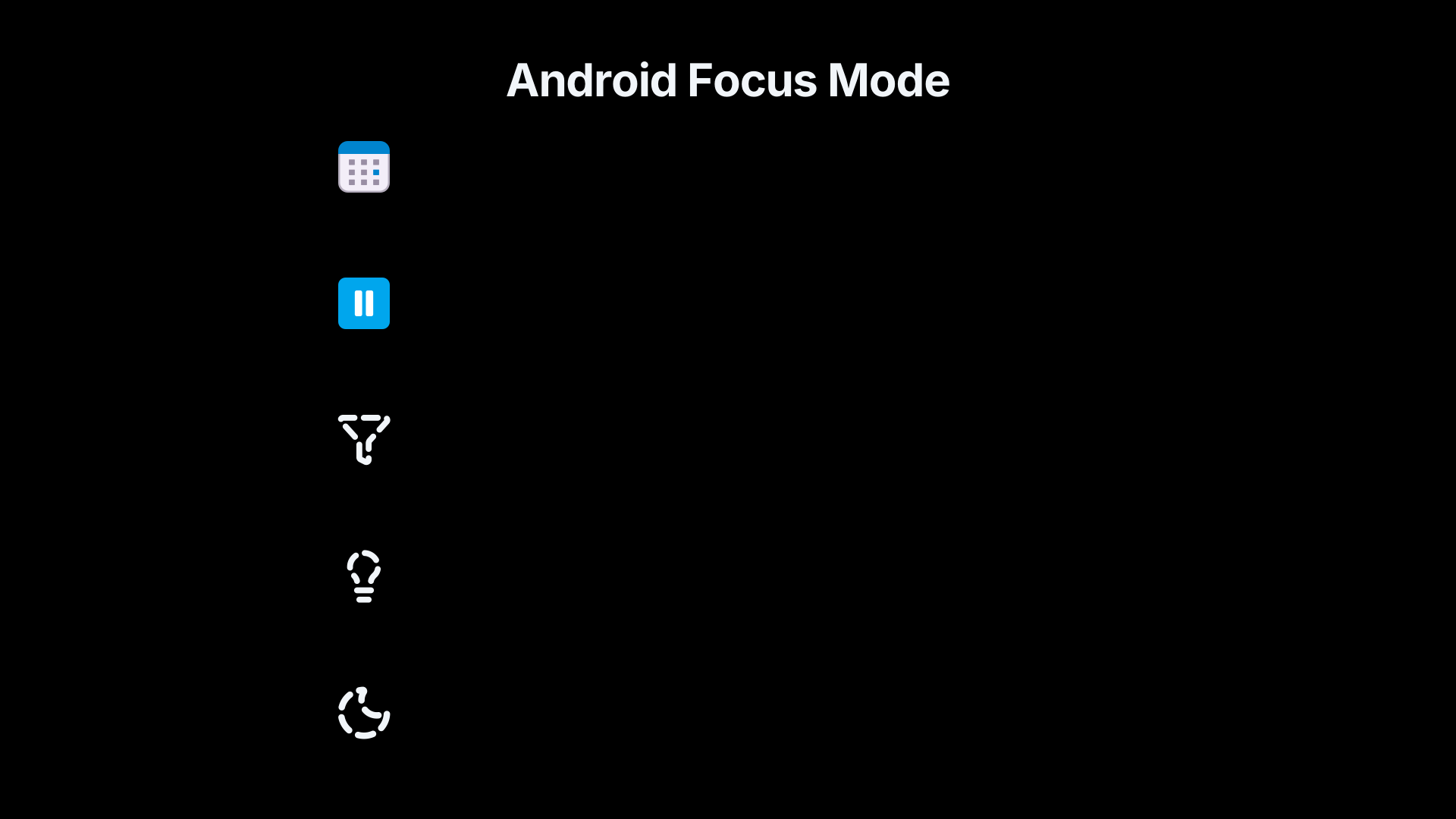
Both Android and iPhone now include built-in systems for this. Android’s Focus Mode can automatically pause selected apps and suppress their notifications on a schedule.[Google Help]support.google.com· Tap Digital Wellbeing and parental controls and then · Choose which apps you want to pause. When Focus mode is on, you can't…Read more…
The key design principle is timing. A blocker that activates only after someone has already opened a distracting app is weaker than one that activates automatically before work begins.
Effective work-hour defaults typically include:
- Blocking social media, video and news apps during defined focus periods.
- Automatically enabling Do Not Disturb or Focus modes during work sessions.
- Allowing calls or messages from a small list of important contacts.
- Creating separate work and leisure notification profiles.
These settings matter because interruption management is not merely about screen time. Research suggests that notifications help create habitual checking behaviour, encouraging people to reach for their phones even when there is no clear reason to do so.[Taylor & Francis Online]tandfonline.comTaylor & Francis OnlineBeyond the Buzz: Investigating the Effects of a Notification…by CA Dekker · 2025 · Cited by 42 — Receiving noti…
A useful question is not “How strong is my self-control?” but “What happens automatically at 09:00 on a busy Tuesday?” If the answer is that distracting apps become unavailable and notifications are filtered, the default is working.
Notification settings are often more important than app limits
People frequently focus on app timers while leaving dozens of notification channels untouched.
From an attention perspective, the order is often backwards.
Many distractions begin with an external trigger rather than an internal desire. A notification appears, attention shifts, curiosity activates and a checking sequence begins. Research examining smartphone notifications has repeatedly found that alerts themselves contribute to distraction and reduced attention performance. ERIC[PLOS]journals.plos.orgeffects of smartphone notifications on cognitive control…by JD Upshaw · 2022 · Cited by 40 — The current study examined the effects of…
For that reason, notification defaults usually deliver a larger benefit than simply measuring screen time.
High-value changes include:
- Turning off promotional notifications entirely.
- Restricting social notifications to direct messages or genuine person-to-person communication.
- Delivering notifications in scheduled batches rather than continuously.
- Using Focus or Do Not Disturb schedules during deep work.
Evidence suggests that batching notifications can reduce cognitive load and attention residue by reducing the frequency of interruptions.[ScienceDirect]sciencedirect.comConsistent with the research on attention residue.Read more…
A practical rule is simple: if a notification does not require action within the next few hours, it rarely needs to appear immediately.
Charging locations create invisible friction
The physical location of a phone is itself a default.
Many people think of distraction as a software problem, yet some of the strongest interventions are environmental. A phone on the desk, in the hand or beside the bed offers continuous opportunities for checking. A phone across the room introduces friction.
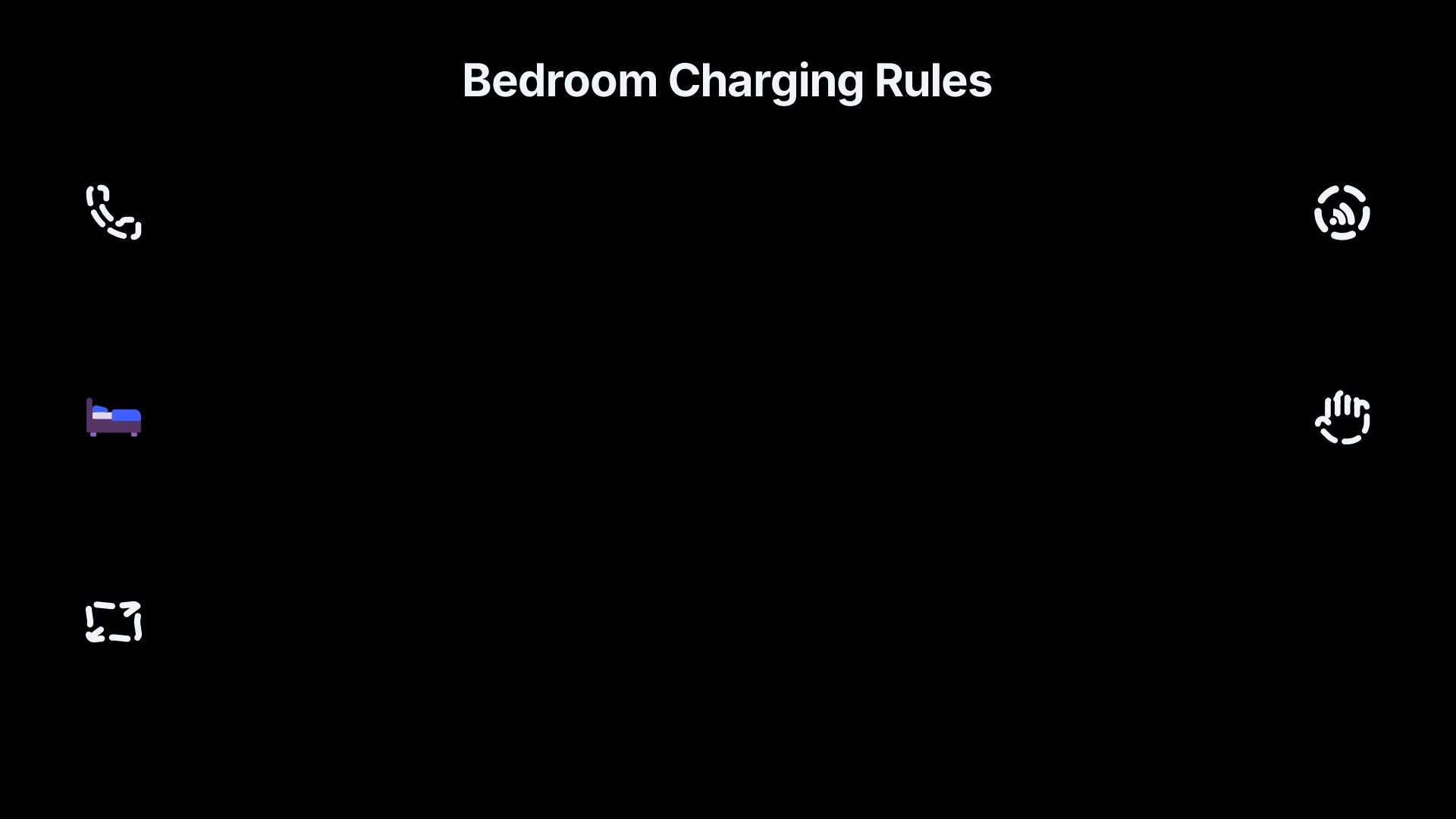
The bedroom provides a particularly clear example. Studies examining smartphone use in bed have found associations with poorer sleep outcomes and greater disruption of sleep-related measures.[PubMed Central]pmc.ncbi.nlm.nih.govPubMed Central“Leave your smartphone out of bed”: quantitative analysis of…by S Kheirinejad · 2022 · Cited by 80 — Our findings indica…
The important behavioural effect is not only what happens at night. A phone charged outside the bedroom also changes the first minutes of the morning.
Instead of waking directly into messages, news feeds and social media, the user must physically choose to retrieve the device. That small delay restores a moment of intentionality before digital inputs begin.
Among people interested in digital minimalism, charging phones outside the bedroom is frequently reported as one of the most effective environmental changes because it removes both bedtime scrolling and automatic morning checking.[Reddit]reddit.comHave you tried leaving your phone outside the bedroom?…I’ve been considering the idea of keeping your phone outside the bedroom…
In choice architecture terms, the bedroom setup determines the default morning behaviour before conscious decision-making is fully awake.
Exit routes that avoid turning structure into a trap
Strong defaults can become counterproductive if they are too rigid.
A common mistake is creating systems that are impossible to override. When a genuine need arises, people become frustrated, disable the system completely and never reactivate it.
The most durable phone defaults usually include clear exit routes:
- Emergency contacts can bypass notification restrictions.
- Focus modes can be paused deliberately.
- Blocked apps can be accessed after a short waiting period.
- Different profiles exist for workdays, weekends and holidays.
This balance matters because distraction management is not the same as prohibition. The objective is to reduce impulsive behaviour, not eliminate flexibility.
Research on digital wellbeing tools also suggests caution against assuming every intervention works equally well for everyone. Some users benefit substantially from notification suppression, while others see smaller effects. The strongest evidence supports reducing interruptions and increasing user control, but the optimal configuration remains individual.[WIRED]wired.comdigital wellbeing android ios facebook instagramDespite the lack of scientific evidence proving that reducing screen time directly benefits mental health, these platforms hope to addres…
A useful default therefore has two properties at once: it is strong enough to protect attention when motivation is low, and easy enough to override when circumstances genuinely require it.
The practical takeaway
Phone and app defaults work best when they intervene before temptation arrives. Notifications are filtered before they appear. Distracting apps are unavailable before boredom strikes. The phone is charged elsewhere before bedtime scrolling begins.
This approach reflects a broader lesson from effective self-improvement: the most reliable systems do not demand repeated acts of resistance. They redesign the starting conditions. When the easiest action already supports the intended behaviour, attention is conserved for work, relationships and decisions that actually require it.
Amazon book picks
Further Reading
Books and field guides related to Set the blocker before the scroll begins. Use these as the next step if you want deeper reading beyond the article.
Digital Minimalism
Focuses on redesigning technology defaults, notifications, and digital environments.
Atomic Habits
Rating: 3.5/5 from 7 Google Books ratings
Explains environment design and making desired actions the default.
eBay marketplace picks
Marketplace Samples
Example marketplace items related to this page. Use the search link to explore similar finds on eBay.







Endnotes
1.
Source: journals.plos.org
Link:https://journals.plos.org/plosone/article?id=10.1371%2Fjournal.pone.0277220
Source snippet
effects of smartphone notifications on cognitive control...by JD Upshaw · 2022 · Cited by 40 — The current study examined the effects of...
2.
Source: sciencedirect.com
Link:https://www.sciencedirect.com/science/article/abs/pii/S0749597816304630
Source snippet
Consistent with the research on attention residue.Read more...
3.
Source: sciencedirect.com
Link:https://www.sciencedirect.com/science/article/pii/S0747563219302596?via%3Dihub=
Source snippet
Batching smartphone notifications can improve well-beingBy randomly interrupting people in an ongoing activity, smartphone n...
4.
Source: [support]({{ ‘support/’ | relative_url }}). google.com
Link:https://support.google.com/android/answer/9346420?hl=en-GB
Source snippet
· Tap Digital Wellbeing and parental controls and then · Choose which apps you want to pause. When Focus mode is on, you can't...Read more...
5.
Source: reddit.com
Link:https://www.reddit.com/r/digitalminimalism/comments/1mnzp17/have_you_tried_leaving_your_phone_outside_the/
Source snippet
Have you tried leaving your phone outside the bedroom?...I’ve been considering the idea of keeping your phone outside the bedroom...
6.
Source: wired.com
Title: digital wellbeing android ios facebook instagram
Link:https://www.wired.com/story/digital-wellbeing-android-ios-facebook-instagram
Source snippet
Despite the lack of scientific evidence proving that reducing screen time directly benefits mental health, these platforms hope to addres...
7.
Source: sciencedirect.com
Link:https://www.sciencedirect.com/science/article/pii/S0747563226000233
Source snippet
How social media notifications disrupt cognitive processingby H Fournier · 2026 — Cell phone notifications harm attention: An exploration...
8.
Source: tandfonline.com
Link:https://www.tandfonline.com/doi/full/10.1080/15213269.2024.2334025
Source snippet
Taylor & Francis OnlineBeyond the Buzz: Investigating the Effects of a Notification...by CA Dekker · 2025 · Cited by 42 — Receiving noti...
9.
Source: pmc.ncbi.nlm.nih.gov
Link:https://pmc.ncbi.nlm.nih.gov/articles/PMC9643910/
Source snippet
PubMed Central“Leave your smartphone out of bed”: quantitative analysis of...by S Kheirinejad · 2022 · Cited by 80 — Our findings indica...
Additional References
10.
Source: researchgate.net
Link:https://www.researchgate.net/publication/291618379_Silence_Your_Phones_Smartphone_Notifications_Increase_Inattention_and_Hyperactivity_Symptoms
Source snippet
“Silence Your Phones”: Smartphone Notifications Increase...7 May 2016 — Using both correlational and experimental methods, we explored w...
Published: May 2016
11.
Source: drkristygoodwin.com
Link:https://drkristygoodwin.com/are-you-suffering-from-attention-residue/
Source snippet
Are You Suffering from 'Attention Residue'?Research suggests that batching, not banning notifications is the most effective strategy to d...
12.
Source: johnryanbydesign.co.uk
Link:https://johnryanbydesign.co.uk/understanding-beds/how-to-stop-your-smartphone-or-iphone-from-disrupting-your-sleep/
Source snippet
How to Stop Your Smartphone or iPhone from Disrupting...Charging your phone outside the bedroom can prevent nocturnal distractions & not...
13.
Source: tomsguide.com
Link:https://www.tomsguide.com/wellness/sleep/stop-doing-this-one-thing-the-second-you-wake-up-to-end-morning-grogginess-for-good-say-experts
Source snippet
Nearly half of Americans check their phones within 10 minutes of waking, a habit that spikes and then crashes dopamine, increases stress...
14.
Source: theses.liacs.nl
Link:https://theses.liacs.nl/pdf/2019-2020-SalvodelliF.pdf
Source snippet
Notifications' Distractions During a Full-attention...by F Savoldelli — The following research question is central in the present resear...
15.
Source: headspace.com
Link:https://www.headspace.com/articles/5-reasons-to-kick-your-phone-out-of-the-bedroom
16.
Source: linkedin.com
Link:https://www.linkedin.com/posts/drfatmazohraatrous_deepwork-focus-productivity-activity-7436343358010122240-aXcT
17.
Source: psypost.org
Title: new psychology research reveals the cognitive cost of smartphone notifications
Link:https://www.psypost.org/new-psychology-research-reveals-the-cognitive-cost-of-smartphone-notifications/
Source snippet
New psychology research reveals the cognitive cost of...18 Mar 2026 — A recent study in Computers in Human Behavior provides evidence th...
18.
Source: theguardian.com
Title: apple ios12 screen time apps how much spent phone digital wellbeing
Link:https://www.theguardian.com/technology/2018/jun/04/apple-ios12-screen-time-apps-how-much-spent-phone-digital-wellbeing
Source snippet
Apple's new 'digital wellbeing' tools aim to help reduce...4 Jun 2018 — A new app called Screen Time will offer iPhone and iPad users a...
19.
Source: elgazette.com
Title: It’s essentially about how the brain works. Leroy’s findings make
Link:https://www.elgazette.com/smartphones-and-focus-in-learning-friend-foe-or-false-ally/
Source snippet
Smartphones and focus in learning: Friend, foe, or false ally?4 Feb 2026 — Attention residue reminds us that distraction isn't just about...
Topic Tree