Within Techniques
Which behaviour change ingredient is actually missing?
A stuck habit often needs a better-matched technique, not more willpower or a bigger motivational slogan.
On this page
- Turn a failed habit into a diagnosis
- Match common blockers to specific techniques
- Avoid adding techniques that solve the wrong problem
Page outline Jump by section
Introduction
When a habit keeps failing, the default explanation is usually a lack of discipline. Behaviour-change research suggests a different possibility: the habit may be missing the right ingredient. The Behaviour Change Technique Taxonomy was created partly to make these ingredients visible and distinguishable, rather than treating all behaviour problems as motivation problems. The practical question is not “How can I try harder?” but “What is stopping this behaviour from happening consistently?”[PubMed]pubmed.ncbi.nlm.nih.govThe behavior change technique taxonomy (v1) of 93…by S Michie · 2013 · Cited by 8845 — "BCT taxonomy v1," an extensive taxonomy…
 This shift matters because different obstacles require different techniques. A person who forgets to exercise needs a different intervention from someone who lacks the skills, faces environmental friction, or loses interest after a week. Adding more motivation to a problem caused by poor planning is often as ineffective as adding more planning to a problem caused by a hostile environment. Effective self-improvement begins with diagnosis before prescription.[The Decision Lab]thedecisionlab.comThe Decision LabThe COM-B Model for Behavior ChangeIn the COM-B model, reflective motivation plays a critical role in guiding deliberate…
Turn a failed habit into a diagnosis
A failed habit contains information. Instead of treating failure as evidence of personal weakness, treat it as evidence about the system surrounding the behaviour.
A useful diagnostic question is: what happened at the moment the behaviour was supposed to occur?
If the answer is “I completely forgot”, the issue is different from “I remembered but was too tired”, which is different again from “I wanted to do it but didn’t know what to do next”. These failures point to different missing ingredients.
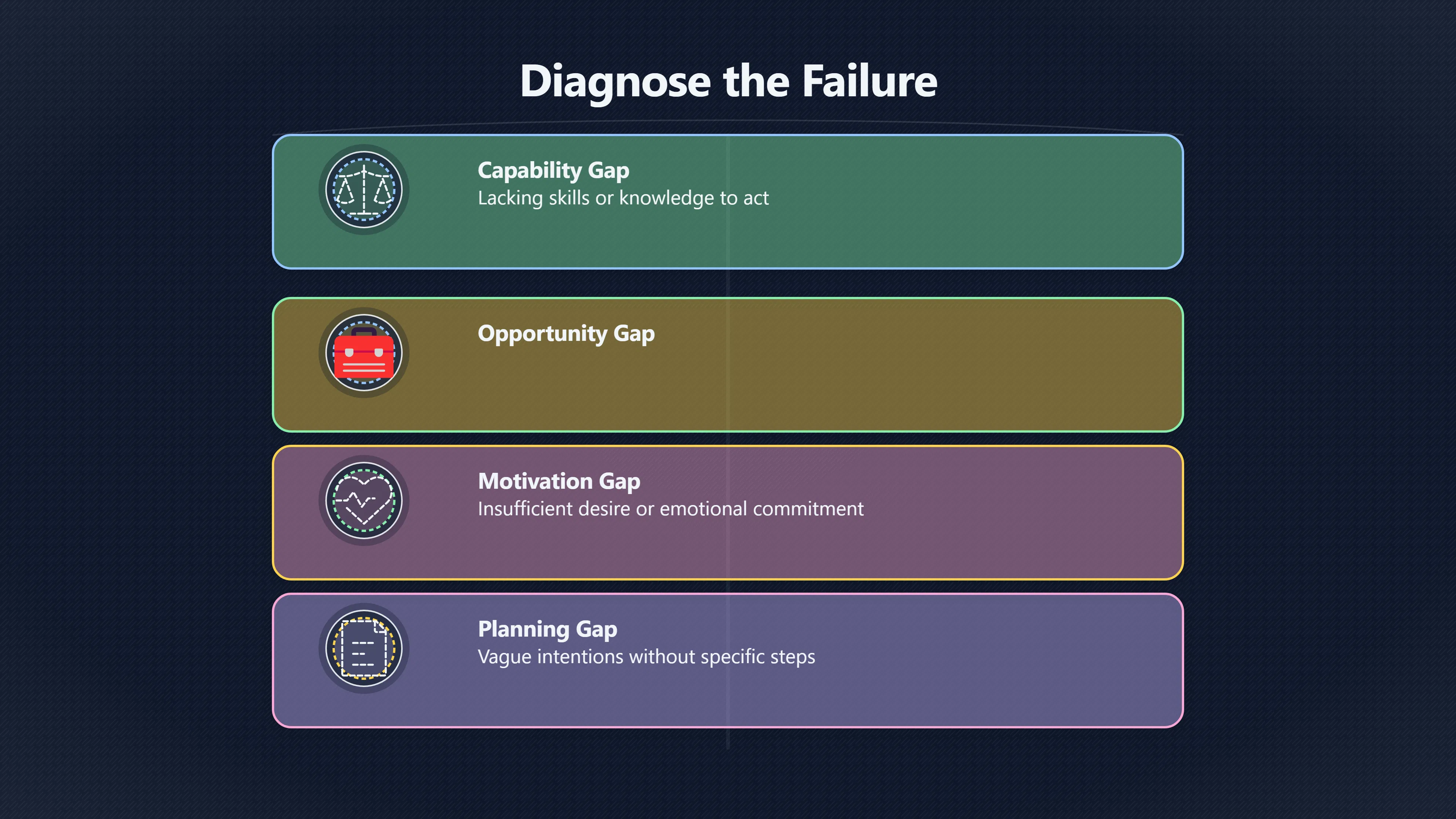
The COM-B model, which underpins much modern behaviour-change work, groups obstacles into three broad categories:
- Capability: lacking knowledge, skills, confidence, or physical ability.
- Opportunity: lacking time, resources, environmental support, or social support.
- Motivation: lacking sufficient desire, value, reward, habit strength, or emotional commitment.[The Decision Lab]thedecisionlab.comThe Decision LabThe COM-B Model for Behavior ChangeIn the COM-B model, reflective motivation plays a critical role in guiding deliberate…
Most self-improvement attempts jump directly to motivation. Yet many recurring failures are actually capability or opportunity problems. Someone who intends to cook healthy meals but has no ingredients at home does not need a more inspiring quote. Someone who intends to save money but has one-click purchasing enabled everywhere may not need stronger values. They may need environmental restructuring.
The key diagnostic principle is simple: identify the bottleneck that appears immediately before the behaviour fails.
Match common blockers to specific techniques
The taxonomy contains dozens of techniques, but a small number account for many everyday habit failures.
“I keep forgetting”
When forgetting is the main obstacle, the missing ingredient is often a cue or prompt.
Relevant techniques include:
- Prompts and reminders
- Environmental cues
- Action planning[implementation intentions]thriva.coThe Science of 'If-Then'…20 Nov 2024 — This strategy, developed by psychologist Peter Gollwitzer, transforms vague intentions into spe… ns (“if-then” plans)
Implementation intentions have been extensively studied as a way of translating intentions into action. Rather than merely deciding to act, a person specifies exactly when and where action will occur: “If it is 7 a.m. on Monday, then I will put on my running shoes and walk for twenty minutes.” Research consistently shows that these plans help bridge the gap between intention and behaviour.[Cancer Control]cancercontrol.cancer.govCancer ControlImplementation Intentionsby PM Gollwitzer — The idea is that intention realization can be promoted by forming if-then plans…[Taylor & Francis Online]tandfonline.comTaylor & Francis OnlineFull article: If-then planningby M Bieleke · 2021 · Cited by 123 — The self-regulation strategy of forming impleme…
“I don’t know exactly what to do”
This often signals a capability problem rather than a motivation problem.
Relevant techniques include:
- Instruction on how to perform the behaviour
- Behavioural practice and rehearsal
- Demonstration by others
- Skills training
Many abandoned habits fail because the next step is unclear. “Start strength training” sounds simple until a beginner enters a gym and has no idea which exercises to perform. The missing ingredient is often competence, not commitment.
“I mean to do it, but never get round to it”
This frequently indicates inadequate planning.
Relevant techniques include:
- Action planning[phwwhocc.co.uk]phwwhocc.co.ukIdentifying and Applying Behaviour Change Techniques• Action planningPrompt detailed planning of performance of the behaviour (must include at least one of context, frequency, duration and intensity)…Rea…
- Scheduling
- Problem solving
- Reviewing plans
Action planning is one of the most consistently used behaviour-change techniques. Research reviews identify it as an effective component in interventions aimed at improving behaviours such as physical activity and diet.[PMC]pmc.ncbi.nlm.nih.govPMCPromoting the translation of intentions into action byby F Wieber · 2015 · Cited by 215 — The present review addresses the physiological correlates of planning effects on behavior. Althoug…
The distinction matters. A goal says what you want. A plan specifies when, where, and how it will happen.
“I start strongly and then drift away”
This often reflects weak feedback loops.
Relevant techniques include:
- Self-monitoring
- Feedback on behaviour
- Progress review
- Tracking outcomes
Without feedback, behaviour becomes psychologically invisible. Progress tracking does not create motivation by itself, but it creates information. Information makes adjustment possible.

“The environment keeps defeating me”
Many people underestimate environmental barriers.
Relevant techniques include:
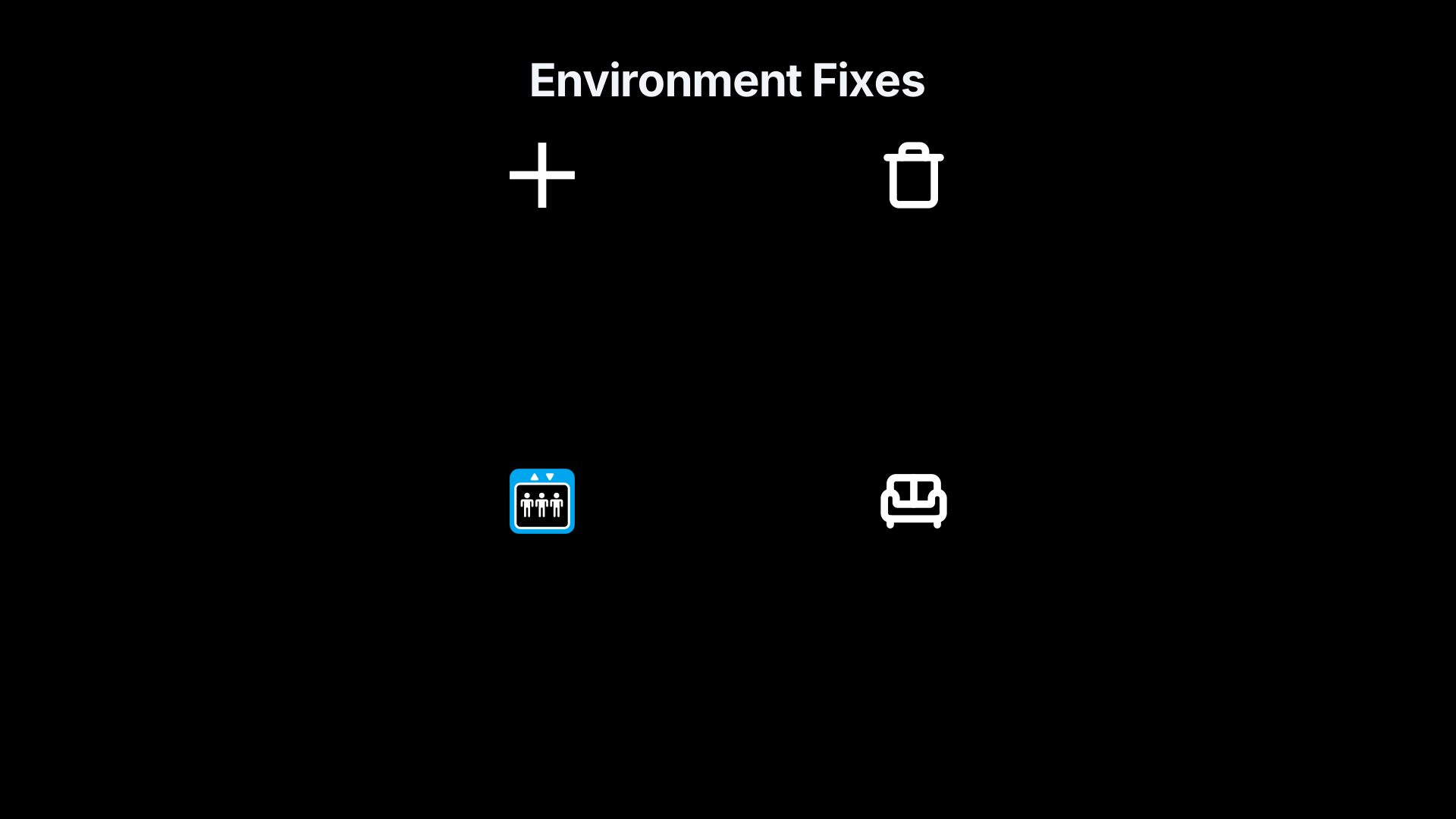
- Restructuring the physical environment
- Adding helpful objects[assets.publishing.service.gov.uk]assets.publishing.service.gov.ukExample BCTs are: 1) Adding objects to the environment, and 2) Action planning…Read more…
- Removing temptations
- Reducing friction
If late-night snacking occurs because snacks are visible on the kitchen counter, a motivational intervention may be less effective than changing what is physically available. Behaviour-change frameworks repeatedly emphasise opportunity and environmental conditions as major determinants of behaviour.[The Decision Lab]thedecisionlab.comThe Decision LabThe COM-B Model for Behavior ChangeIn the COM-B model, reflective motivation plays a critical role in guiding deliberate…
“I can do it when others are involved”
This suggests a missing social ingredient.
Relevant techniques include:
- Social support
- Accountability arrangements
- Group participation
- Encouragement and feedback from others
The obstacle is not necessarily personal motivation. The behaviour may depend on social opportunity that is absent when acting alone.
Avoid adding techniques that solve the wrong problem
One of the most common self-improvement mistakes is technique stacking without diagnosis.
Imagine someone trying to establish a daily reading habit.
They fail for a week and respond by:
- Buying a new productivity app.
- Watching motivational videos.
- Creating a vision board.
- Setting a larger goal.[digitalwellbeing.org]digitalwellbeing.orgNote: evidence of action planning does not necessarily imply goal setting, only code latter if sufficient evidence. Encourage a…Read more…
If the real problem is forgetting, none of these additions addresses the bottleneck. A simple cue beside the bed might outperform all of them.
Likewise:
- More goals do not solve skill deficits.
- More tracking does not solve missing opportunities.
- More reminders do not solve lack of knowledge.
- More motivation does not solve excessive friction.
The Behaviour Change Technique Taxonomy is valuable precisely because it separates these ingredients. It encourages matching interventions to causes rather than assuming every problem has the same solution.[PubMed]pubmed.ncbi.nlm.nih.govThe behavior change technique taxonomy (v1) of 93…by S Michie · 2013 · Cited by 8845 — "BCT taxonomy v1," an extensive taxonomy…
A practical diagnosis sequence
When a habit repeatedly fails, work through these questions in order:
- Did I remember at the right moment? If not, add prompts, cues, or implementation intentions.[link.springer.com]link.springer.comIntentions | Springer Nature LinkImplementation intentions and goal achievement: A meta-analysis of effects and processes…
- Did I know exactly what to do? If not, add instruction, practice, or skill development.
- Did I have a specific plan? If not, create a detailed action plan.
- Was the environment helping or hindering? If hindering, redesign the environment.
- Was progress visible? If not, add monitoring and feedback.
- Did I need other people? If yes, add social support or accountability.
- Did I genuinely want the outcome enough to persist? Only after checking the previous questions should motivation become the primary suspect.
This sequence prevents a common error in self-improvement: diagnosing every failure as a character flaw. Often the missing ingredient is not more effort. It is a better-matched behaviour-change technique aimed at the real obstacle in the routine.
Amazon book picks
Further Reading
Books and field guides related to Which behaviour change ingredient is actually missing?. Use these as the next step if you want deeper reading beyond the article.
eBay marketplace picks
Marketplace Samples
Example marketplace items related to this page. Use the search link to explore similar finds on eBay.






Endnotes
1.
Source: cancercontrol.cancer.gov
Link:https://cancercontrol.cancer.gov/brp/research/constructs/implementation-intentions
Source snippet
Cancer ControlImplementation Intentionsby PM Gollwitzer — The idea is that intention realization can be promoted by forming if-then plans...
2.
Source: pmc.ncbi.nlm.nih.gov
Title: PMCPromoting the translation of intentions into action by
Link:https://pmc.ncbi.nlm.nih.gov/articles/PMC4500900/
Source snippet
by F Wieber · 2015 · Cited by 215 — The present review addresses the physiological correlates of planning effects on behavior. Althoug...
3.
Source: pmc.ncbi.nlm.nih.gov
Title: PMCBehaviour change techniques that constitute effective
Link:https://pmc.ncbi.nlm.nih.gov/articles/PMC9403139/
Source snippet
by H Lin · 2022 · Cited by 44 — Action planning is a brief and effective behaviour change technique (BCT) to improve physical activity...
4.
Source: cancercontrol.cancer.gov
Title: goal intent attain
Link:https://cancercontrol.cancer.gov/sites/default/files/2020-06/goal_intent_attain.pdf
Source snippet
Gollwitzer New York...by PM Gollwitzer · Cited by 133 — The idea is that intention realization can be promoted by forming if-then plans...
5.
Source: pubmed.ncbi.nlm.nih.gov
Link:https://pubmed.ncbi.nlm.nih.gov/23512568/
Source snippet
The behavior change technique taxonomy (v1) of 93...by S Michie · 2013 · Cited by 8845 — "BCT taxonomy v1," an extensive taxonomy...
6.
Source: thedecisionlab.com
Link:https://thedecisionlab.com/reference-guide/organizational-behavior/the-com-b-model-for-behavior-change
Source snippet
The Decision LabThe COM-B Model for Behavior ChangeIn the COM-B model, reflective motivation plays a critical role in guiding deliberate...
7.
Source: tandfonline.com
Link:https://www.tandfonline.com/doi/full/10.1080/10463283.2020.1808936
Source snippet
Taylor & Francis OnlineFull article: If-then planningby M Bieleke · 2021 · Cited by 123 — The self-regulation strategy of forming impleme...
8.
Source: bct-taxonomy.com
Link:https://www.bct-taxonomy.com/about
Source snippet
Behaviour Change Technique TaxonomyThus BCTTv1 offers a generally reliable method for specifying, interpreting and implementing the activ...
9.
Source: link.springer.com
Link:https://link.springer.com/rwe/10.1007/978
Source snippet
Intentions | Springer Nature LinkImplementation intentions and goal achievement: A meta-analysis of effects and processes...
10.
Source: link.springer.com
Link:https://link.springer.com/article/10.1186/s12889
Source snippet
barriers: using the behavior change wheel to...by SO Ojo · 2019 · Cited by 161 — The aim of this study was to use the Behaviour Change W...
11.
Source: goodmedicine.org.uk
Link:https://goodmedicine.org.uk/media/files/implementation%20intentions%2C%20background.pdf
Source snippet
ctively with self-regulatory problems that...Read more...
12.
Source: psychologytoday.com
Title: implementation intentions facilitate action control
Link:https://www.psychologytoday.com/ie/blog/dont-delay/201001/implementation-intentions-facilitate-action-control
Source snippet
21 Jan 2010 — I'm picking up where I left off with a focus on implementation intentions by summarizing the main ideas presented by Frank...
13.
Source: nationalelfservice.net
Link:https://www.nationalelfservice.net/social-care/support-planning/implementation-intentions-helping-people-achieve-their-goals/
Source snippet
Implementation intentions: helping people achieve their...by A Underwood — The meta-analysis looked at the effect of if-then intentions...
14.
Source: thriva.co
Title: implementation intentions
Link:https://thriva.co/hub/behaviour-change/implementation-intentions
Source snippet
The Science of 'If-Then'...20 Nov 2024 — This strategy, developed by psychologist Peter Gollwitzer, transforms vague intentions into spe...
Additional References
15.
Source: researchgate.net
Link:https://www.researchgate.net/publication/263504602_The_Behaviour_Change_Technique_Taxonomy_BCTTv1_of_93_hierarchically-clustered_techniques_testing_reliability_of_the_taxonomy_in_specifying_the_content_of_behaviour_change_interventions
Source snippet
The Behaviour Change Technique Taxonomy (BCTTv1) of...18 Jan 2016 — This work produced the 93-item hierarchically-structured BCT Taxonom...
16.
Source: researchgate.net
Link:https://www.researchgate.net/publication/362855090_Behaviour_change_techniques_that_constitute_effective_planning_interventions_to_improve_physical_activity_and_diet_behaviour_for_people_with_chronic_conditions_a_systematic_review
Source snippet
Behaviour change techniques that constitute effective...22 Aug 2022 — This study aimed to identify critical BCTs and mechanisms of actio...
17.
Source: kops.uni-konstanz.de
Link:https://kops.uni-konstanz.de/server/api/core/bitstreams/d703c468-46e9-47fc-8900-d32d7d19c8d9/content
Source snippet
uni-konstanz.deMeta-analysis of the scope and components of...by P Sheeran · Cited by 67 — Findings corroborated the conclusion that imp...
18.
Source: discovery.ucl.ac.uk
Link:https://discovery.ucl.ac.uk/1400691/
Source snippet
Behavior Change Technique Taxonomy (v1) of 93...The Behavior Change Technique Taxonomy (v1) of 93 Hierarchically Clustered Techniques: B...
19.
Source: digitalwellbeing.org
Link:https://digitalwellbeing.org/wp-content/uploads/2016/11/BCTTv1_PDF_version.pdf
Source snippet
Note: evidence of action planning does not necessarily imply [goal setting]({{ 'goal-setting/' | relative_url }}), only code latter if sufficient evidence. Encourage a...Read more...
20.
Source: phwwhocc.co.uk
Title: Identifying and Applying Behaviour Change Techniques• Action planning
Link:https://phwwhocc.co.uk/wp-content/uploads/2024/02/Identifying-and-Applying-Behaviour-Change-Techniques-1.pdf
Source snippet
Prompt detailed planning of performance of the behaviour (must include at least one of context, frequency, duration and intensity)...Rea...
21.
Source: research-portal.uea.ac.uk
Title: the behavior change technique taxonomy v1 of 93 hierarchically cl
Link:https://research-portal.uea.ac.uk/en/publications/the-behavior-change-technique-taxonomy-v1-of-93-hierarchically-cl
Source snippet
behavior change technique taxonomy (v1) of 93...by S Michie · 2013 · Cited by 8667 — Objectives: The objective of this study is to devel...
22.
Source: openaccess.city.ac.uk
Title: Michie et al Annals of Behavioral Medicine 2013 BCT Taxonomy v1
Link:https://openaccess.city.ac.uk/3293/1/Michie%20et%20al%20Annals%20of%20Behavioral%20Medicine%202013%20-%20BCT%20Taxonomy%20v1.pdf
Source snippet
et al Annals of Behavioral Medicine 2013by S Michie · 2013 · Cited by 8746 — The Behavior Change Technique Taxonomy (v1) of 93 hierarchic...
23.
Source: assets.publishing.service.gov.uk
Link:https://assets.publishing.service.gov.uk/media/5e7b4e85d3bf7f133c923435/PHEBI_Achieving_Behaviour_Change_Local_Government.pdf
Source snippet
Example BCTs are: 1) Adding objects to the environment, and 2) Action planning...Read more...
24.
Source: sbm.org
Link:https://www.sbm.org/UserFiles/file/Michie-etal2013BCTV193techniquesAddlFileTaxonomy.pdf
Source snippet
b An additional technique 'Increase positive emotions' will be included in BCT...Read more...
Topic Tree